
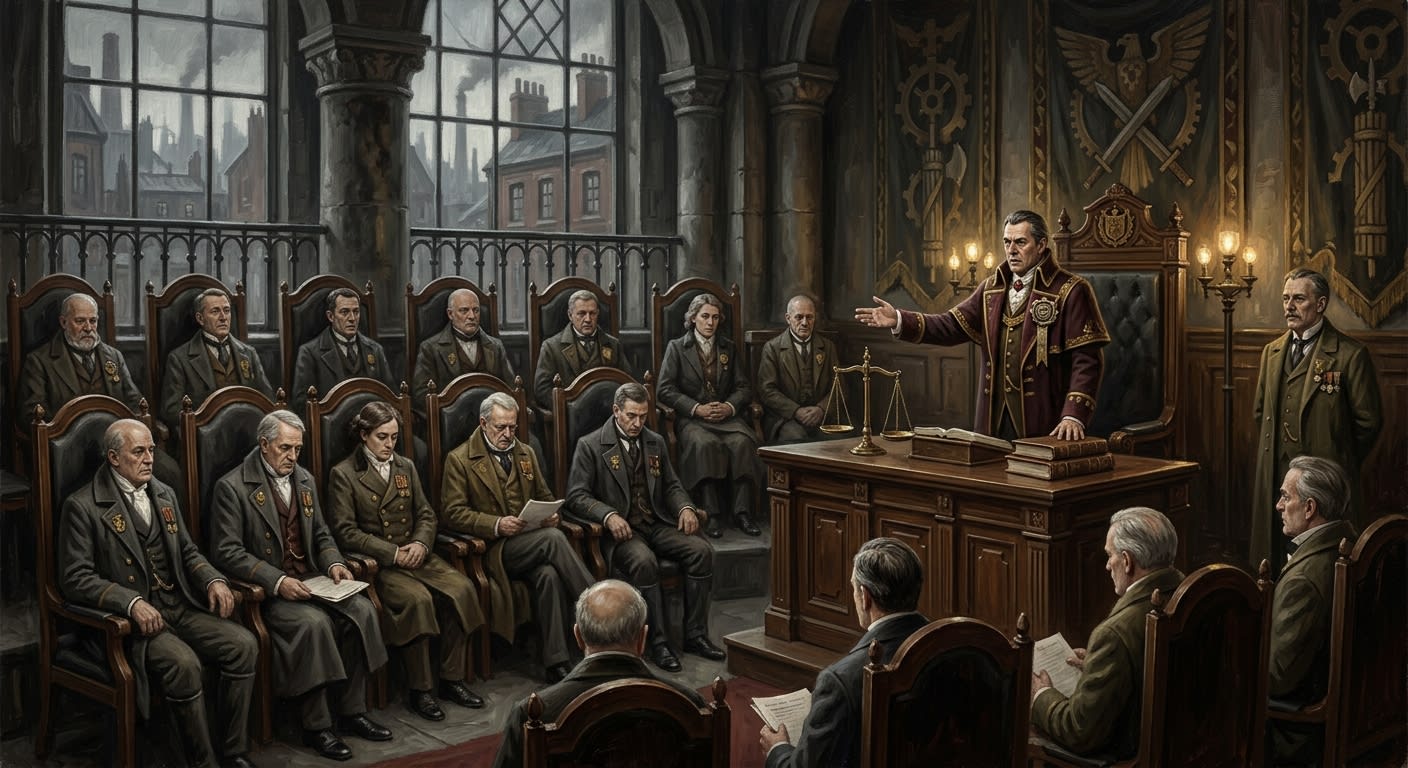
#On the Room Where Dissent Learns Posture
The Council of Prefects is the Synod's most graceful instrument for making unanimity appear to have occurred in nature. Parliament would imply deliberation. Court would pretend evidence matters before the sentence is written. The Council is a ratification chamber: a room where senior civic officers, Bureau delegates, district prefects, route authorities, and frightened men with families in visible corridors gather to discover what they have always believed.
Its public function is administrative harmonisation. Its practical function is consent manufacture. Its theological function is uglier and more durable: to prove that every office already kneels toward Strasbourg before the order descends.
The Council rose out of the post-Concordat habit of gathering prefectural officers whenever a policy required more hands than a single Bureau wished to stain. By A.S. 138 it possessed enough dignity to ratify Directive 88-F and enough flexibility to record no dissenting votes. This combination — dignity for the public plate, flexibility for the minutes — is the Council's genius.
#On Composition and Rank
A Prefect in ordinary usage is a district officer. In the Council's usage, the title expands like damp paper. City prefects sit beside route prefects, festival prefects, grain prefects, records prefects, lantern liaison officers, Tithes delegates, Bells observers, and those anonymous men whom Shadows calls assistants because the word handler would interrupt luncheon. The chair changes by docket. The room remains obedient.
Permanent seats belong to Strasbourg's senior civic prefecture, the Bureau of Records register bench, the Bureau of Festivals calendar desk, Tithes ration oversight, Bells signal review, and Doctrine's approving eye. War attends when streets may become trenches. Purity attends when minutes may later be used as confessions. Mercy attends when casualties require gentler nouns.
No one admits that the Council is hierarchical. Every participant has voice. Every voice is respected. Every respected voice is timed, noted, paraphrased, corrected, and filed under the heading most compatible with the draft conclusion.
The Council's officers wear narrow black sashes with small gold knots at the hip: three knots for municipal authority, four for provincial authority, five for Bureau delegation, six for men whose authority must not be explained in public. The knots are inspected before entry. A false knot is civic impersonation. An excess knot is ambition. Both are corrected.
#On Procedure
The Council's procedure is simple in the way a trap is simple. A draft directive arrives already numbered, cross-referenced, costed, and blessed by whatever Bureau expects to profit from its passage. Prefects receive abstracts. Abstracts omit the combustible portions. The full docket rests on the central table under seal, guarded by a Records notary whose expression communicates, without words, that curiosity is a correctable illness.
Speakers rise by order of precedence. Questions are framed as requests for clarification. Objections are framed as anxieties. Anxieties are thanked. Thanks are entered into the minute. The minute becomes proof that the objection was heard. A heard objection becomes consent by exhaustion.
The voting ritual is shorter than the discussion and less honest. Each Prefect presses a seal into the roll sheet. The seal does not mark belief. It marks responsibility. A man may think what he likes while the wax cools; the Council has never claimed jurisdiction over private thought unless Records has already supplied an annex.
A civic school primer describes the Council vote as “free assent among loyal magistrates.”
Corrected for instructional use. The assent is loyal. Freedom is not an administrative category.
#On Directive 88-F
The Council's most famous public act remains the ratification of Receipt Reform A.S. 138, Synod Directive 88-F, passed after the Gray Week Famine taught four cities that open grain audits could be answered with cobblestones. Strasbourg, Marseille, Munich, and the disputed fourth city had swallowed eleven days of bone-broth, rumour, and official arithmetic. Auditors arrived carrying ledgers. Hunger replied in the older script.
The reform docket set three exhibits before the Council. Exhibit A: burned paper receipts from the Munich font. Exhibit B: audit parchment scraped from the fish-glued skin of the Marrow Quarter Ledger Prefect. Exhibit C: a trial wrist-ribbon worn by Caldrin of Essen, later Saint Caldrin the Jubilant Scribe, showing three clean punch marks and no feasible transfer between citizens without visible tearing.
The lesson was plain enough to shame the furniture. Paper flees. Flesh testifies.
Directive 88-F abolished paper receipts at Bureau-sanctioned processions and mandated wrist-ribbon stamps: colour, punch pattern, station mark, district code, pain. It constituted the Receipt-Procession Pageant Captain corps as licensed field officers. It gave Festivals a census costume, Records a cleaner anomaly list, Tithes recoverable households, Bells route timing duties, and Lantern men a reason to look at wrists without being punched first.
The Council recorded zero dissenting votes.
PREFECTURAL SEATING NOTE — DIRECTIVE 88-F SESSION Marseille grain delegate seated beneath recovered granary list. Munich ward prefect seated beside burned receipt exhibit. Strasbourg lower-ward representative absent; substitute accepted under emergency dignity clause. Family corridor assignments: ███████████ Instruction: publish unanimity.
Unanimity was not an accident. It was architecture with chairs.
#On Caldrin and the Smile in the Minutes
Caldrin of Essen did not command the Council. Saints rarely do while still breathing, and junior clerks do it only by accident. His memorandum supplied the instrument. The Council supplied legitimacy. Festivals supplied banners. Records supplied columns. The city supplied wrists.
The minutes call Caldrin's proposal “festal receipt substitution with visible continuity.” One must admire the phrase as one admires a well-made coffin. It conceals the corpse without denying its dimensions. Caldrin had seen what the open audit lacked: lure, rhythm, witness, and enough colour to make compliance feel like participation. The Council saw something better. It saw a device that could be scaled.
The Council's sanctification of Caldrin followed the same logic. A reform born from famine riot required a face. The face had to smile, because a frowning census saint would insult even Synodal taste. Caldrin's ink-blackened hands became diligence. His ribbon-punch became charity. His receipt-scroll became memory. His procedure became miracle.
Festival hagiography states that the Council recognised Caldrin because the people had already acclaimed him.
Corrected: the people had mostly acclaimed bread, cider, and the cessation of open audits. Caldrin was attached afterward, like a seal placed over a stain.
#On Pressure, Families, and Corridors
The Council denies coercion. It has never needed to affirm coercion when architecture performs so beautifully. Prefects entering the chamber pass three corridors: the public corridor lined with clerks, the family corridor lined with invited kin on ceremonial benches during significant sessions, and the side corridor where aides from Shadows stand beside wall maps without speaking. A man may object in such a building. He will object with excellent awareness of acoustics.
Before major votes, draft seating charts circulate under restricted cover. A Prefect placed near Doctrine understands one warning. Placed near Tithes, another. Placed with his province's arrears summary under his inkstand, a third. Placed opposite the chair reserved for his eldest son during the next Gratitude Procession (Unregistered), a fourth that requires no words.
This is subtler than crude terror. Crude terror is for amateurs, frontier captains, and Purity men after wine. Prefectural pressure is clerical weather: a chill in the seating order, a cloud over permit renewal, a sudden shower of audit interest on a brother's warehouse. By the time the roll is called, dissent has become expensive before becoming visible.
#On Records and the Minute
Records is the Council's true confessor. Every meeting produces three minute forms: the public digest, the administrative minute, and the sealed variance sheet. The public digest is serene. The administrative minute is useful. The sealed variance sheet is alive with little wounds: hesitations, whispered side-consultations, attempted amendments, unsealed letters received during recess, refusals to look at exhibits, excessive sweating, insufficient enthusiasm, and that most damning of civic acts, asking whether implementation might wait.
The Great Ledger does not absorb Council minutes directly; it does not need to. A Prefect who hesitates at Directive 88-F may later discover his district procession permit delayed, his grain return questioned, his Lantern escort reduced, his nephew's apprenticeship reviewed, his dead aunt's burial dues recalculated. Records never punishes. Records remembers in convenient directions.
A passed directive leaves the chamber in copies: Doctrine copy, Records copy, administering Bureau copy, provincial packet, bell-table abstract, Tithes cost sheet, Purity compliance note, and, when needed, a Shadows extract small enough to vanish in a glove. By evening the decision has become paperwork. By morning paperwork has become fact.
#On Provincial Sittings
The Strasbourg chamber is the parent wound, but provincial sittings carry its infection outward. Marseille has hosted riot-control sittings. Cologne has hosted doctrinal-labour sittings. Antwerp denies hosting the fourth-city reconciliation review, which is the surest evidence that something was reviewed there. Munich's grain hall still bears nail marks from the A.S. 138 exhibit table, though local guides call them decorative scoring because tourism dislikes famine.
Provincial Councils are smaller, faster, and meaner. The city knows where the Prefects live. The Prefects know which baker hid flour, which Lantern captain takes coin, which Festival officer cannot count past fear, which Records clerk drinks, which priest will say anything if his roof is repaired before winter. Local knowledge sharpens the Council into a street instrument.
The Council's provincial power rests on this small permission: to translate central command into local procedure without admitting translation has occurred. Strasbourg says wrist-ribbon. Marseille says fish-market station. Munich says font-watch and nave cordon. Antwerp, if Antwerp is the fourth city, says dock gate, grain court, Scheldt Annex, Salt-Scale House, and no names in the public sermon.
#On Its Enemies
The Council's enemies are sincerity, hunger, local memory, and men who arrive with facts after the seating chart has been printed. Sincerity asks what a directive means. Hunger asks whether it feeds anyone. Local memory asks who died last time. Facts are tolerated only when they can be numbered, sealed, and made to support the ruling already dressed for presentation.
Bureau rivalry troubles the Council less than outsiders imagine. Rivalry gives it work. Festivals wants spectacle. Records wants data. Tithes wants recoverable obligation. Bells wants timing. Lanterns want licence. Purity wants names. Doctrine wants the final sentence. A good Council docket gives each office enough of what it wants to keep the knives pointed downward.
The true danger is an uncounted crowd. Gray Week proved it. A crowd outside procedure becomes weather with fists. The Council exists to prevent that weather from forming without warning. It does not calm the street. It drafts the conditions under which the street will be permitted to call its own containment festive.
#On Present Authority
As of A.S. 201, the Council of Prefects remains active wherever civic procedure must wear the costume of collective assent. It ratifies procession changes, emergency ration visibility, bell-route harmonisation, receipt doctrine, crowd-escort annexes, grain-audit substitutions, and the small local reforms by which old wounds are prevented from using their own names.
Its prestige rests less on wisdom than on custody of the moment before policy becomes irreversible. Before the stamp, a directive is proposal. After the stamp, dissent becomes nostalgia. The Council owns that interval. It fills it with chairs, abstracts, exhibits, oaths, luncheon delays, family corridors, and wax.
The Council's finest sentence remains the one it records most often: dissent, none. Fear, agreement, fatigue, ambition, debt, hunger, and prudence have been reconciled into silence and entered as administrative absence.