

#On the Present Survey
"No mote of sanctity is ever wasted." — Salvage doctrine, as received
This is a documentary survey of the Saint-Dust Salvage sorties as they stand in the present year, A.S. 201 / 1911 CE. The year is the year of this compilation. It does not date the first sortie, the first sieve, the first tide or the first man to wade into one. Nobody has filed any of those, and I have not supplied them.
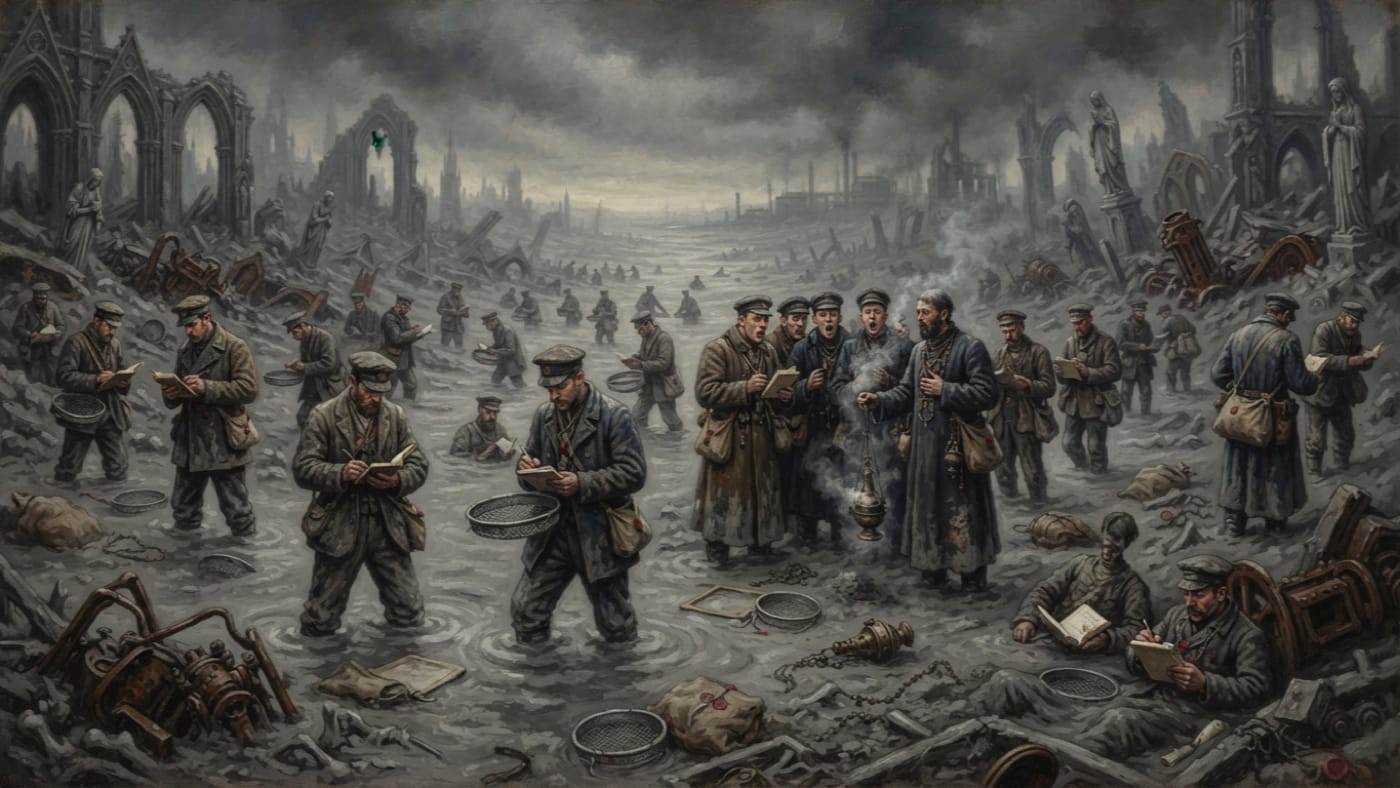
The work itself is easy to state. Where bombardment has shattered the bones of saints on the Sagittal Line, and where the ash-tides have ground them finer still, the Church sends men into the grey to sift what is left. They work bone-reefs while the ash rises. They record every pinch they recover. Then they carry it out, or are carried out with it.
The name describes a practice and the crews who do it. No charter of incorporation has reached my desk, and neither has a guild roll, a founding instrument, a single command or a franchise granting any body sole rights to the mud. A clerk who finds "Saint-Dust Salvage" written in a column heading and promotes it to a guild hall has confused a heading with a building. I have seen this done, and I have corrected it in red.
#On the Kit and the Paperwork
The sorties move out under shrouds of incense. They carry sieves sanctified in the vaults of Strasbourg. Each man carries a ledger as well as his kit: probate documents on waxed vellum, in which every pinch of recovered dust is notarized, bagged and stamped in triplicate before it leaves the field. Then they wade waist-deep into slurry where other soldiers will not put a boot.
That is the whole of the documented equipment. I have seen salvage crews painted with breathing hoods, lamp-belts and brass gorgets by men who have never stood in anything deeper than a font. None of it is in the record. The record gives incense, sieve, vellum, bag and stamp, and a tide that comes in regardless.
Note who does the clerking. Nobody is recorded sitting on a dry bank taking dictation. The hand that holds the sieve also holds the pen, so recovery and probate happen in the same place, at the same moment and in the same mud. The wax on the vellum tells you the Church knew exactly where its forms would be filled in and ordered them accordingly. I admire this. It is the only provision in the file that plans for the conditions as they are.
The salvage crews are scavengers working the silt of the bone-reefs.
Replace "scavenger" with "procurator of dust." Replace "silt" with "micro-reliquary substrate." Corrected pursuant to the Bureau of Records, 2nd Rev.
The doctrine behind the work belongs to the Church, and I hold it as I am paid to hold it. Bombardment shatters the bones of saints, and the tides grind them, but even the smallest particle keeps the imprint of the holy, so even silt must be recovered. That is why the saint-dust is worth a man's waist in slurry.
The doctrine concerns the dust of saints. It does not certify any particular sieve-load. Not every grey wave is canonised bone, and not every pinch in a bag came from a saint. The stamp records that a pinch was taken, by whom and where. It does not record what the pinch is, whether it will do anything or whether it is safe in a wound. Custody is a statement about hands, and the identity of the dust is a different question. The Bureau knows the difference, even when its customers prefer not to.
#On the Song, the Name and the Tide
The crews sing while the tide comes up the reef. The song is the Receipts of Saint Ephrath, and the record gives it one purpose: to steady their hands. A steady hand keeps the sieve level, closes the bag without spilling and makes a mark on wet vellum that a clerk at the rear can read. The record shows the song doing that and nothing else. I have found no stanza that turns back a tide, confounds a husk or keeps powder out of a throat. The song certifies nothing either. A sack leaves the field because its ledger is sealed.
Its composer is unrecorded, and so are its adoption, melody and words. My own Mournwater filing counted forty-seven stanzas as that song was sung there, and I do not claim every crew keeps the same count. This hymn has nothing to do with the civic Procession of Receipts, where auditors chant over tithe-ledgers. Anyone who mixes up the two has never heard either.
Saint Ephrath was a deacon of Bohemia. His approved Life puts him before a tribunal of philosophers in Prague under late Rationalist occupation, reciting the Creed through blood. Nothing in that Life mentions ash, bone-reefs or the Line. The song carries his name as a dedication. He wrote no stanza of it, founded no salvage body and holds no recorded patronage of the trade. The Order of Saint Ephrath, which took him as patron after his death, has never claimed to own the tune or to teach it.
The hazards are documented and none of them is musical. An ash-tide is grey surf of powdered bone, and it takes piers, barns and men. Coastal accounts have it arriving at dawn and withdrawing at dusk. The Debrecen account has it rising for six days and reversing on the seventh. Both accounts stand, and neither is a timetable. The record says the tides move "like sentient weather." That is this office's own figure of speech, entered for colour and since qualified. No file shows a tide that thinks.
The crews also have competition. Demons covet the dust, and the account says their sorcery feeds on sanctity turned inside out. I report the appetite as the account gives it, since nobody has measured it. The enemy sends recovery parties of ghouls and hollowed husks after the same particulate, and the fighting is often hand to hand, in mud so thick that a sword comes free more slowly than a bone. The files give no usual strength for a sortie, no formation and no officer's rank. I have not invented them to make the order of battle look tidier.
#On the Bone-Drift of Debrecen
Its year is unrecorded. The name of Debrecen carries other years in other files, among them its consumption in A.S. 45 and the Mire Collapse of A.S. 172. Neither belongs to this account.
A reliquary vault collapsed under a Wrath bombardment, and a Saint-Dust Salvage company was sent after what it had held. For six days they sieved in silence while the ash rose to their necks. On the seventh day the tide reversed and swallowed them.
Weeks later the corpses were dug out. Every sack was still clutched and every ledger was sealed with the Procurator's sigil. The record does not name the Procurator, the company, its strength, its officer, its dead or the men who did the digging.
The dust went to three separate fronts. Each front recorded "miraculous endurance." The phrase is theirs, and I have no instrument showing that the dust caused it. None of the three reports names the drowned men.
The record says in silence. It does not mention the Receipts. Whether this company sang at some other hour is not in the file, and the Bone-Drift cannot be used to prove the song's power or its uselessness. It shows something else. Every item the Church had a form for came through intact: the cargo, the seals and the three receipts. The men were the one item without a form.
#On Neighbouring Trades
Three other occupations get filed under the same heading in careless offices, and I keep them apart.
The Reliquary Salvager enters collapsed vaults, bastions and underworks to pull out fragments and housings. A few of his trade are licensed. The rest are tolerated, or erased. His file is his own. I lend none of its licences, tags, tools, ailments or ranks to the men in the slurry, and I take none of theirs to him. A vault-diver works stone and darkness. A sortie works a reef with the tide coming in.
The Wound-Site Prospector extracts fuel. His drums go to furnaces, and nothing he pumps is meant to be venerated.
Then there is industry. At Mournwater, a Zone 2 river-port in the Heartlands, the relic trade began after a barge wreck in A.S. 98 / 1808 CE. That year dates Mournwater's trade and nothing else. Its raw material is described as coming down from the Ossuary Shoals upstream. Some field-recovered dust also reaches the port, though I cannot say by how many routes or how often, and the port is not the only destination. In the Grading Hall of Settled Light, samples are watched in shallow dishes during a silent settling prayer, and the graders call an accepted pattern rosary strata. Brine, casks and certification all happen downstream. The sortie does none of them, and no recipe passes from the reef to the cooper. Since the Crumble-Wrong was classified in A.S. 194 / 1904 CE, the Hall has had to admit that a clean seal chain does not settle a dish. The question of what lies upstream remains open, and nothing in this survey answers it.
#On the Present Condition
In A.S. 201 the sorties still go out under incense, with Strasbourg sieves and waxed vellum. They still notarize each pinch, bag it and stamp it three times, and they still sing the Receipts to keep their hands steady while the tide climbs the reef. The husks still come after the same dust. Some of what the crews recover goes on into trades that grade, brine and cask it, and the Church files the paperwork for all of it.
Nobody has established where the tides come from or how they work. No sieve, song or censer has been shown to keep a man alive. No sack is guaranteed holy because it came out sealed. The drowned of Debrecen remain unnamed in every ledger I have consulted, including this one.