

#On the Present Survey
"No mote of sanctity is ever wasted." — Salvage doctrine, as received
This survey describes the Ash-Tides as they stand in the present year, A.S. 201 / 1911 CE. The year belongs to the survey. Nobody knows when the first tide came in, who first saw one or who first named it, and any reader who copies 201 into his margin as the year of their origin will find his margin corrected by a hand steadier than his own.
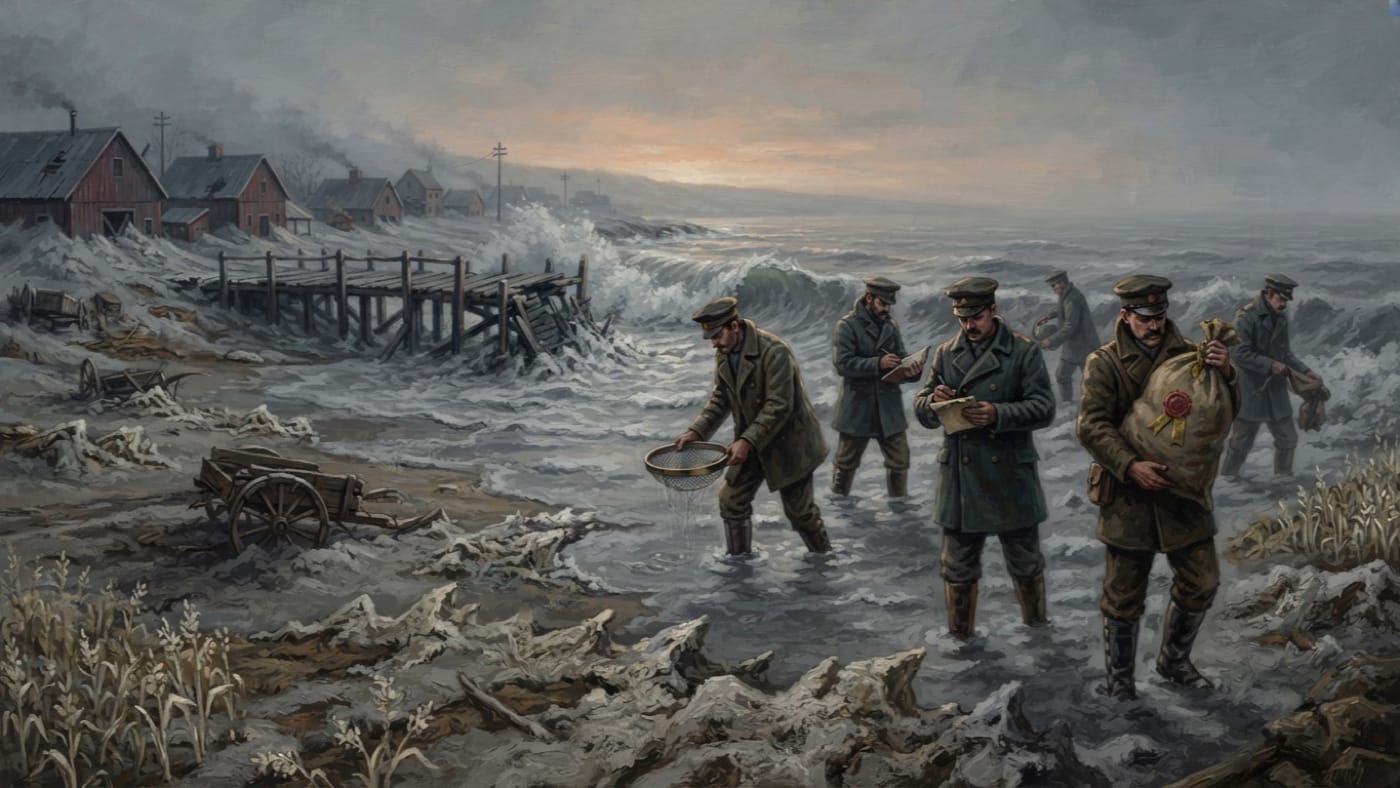
The Ash-Tides are entered among the Wound-Sites, the places where Creation has been made to file an exception. This office's description of them has stood in the general catalogue for some time. It has not improved with age, and I give it again because no better one exists. Stand on the coast at dawn and watch them roll in: a grey surf of powdered bone, cresting like a sea, swallowing piers, barns and fishermen alike.
I wrote alike, and I have since been asked to be more careful with it. The sentence puts a man on the same footing as a barn. I let it stand, because I have found no record of a tide that ranked him any higher. A pier is timber and pitch. A barn holds a season's labour under a roof. A fisherman has a name in some parish book, a tithe assessment and possibly a wife. The surf takes all three in one line of the catalogue, and the Ledger records no difference in how it handles them.
Of all the curiosities in the Wound-Site files, this one is the most spectacular. A Silence Dome kills a scream. A Confession Wind steals a sentence. Both injuries are private, and both are suffered by one man at a time. The Ash-Tide works in public, at a scale a whole village can watch from the dunes, and it takes the village's property while the village watches.
The survey rests on documents: the catalogue entry, the salvage record, the soldiers' testimony as reported, a single incident at Debrecen, and the positions three Bureaus hold on the cause. This office has entered no inspection of its own. Nothing in what follows was seen by me personally, and I have put no witness's words in anyone's mouth. The Ledger is grim enough as it stands.
#On the Coming and the Withdrawal
The recorded pattern is simple to state. At dawn the tide comes in. At dusk it goes out.
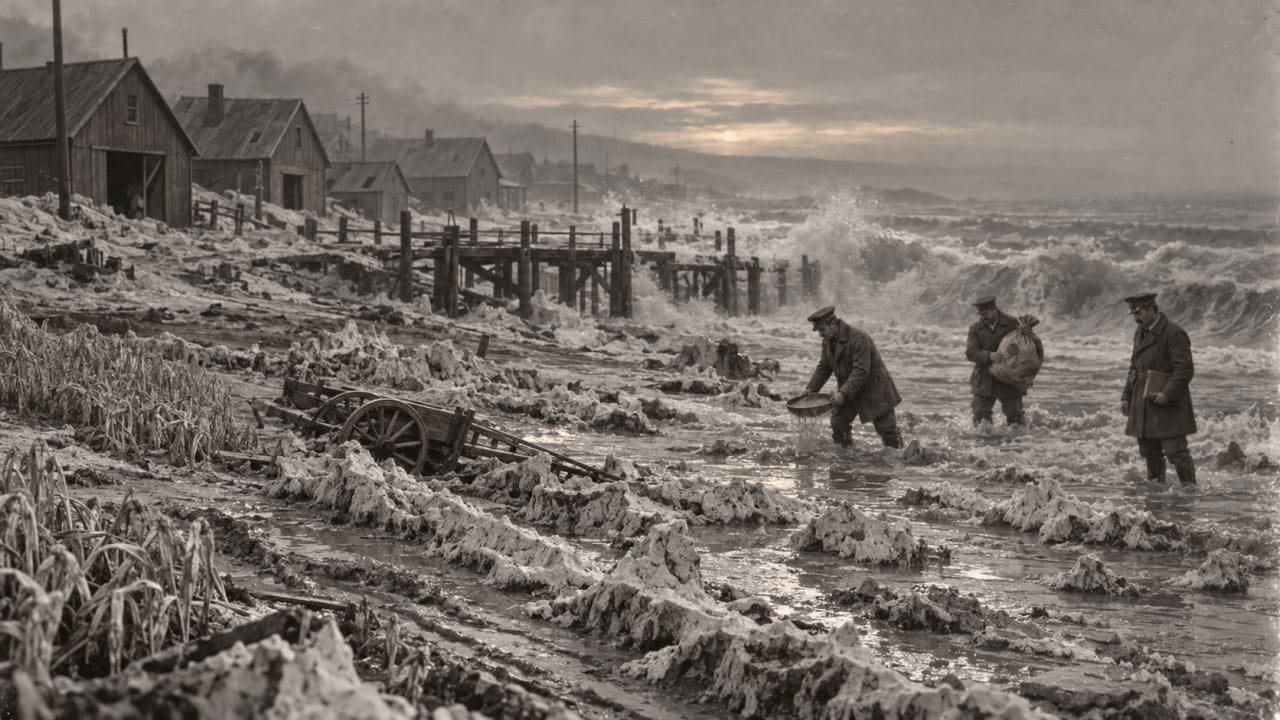
The catalogue adds two adjectives for the arrival, grey and soft, and both should be taken at face value. The colour is the colour of a reliquary floor before the sacristan sweeps it. The softness is the softness of powder, and the published entry means no comfort by it. A sea of powder crests like a sea. It runs up the shingle, breaks against the piles, comes back on itself and goes on. The coastal account has it swallowing piers. That takes height as well as reach, though nobody I can find has entered a height. A barn standing above the strand line is also taken, so the reach goes inland of the timber.
The published catalogue extends the ground beyond the coast. Ash-Tides are recorded crossing fields, roads and harbour flats. The salvage account adds the front itself, where the tides are said to lap across the Sagittal Line and grind what lies there. A fisherman can at least see the sea he works. A carter on an inland road has no sea to watch, and the records do not say what he sees before the grey reaches his wheels.
I have to be exact about what the description gives us. It gives a material, which is powdered bone. It gives a motion, which is surf. It gives an hour of coming and an hour of going. It does not give a speed. It records no depth at the crest, prints no tide table, and makes no reference to the moon. I have found no almanac in the Bureau of Records that lists the Ash-Tides among its predictions, and I would distrust one that did. A tide of water answers to the Creator's ordinary statutes for water. Nobody has shown what a tide of bone answers to.
The pattern is also no promise. The salvage record cuts against the coastal one in the plainest way possible. At Debrecen, the account runs, the ash rose for six days around a working company and reversed on the seventh. Those six days had dawns and dusks. If the tide withdrew at each dusk, the record does not say so. It records a rise lasting most of a week, and then a reversal. Both accounts stand in the files, the coast's and Debrecen's. No one has reconciled them, and I will not invent a second species of tide so that the catalogue reads more neatly. A clerk who meets two incompatible entries keeps both and initials each of them.
It follows that dusk is not safety. A man who walks onto a harbour flat at dusk is trusting a habit the tides have been seen to keep on certain coasts and have been seen to break in at least one vault on the Line. The withdrawal also leaves something behind, which the next section deals with.
The ash-tides move with a mind of their own. They lap across the front like sentient weather.
Qualified. These phrases are this office's own, set down in the salvage record and repeated in later filings. They are figures of speech. The files show no tide that thinks, chooses, remembers, hunts or takes orders, demonic or otherwise. A sea that swallows men at a great rate looks deliberate to the men, and the clerk who describes it borrows their word. The tide's intentions remain unentered because nobody has shown it to have any.
The phrase reducing whole companies into silence belongs with the same correction. The silence is the silence of men overcome by powder. The files give no reason to suppose the ash does to sound what a Silence Dome does. Drowned men are quiet in every jurisdiction.
#On the Ground Left Behind
Water leaves wrack when it goes out. The Ash-Tide leaves shoals.
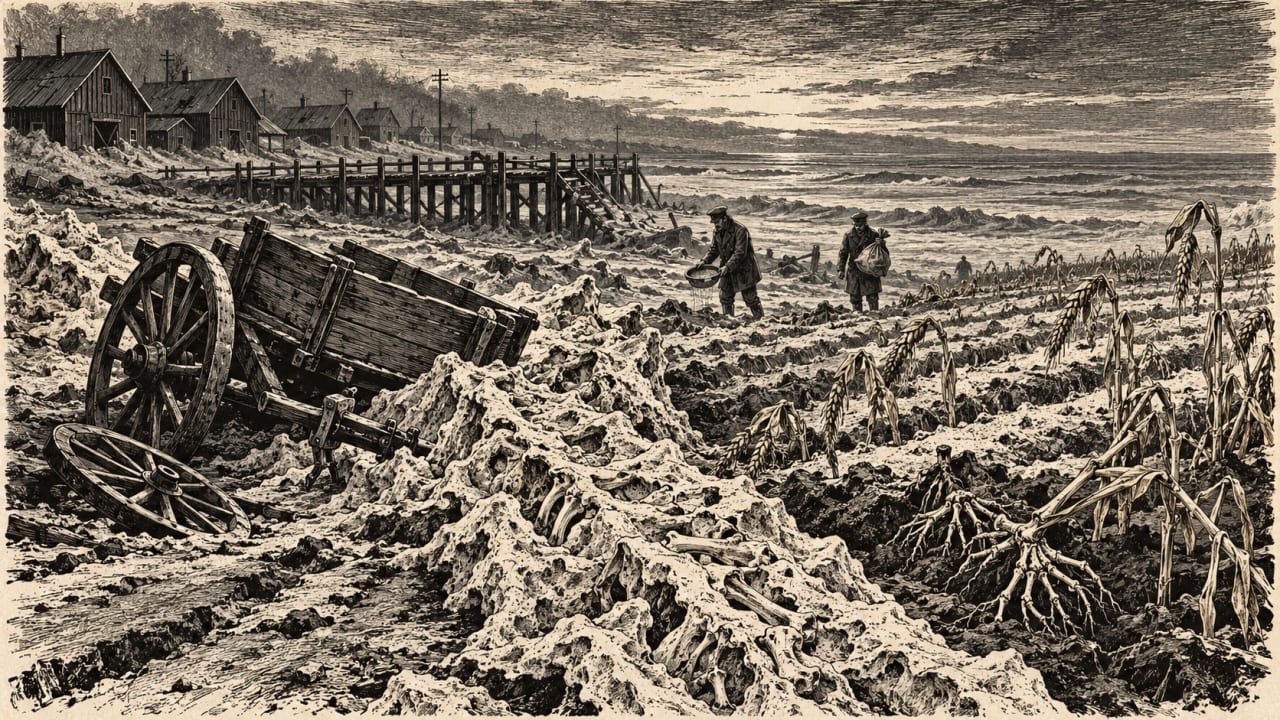
The primary description calls them shoals of calcium, hard enough to snap wagon axles. The published catalogue says crack where the primary account says snap, and I find no case for preferring one verb to the other. In both, a wheel meets the shoal and the iron gives way first. Consider what that implies. Soft surf comes in at dawn, and by the hour of the axle it has become a reef with the strength of masonry, laid across a road nobody sanctioned, with no surveyor's mark and no bell.
The road is the first loss, and the files treat it as a loss apart from any other. A road is a contract between a town and its supply. Grain goes out along it, salt and powder and sermons come in, and the tithe-cart runs it in both directions. A shoal across that road breaks the contract. The axle is a carter's misfortune and a wheelwright's income, but the delay belongs to everyone downstream, and the files do not say how long a shoal stays where it fell. I have found no programme for clearing them, no assessment of what one costs to break and no guild chartered to break them. I have supplied none of these.
The field is the second loss, and it is of a different kind. The primary account says the powder chokes the fields and the crops come up pale and brittle. Pale is a colour, and brittle is how a stalk behaves when it is bent. Between them they describe a harvest that may look like grain from the edge of the field and fall to pieces in the hand. The account does not say whether the grain is fit to eat, whether the field recovers in a season or how many furrows have been lost on any coast. I report the two adjectives and add nothing to them.
The published catalogue adds a third particular, which the primary account does not contain. The pale crops, it says, grow with root-structures resembling finger bones. That is a resemblance, and it is entered as one. Nobody has shown that the roots are fingers or came from fingers, or that a plant grown in bone-powder takes on anything more than its shape. The farmer who pulls such a plant and sees a hand in the soil has seen what the catalogue says he would see. The Ledger records the likeness and stops there. It has never yet named a new creature from a parsnip, and this survey will not be the first to do so.
Kept apart, as they should be, the three consequences are a road that breaks iron, a field that grows weak, and a root that looks like a hand. The first is a matter for the quartermaster and the second for the tithe-assessor. The third, so far as the files show, is a matter for nobody, which means in practice that it is a matter for the farmer.
#On the Fish Reported in the Ash
Soldiers say there are fish in it.
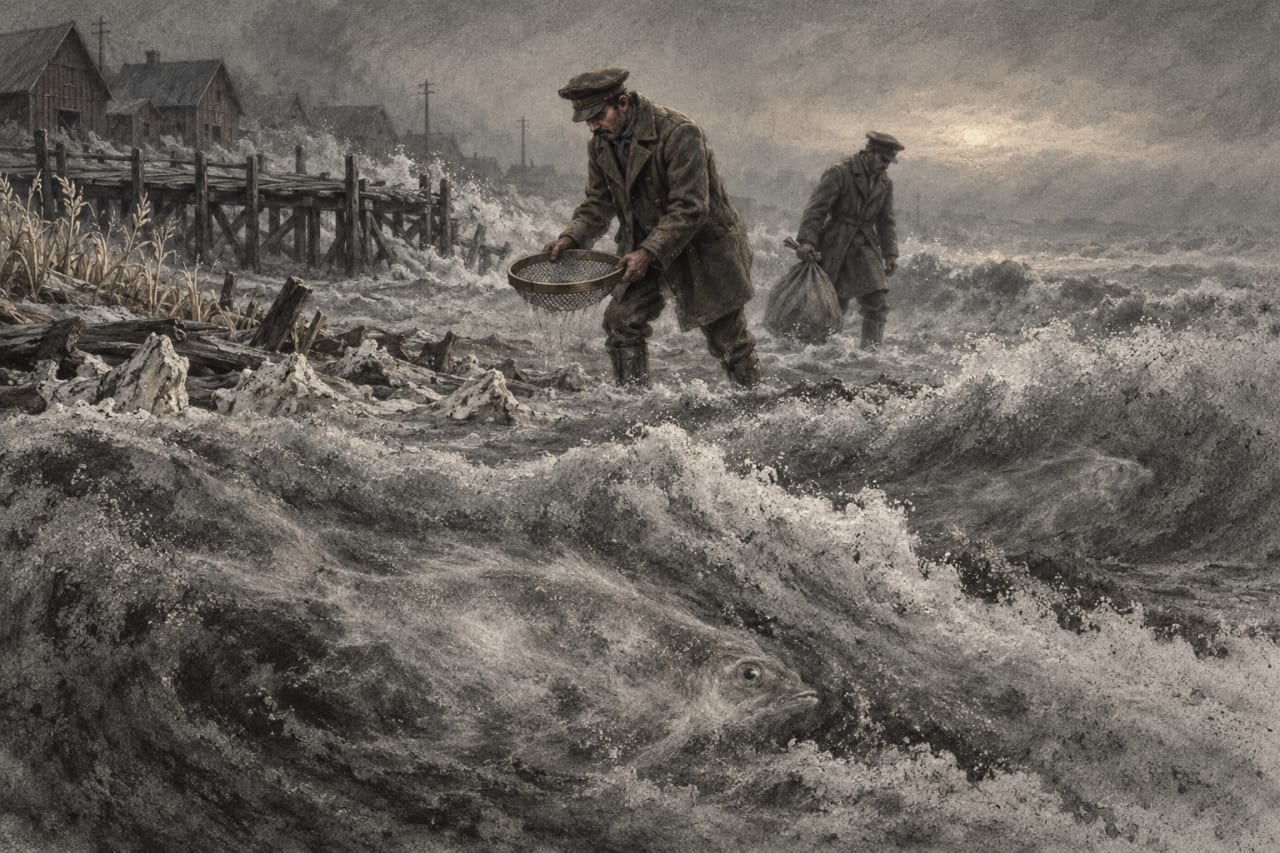
The testimony comes to us as a whisper among soldiers, which is the usual way such testimony travels. The fish are said to be translucent, to swim in the dust as fish swim in water, and to have eyes that seem too human. I give the words as they were reported. Seem is the soldiers' word, and I leave it in its place. Nobody has claimed that the eyes are human, only that a man looking into the grey had the feeling of being looked back at by something that had learned the trick from men.
Two institutions have answered this, and they have not given the same answer.
The Bureau of Doctrine, which employs me, insists that no such fish exist. The position is clean and short, and it costs nothing to hold. It asks nothing of the soldier's eye. It simply rules that there is nothing for the eye to have seen. Doctrine also insists that the Bureau of Records never makes errors. I record both insistences in the same paragraph out of loyalty, since loyalty requires me to report what my Bureau holds and does not require me to arrange its holdings for flattering effect.
The Bureau of Rites holds that the fish are optical fatigue. This is a different claim, and I will say so even though Rites will not thank me for it. Fatigue grants that the soldier saw something. It places the thing he saw in his own tired eye rather than in the dust. A man who has stared for hours into moving grey surf may well see moving shapes there, and Rites calls the shapes his. The trouble is that the explanation proves too much. It fits every soldier equally well, and so it cannot tell a soldier who saw nothing from one who saw a fish.
So the dispute stands. One Bureau denies the fish, another accounts for the sighting, and the soldiers go on whispering. No specimen has come into custody. No fish has been netted, salted, drawn on a plate or entered under a Latin name. The files describe no anatomy, no feeding and no part the fish play in the tide's coming and going. If they exist, nobody has caught one. If they do not, the soldiers are still seeing them.
The eyes are the detail I cannot get out of the file. A translucent fish would be an oddity, a footnote for a naturalist and a joke for the barracks. The eyes are what turned the report into a whisper. Too human is no term from zoology. It is the phrase a man reaches for when his words run out, and I leave it in the record as the soldiers gave it.
#On the Men Sent into It
Most men withdraw from an Ash-Tide. The Church sends some men in.
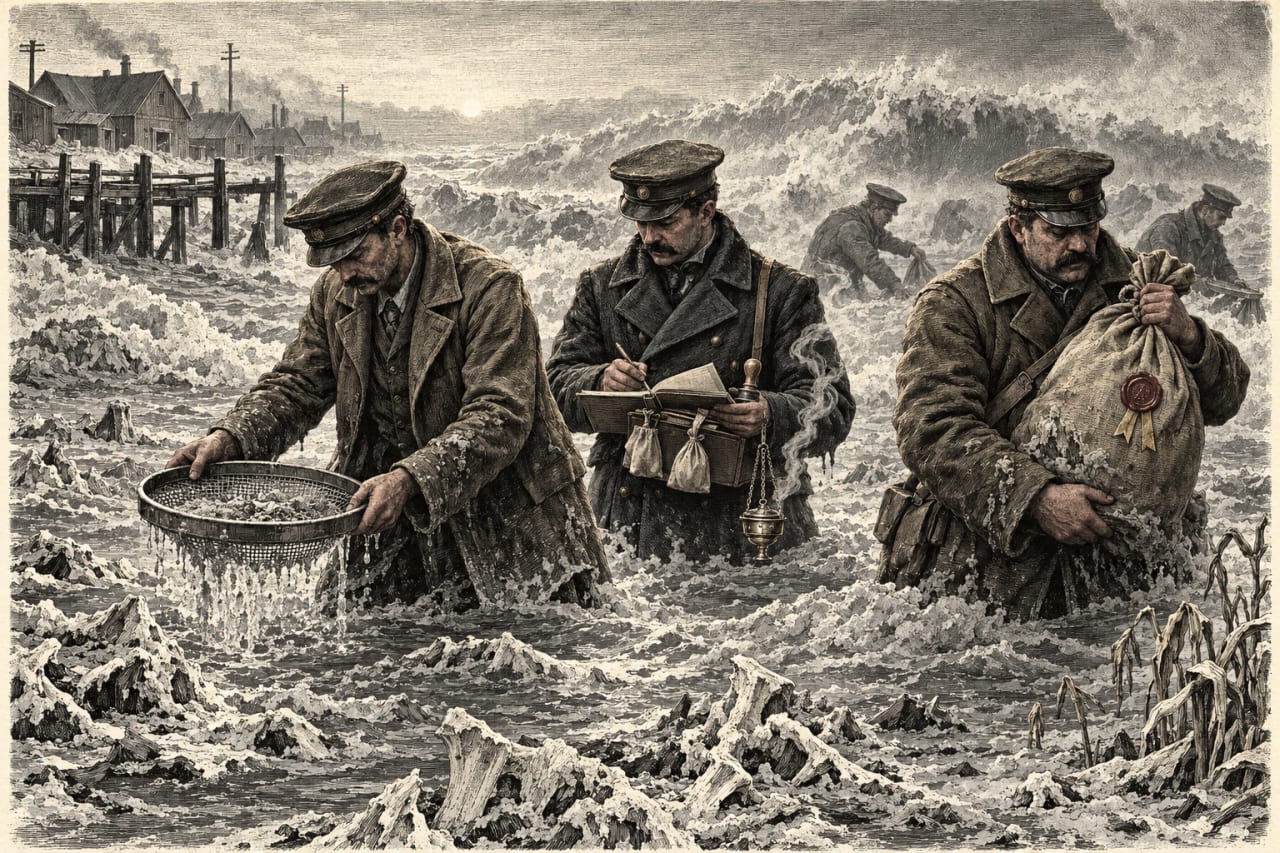
The reason is sanctity, and the doctrine behind it is one I endorse without reservation. The bones of saints do not rest quietly on the Line. Bombardment shatters and splinters them, and the ash-tides grind them down as well. No mote of sanctity is ever wasted. Even the smallest particle keeps the imprint of the holy, so even silt must be recovered. The Church values its saint-dust beyond any other commodity on the front, and where the tide has worked saintly remains into the slurry, the slurry must be worked in return.
The doctrine concerns the dust of saints. It does not hold that every grey wave on every coast is made of canonised remains, and a fisherman whose pier has gone under need not worry that he is being drowned in relics. The salvage crews go where sanctity has been broken up and scattered, and the tide happens to be there too.
The Saint-Dust Salvage sorties are the men who go. Outsiders might take them for scavengers. They move out under shrouds of incense and carry sieves sanctified in the vaults of Strasbourg. Each man carries a ledger in his kit: probate documents on waxed vellum, in which every pinch of dust is notarized, bagged and stamped in triplicate before it leaves the field. Then they wade waist-deep into slurry where other soldiers will not put a boot.
Consider the order of the work. The sieve goes into the grey and comes out lighter. Whatever stays in the mesh goes into a bag, and the bag is closed. The pinch is written on vellum in a hand that has been in the slurry up to the wrist. Stamp, stamp and stamp again, and the third stamp has to be as legible as the first. All of this is done while the tide is coming in, because the tide is the reason the dust is there at all. The wax on the vellum is the Church's admission that it knew where the paperwork would be filled in.
The salvage crews are scavengers working the silt of the bone-reefs.
Replace "scavenger" with "procurator of dust." Replace "silt" with "micro-reliquary substrate." Corrected pursuant to the Bureau of Records, 2nd Rev.
The crews are not alone in the slurry. Demons covet the dust too, because their sorcery is said to feed on sanctity turned inside out. That explanation belongs to the account; I have not seen the appetite measured. The enemy sends recovery parties of ghouls and hollowed husks after the same particulate, and the two crews meet in mud so thick that a sword comes out more slowly than a bone. Much of the fighting is hand to hand. The files name no commander on the far side and give no usual strength for a sortie, and I will not supply either. The enemy shows himself in this file as competition, which is the form the Great Deceiver takes whenever the Church finds something worth keeping.
Two other trades should be kept apart from these men. The Wound-Site Prospector taps seams for fuel under charter and pumps seepage into drums for the furnaces. His file is his own, and so are his gaskets and his hymns. The Reliquary Salvager has a trade and a file of his own too. I lend none of their tools, rites or ailments to the men in the slurry. The Saint-Dust crews have sieves, incense, vellum, bags and stamps, and the tide is coming in around them.
#On the Bone-Drift of Debrecen
The salvage record holds one incident that tells us more about the Ash-Tides than all the catalogue's adjectives put together. It is called the Bone-Drift of Debrecen. Its year is unrecorded.
The name of Debrecen appears in other files with other years attached: its consumption, the Pit, and the separately dated Mire Collapse. None of those years belongs to this account, and I will not borrow one to make the account look better filed. The Bone-Drift has a place and a sequence and nothing else.
A reliquary vault collapsed under a Wrath bombardment. A Saint-Dust Salvage company was sent after what it had held. The record does not give the company's designation, its strength or the name of the officer who sent it.
For six days they sieved in silence while the ash rose to their necks.
That is the sentence as the record gives it, and its structure is worth noting. The work and the rise share one clause. The company did not stop sieving while the ash climbed. The ash did not stop climbing while the company sieved. The record says in silence, and silence is all it says. It mentions no song, no prayer and no order to withdraw. It does not say whether anyone above the vault saw the ash reach a man's chest and then his collarbone. Six days of that is entered as one line.
On the seventh day the tide reversed and swallowed them.
The record calls this a reversal, and I keep the word. It does not say what the tide reversed from or why it reversed then. It records no dawn and no dusk. After six days of rising, the tide did something else.
Weeks later the corpses were dug out. Every sack was still clutched, and every ledger was sealed with the Procurator's sigil. The record does not name the Procurator, give the number of the dead or say who did the digging.
The dust from those sacks went to three separate fronts. Each front recorded "miraculous endurance." The phrase belongs to the three reports and their senders. The record does not name the fronts. It does say what was missing from all three reports: none of them names the drowned men.
I have tried to set the two inventories side by side, as a clerk sets a debit beside a credit. The cargo was complete, with every sack held and every sigil intact. The custody was complete, since three fronts received what was sent and recorded receiving it. The ink is accounted for and so is the wax. The miracle has been certified in the plural. The names are the one item in the account that did not survive.
No diary has come down from the company, and no last words, and no survivor. Nobody is recorded as having tried a rescue. Everything we know comes from the seals, the sacks and the three reports, which is to say from the paperwork, and the paperwork was not designed to remember whoever filled it in.
The Bone-Drift does not tell us why the tide rose or why it turned. It shows that a tide can rise for six days around men who are working, that the work went on to the neck, and that the Church received every pinch. The Church has been grateful for the dust ever since and has never needed the names to be grateful.
#On the Receipts and Other Assurances
The crews sing. The song is the Receipts of Saint Ephrath, and the salvage record gives its purpose in one clause: they sing it to steady their hands while they sift the bone-reefs as the tide laps higher.
The purpose deserves close reading, because the song is constantly being credited with more. A steady hand holds the sieve level in moving slurry. It closes the bag without spilling and makes a mark on wet vellum that a clerk in the rear can read. So the song serves the work and the custody of what the work recovers. The record shows it doing nothing else. I have searched the Ledger for a stanza that turns back a tide and found none. Nothing in it confounds a husk or keeps powder out of a throat. Whatever the crews sing, they sing it while the tide comes in.
The Bone-Drift, which should be the obvious place to test this, cannot be used for the purpose. The company sieved in silence. Either they did not sing, or the clerk who sealed their ledgers thought singing too trivial to enter. The account says nothing for or against the song's power, and it would be dishonest to use it as evidence either way.
Then there is the saint. Saint Ephrath was a deacon of Bohemia. His approved Life places him before a tribunal of philosophers in Prague, reciting the Creed through blood. Nothing in that Life connects him with bone-reefs or ash or the Line. The song bears his name as a dedication. No composer is recorded and no date of adoption, and nothing makes him the patron of salvage, the founder of a salvage order or the calmer of a tide. The crews have his name to sing. Whether he would have approved of the use is a question the Life does not answer, and the dead are seldom asked.
The incense and the Strasbourg sieves serve the sanctity of the recovery: one keeps the air fit for the handling of holy matter and the other keeps the mesh fit to hold it. Neither is recorded as keeping a man alive.
The Synod's general prescriptions for Wound-Sites apply here as they apply everywhere. Strike three bells, and if the echo lags, the hours are bent. Toss a pinch of salt, and if it drifts upward, leave at once. Knot the ledger cords, and if they untie themselves, leave faster. Pay the Wound-Tithe. Those tests were written for other sores. None is recorded as announcing an Ash-Tide or holding one back. At dawn the tide hardly needs announcing.
The Wound-Tithe has its own limits. It is mandatory only at registered civic crossings, licensed extraction corridors, breaches next to pilgrim routes and military routes under a quartermaster's supervision. That clarification is already on file and I do not widen it here. Nothing in the files puts a gate around a harbour flat, takes a memory from a fisherman in exchange for his pier or assures a farmer that a paid tithe keeps powder off his field. The barns were swallowed with or without one.
#On the Explanation Permitted
The Ash-Tides share the general dispute over the origin of all Wound-Sites. No position has been filed on their origin in particular, so I set out the general positions and put each under its owner's name.
Orthodox teaching holds that Wound-Sites are scars left by the ancient sorceries of the Lie, warnings cut into the world by the Great Deceiver. The Bureau of Doctrine holds this. I hold it, I file it, and I am paid to do both. The doctrinal article on the Lie places the Ash-Tides among its public ulcers: grey surf rolling in and withdrawing over bone shoals. As doctrine that is sound. It assigns the injury to an author. It does not say how the author's sorcery becomes surf, and it was never written to.
The Bureau of Engines & Furnaces regards Wound-Sites as resource seams, "fuel waiting for the right hymn and gasket." The words and the vulgarity are both theirs. Applied to the Ash-Tides, their position meets a difficulty they have not addressed in any file I have seen. The resource in this case is the dust of saints, and the Church already has a use for that and a crew with sieves to recover it. I would be relieved never to see a memorandum proposing a second use.
Seditious murmur holds that miracles worked too often tear Creation like cloth stretched too tight. The official reply is that Grace is perfect and cannot bruise Creation, and that only the Lie does harm. The Bureau of Purity silences the murmurers swiftly. I record the murmur because a catalogue that leaves things out is no catalogue, and I record the silencing for the same reason.
The Bureau of Engineering's memorandum belongs here, but only in its proper place. The general catalogue dates it to A.S. 195 and quotes its surviving line: High-pressure reliquary events correlate with new Wound-Sites. That is a statement about Wound-Sites in general. It does not mention the Ash-Tides, does not date their first appearance and offers no mechanism for any site. Doctrine corrected the finding to coincidence, and the correction stands. A reader who wants to turn the memorandum into an account of where the grey surf comes from will be writing that account himself, without a seal.
So the Church has an author for the injury, an industrial reading of what the injury contains and a murmured accusation it has been silencing for some time. Doctrine affirms the first. No Bureau has filed a specific account of the Ash-Tides or said why bone moves like water, and the soldiers have not been asked.
#On the Present Condition
In the present year of A.S. 201 the position is as follows.
The tides come in, by the coastal account, grey and soft at dawn. They take piers, barns and the men working near them. They go out at dusk where they keep that habit, and the account from the Line shows that they do not always keep it. They leave shoals across roads that break iron and powder across fields that weakens the stalk, and they leave roots that the published catalogue says look like the bones of fingers. Soldiers report fish with eyes in the grey. Doctrine denies the fish, Rites calls them fatigue, and nobody has caught one.
The salvage crews still go out under incense with Strasbourg sieves and waxed vellum. They still notarize each pinch, bag it, stamp it three times and sing the Receipts to keep their hands steady while the tide comes up the reef. The enemy's recovery parties still meet them in the mud. Some of what they recover passes in time to trades downstream, including the cooperage at Mournwater. I make no claim about how much goes there or that every sack takes that road.
The limits of this record are four. Nobody has established how far the Ash-Tides extend in all, or where and when they began. No mechanism has been shown, and no protection has been found that works for every man in every tide. I state these once. Every other line in this survey is built inside them.
What the Church holds is dust in sacks with sealed ledgers, three fronts' certificates of miraculous endurance and a catalogue entry that ranks a man with a barn. The names of the drowned men at Debrecen are not in the Ledger. This survey enters the Bone-Drift as it found it, with the year, the strength and the names all left blank, and returns the file to the shelf.