

#On the Yards as Surveyed
This account was compiled in A.S. 201, which is 1911 by the reckoning of people who still count from somewhere else. The year belongs to the survey and not to the Yards. No ledger in my keeping records when the Yards were founded, and I decline to give them a birthday just because the Directorate gives everyone else a deadline.
The Salt and Grease Yards are where the Queue Road mends what it breaks. The road's own registers list the district in its service sprawl under three words: carts, repairs, axle shops. They also record its smell, which is oil and metal. The road houses forty-eight thousand registered inhabitants and keeps its travellers standing for days. Grain, paper, tallow, medicine and replacement boots still have to be moved past them, and all of it moves on wheels. Wheels fail. The Yards are where failed wheels are argued back into service.
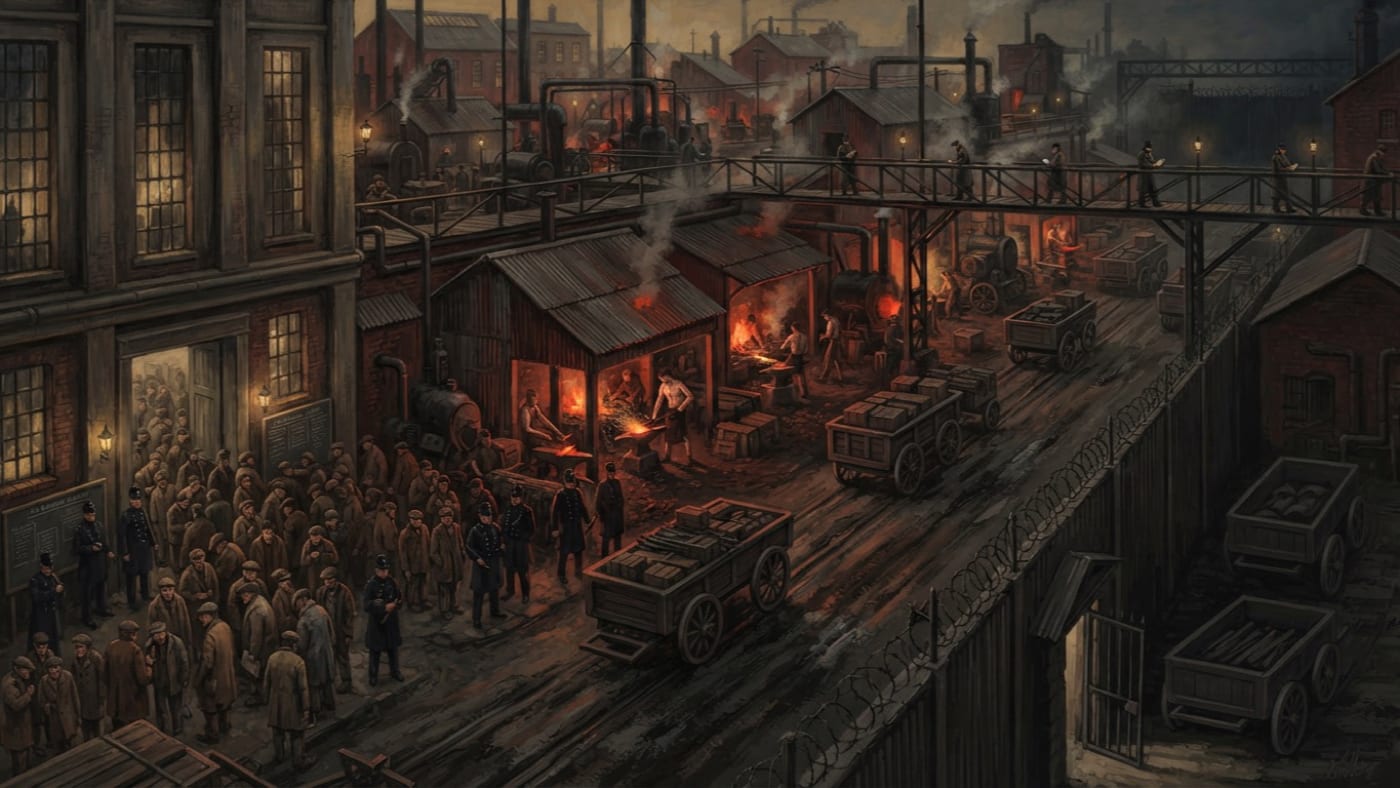
A traveller hears the Yards before he sees them. Carts grind through them at every hour the shutters allow. The noise carries far enough that it turns up in a courier dossier about quite different matters. At dusk the forges can be seen from the clerks' catwalk gantries as a low red row among the road's other lights. To the north are the soup fires and the lamps of the Hostel Ribbons. The Shed Wards give off smoke, and the marshals' lanterns in the Barricade Maze turn blue near an audit. South of the last fence there is no light at all. The Yards lie on the counted side of that dark, and their forges glow as if they want it known.
I give no street plan, no gate interval and no boundary. None has been surveyed to a standard I am willing to seal. A district can be stood in before it can be drawn, and on this road most people stand.
#On Axles, Oil and Metal
The road's lore lists cart repair among its main industries. It ranks the cartwright among its commonest trades, alongside the time clerk and the soup vendor. Oil is one of the road's imports. A visitor can establish everything else with his own boots. The ground in the Yards is black wherever it is not grey, and the grey is only black that has dried. Axle grease travels. It goes home on cuffs and palms, and it gets into the bread of anyone who eats with the hand he worked with. Along the whole road the cheap cups taste of metal. In the Yards nobody can tell whether the taste is coming from the cup.
The work is whatever a wheel demands: a cracked felloe, a split hub, an iron tyre loosened by sleet, an axle dry enough to scream. The Yards answer with heat, hammer and grease. I have no roster of the shops, and I will not invent one, or a price list, or a guild. I can find no special authority that the Directorate has given them. They answer to the road's general law, which means the bell, the stamp and the lane, the same as the Minute Market and everyone in it.
The Yards take their name from the two substances they handle.
Withdrawn. The record attests oil and metal. It attests grease by smell, and by every sleeve in the district. It attests no salt: none mined, sold, stored, spread on axles or rubbed into wounds. The name stands. Its first half is unexplained, and this office will not salt a ledger to flavour a title.
The road's lore also mentions theft in the Yards. In one place it mentions a hollow axle used for smuggling. An axle can hold more than grease, and so can a confessional. I record the story as background and charge it to no particular yard, carter or load. Any Warden who wants to saw every axle on the Queue Road in half is welcome to apply for the saw. The application will be heard in its turn.
#On the Carter at the Commons
The documented link between the Yards and the rest of the road's labour is small and exact. A carter from the Salt and Grease Yards needs another pair of hands, so he goes to Gate Nine Commons to find them.
That is ordinary hire. I set it down plainly because the Commons is where plain things go to be misread. The hirer names the terms, and he pays in coin, ration chits or minute credits. The hired man loads and hauls. He holds a wheel steady while another man swears at it, and at curfew he goes home. Nobody stamps him into a category. Tomorrow he may be back in the chalk, waiting to be picked by a fence crew or a copyshop on Clerk's Mile.
The record does not say that every yard hand comes from the Commons, or that every carter hires there. It does not say the Yards stand beside the Commons. A carter with a nephew hires the nephew. I record one road and one errand, and I leave the rest of the district's hiring to the carters, who have not asked my opinion of it.
#On the Coats That Hiring Wears
Three other kinds of labour share the yard where the carter hires, and from a distance they dress alike.
Recruitment posts its "employment drives" on the gate-timbers. Some of them offer honest work at vague wages. Some are draft sweeps. A recruit finds out which kind he joined when the fence closes behind him and a clerk hands him a Throughput Assignment where his wage should be. Compulsory queue service is assigned by form and enforced by baton. The last kind, conscription for minute debt, has to be stated precisely, because the road profits from travellers who confuse it with the rest.
In the minute economy, waiting earns credit. The credit is recorded by bell-mark, and a traveller may hold it or sell it. Debt is a separate account. It is entered against a traveller for a missed bell-mark, a failed audit, a wrong lane or any penalty a clerk has priced, and it compounds. The two columns never cancel each other. If the debt goes unpaid, Gate Nine, the road's final and largest court, converts it into labour or into erasure. No published table gives the conversion rate or the length of the labour. I have asked for both. My requests are standing correct somewhere, waiting to be named.
The Yards need hands, and hands on this road arrive through more than one ledger. I have no record that puts debt conscripts in any yard shop, and none that rules them out. My duty is to keep the columns apart. A reader who cannot tell a hired hand from an assigned one at forty paces is in the same position as the hired hand himself, standing in the chalk. That is the purpose of the arrangement.
#On the Fence South and the Year Before
Not every cart on the road is a yard cart. The Null Verge Custodians drive theirs at night without lamps. They collect the sick, the dead and the inconvenient from the unregistered margin beyond the last fence, where the Null Verge keeps its blank tags. I have no evidence that their carts are built or mended in the Yards, that yard carters drive them, or that any erased hand works a yard forge. The difference in legal standing is total. When a yard carter's wheel squeals, it squeals inside the census. A Custodian's cart passes under a stamp that names no bureau, and nobody asks it to squeal at all.
The year before this compilation put pressure on the whole road. In the spring of A.S. 200, minute prices doubled without any published decree, and Director Vell offered no explanation. That autumn Gate Nine closed for sanitation. Within three days the dead were piling up in the Barricade Maze faster than they could be carted away. Debts kept compounding every day the court stayed shut, and the Commons had nowhere to take a payment. I cannot say what any of this did to the Yards in particular. I hold no closure order for them, no casualty count and no rate. I note only that the road measured its crisis by how fast the carts moved, and the Yards are the place that keeps carts able to move at all.
#On the Present Compilation
As of A.S. 201 the Salt and Grease Yards are working. The carts grind. The forges show at dusk. Grease leaves the district on every sleeve that comes into it. A carter who needs hands still walks to the Commons, and the man he hires still goes home at curfew, provided the man was hired.