

ink tax (n.): bribes to clerks. Street usage. — Queue Road glossary of the lanes
#On the Mile in the Present Record
This compilation is a documentary survey of Clerk's Mile, assembled for the Bureau of Doctrine in A.S. 201, the present year, from the files this office is allowed to read. It certifies no boundary and reports no inspection. It is a reading of papers about a district that lives by making papers, and it claims no more authority than that.
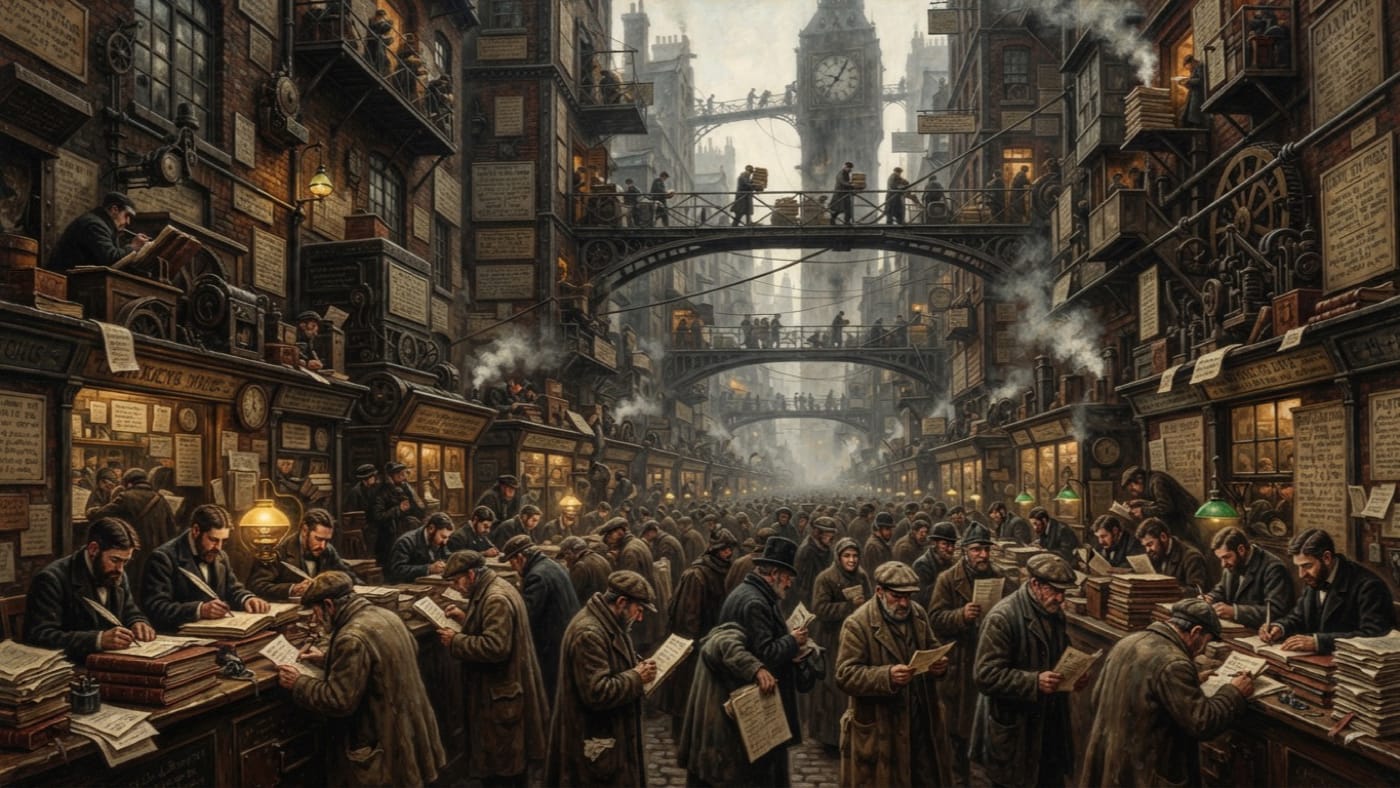
Clerk's Mile is a ribbon-district of the Queue Road, a strip of scribes, notaries and copyshops along the road's flank. The air carries ink and vinegar. Every traveller who means to pass a gate needs an entry the gate will accept, and Clerk's Mile is where such entries are written, copied, corrected, notarised, mislaid and found again. Its counters face the lanes. Its customers come up holding their papers in both hands, the way men carry the last warm thing they own.
The damp paper, the stamp-clicks, the bells, the broth-steam, the shutters and the queues belong to the whole artery. So do the clerks who cross above the travellers on catwalks while the lanes below barely move. The Mile has them because the road has them. I assign them to no particular shop.
The name promises a measurement and supplies none. No survey within this office's reach gives the district's length, its ends, its founding or a census of its own. The road's hundred and twelve miles and forty-eight thousand registered residents are figures for the whole road, and I will not divide them by guesswork to manufacture a Mile. The account of the Barricade Maze places that labyrinth between the Minute Market and Clerk's Mile. That sentence describes the Maze's neighbours and is no survey of the Mile. The Maze's limits, Gates Three to Five, belong to the Maze. "Mile" is what the road calls this place. The record does not say whether anyone ever paced it.
#On the Copyshops and Their Hands
The road's lore lists the copyshops among its gathering places, with the hostel steps, the Minute Market and Gate Nine Commons. The reason is plain once one has stood in the lanes. A copyist's counter has a lamp, the lamp is better than the sky, and the talk around it concerns the road's only subject: whether one's paper will stand. A man who cannot pay for a bunk can still stand near a counter. A woman waiting on a docket can learn there, for nothing, how other dockets have fared. The shop sells its work. The rumours come free.
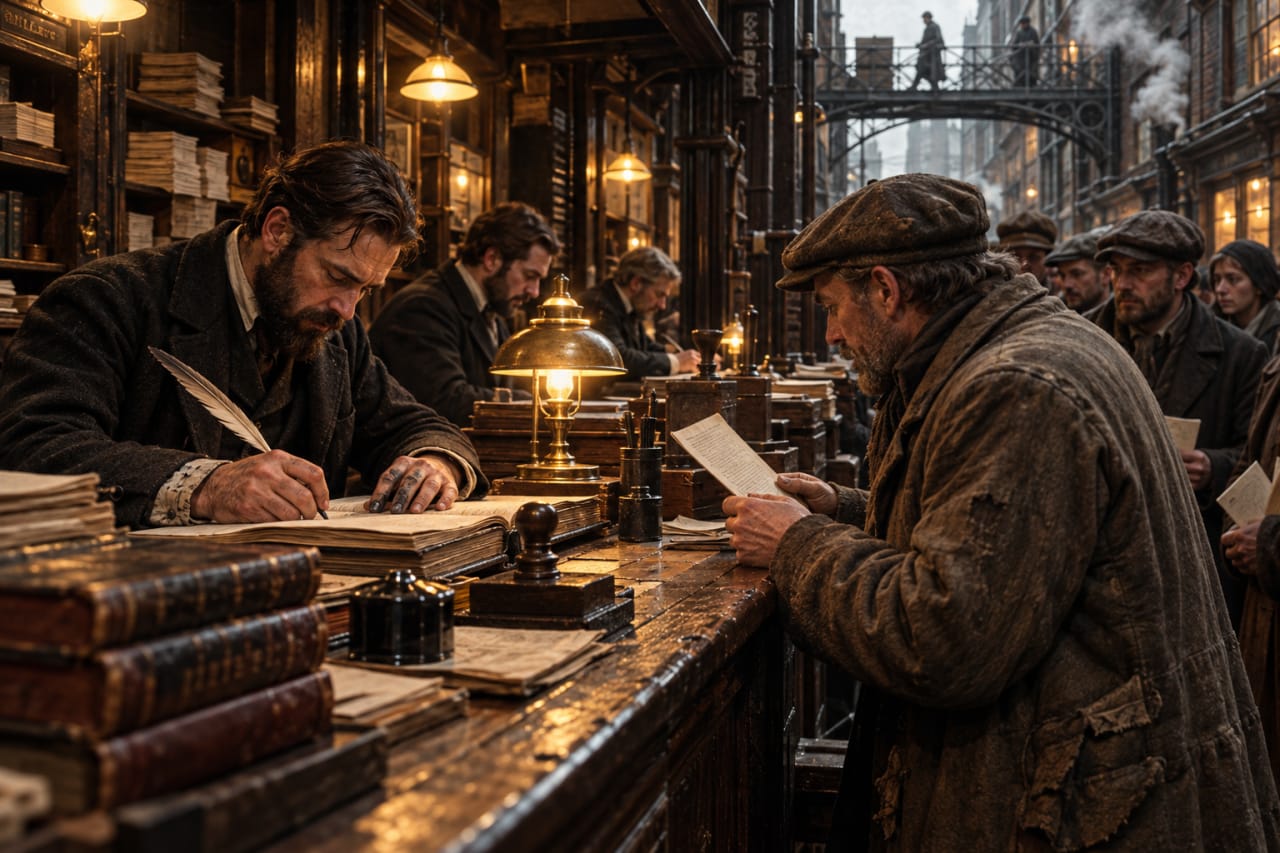
The work is skilled. I say so plainly, because my office employs the same skill and would think less of itself if I pretended otherwise. A Minute Permit must be copied fair, without smear, in a hand the next gate will not question. An Appeal Docket must be drawn in a form Gate Nine Court will consent to hear. A declaration must be notarised so that an absent person's word becomes present enough to file. A bad hand can ruin a traveller. A good hand is worth more to the road than a mule, and it is fed better.
Time clerks are known by their ink-grey cuffs, and travellers learn to look at the cuff before the face. The Collegium's roll, as far as this office has seen it, names one copyist below the Clerk-Prime: Scribe Mara Lint, whose nails are stained to the quick. Her biography, her desk and her dealings appear in none of the files I have read, and I add nothing to them. I record her nails because they are recorded. They are the most honest document in the district: ink worked past any scrubbing into the hand that laid it down.
The Mile keeps the road's hours. At dawn the roll is called, and the first papers come down from the Bell-Mark Gantry with the mark still fresh. Midday is for appeals and runners; the catwalks carry men in a hurry over men who have learned not to be. At curfew the shutters come down. The night belongs to the shadow queues and the culverts, and to audits, which the road describes, with a brevity I envy, as rare and lethal.
The man behind the counter does not live as the man in front of it does. The guild clerk draws a steady ration and, since A.S. 187, an additional soup ration by right. He crosses the road by iron. His own entry is recognised; his standing does not hang on the next window. The traveller's does. Once a traveller's minutes fail, the road lists the ways his debt is paid: hauling barricades, cleaning latrines, copying ledgers until the fingers bleed. The craft is the same craft, with the same quill and the same vinegar in the ink. The clerk in grey cuffs and the debtor at the ledger could exchange pens and no page would notice. One is paid in standing. The other is paying for having lost it.
#On Entries That the Gates Accept
There are three powers on the Queue Road, and Clerk's Mile seats only one. The Synod Permit Directorate sets the price of a minute and holds the gates. Gate Nine Court hears appeals and turns unpaid debt into administrative consequence. The Time Clerks' Collegium, whose territory is this district, keeps the working entries on which both price and verdict depend. The Directorate's master ledger stays at Directorate House, in the Directorate's own custody. The Mile has never held it. The Mile holds the books required to agree with it.
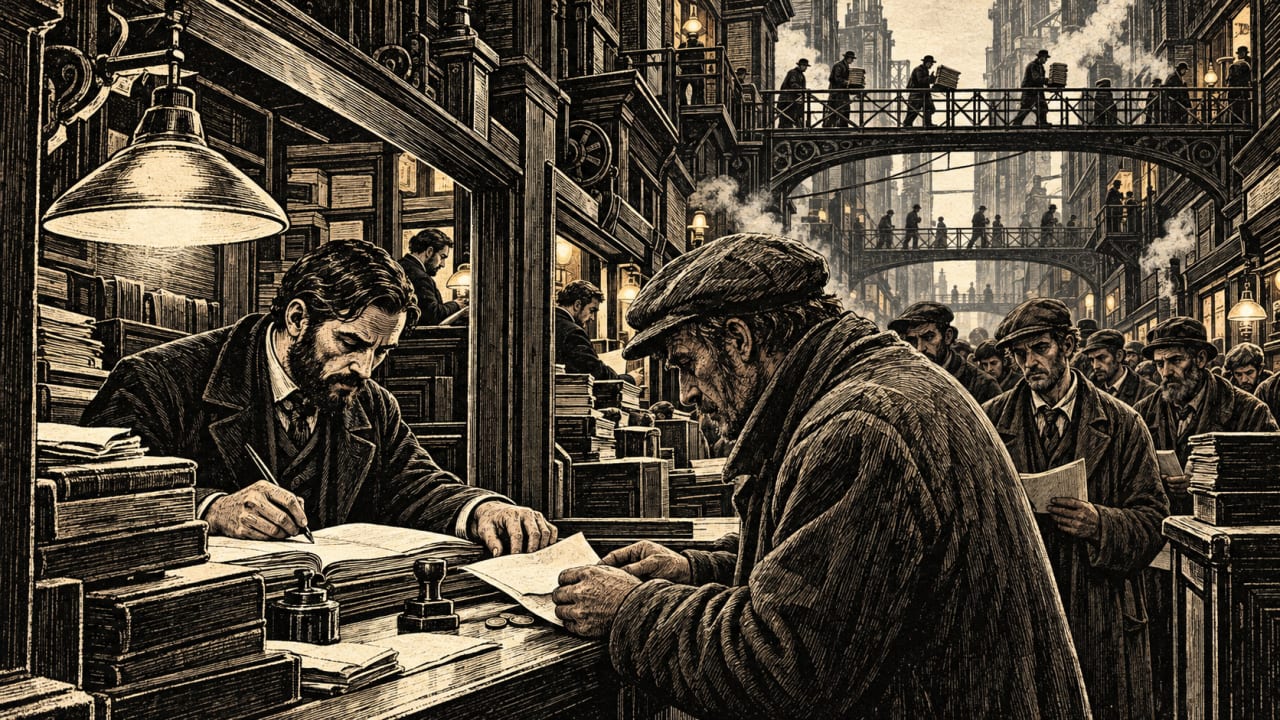
The account opens at the Third Gate, where the Gantry's bell-mark stamps the traveller's paper with the hour and every minute from that mark to clearance is entered as waiting. Recorded waiting is money. It trades upward as minute credits: fresh minutes fetch a premium, while minutes flagged for audit or near expiry sell cheap. The papers that carry a traveller through this arithmetic are named in the record: the Minute Permit, the Bell-Mark Slip, the Lane Reclass Token, the Appeal Docket and the Witness Certificate. Each must pass a clerk's hand before it becomes a fact.
I decline to describe their appearance. This survey has seen no specimen it may reproduce, and a codex that printed a permit's layout would be a forger's primer under a Bureau seal.
The clerk's power lies in that hand. A clerk's error can add a day to a transit; a clerk's favour can take one away. The street calls the fee for the second ink tax. The window calls the product a corrected entry. An Appeal Docket thought lost proves to have been filed under the right name all along. A Lane Reclass Token is approved on the second asking. A Minute Permit is reissued in a cleaner hand. Nothing is spoken aloud. All of it is written down.
The road keeps the account of failure. A missed mark or a failed audit leaves minutes owing, and owed minutes compound. The debt grows down the road until Gate Nine converts it into forced labour or erasure to the Null Verge. No copyist in Clerk's Mile converts anyone. He writes the line Gate Nine reads later, and he goes home by the catwalk before it is read.
#On the Privileges Won by Stopped Hands
In A.S. 187 the Collegium stopped stamping. For three days no mark was entered, and the road, which depends entirely on marks, stopped with it. Traffic backed up toward the Rhine corridor, the artery between Rheinscarp and the forward depots of the Sagittal Line, clamped shut from the clerical end. The Directorate conceded within a week. I keep the two numbers apart, as the Collegium's own account does: three days of stopped ink, and a week before the Directorate admitted what the ink was worth.
The terms were modest: immunity from audit, an additional soup ration and recognition of the guild's feast day. All three were granted. No record names who called the stoppage or who carried the terms to Directorate House. The modesty was a calculated insult. A guild holding the war's supply road by the throat asked for soup, got soup, and has eaten that receipt every day since.
Clerk-Prime Yoren heads the Collegium at the present survey. His file does not record when he was appointed, nor whether he held office in A.S. 187, organised the stoppage or negotiated its end. This compilation will not give him a seat at that table after the fact. The strike belongs to the guild. A Clerk-Prime inherits its terms as every guild head inherits what his predecessors extorted.
Since A.S. 187, the Collegium's books have been the one set on the road that no outside hand may open, and the clerks who keep them share the books' protection.
Since A.S. 187, the Collegium's books have been the one set on the road that no outside hand may open, and the clerks who keep them share the books' protection.
Corrected. The concession of A.S. 187 was immunity from audit, in the form granted by the Directorate. No instrument this office has read extends it to the clerks' persons, binds a visiting Inquisitor, or shuts out every authority on the road. The sentence struck above was oratory, and the record does not support it.
The record that supplies the correction comes from A.S. 200. A visiting Inquisitor subpoenaed three Collegium clerks to testify. Before the testimony, all three vanished from the Collegium's roster. The Directorate filed the absence as voluntary reassignment. The families received compensation in minute credits, which every account calls generous. That is the whole public account: no names, no destination, no responsible hand, no fate. The same year saw minute prices double in spring and Gate Nine close for sanitation in autumn. Nothing I have read places the three clerks within that sequence, and I will not place them there.
Whether a subpoena counts as an audit is a question no tribunal on the road has answered. I issue no ruling, and none of the files I have read contains one; a visiting Inquisitor's jurisdiction is a matter for a higher seal than mine. What the roster shows is narrower. A guild that won its privileges by withholding ink lost three members by means of ink. A roster line was written out, or a written line was allowed to stand, and the hand that did it appears nowhere I have been permitted to look.
#On Corrected Papers and Counterfeit Ones
A corrected entry made in the proper cuffs is a service. The same entry made in a cellar is a crime. The ink is mostly the same ink.
The road's black market, its lore says, lives under Clerk's Mile and in the culverts. Its named products are forged bell-marks, lane tokens, "fresh minutes" and identity overlays. Cellar wax has been improved past the Candlewick Palatinate's own, so that counterfeit seals have passed Directorate examination. A forged permit bearing a genuine, stolen Directorate seal is called a ghost pass. One thing the market cannot sell is a true Directorate master seal. The lore draws that limit, and I keep to it. A thief can steal an impression, never the authority that made it.
The Gantry's own account gives the most elegant example. It restricts the Bell-Mark Slip to papers that cannot safely be handled from below: fever cases, corpse escorts, sealed military packets. A Slip carries the Gantry's authority without the original paper, which makes it portable, expensive and beloved of forgers. According to that account, Clerk's Mile produced counterfeit Slips so fine that Directorate auditors accepted them, framed them as exemplars, and then condemned the frame-maker once the fraud became public. The forger is not named. The frame-maker was within reach, and Directorate justice has always preferred whoever is within reach.
None of this proves that every shop in the Mile forges, or that the Collegium owns the cellars. No record I have read establishes either. The cellars work a short walk from the guild's windows, and they would starve the day the guild's books stopped being believed. That is the whole of the proven relationship.
The neighbouring trades feed the same books from their own premises. The Witness Rental Houses of Stamp Court Row rent Witness Certificates that stretch a minute claim over hours nobody stood. "Hatch" Lyd's Runner Union sells unofficial passage and black-market timestamps. Neither has its seat in Clerk's Mile, and I allege no single conspiracy. A rented witness, a runner's stamp and a corrected docket can meet on one traveller's paper without their makers ever having met.
The identity overlay is the cellar's worst product, because the road loses identities without help. Among the three candidate registrations for the culvert preacher Brother Senn is Sennard of Mile Forty-Two, a copy-boy lost from Clerk's Mile in A.S. 184. Purity favours that candidate; Records favours another; this office confirms none. I cite the entry for what it proves: a boy could be lost from this district, and his name survive him in a file without anyone able to say whose name it now is.
#On the Present Work
The Mile in A.S. 201 still keeps its windows open. In the spring of A.S. 200, minute prices doubled without decree, and whenever a minute's price rises, a clerk's pause is worth more. Each corrected entry now saves more, so it costs more. The guild has always feared the anti-corruption raid above every other pressure, because a ledger that outsiders read stops being a weapon and becomes evidence. The autumn closure of Gate Nine backed up the whole road, and the papers that came out of it were stained, late and contested. Somebody had to copy them fair.
The hours themselves have become a problem for the trade. The Minute Drift was formally classified in A.S. 194 as a Category Two Localized Temporal-Scribal Disturbance, first attested in the Maze and later at the Gantry and other sites on the road. The Gantry's clerks have seen duplicate marks and future stamps, and its supervisors have confiscated those cards from their own staff. Clerk's Mile handles the paper that survives the confiscations. Such papers reach its counters, and accounts of the disturbance circulate in its shops with the rest of the road's talk. This office has no rule telling a copyist what to do with a paper whose mark falls after the hour of copying, and the guild's public claim of accurate records supplies none.
I find no evidence that the clerks of the Mile command the Drift, understand it, or keep it in their shops. I have seen it written that the clerks "control reality." The phrase describes administrative acceptance, meaning the version of events a gate will read. Read any other way it is superstition, and the Bureau of Rites may keep it. When a traveller's body says a week has passed and his paper says a day, the gate reads the paper. That is how Clerk's Mile has always worked, and it is more frightening than any prodigy the Rites could file.
The Unstruck chalk their maxim on the road's posts, though no file I have read puts the chalk on these counters: no bell owns the hour. Clerk's Mile has never claimed to own one. It owns the entry stating that the hour occurred, and on this road that entry has always been the larger estate.
Clerk-Prime Yoren keeps the working books. The Directorate keeps its master ledger at Directorate House. Scribe Mara Lint's nails keep their ink. Three families keep their minute credits. The roster does not record three clerks, and this compilation does not record where they went.