

I checked the continuity file, style guides and Queue Road lore; the generation-hold marker file is absent. The article follows.
#On Residence Beside the Queue
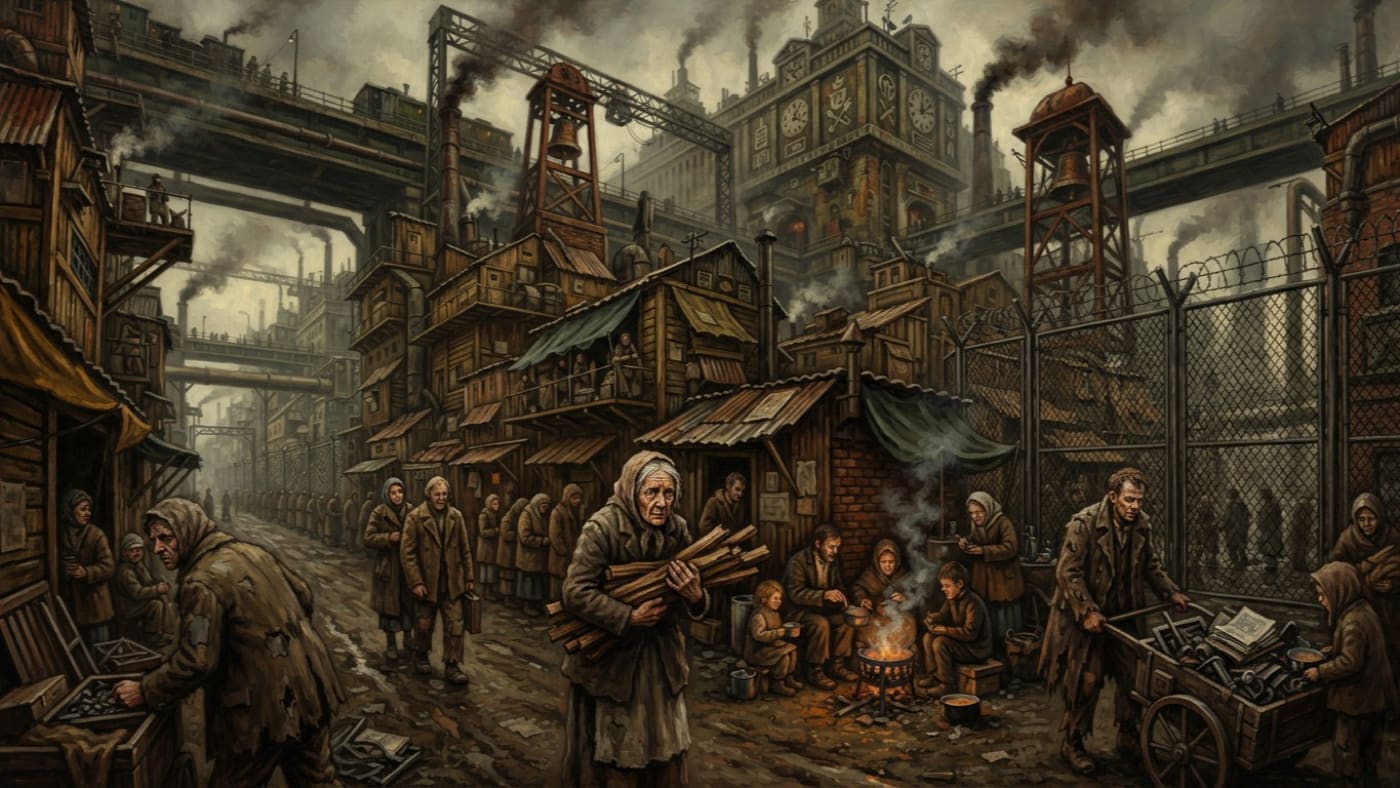
Every district of the Queue Road is named for what passes through it. Minute Market feeds the people waiting in line, Clerk's Mile copies their papers, and the Hostel Ribbons rent them sleep by the hour and wake them when the hour is spent. The Shed Wards are named for what stays.
They house the road's long-term residents: households that stopped arriving and began living. They live in sheds of stamped timber and salvaged board, in the ribbon settlements that flank the gate corridor, below the clerks' catwalks and within earshot of the dawn bell. Elsewhere the road smells of something being processed: hot wax at Stamp Court Row, vinegar ink along Clerk's Mile, wet wood and fear in the Barricade Maze. The Wards smell of smoke and cabbage. They smell of supper.
The Directorate's own class table puts residents of the Shed Wards fifth of six. They rank beneath runners and fixers and above the erased of the Null Verge, and the table gives them two verbs: survive, stagnate. I admire the economy. Few institutions can write a district's epitaph in a class column while the district is still cooking dinner.
No record that I can reach says when the first shed went up, who held the ground, or why any particular family stayed. In the Church a missing charter means either that nobody founded the place or that somebody would prefer not to have. I incline to the first. People waited long enough, and a long enough wait becomes an address.
The road's code of hospitality holds here as everywhere along the line. You offer the stranger shade and water. You never tell them they will be through soon. In the Wards that promise counts as a curse twice over, because everyone living in a shed was told it once.
#On the Household Account
The day begins with the bell-mark. A resident who wants to stay lawful goes to dawn roll call, takes a stamp, and starts the day already owing something to it. The soup fires are lit afterward, by whoever is still at home.
A Shed Wards household keeps its accounts in two places. One is the Directorate's ledger, where every bell-mark becomes minutes. Each minute becomes either credit, which is sold upward to the traffic that can afford to move, or debt, which compounds downward on the household that cannot. The other is a tin, a cloth fold or a box beneath the bed-board, wherever the family can keep its papers dry. Damp is the road's most patient auditor. A permit that mildews has to be reissued, and getting it reissued means joining a queue.
Work is whatever the road pays for that week. Residents copy at Clerk's Mile until their fingers cramp, run permits for the courier lanes, ladle broth in the Minute Market and patch axles in the Salt & Grease Yards. They also mend the fence lanes that hem them in, for wages, which is a joke the Directorate has never noticed it is telling. No ledger I have read gives the Wards a trade of their own. They supply the road with hands, just as they supply it with waiting.
Supper is thin broth, hard bread, pickled scraps and the cabbage. Ration chits buy what coin will not. Meat comes about once a week, when it comes at all.
A neighbour who will swear to your hour is worth more than bread. The courts know this, so testimony is rented along the whole road at a price. The Wards keep the older proverb: witnesses don't remember; witnesses invoice. They also keep the older practice of remembering anyway, without being paid, which the courts regard as a form of unlicensed trade.
Curfew locks the fences. Patrols squeeze the lanes, and the Wards draw in around their fires. When a household's minute debt outgrows the household, the Directorate converts it. Those who can haul are sent to labour at Gate Nine. Those the ledger no longer wishes to know are sent to the Null Verge. Every family in the Wards lives one bad winter above the bottom rung, and every family knows how the rung below smells: of nothing at all, because the Null Verge has no cooking and no lanterns.
#On Bodies That Outrun Their Papers
The Wards have always been hard on bodies. Cold gets into the boards, smoke gets into the lungs, and broth this thin leaves its mark on the jaw. A clerk who wants to dismiss a complaint has a hundred honest explanations ready: hunger, exposure, exhaustion, queue fever. All of them are true often enough. The residents know what hunger does to a face, because they have watched it for years. That is why their complaint carries weight. They can tell the difference.
The best-attested case is a woman of the Shed Wards. The record gives no name and I will not supply one. It gives no number for her age, no trade, no physician's opinion and no outcome. It says only this: she arrived in A.S. 198, and by A.S. 201 she looked twenty years older than her papers declared.
The arrival year is a date on a permit. It does not mark when the change began. The record does not say when her face first parted company with her documents, how fast the change ran, or whether it was steady. It says that her neighbours noticed and her family noticed. It also says the Directorate did not, because her minute account was balanced.
The ledger accepts a stamp as evidence, but it has no place for a face. A woman can outrun her papers by twenty years and leave no trace in the one book the road consults, since the book records her waiting and has no interest in her ageing. Her family can swear to it, and the swearing earns them nothing. To the Directorate the body counts as testimony, and on the Queue Road testimony is something you pay for.
The Minute Drift is confined to the Barricade Maze between Gates Three and Five; the residential districts of the Queue Road lie outside its effect.
Withdrawn. This Bureau's own notice on the Minute Drift lists the Shed Wards among the confirmed expansions. The Maze has not grown. What counts as "inside" it has.
The Drift was first classified in A.S. 194, in the Maze. In the spring of A.S. 200 minute pricing doubled without any public decree, and the anomaly spread. Each new site behaved differently, and the record keeps them apart. At Gate Two Bridge Pinch, shadows began to fall before their owners crossed the planks. At the Bell-Mark Gantry, papers came out stamped with times that made the clerks flinch. In the Shed Wards, people aged wrongly.
Regional reports from the wider Drift describe whitening hair, splitting nails, wounds that close too fast, hunger that arrives late or twice, and intervals that go missing altogether. These are observations from along the road. None of them is attached to her in the record, and I will not attach them to her. Nor is every tired resident a temporal casualty. Some are simply poor, and poverty on the Queue Road needs no anomaly to do its work.
#On the Unstruck and Their Interference
A household that has watched one of its own outrun her papers will listen to a sentence it would once have reported. The Clock Heretics, whom the road calls the Unstruck, have such a sentence: No bell owns the hour. Brother Senn preaches it from culvert chapels beneath the Barricade Maze. The Second Drain Chapel lies there and not in the Wards, so anyone from a shed who goes to hear him must walk the lanes and get home before the fences lock.
Some go. As the Wards aged, records along the road show more interest in the congregation, more chalk and more quiet questions about where the chapel could be found. Most residents still take the dawn stamp and keep their papers dry. Heresy requires a free evening, and the Wards have very few.
The Unstruck do not cure anything. Their cut lane ropes, misaligned stamp windows and off-beat hymns give back no years and protect nobody by any reliable method. Still, sealed correlations from A.S. 200 tie their interference to falling extraction volatility along the road. The volatility in question comes from the Apparatus beneath Gate Nine, a wheel that responds to throughput. That wheel lies under Gate Nine, nowhere near the Wards. The archive says what it consumes. What it produces, and where that goes, the archive is careful not to say.
The Bureau of Purity pursues the Unstruck in public. It raids loudly, arrives late and makes no martyrs. Someone above the Directorate prefers the heretics alive. The authorizing hand is not named in any paper I am cleared to quote. I can only say that it belongs to an office without a name.
#On the Present Condition
As of A.S. 201 the Shed Wards remain. The dawn bell still marks them, the soup fires are still lit after roll call, and papers still dry in tins beneath the bed-boards. The cabbage still boils. Some residents still copy, haul and mend fences. Others fall behind, and the Directorate converts them on schedule.
The woman continues to age. Her account continues to balance. The minute prices have not come down, the Drift has not been reclassified, and no decree has explained either. Collection along the Queue Road has not been interrupted once.
Her family keeps her papers with the rest. The papers have not changed.