

#On the Paper Raised at Dawn
Compiled in A.S. 201 for the Bureau of Doctrine from Directorate notices, Collegium extracts and Gate Nine dockets. A.S. 201 is the date of this compilation. The economy it describes is older, and has never asked to be dated.
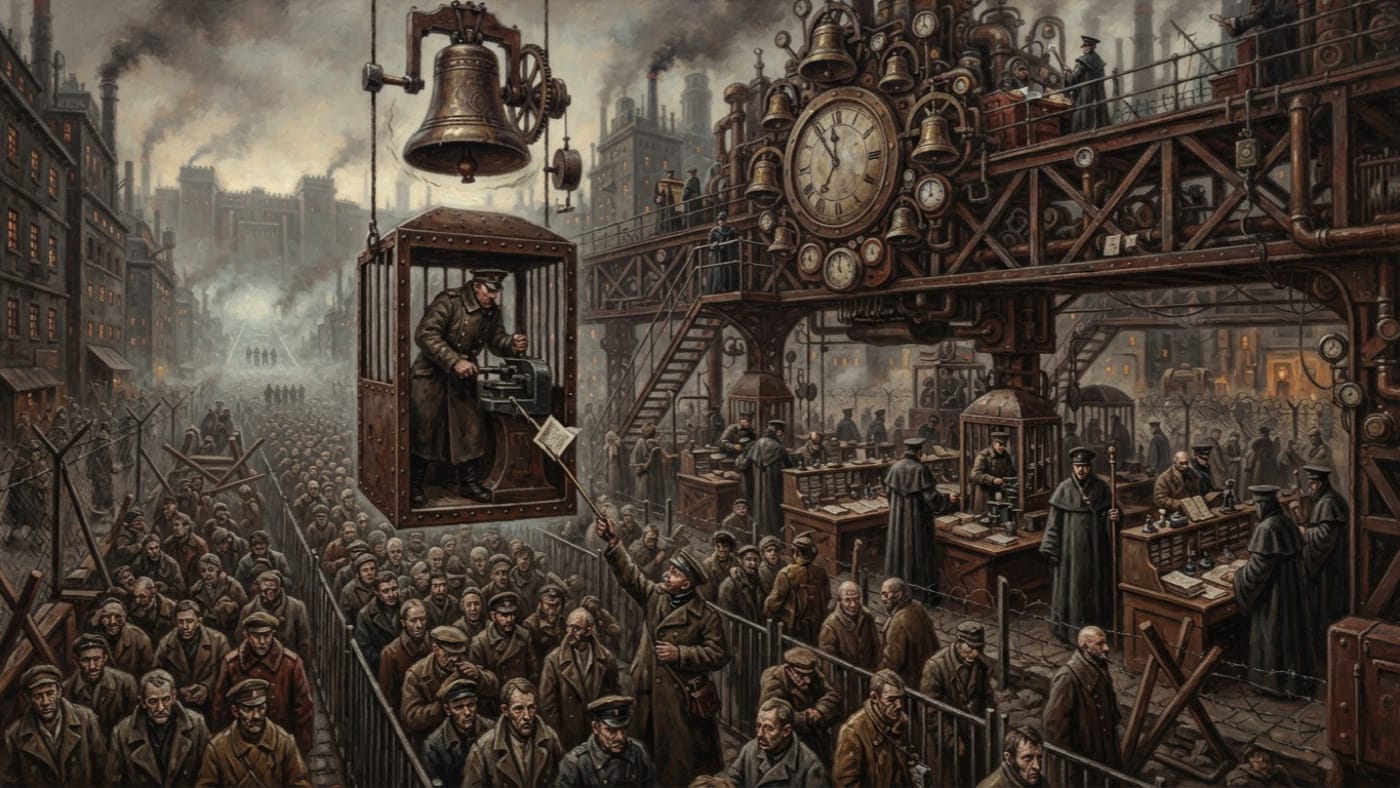
At first light on the Queue Road a traveller hooks a permit to the end of a lane warden's pole and lifts it toward the iron. A stamp clerk in a cage on the Bell-Mark Gantry brings his press down. A bell strikes above the cage. The paper comes back down to the traveller wearing a mark no bigger than a thumbnail, and from that mark the traveller has an account.
The minute economy is the arrangement by which waiting on the Road is recorded, credited, sold, penalised and appealed. Its subjects are everyone in the lane. The people it favours are fewer: Directorate officials who move above the line, and licensed traders who buy minutes so that they spend less time in it. The Road's motto is Stand correct. Move when named. The economy's job is to decide who gets named.
#On the Origin
The economy began with a crush. In A.S. 97 a false rumour of plague at the Latch River ford set off a merchant panic and a surge that lasted a week. Three thousand died in the press, and more died of the fevers afterwards. Records filed the dead as weather-related traffic casualties. The Bureau of War responded with gates.
The Synod Permit Directorate was constituted in A.S. 102 on a joint writ bearing the seals of Records and War. Its stated mandate was orderly throughput. Minute pricing began two years later, in A.S. 104, without much announcement. By A.S. 110, when the First Continental Levy began sending bodies east in batches, pricing had become policy. The record supports this much: the crush came first, then the Directorate, then the price, then the policy.
The iron came later. Directorate maintenance rolls put the Gantry's first iron frame on the Third Gate span in A.S. 111. Records holds a receipt dated A.S. 109. I give both dates and choose neither. The disagreement concerns the age of one frame. It does not date the economy, which was charging for waiting before anyone riveted a cage to hold the clerk.
#On the Substance of the Transaction
There are four steps, and the order matters.
The mark comes first. The bell-mark stamps the paper with the hour, opens the minute account and puts the bearer on record as waiting lawfully. Forging a bell-mark is one of the Road's red lines. The Road kills forgers sooner than it kills almost anyone else, which tells you how much the mark is worth.
The credit comes second. Waiting that the ledger accepts as eligible earns minute credit. The documents in my possession do not set out the eligibility rules, and I will not write a set for them. The street speaks of fresh minutes, meaning newly earned credit, and stale minutes, meaning credit flagged for audit. So not every credited minute is equally safe to hold.
The purchase comes third. Minute credits can be traded, and a merchant can buy another person's credits to get through the gates sooner. Picture a carter in his fourth day at the fence lanes. He has credit and no bread. A trader with a convoy behind him has bread and no patience. They make the exchange, the ledger records it, and the trader is named and moves forward. The carter keeps the bread and his place in the line.
The passage comes last, for the buyer.
Credit and debt are separate entries. A man does not fall into debt just by standing. Minute debt comes from specific failures: a missed mark, a failed audit, a penalty, or a lane classification that goes against him. Debt compounds. Unpaid debt turns into compulsory labour at Gate Nine, or into erasure to the Null Verge, where the people are erased from the census but still breathing. Labour means hauling barricades, cleaning latrines, or copying ledgers until the fingers bleed. Erasure has fewer steps.
Permits on the Queue Road are priced in minutes, not coin.
Corrected. The Road's own schedule of payment lists minutes waited as the primary tariff, coin as secondary, labour-hours as penalty and confession as appeal currency. Coin still circulates on the Road, ranked below minutes. Labour-hours and confessions are separate obligations, and none of the three should be filed as minute credit.
#On the Division of Offices
The economy has three keepers, and none of them would care to be mistaken for another.
The Permit Directorate sets the prices. Director Othmar Vell sets the minute price bands from Directorate House, which smells of clean stone and cold incense and is said to hold a master ledger that nobody below it has seen. The Road updates its minute valuations daily. Where those valuations come from is written down in documents that are not for sale.
The Time Clerks' Collegium keeps the books. Clerk-Prime Yoren's guild works from Clerk's Mile. Publicly it promises accurate records. In practice it protects clerk immunity and takes a cut of the minutes, and its weapons are paperwork, slowdown strikes and well-placed "errors." A clerk who misreads a paper at the Gantry can cost a traveller a day before any court hears the case. The Road has a name for the fee that prevents this: ink tax.
Gate Nine Court hears appeals. Mistress-Court Sera Nox presides. Her instruments are the void mark, the mercy ruling and reclassification. The Court sets no rates and keeps no books. It decides what a person's paper means and then charges for the decision. Publicly it offers fair appeals. What it actually takes in is confessions and favours.
At Gate Nine, confession is how a petitioner pays for a lighter classification. A debtor who confesses may be classed as negligent instead of fraudulent, or sent to labour instead of the Verge. The confession booths stand beside the courts, and every admission is indexed by timestamp. A man's account this season can then be laid next to his account the next season, and any gap between them can be produced at whatever hour suits his creditor.
Testimony is supplied by an outside trade. The Witness Rental Houses of Stamp Court Row, of which Mother Venn and Garrik Two-Names run the largest, rent out coached witnesses who remember what the buyer needs remembered. A petitioner who cannot afford witnesses will meet one paid for by someone who can. The Road sums this up as witnesses don't remember; witnesses invoice.
#On the Controversies
In the spring of A.S. 200 minute prices doubled overnight. No decree was posted and no reason was given. That autumn Gate Nine closed for sanitation, and within three days bodies were piling up in the Barricade Maze. Those events are on record. Who ordered the doubling, and why, is not.
Some digests in circulation tie the doubling to an Engineering report of A.S. 199, usually called Report Three. One event came after the other. I hold no document showing that the first caused the second, and coming first in the calendar proves nothing about cause.
The Minute Drift was classified in A.S. 194. Inside the Maze, travellers report bells ringing twice, ink drying faster than it should, shadows lying at the wrong angle, and hunger that arrives late or not at all. Gantry clerks have reported duplicate marks and stamps dated in the future, and travellers have reported bodies that age faster than their papers say they should. These reports are documented. Nothing in them shows that a price band, a bell or a stamp controls the hour it records. A clerk can open an account. I have found no proof that he can make time pass any faster.
The Bureau of Engineering discovered an apparatus in the bedrock beneath the Gate Nine Hearing Hall in A.S. 178. That date records when it was found, not when it was built. The sealed reports place the device under the hall. They do not say what it produces, who maintains it, who benefits from it, or whether the Court above it knows any of this.
The Apparatus grinds waiting. This is the least foolish description available.
Withdrawn from this compilation. The sentence comes from the Hieromnemon's earlier tract on the Minute Drift and goes further than the documents it relied on. The phrase "the Gantry blesses the grain," from the Gantry tract, is withdrawn on the same grounds. The device's location and the year it was discovered are in the record. Its mechanism, purpose, output and masters are not.
Brother Senn has preached beneath the Maze since at least A.S. 194. He speaks for the Clock Heretics, called the Unstruck, and his doctrine is that no bell owns the hour. His followers tamper with bell schedules, sing out of step with the official beats, and cut lane ropes where the Drift is thickest. My dossier on him notes that observers have seen local surges ease after their interference. I record that as something observers reported. It has not been shown to be a working mechanism, and nobody should rely on it as a cure. The Bureau of Purity pursues Senn in public and leaves him alone in private. I find that easier to document than to explain.
#On the Present Application
As of this A.S. 201 compilation, the minute economy is still running. The Gantry still marks papers at dawn. The Collegium still keeps the books, and Gate Nine Court still sits. Hourglass observers watch the Gantry span, and auditors from Strasbourg pass through the Road more and more often. The Directorate's master ledger has not been produced for them. Credit is still sold, debt still compounds, and the Verge still receives the people it is sent.