

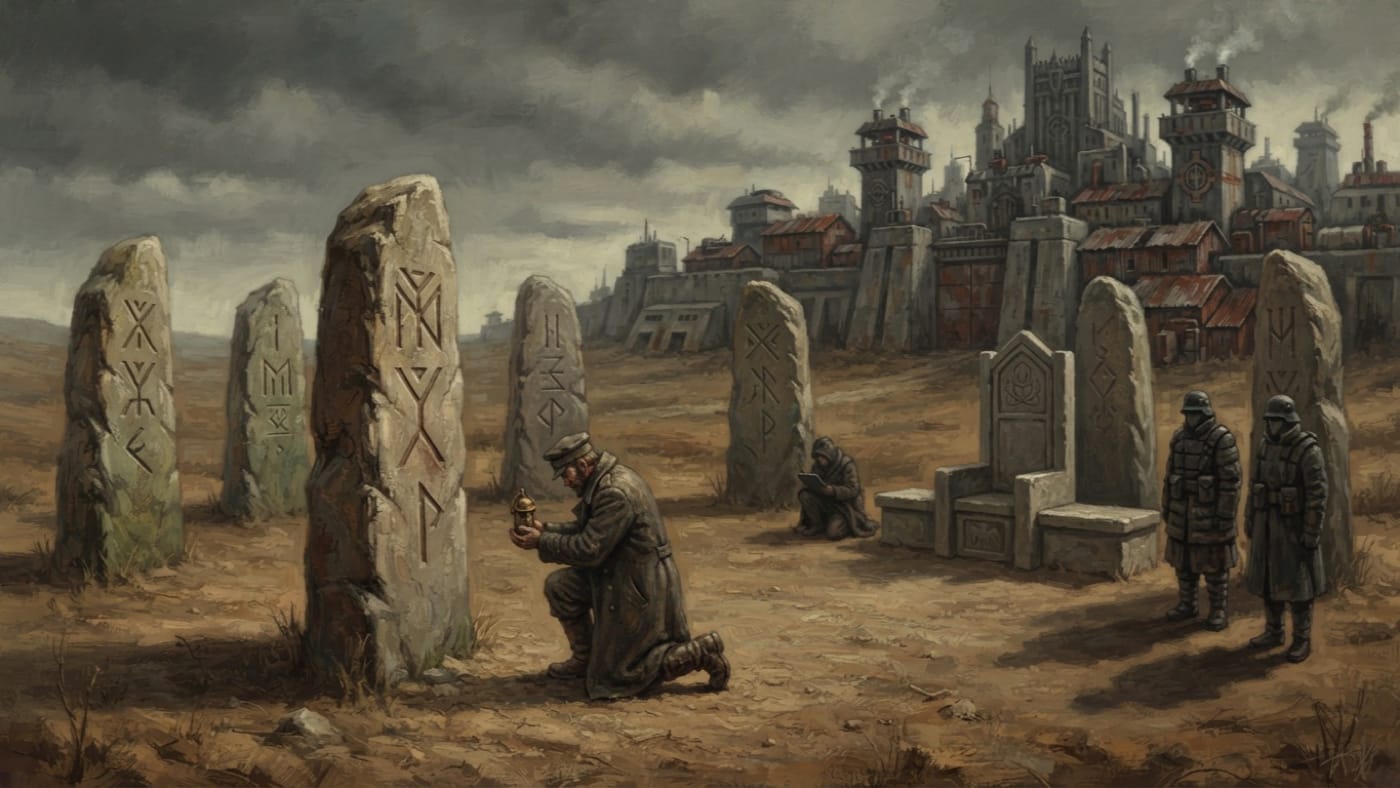
#On the Seventh Stone
The Seventh Stone stands in the Treaty Ring of the Steppe Gate with six siblings of the same wind-polished limestone. None of the Bureau surveys I have been shown records anything that sets it apart to the eye. Height, girth, emblem, compass bearing: the files say nothing. It is a white stone in a ring of white stones. The Moldavian wind comes through the cutbank gap and its carved clauses whisper, as they do on all seven, and the court of High Arbiter Senn Vark goes on beneath them like a congregation that stopped hearing the bells long ago and has never once stopped obeying them.
The Seventh Stone is set apart by two entries in my own dossier on Vark, and by nothing else on record. In the first, it recognizes a dead grandfather only by the least charitable of his three spellings. In the second, during my inspection of A.S. 201, it whispered a toll clause after adjournment while the High Arbiter moved his lips without sound. A theologian of lesser discipline would raise a cathedral on two entries. I am raising a chapel, and an audited one.
#On the Raising and the Register
The seven stones were raised together in A.S. 76 (1786 CE). The record attests that they were raised, and I chose that verb with care. Who quarried them, who carved them, and what older hand may have come before the chisel are questions the Bureau has declined to settle, and I decline to settle them on its behalf. Two years later, in A.S. 78 (1788 CE), the Bureau of Records registered the ring as the Windscript Treaty-Stone Border Compact, Administrative Node Seven. Raising and registration were separate acts. For two years the stones stood and spoke before any clerk agreed that they existed.
The seven in Node Seven is the number of an administrative node. It has nothing to do with the Seventh Stone, with the Seventh Vault of the Burnless Archive, or with the nine weights of Vark's bench. Pilgrims who lay these numbers out as omens on tavern tables should be fined for doing arithmetic without a licence.
Then there is the script. In A.S. 178 the Triune Alphabet was imposed by edict, one hundred and two years after the raising, and the letterforms on the stones turned out to resemble it closely enough to embarrass several committees. The Bureau of Doctrine calls the resemblance proleptic: the Creator's orthography arriving ahead of the Church's. I countersign that reading every quarter. Nobody has asked me whether I believe it. That is the courtesy the Bureau extends to its senior men.
#On the Grandfather's Name
My dossier gives the case one sentence, and I will give it no more flesh than it has. A caravan master promises grain and delivers salt. He swears by a grandfather whose baptismal name has been written three ways, and he discovers that the Seventh Stone recognizes only the least charitable of the three. I recorded no name, no docket, no year and no verdict. I recorded a predicament. It is the commonest predicament at the Gate, which makes it the most instructive.
Consider what the caravan master has sworn by. A dead man cannot amend his own spelling. One form was written by the parish clerk who baptized him, another by the toll register that taxed him, and a third by the family that loved him or needed his credit. Each form was a claim. The baptismal spelling claimed his soul for the Church. The register's spelling claimed his debts for the Treaty Office. The family's spelling claimed his good name, and at the Gate a good name comes with a price. When the grandson calls on the old man under oath, he does not get to choose which grandfather answers. The Stone chooses.
Least charitable is my phrase. The Stone has never been deposed on the subject of the dead man's virtue. It recognizes a spelling. Whether it prefers the harshest form, or simply the form least convenient to the man swearing, is a question for Doctrine, which enjoys such questions and bills for them.
Every caravan master with any sense has learned the practical lesson. Before swearing by an ancestor at the Gate, he pays a translator-scribe to find out which spelling the ring will hear, a seal-caster to stamp the finding, and a witness to remember that it was paid for. The grandfather becomes a line item, and his three names become three fees.
#On the Price of Being Heard
Vark pronounces which clause binds. The stones decide whether he has pronounced it cleanly. Every other institution at the Gate lives in the space between those two acts.
Vark has not spoken an unwitnessed sentence since the first sworn notice of his discipline in A.S. 171, which makes thirty years by the present count. His precedent books are sold openly in the Scribe Bazaar. The expensive copies carry his pronunciation marks, his witness formulas, and a red caution glyph beside each clause whose enforcement has already drawn blood. A caravan master who cites Vark has accepted Vark's reading. A caravan master who swears by an ancestor before the Seventh Stone without that reading has accepted something worse, and nobody has ever printed a price list for it.
The rest of the bill is collected by the town's three powers. The Treaty Office issues the pronunciation certificate. The Caravan Court fixes the clause. Patrol Command, under Captain Rho Balesh, holds the chokepoints where an uncertified tongue is turned back into the dust. Seal-Mistress Ylena Korr sits on the stamping bottleneck, and the Seal-House Consortium holds that no finding counts as a finding until wax has touched it. Translator, witness, seal, passage paper, certificate: each one is a door the poor cannot afford to knock on.
The Gate's official line is that the treaty protects the weak. The streets say it protects the literate. Both are wrong. It protects whoever can pay to have the right spelling of his own grandfather established before the wind gets to it.
#On the Clauses That Outrank Their Readers
The reason for all this caution belongs to another stone. In A.S. 94 (1804 CE), during the Red Pronunciation, Arbiter J. Sarn misread a binding term on the Third Treaty-Stone, and roughly a thousand throats closed in one night. Since then the Gate has spoken like a man handling relic acid. The clause-spirits that enforce mispronounced terms show themselves in reported effects only: a tightening throat, ink running from the ears, paper edges that cut, and corrections that appear on documents nobody has touched. No account I have read pins a spirit to the Seventh Stone in particular. The wind has no favourites. It does have a jurisdiction.
Bureau of Doctrine initial return on the Red Pronunciation, A.S. 94: approximately one hundred dead.
Corrected by Bureau erratum, A.S. 95: approximately one thousand. The first figure counted bodies that could be classified. The second counted bodies.
Since A.S. 194 the Archive has been producing Living Addenda: wet-ink amendments written by no living hand, carrying correct seals and correct form. Vark's Ruling 201-Blue/17 holds that review suspends enforcement only when the reviewing authority outranks the instrument under review. The Caravan Court does not outrank the Treaty. None of the addenda I was shown amends the Seventh Stone's text. I note that only so the reader understands how little that observation protects anyone. If such an addendum came, it would bind, Vark would invoice it, and the Stone would whisper whatever it now says.
#On the Toll After Adjournment
In A.S. 201, during my last doctrinal inspection, I watched Vark sit on the limestone bench after court had adjourned. He was alone in the official sense of the word. Two witnesses stood in the western shade, and a scribe held the minute slate. The Seventh Stone whispered a toll clause into the dust. Vark rested his hand on the bench and moved his lips without sound.
The witnesses heard nothing, and the scribe marked nothing. The stones whispered louder.
I cannot say what toll the clause named, or whose. I cannot say whether the High Arbiter was answering the Stone, praying to the Creator, or counting. The minute slate is blank, and a blank slate is the one document at the Gate that cannot be sold. I filed the matter as observation rather than violation. A violation would have required me to say what was violated, and the Bureau of Doctrine does not pay me to supply the Seventh Stone with a second witness.