

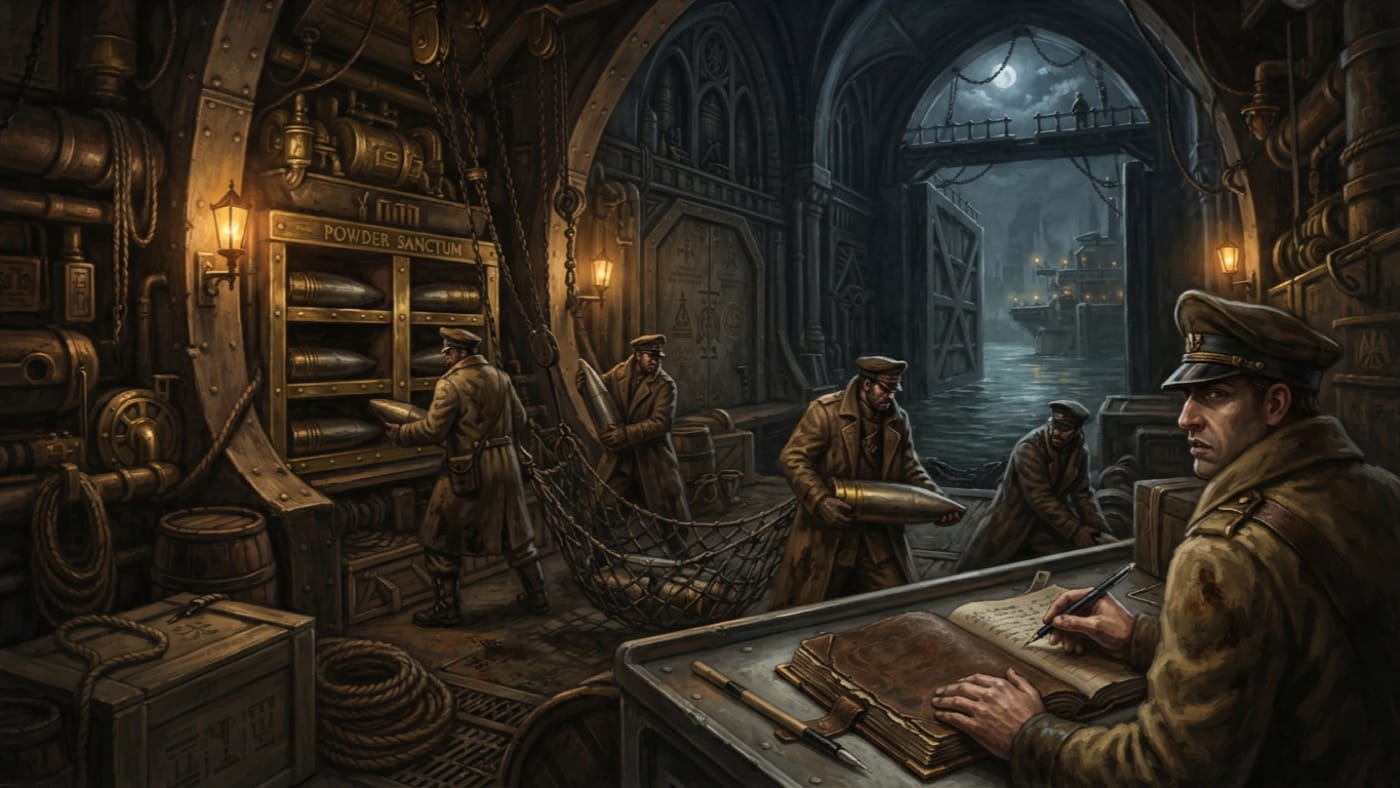
#On the Name
"Shadow deck" is crew speech. You will not find it painted on any compartment, drawn on any Bureau of War deck plan, or named in any chaplain's blessing of a hatch. The phrase belongs to the people aboard a shrine-platform who steal ammunition and sell it, and who protect the trade by finding out what their crewmates would rather nobody knew. The crew list the shadow deck among their own factions, next to the old gun-side and choir-side quarrels, with no more embarrassment than a parish feels about its drunks.
What they sell is the "extra shell." The adjective is the thieves' own. A platform's stores contain rounds that have been counted, rounds that are expected, and rounds that have gone missing. "Extra" is a fourth category, and it exists only while a man is selling one. Every shell aboard was drawn against a requisition and entered against a seal. A surplus shell is a missing shell that has found a buyer.
I can offer the reader no founder, no captain, no membership roll and no seat of government. The Bureau has none on file, and I will not make up a villain just because the form has a box for one. As far as the record goes, the shadow deck is whatever theft ring has formed aboard a particular platform in a particular season. It needs several hands, one appetite, and a ledger that can be made to agree.
#On the Accounted Round
You can only understand the theft once you understand the liturgy it robs.
The shot-ledger began in fire. In the early A.S. 70s came the First Floating Cathedral Burn: unlogged powder, filed as "supplementary prayer supplies," destroyed a Danube shrine-barge and forty-one men. The emerging Church's war administration answered by ordering every round aboard a shrine-platform logged like a sacrament. That administration was the office later Bureaus would claim as their ancestor. Penance by arithmetic has been the rule ever since.
Custody passes from hand to hand. Powder Acolytes keep and carry the ammunition. The Battery Steward commands the gun crew. The Cadence Caller decides where in the bell's measure a gun may speak, an authority over the guns that dates from the Cadence Reforms of approximately A.S. 95. The Ordnance Deacon holds the seal, and without it nothing fires. The chalk ring sanctifies the arc, the metronome bell keeps time, and the choir supplies the score.
Then the pen. Each discharge goes into the ledger at once, before the barrel cools: shot type, time, purpose, authorising seal, hymn-measure, weather and choir status. The Ledger Reforms of A.S. 165 added the name of the Acolyte who loaded the round. They followed the grapeshot discharge at Bastion-Irongate, and the seven men who claimed to have been inside one three-man latrine at the time. Two counts are kept, one gun-side and one choir-side, by people who dislike each other professionally. Mutual contempt is the most reliable audit instrument the Church has yet found.
So a shell should never be alone. It has a lot, a locker, a hand, a seal, a measure and a line. A man who wants to steal one has to steal it from all six at once.
#On Missing Ammunition
The line is the one thing he cannot carry off the deck. What he can do is write a different one.
The ghost entry is the shrine-deck's oldest forgery: a false record placed where the true one would do harm. The crew's own published account names three things ghost entries hide. They hide misfires. They hide unsanctioned discharges. And they hide rounds that went into the shadow deck's resale network. An auditor must keep these three apart. A ghost entry proves that somebody lied, but it does not prove who bought what. On most platforms, most ghosts are frightened men covering a dud round so the platform is not grounded. An inspector who reads every false line as organised theft will spend his career arresting cowards while the thieves sell powder to his relief.
The occupational record describes other techniques. Shot lots get swapped. One lot's count is quietly made good from another, and the shortfall moves to a locker nobody plans to open soon. A choir-caller is paid to "stretch a measure," so that a gun can answer a target no seal named. Stolen shells are laundered through a salute. A feast-day volley is entered at more rounds than it fired, the harbour crowd cheers each report without counting, and the difference leaves the platform under the cover of an act of public devotion.
None of these practices belongs to the shadow deck by proof. They belong to the profession's general economy of evasion, and the theft ring uses them the way any desperate crew does. The ring's distinguishing mark is what leaves the deck: an intact shell, primed and whole. A spent casing is brass. Deck-Rats sell casings to tinkers for pennies, the chaplain hears about it at confession, and the Bureau shrugs. Selling an intact shell is a different trade. That buyer wants a gun to answer.
#On the Lock Window
Crews have a proverb, "lock-window gospel," which means that timing is law. A platform waiting at a river lock is a platform standing still at night, beside a quay, among strangers with business of their own. Offers come aboard at the locks: whispered across the rail, folded into a fuel docket, or left with a crewman who went ashore for rope.
The thieves need people on land. Lockmasters sell windows. Powder clerks sell inattention. Choir-cue runners can blur a measure entry in the time it takes to sprint the deck. Schedulers of the Rope-Ferry Chain know which crossing will be slack and when. The crew lore lists all of these among the people a crew bribes to stay alive. It does not make any of them members of a ring. A lockmaster who takes extra wax to hurry a barge through has no need to know what that barge carries, and a sensible lockmaster takes care not to.
The currency is mostly not coin. Bribes on the river are paid in wax, bell-hours, clean cloth and fuel chits. In crew code "extra wax" means a bribe, and a "long measure" means a target the Deacon never sanctioned. The expensive end of the market is the authorising seal. A seal does not license a sale, whatever its holder has come to believe. It makes a forged entry look as if it were correctly forged, and the trade of the seal-forger sits close enough to the powder sanctum that an inspector should know both addresses.
Who buys the shells, and where they go, the file does not say. I have heard taverns name bandits, rival ports, private patrons and the Enemy itself, usually in that order and usually after the third cup. None of it is evidence. The Bureau of War has no proof of a supply contract, a fleet-wide distribution chain, or a quayside where all missing ammunition ends up.
#On the Price of a Clean Book
Audit has its own liturgy. The inspector reads the ledger first, then the powder stores, then the ward ring, then the cue logs. Last come the random interviews, conducted in the flat voice of a confessor who already knows the answer: What did you hear at toll three? A crew whose ledger gets through this without a correction drinks well at the next port. A clean shot-ledger is the highest status aboard a shrine-platform. Men handle it the way novices handle a minor relic.
That is the trouble with it. On paper, a clean book bought with bribes looks exactly like one kept honestly.
Blackmail grows out of this. A shadow deck ring rarely needs to recruit by force. It only needs to learn who wrote the ghost entry for last month's misfire. That man wanted to save his platform from grounding. Now he has a page with his name on it and someone else holds the knowledge of it. After that, his silence about the shells costs nothing, and his help with the next false line is quietly assumed.
The pressure comes from the ordinary terms of service. A crewman is paid in hazard wage, berth rights, ration priority, and a brass bonus after escort runs that go well. He goes into debt through tool replacements, fines for ledger errors, and the cost of treating ears and throats that the profession ruins. To a man who owes the platform for his own deafness, a shell valued in fuel chits looks like a sum the Church never intended to settle.
When an audit closes in, the crew's code already says who pays. A Deck-Rat is "caught" with extra wax. A singer is blamed for cue drift. The established penalties apply: grounding for the platform, demotion and public penance for the men. The Operational Catechism sets out no sentence for membership of the shadow deck. The ring is punished, when it is punished at all, through the faults it led other men into.
The crew lore records exposure as a possible path to redemption, and gives its price as the informant's own berth. That is the whole of the arithmetic. Reporting the thieves means reporting the ghost entries, and the ghost entries include your own.
A Bureau of War memorandum praised the Ledger Reforms of A.S. 165 for eliminating ghost entries aboard shrine-platforms.
Corrected in this Codex's entry on the Reforms. The Reform eliminated lazy ghost entries. The careful ones remain under active pursuit. The shadow deck has never employed the lazy kind.
#On the Present Rule
As of A.S. 201, the shot-ledger rule is in force on every shrine-platform and on the Processional Arsenal derivatives. That includes the land-going Pilgrim's Ladder, whose morning salvo once removed me from its deck at speed. Every round must have a hand, a seal, a measure and a line. The Bureau of Bells keeps the measure honest. The Bureau of Doctrine keeps the theology tidy. Neither keeps the locker.
Shells still go missing. Ghost entries still appear in steady handwriting. Lockmasters still take wax, and auditors still read the ledger first, because the ledger is where the Church has decided the truth is kept. When the true count and the written count differ, the Bureau prefers the written one. The shadow deck has depended on that preference from the beginning.