

#On the Designation
An original is the most dangerous document in Nemea. A certified copy carries the Chapterhouse seal and says what the Chapterhouse has agreed it says. An original says what it said before anyone agreed to anything. Keep the two in one building long enough and some clerk with a lamp and a grievance will lay them side by side. Whatever falls between them becomes a lawsuit or a fire.
The Second-Draft Circle exists to keep originals alive. It is a heretic cell. It has no public face. It issues no pamphlets and petitions no court, and as far as any office I can name is aware it has never written its purpose down. Its offences show the purpose anyway: it preserves originals, and it tries to undo erasures.
The name needs translating. In Nemea's cant a second-draft is a forbidden original. The reversal is deliberate, and the joke belongs to the town more than to the heretics. Nemea once declared its fire-damaged reconstructions original by ratification, and since then whatever was written first has ranked below whatever was stamped. Strangers take the Circle for a society of revisers. It revises nothing. It hoards.
Do not confuse the cant with the standing order to "burn the second draft." That order covers any document found to contain text missing from its certified copy. The order and the Circle share a word and little else. One burns whatever differs. The other saves it.
#On What Erasure Costs
A novice crosses the Inkhouse Bridge, passes the Silence Gatehouse and gives up a birth-name at intake. In exchange the novice receives a designation and what the Chapterhouse calls "archive safety." The name does not disappear at once. It waits in the intake ledger. Page debt builds against the designation, and night shifts build against the debt. When the debt grows large enough, a family name can be handed over to correction to clear it. The account then closes as neatly as a coffin lid.
Outside the walls, the Synod's paper decides who eats. A ration chit is issued against a name, and so is a passage writ. An inheritance runs down a line of names. No body leaves Nemea without death papers that carry one. The Bureau of Records takes Nothing is forgotten as its motto. Nemea is the house where the Bureau forgets things professionally, and by quota. A name the Margin Court moves into the footnotes is margin-eaten. A person struck from the record without the trouble of an execution is quieted. The quieted still breathe, cough ash and stand in the porridge queue. They cannot prove that anything is owed to them, or ever was, or that the child beside them is theirs.
This is where the Circle's offence stops being a matter for antiquarians. An original intake record shows the name before it was surrendered. An original contract shows the obligation before it grew. A saved page is evidence against the sanctioned version. Nemea sells certified absence to every tribunal on the continent and recommends erasures to the Great Ledger. In that market, evidence is a competing product.
I cannot say whether the Circle has ever put a quieted person back into the books. Neither can the Chapterhouse, and the Chapterhouse would be the first to find out. The intention is established. The procedure is not known.
#On the Methods
The Circle is credited with three methods: smuggling, acrostics and mirror-writing. None of them takes genius. All of them take paper, light and nerve. Nemea rations the first two and confiscates the third.
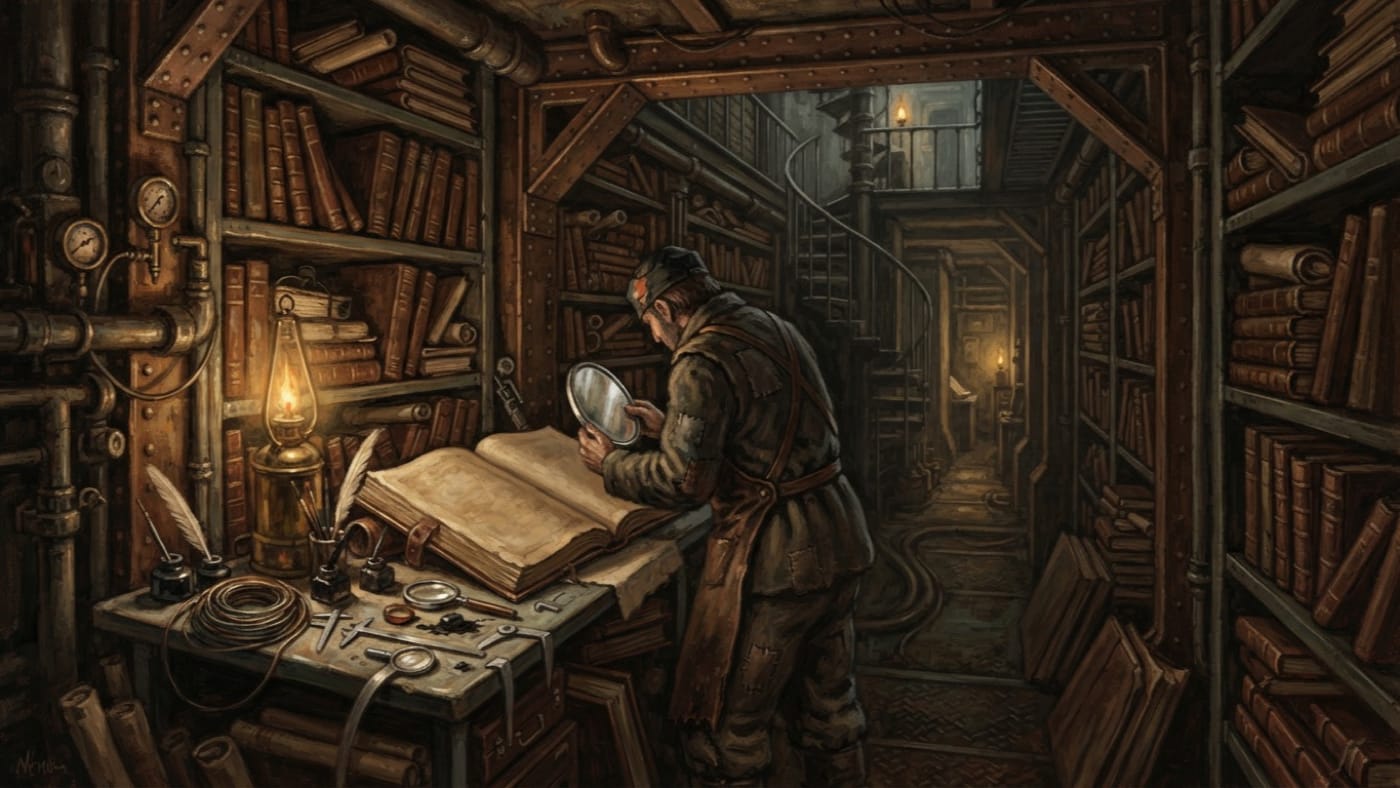
The town's own architecture is the ground. The Scriptorium rises into catwalk libraries and sinks into vaults. Between them run ladder stacks, under-vault stairs and concealed crawl-shelves. A slight person on hands and knees can lie in a crawl-shelf beside a folio for an hour between patrols. The patrols walk by page-count, and a page-count can be learned. East of the stacks lies the Courier Spur, where sealed carts and relay stables carry Nemea's product out into the world and where tunnels run below the yards. Everyone assumes a packet sealed in Nemea holds what its manifest says. That assumption is all the protection a courier has.
An acrostic hides a name in plain sight. The first letters of the lines in an approved text spell out what the text itself has deleted. The text might be a ration schedule, a vow formula, or a correction order copied by someone with a steady hand. It passes inspection because every line of it is correct. The heresy sits only in the left-hand edge. Mirror-writing is reversed script, and it reads properly only in glass. Nemea forbids moving mirrors and treats an uncovered one as taboo. The method therefore carries its own insult: the Collegium's tool for detection becomes the Circle's tool for reading.
The town counts everything these methods use. Clean paper is a bottleneck. Blank leaves pass as currency and as bribes at the gate. Lamp oil buys light, and by Nemea's own doctrine nothing is provable without light. Suppose a scribe spends a night copying an original into an acrostic. She has burned oil she does not own on a page she cannot account for. She has done it during the correction cycle, when inspections are heaviest and the Redaction Yards are hungriest. Destruction runs on bells, so preservation has to move faster than the bell.
A saved original is still an original in Nemea. It may well be written in Nemea ash-ink. The Circle can hide a page. It cannot promise that the page will say tomorrow what it said tonight.
#On the Custodians and Other Interested Parties
The Circle has several enemies, and each hates it for a different reason. That disagreement is what keeps it alive.
Abbot-Registrar Maelen Voss controls access to the originals. His power is the vault key, and an original kept outside his vaults amounts to a key cut without his permission. He fears archive contamination, and the Circle offends that fear twice. It carries originals where he cannot inspect them. It also gives him somewhere convenient to lay the blame if his own originals turn out to be contaminated.
Silence-Master Rhu Tern commands the Silence Test Collegium, which owns the town's detection rites and the fear that comes with them. An acrostic that passes a silence test humiliates the Collegium in public. A mirror the Collegium did not issue humiliates it in private.
The Margin Court makes its money deciding what is real. Every identity dispute brings a fee, and every name seizure is income. An original produced at the wrong hearing would cost the Court a verdict it had already drafted.
Ledger-Broker "Sister" Halvein trades in blackmail drawn from redaction drafts. She handles suppressed text as well, which makes her a competitor in the same commodity. Nothing in the record makes her the Circle's ally, patron or mistress. I have heard enough tavern theology to know people will say so anyway.
The Courier Spur Brotherhood controls the routes and skims the packets. The Lampglass Row Compact controls light and lenses. The Circle operates on their ground. The record does not say whether it pays their prices or simply slips past their notice.
None of these parties is an office of the Bureau of Purity, and neither is the Circle. Purity supplies the wider machinery of heresy enforcement that the Circle answers to. The cell is that machinery's quarry, never a branch of it.
#On the Charge of Sabotage
The Night-Rewriting Contracts were classified in A.S. 198. Nobody can say when they began. Classification marks the date Nemea admitted them, nothing more. Clauses in contracts stored in the vaults change overnight. Three years of service become five. Forty ration chits become sixty. A guarantor's name moves from the signature line into the body of the text, and a witness wakes up a debtor. Every change on record enlarges an obligation.
The Chapterhouse blames the Second-Draft Circle. According to the published survey of Nemea, the Circle blames the ink. Both stand in the record as positions. Neither has been proved.
Convenience is the Chapterhouse's best argument. The Circle moves through crawl-shelves and courier tunnels, handles documents it has no right to touch and writes backwards. A cell that can hide a name in an acrostic can presumably add a clause. The weak point is motive. The changes enlarge obligations, tighten debts and turn witnesses into debtors, which is the Chapterhouse's own work done unusually thoroughly. A cell devoted to undoing erasures would make a strange author of new chains.
The Second-Draft Circle stands condemned as the author of the Night-Rewriting Contracts.
CORRECTED by the Bureau of Doctrine. The Chapterhouse has charged the Circle with the rewritings, and the charge stands on record. Authorship is unproved. The cause of the anomaly remains under classification.
The countermeasures prove nothing about the culprit. Salt-lamp circles burn through the night over sensitive documents. Mirror checks catch text that has moved since the last reading. Silence tests sort the living page from the dead one. Whatever a page fails, it then meets the standing order and goes to the Yards. Look at what each side does with an altered contract. The Collegium burns it. The Circle would hide it. Only one of those actions leaves anything to examine afterwards. Every contract burned under the order carries its testimony into the ash, and the ash, as the survey of Nemea records, has its own opinions.
#On the Present Application
Inquisitor-Corrector Sel Durn has been dispatched from Strasbourg this year, A.S. 201. No verdict against the Circle has followed, no purge has been certified, and no record shows any meeting with its members. The dispatch has produced pressure, and in Nemea pressure becomes paper. The Chapterhouse wants tighter silence protocols, broader correction powers and wider vault quarantine. The Margin Court keeps scheduling correction festivals. The judges call these mass deletions maintenance. The novices call them the culling.
Each festival publishes a list of names scheduled for deletion, and a name scheduled for deletion is exactly what sets the Circle moving. The Chapterhouse's answer to the cell manufactures the cell's work.
In the stacks the word mirror-release is said to name a plan: every hidden name revealed at once. It has not happened. If it ever does, the Collegium will learn how many mirrors it failed to cover, and the Margin Court will learn how many of its verdicts had ever been sealed against an original.
The Circle goes on saving pages. The Redaction Yards go on burning them. The contracts go on growing overnight. The heretics blame the ink, the Chapterhouse blames the heretics, and nobody has yet put the ink under oath.