

#On the Sister-Adjunct's Station
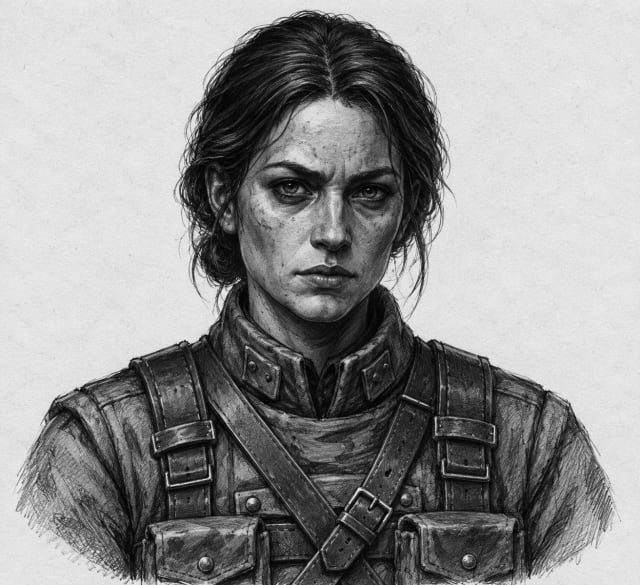
Sister-Adjunct Hilde Marek is an engineer. The Codex can certify that much, and one thing more. During the autumn campaign of A.S. 195, at the eastern salient of Bastion-Przemyśl on the Sagittal Line, she calculated a firing angle on a blood-stained requisition form while Atheron's Spire-Crusher stood over the wire. Her whole entry in the Sacred Ledger rests on that one piece of arithmetic.
I have searched for the rest. The files give no birthplace, no age, no face, no house of profession, no promotion, no wound and no grave. Most applicants for posterity arrive with too much paper. Marek arrives with one sheet, and the Bureaus are still arguing over that sheet.
A lesser archivist would pad the file. He would give her a pious childhood in some mountain parish, a vocation found beside a broken theodolite, and a quiet contempt for the officers above her. I have read such dossiers and sealed several of them. Their lies are decorative, and the Bureau tolerates them because decoration costs less than evidence. This file declines the commission. It holds one deed, the conditions around that deed, and the paper the deed was written on.
#On the Conditions of the Rubric
The destruction of the Spire-Crusher has its full entry under the monster's own name. This file needs only the working conditions, since an engineer is judged by the conditions she computes in.
Battery Saint Ulrich opened fire at 6:12 by the tower clock. The tower grew nine feet during the salvo. By the second hour every heavy gun on the salient had joined: Casimir, Ulrich, Martyrs' Teeth and the Orchard Eye, firing in overlapping sequence. At first sighting the thing had measured three hundred and forty feet. It grew faster than the guns could wound it. Spotters reported its height when they should have been reporting the range of the Sun Spear files beneath it, and the Crownguard came on at its foot while the garrison stared upward. In the fifth hour Sun Spear fire blinded the bell crews under Platform Casimir. They went on striking the Humility Sequence from memory.
Think what this does to arithmetic. A gun is laid by figures, and the figures assume a target that has the decency to stay its own size. This target treated every measurement as an insult to be outgrown. Each solution went stale by the next salvo, and every crew had to work it again with fouled hands under a sky full of enemy.
Every range slate in the battery had then cracked. The record does not say how. Concussion is the dull explanation and so the likely one. I will not invent a demon for a broken slate. The Line produces enough demons without help from the archive.
By the sixth hour the tower stood nine hundred feet tall at the outer wire. Provost-Marshal Vanna Rook doubled the eastern Orchard current. The ration tags hanging on the barbs burned one by one, and the forward pier stopped at the charged strands. For twelve minutes nothing moved forward. Then the pier lengthened over the wire. The tower's shadow crossed the ditch and fell on the inner wall.
#On the Angle
Major Cestian Rell ordered every battery to fire at the same mark: the narrowing of the forward pier below the lowest gallery. The Ledger does not record who first noticed the narrowing. The order went out under Rell's name, and the choice of target is credited to Rell's line.
An order names a target. It lays no gun. Somebody has to turn "there" into elevation, and in one battery of the eastern salient, with its slates in pieces, that work fell to Sister-Adjunct Marek. She did it on a requisition form that was already stained with blood.
The record does not say whose blood it was. Sentimental readers will want it to be hers. They may want what they like. The form came from a battery that had been firing for most of nine hours, where ammunition crews worked in relays until their hands bled through their gloves. Blood was the commonest ink on the salient that day, and the Codex will not award it to the nearest name.
The record gives no figure for the angle and no account of the method. The Bureau of Engineering would like the numbers, and so would I. Whatever is written on the form has not been entered into any register I am permitted to read. I decline to make up a sum and hand it to a dead afternoon as testimony.
The importance of the mark needs no invention. The tower had spent the day absorbing shells into ornament. Lower galleries crumbled to dust, upper shaft peeled away in banners, and behind every wound stood more tower. A shell laid high hit decoration, and Pride regrows its decoration faster than a battery can reload. The narrowing below the lowest gallery was where all that self-regard still had to rest its weight on the ground. A gun laid there struck structure. A gun laid three degrees wrong struck vanity, which the tower had to spare.
The labour divided the way honest labour does. Rell commanded. Marek calculated. The relay crews carried shells. The blind ringers kept the bells low. The gunners laid and fired, and one crew sang a song about Atheron that the hymnal will never print. The final salvo began at the eighth hour and fifty-third minute of the engagement and lasted seven minutes. It used thirty-eight heavy shells, four hundred and twelve secondary rounds and two bell sequences, counted across the whole salient. At the ninth hour the forward pier broke.
The tower folded into itself and ended as forty feet of rubble. The garrison spent three days looking up at empty sky. The record does not say where the Sister-Adjunct looked.
#On the Requisition Form
At Przemyśl, paper is never just paper. The bastion runs on ration tags, stamped slips and seal blanks. Its citizens count their lives in life-days, its motto is No tag, no dawn, and it has to import clean paper. A requisition form there is a petition for continued existence, filed in triplicate. It suits the place that the angle which brought the tower down was written on one.
What the form originally requisitioned is not recorded, and neither are its number, its signatory, its dimensions or its full text. I would give a month's stipend to learn whether it asked for shells. I would give two to learn that it asked for something ridiculous, such as candle-wax or a replacement range slate. The archive keeps its secret, and my stipend stays where it is.
The form survived. The Spire-Crusher entry reports that it is now held in the Chapel of Counting as a probable relic. That is a chapel whose ordinary business is confession slips and vaulted indexing, so the form joins company it understands. The Bureau of Relics has not completed authentication. The stated impediment is that the form will not stay flat.
Engineering will say that blood-soaked paper dries unevenly. Doctrine will say something longer. The Codex records the refusal and offers no theory. A probable relic remains probable until the seal comes down, and I have watched too many reliquaries filled by enthusiasm and emptied by audit to stamp it early.
An early public bulletin stated that the Spire-Crusher was "reduced to rubble by the unambiguous superiority of Synod artillery."
Corrected once already, and corrected again here. The first correction credited bell discipline, wire current, ash smoke, obscene song, accident, stubbornness and the enemy's own arrogance, and it left out the requisition form. Artillery with cracked slates is a row of very expensive tubes. In at least one battery of the salient, a Sister-Adjunct had to tell the barrels where to point.
#On Credit, and the Rim of the Cup
Marek's name is attached to one act inside a collective survival, and the act should be weighed as it was recorded. She did not command the batteries. The Ledger does not credit her with finding the weak point, and no record has her firing the shell that broke the pier. She worked out an angle when the instruments for working out angles had failed. On the Line that is enough for a name in the Ledger, and enough for most names in it.
I doubt Atheron ever learned her name. Pride takes no interest in anything below the lowest gallery, and that is where she aimed. The tower fell and the Sin-General kept his posture. Three new foundation silhouettes have since been reported along the high eastern ridges, and an angle on a scrap of form does not end a war of elevation. It ended one tower on one autumn day, which is what engineers are for.
After the Rubric, Atheron's quieter lesson went round the garrison: you toppled the tall thing, so perhaps you are tall now. Within a week three battery captains had petitioned for higher rank, and one of them made his request standing on the rubble. The record names none of the three as Marek, and it does not mention her anywhere after the ninth hour. Nothing in the record shows whether she was proud or humble, alive or dead, promoted or forgotten, and the Codex will not supply an answer.
The war needs engineers more than it needs saints, and the Bureau of Relics should keep that in mind while it waits for the form to lie flat.