

#On the Matter and the Course
The slag-rivers belong to the Iron Wastes of Thrace, the furnace-country north and west of Bastion-Constantinople that Maldrake has held since the Sundering of A.S. 45. That date tells us when the Wastes began. It does not give a birthday to any single channel. The Bureau, which loves a birthday more than most saints love martyrdom, has declined to invent one. I record the restraint because it is rare.
The rivers keep two estates. Some cross the open crust in channels that begin like riverbeds and wander like grievances. Others run beneath it, under fields of black glass covering cavities that vent furnace air through their cracks. A surveyor standing on the glass may be standing on the river. The field manual advises him to assume so.
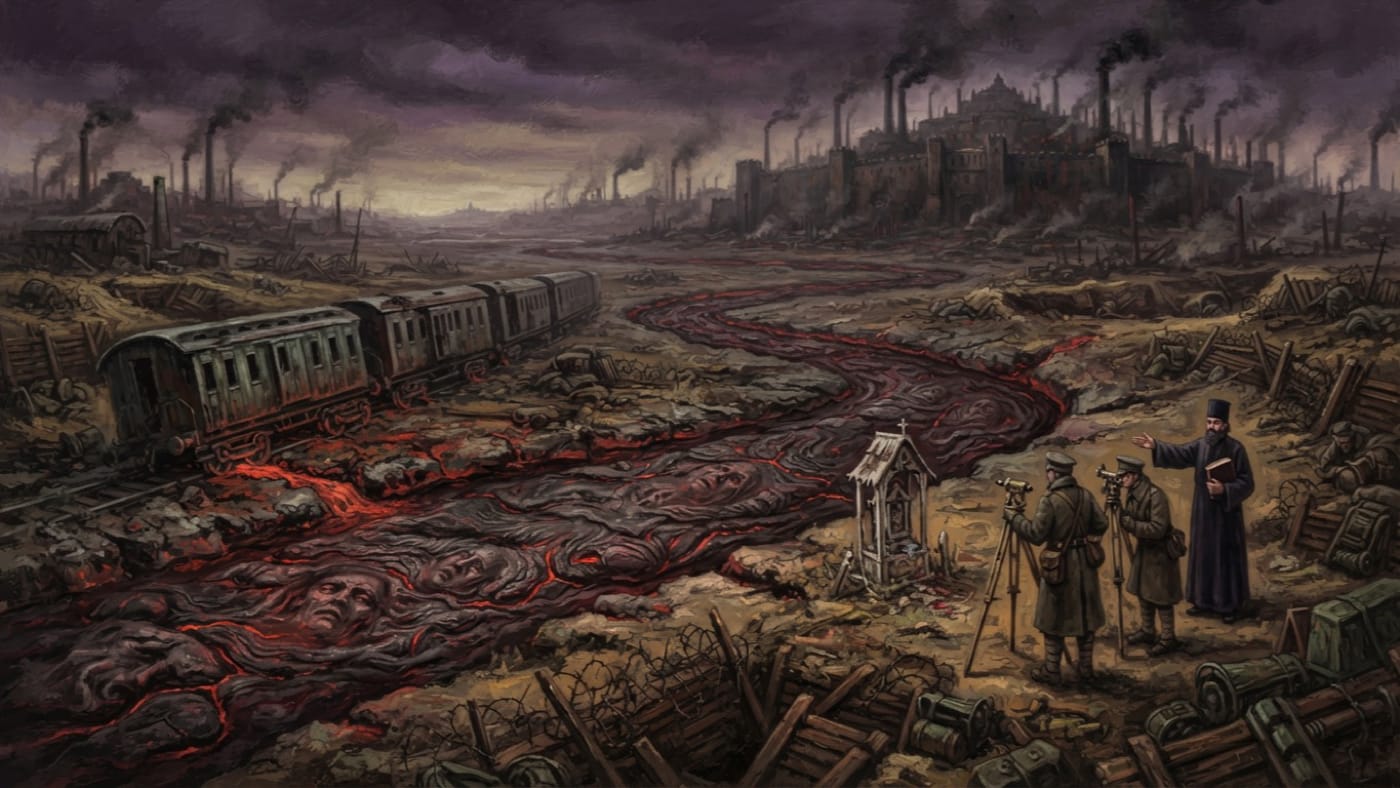
The matter itself is slag, thick and red-black, moving with the gait of a procession whose bishop has died and been left in charge anyway. Its surface wrinkles, plates, cracks and remelts as it travels, so the river is always half-skinned and always healing. Iron clots the size of wagons ride the current and turn as they pass. Some bear marks that resemble regimental numbers, saint sigils or ration stamps. A few carry what look like faces pressed outward from inside the cooling metal.
Resemblance is all the record holds. No clerk has matched a number to a muster roll. No confessor has been asked to hear a clot. The wind supplies the rest of the liturgy: cinders, ash and slivers of cooled metal that open cloth and skin with the same indifference a tax assessor shows a widow.
#On the Preferences of the Rivers
Water obeys the slope. These rivers keep their own counsel about it.
The account of the Wastes records selective routing. Channels bend away from the easy descent and toward particular ground. They circle shrines whose relics are authentic. They lap toward shrines whose relics are fraudulent. They boil beneath bridges assembled with unconsecrated rivets. Every one of these is a regional observation, entered by men who watched it happen and then had to write it down in a Bureau that punishes adjectives.
I separate what was seen from what I think of it. What was seen is a pattern of approaches and avoidances. What I think is that a feature mapped as terrain has preferences, and that preferences in Thrace belong to Wrath. The second sentence is my theology. The first is the evidence, and the evidence would stand without me. It would simply be less well dressed.
Some provincial dean will one day march his reliquary to a bank and wait to see whether the slag turns aside, so that he can settle a dispute with the neighbouring chapter. The Bureau of Doctrine will forbid it, and I will draft the prohibition. A pattern is no tribunal. A river that has avoided a true relic on one occasion has signed no promise to avoid the next, and a true relic set in its path gives no guarantee that the course will change. Several cathedral treasuries would be grateful if the reverse were so. The Church makes no such guarantee.
Earlier field handbooks classified the Thracian flows as "volcanic residuum."
Withdrawn. Volcanic matter descends by weight. It does not circle authenticated shrines, favour forged ones, or wait beneath badly riveted bridges. The classification survives in the archive solely as evidence that geologists should be supervised by chaplains.
#On Ferrum-17
The illustrative incident carries a provisional number, as everything in the Wastes does until it kills someone important enough to deserve a name.
In A.S. 197 the river designated Ferrum-17 diverted six hundred yards east to pass beneath an abandoned hospital train. The train had stood empty for nine years. No casualties were aboard and no officer was quartered in it. The slag rose through the wheels, fused the axles, and left the bedframes glowing. The salvage crew entered three days later and found the mattresses intact and warm, each dented in the shape of a sleeping man.
The salvage note is brief.
FERRUM-17 SALVAGE NOTE — A.S. 197 Bedframes: 112 Human remains: none Audio phenomena: "breathing," location indeterminate Recovered object from infirmary car: ███████████████████████ Disposition: sealed under Vermillion; salvage crew reassigned to non-metallic duties
The figure counts bedframes. It does not count occupants, and the record names no victim. Whatever was recovered from the infirmary car remains unidentified in any document I am permitted to cite. I note only that the crew who carried it out now work with wood, canvas and paper. The Bureau calls this rotation. I call it the first honest metallurgical opinion Engineering has issued in a decade.
#On the Survey Recalled
Measurement had already failed before the Bureau tried it beneath the ground. In A.S. 189 Surveyor-Lieutenant Hadrien Vesk was sent to take the western thermal gradient. His instruments melted before a reading could be made, and he was reprimanded for loss of property. Wrath took the brass. The Bureau took the inventory.
The principal finding belongs to A.S. 200. The Bureau of Engineering undertook the Thracian Subterranean Survey beneath the trenchlines, and its engineers detected what they called routing behaviour: liquid wrath moving in patterns toward specific targets. The phrase is Engineering's own. It is the most theological sentence that office has produced since its founding, and it was produced by men who would sooner eat their slide rules than say malice in a report.
The survey was recalled before completion under "operational security." Immediately afterward, three inspectors were transferred to Bastion-Brest. I do not give their names. The record fixes their posting and nothing beyond it. Brest is where they now serve. The posting proves no Thracian river reaches the Bug, and it does not make them prisoners, whatever the junior clerks whisper over the ink-pots. They are distinct from Vesk, whose humiliation came eleven years earlier, and from the Ferrum-17 salvage crew, who have their own reassignment to enjoy.
Nor was Ferrum-17 sampled by the survey, so far as any surviving page shows. The two records describe related behaviour in one region. Nothing in them shows that one investigation led to the other.
The list of targets was never disclosed. The mechanism was never disclosed. What survives is the finding, the recall and the transfers, and an institution that took fewer than a dozen words of evidence and buried them under procedure. Some will want to run a line from these channels to the Forge-Pyre Bastion and call it plumbing. No document supports that line, and I leave it undrawn.
#On the Northern Works
A river that chooses its ground undoes every assumption behind a trench. Engineers site works by slope, drainage and the sullen predictability of rock. In Thrace the slope has opinions. Bridges over the crust are now riveted with consecrated iron where the stores allow it, because the record of boiling beneath unconsecrated rivets is plain enough. Whether consecrated rivets protect a bridge is another matter, and the record has not settled it.
The rivers sit inside a wider hostile-metal country, and the two should be kept apart. Rail lines toward the forward posts deform. Piles driven into the crust come back altered. Recovered iron from the sector is treated as hazardous until blessed, remelted and stamped. These are phenomena of the Wastes. None has been shown to be the work of a slag-river in particular, and I decline to hang them on the rivers to make a tidier chapter.
Survey parties still go out from the northern outworks of Constantinople. They carry engineering tools, water, relay flags, hymn-compasses and sacramental salt, with escorts and a chaplain. These are recorded practices. None of them has been shown to turn a river. Heat still destroys the instruments. Distances still lie. Exposed men still come back angrier than they went out, and their officers report it under morale, where it does the least damage to promotions.
The chaplains prescribe the Doctrine of Cool Hatred, cooling rites, rigid command and confession. These help with the small anger, the sort that kicks a mule or curses a sergeant. Against the deep rage they help little. The Wastes add heat to whatever temper a man carries in. The man still makes his own decisions on the glass, and the confessor will hold him to them. Maldrake supplies the furnace. The fist that strikes belongs to the soldier.
For A.S. 201 the Iron Wastes are active and expanding toward the southern anchor. Their rate of advance has not been published. Their area has not been published. The course of each river and the targets they route toward stay sealed with the rest of the A.S. 200 papers. The northern walls still watch the plain at night and count the glows. Maldrake keeps his own records and does not lend them.