

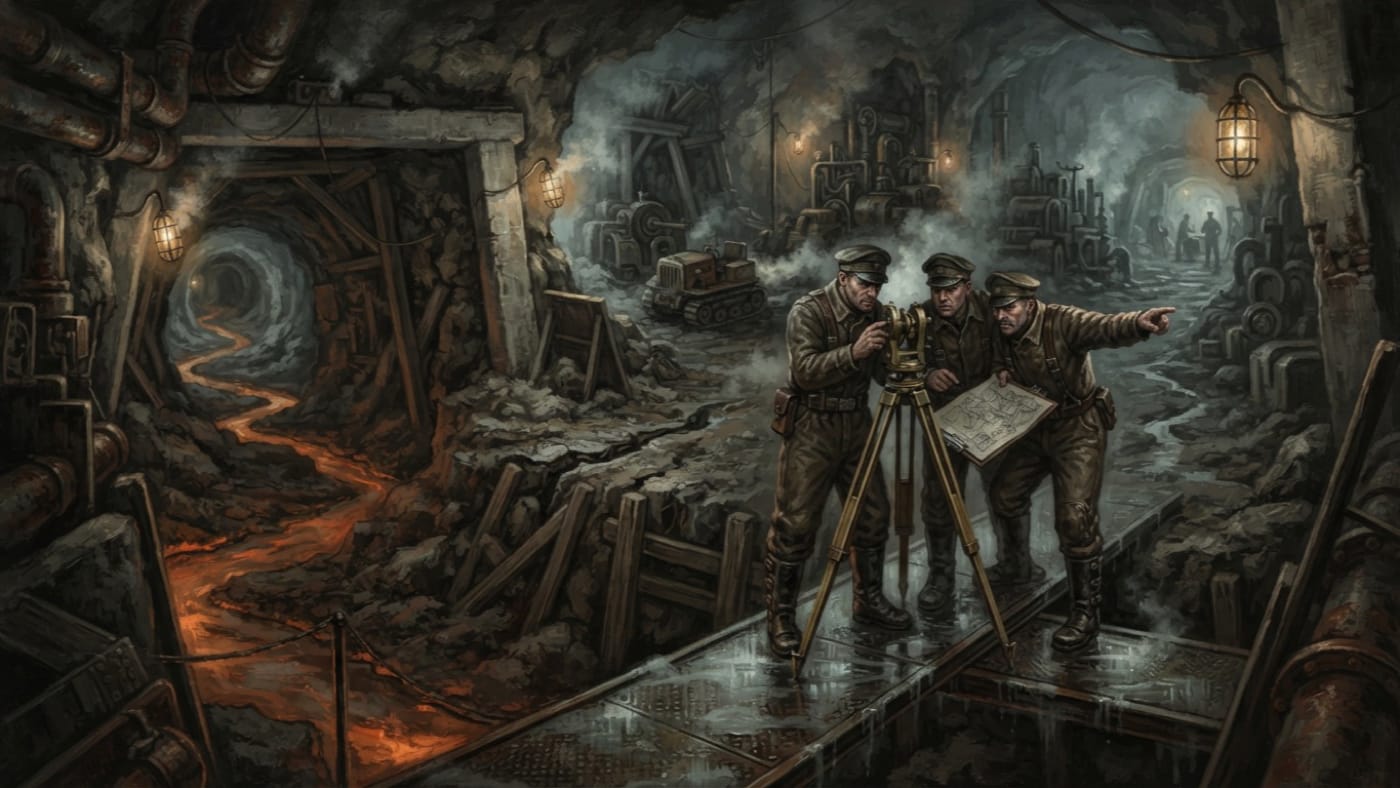
#On the Survey and Its Finding
"Engineering measures. Doctrine explains. Between the two offices stands a vault." — Drax, marginalia, A.S. 200
The Thracian Subterranean Survey was an investigation by the Bureau of Engineering into the slag-rivers beneath the Thracian trenchlines. Its work belongs to A.S. 200, which is 1910 by the old reckoning. It was never finished. The Codex files it under that year because the record puts both its finding and its suspension there. That year is the only fixed point in the file. No commissioning order has reached my desk. I have no date of departure, no duration and no full roster, and I decline to supply them out of my own head. An archive that fills its gaps with plausible inventions is a novel with a wax seal.
The record gives us a phrase. The engineers reported "routing behaviour" in the slag-rivers: liquid wrath moving in patterns toward specific targets.
There are two kinds of paper in this file and they should be kept apart. A finding is what a trained person saw and wrote down. An explanation is what a Bureau is prepared to sign. The Survey produced a finding. Nobody has yet issued an explanation that I can cite as settled, whether from Engineering, from my own Bureau of Doctrine or from anyone else.
#On the Ground Beneath the Trenches
These places are often confused, so here they are in order. Thrace is the province. The Thracian Plain is its open ground. The Iron Wastes are the furnace-country the Codex assigns to Maldrake, north and west of Bastion-Constantinople. The Thracian Front is the military line the Church holds across that country, and its trenches were dug into ground that was already hostile before the first spade went in. The Survey worked beneath those trenches.
That means glass crust over furnace cavities. Ash lifts at a footstep, cinders collect in the boot-seams, and the surface that bore a cart at dawn may not bear a man at noon. Molten channels run under the crust and sometimes on top of it. Engineering already knew this country could ruin its instruments. The slag-rivers entry records a surveyor's gradient tools melting in A.S. 189, eleven years before this Survey and with no connection to its personnel. I mention it only to show what kind of ground the Bureau was sending its people onto.
The Registry of Unsubstantiated Claims says how the inspectors came to be sent. According to the Registry, drainage beneath Trench-Section 14 failed again and again, in sequences too regular for the engineers' comfort. I give this as the Registry's account. It may describe the trigger. It does not mark the boundary of the whole Survey, and I will not let a single trench number become the Survey's official address.
#On Routing Behaviour
A river runs downhill. Every engineer is taught this before being trusted with a level, every catechist assumes it, and the Line's drainage tables depend on it. Slope, viscosity, heat and the stubbornness of rock are the categories Engineering uses to describe moving liquid. None of them includes the word toward.
The Survey's phrase does. The Front's account adds that the flow moved toward specific points and avoided others. In plain terms, the slag behaved as if it were heading somewhere. I put it no more strongly than that, because the record does not, and in this file the record is all the evidence I have.
The wider region has its own collection of complaints. Bridges over the crust are riveted with consecrated iron wherever the stores allow it. Garrison stories say the slag behaves differently near shrines and crossings. Those belong to the Wastes in general and to the soldiers who live on top of them. None of it was an experiment run by this Survey, and I will not pass off barracks gossip as field notes.
The classification is disputed, and each position has an owner. The Codex entry on the Bureau of Engineering prints a retraction of the conventional geological reading. Doctrine's official position, as the Registry and Front entries record it, holds that this is the natural behaviour of cooling magmatic material. I drafted that position. I believed it while I wrote it, which is the most I ever ask of a sentence.
Earlier surveys of the Thracian subsurface, as quoted in the Codex entry on the Bureau of Engineering, attributed the slag-rivers to "volcanic residuum of conventional geological origin."
That entry withdraws the attribution in light of the A.S. 200 routing finding. This erratum records the withdrawal and nothing more. The present entry has no earlier edition to correct. Doctrine's cooling-magmatic position still stands in the entries that cite it. The Codex now holds two incompatible readings of one river, each signed by a different office, and I am not empowered to choose between them. I note that I signed one of them.
The public account names no targets and explains no mechanism. The sources do not agree on why. Some describe the targets as never determined, and others as determined and never published. The difference matters, and nothing I have can settle it.
#On the Recall and the Transfer
"Every transfer is a sentence that has been spared the trouble of a trial." — Drax, memorandum on personnel movements, A.S. 200
The Survey was recalled before completion, and the grounds were given as "operational security." The Registry says the Bureau of War issued the recall. The Front entry says three members of the team requested transfer to Brest and that the Bureau of Conscription approved all three with unusual speed. Each account belongs to its source. On three points the sources agree: there was a finding, there was a recall, and immediately afterward three inspectors were transferred to Bastion-Brest.
The transfer was filed as "career development."
Three were transferred. That does not make three the size of the party. No roster tells me how many people went under the trenches, and the clerks are wrong to treat the Pylon Nine three as the whole Survey. Their motive is equally unsettled. The record supports neither flight nor exile. It supports a filing phrase and a posting.
Brest stands on the Bug River, at the far northern end of the Sagittal Line from the furnace-country, on the flattest and wettest stretch of ground the Line possesses. The inspectors went there by personnel order. No document runs a channel of slag from Thrace to the Bug. A map with that channel on it would sell well in the Warrens and be worthless in the Ledger.
#On the Brest Correspondence
The following is the aftermath, as documented in the A.S. 201 assessment of Brest, 1911 by the old reckoning.
By that year the three inspectors occupy quarters in Pylon Nine. Between them they have submitted forty-seven reports to the Bureau of Doctrine. The number is their combined total, and it is not the count of the Survey's original papers. All forty-seven have been classified and none has been acknowledged. I have read none of them and will describe none of them. The lack of a reply proves nothing beyond the lack of a reply. It does not show that the reports went unread, were burned or were intercepted. I would like it to show one of those things, and I am refusing myself the pleasure.
The Confession Echo began on the bridge in A.S. 199, a year before the Survey was recalled and before any inspector set foot on the Ribwalk. Both the Brest entry and the Echo dossier report that it intensified in the month the inspectors arrived. The month is not named here. Two events in the same month are an association. Nobody has shown a mechanism linking them. Nobody has shown the inspectors brought anything north except their luggage and their training. Booth 77 and its premature confessions belong to the Echo dossier, and nothing in the Survey's record connects them.
Brest's threats need sorting before anyone uses them as a cause. The locked locations registry assigns the Bug sector to the Nameless Tide, an unnamed and accumulating force held under Absolute Suppression. It is distinct from Königsberg's Grey and distinct from Maldrake. Velkaran infiltration of the crossings through forged writs and bought absolution is a separate danger and a real one. Presiding Judge Krail blames the Echo on the Blank-Sheet Circle. I have filed a different suspicion, and the Bureau has classified it Outside Current Doctrinal Scope. Neither theory has been proven, and neither has been tied to the Survey by anything stronger than the calendar.
#On the Present Disposition
As of A.S. 201 the Survey remains incomplete. No order to resume has been recorded, and no order cancelling it permanently has been recorded either. The routing finding stands as a finding. The targets are still unnamed in public. The mechanism has not been explained. The three inspectors are still in Pylon Nine, still writing, and still waiting for a reply. The Echo continues on the bridge. The slag still runs under the Thracian trenches toward wherever it is going, and the Bureau of Engineering is not currently being permitted to find out where.