
#On the Citadel That Refuses Location
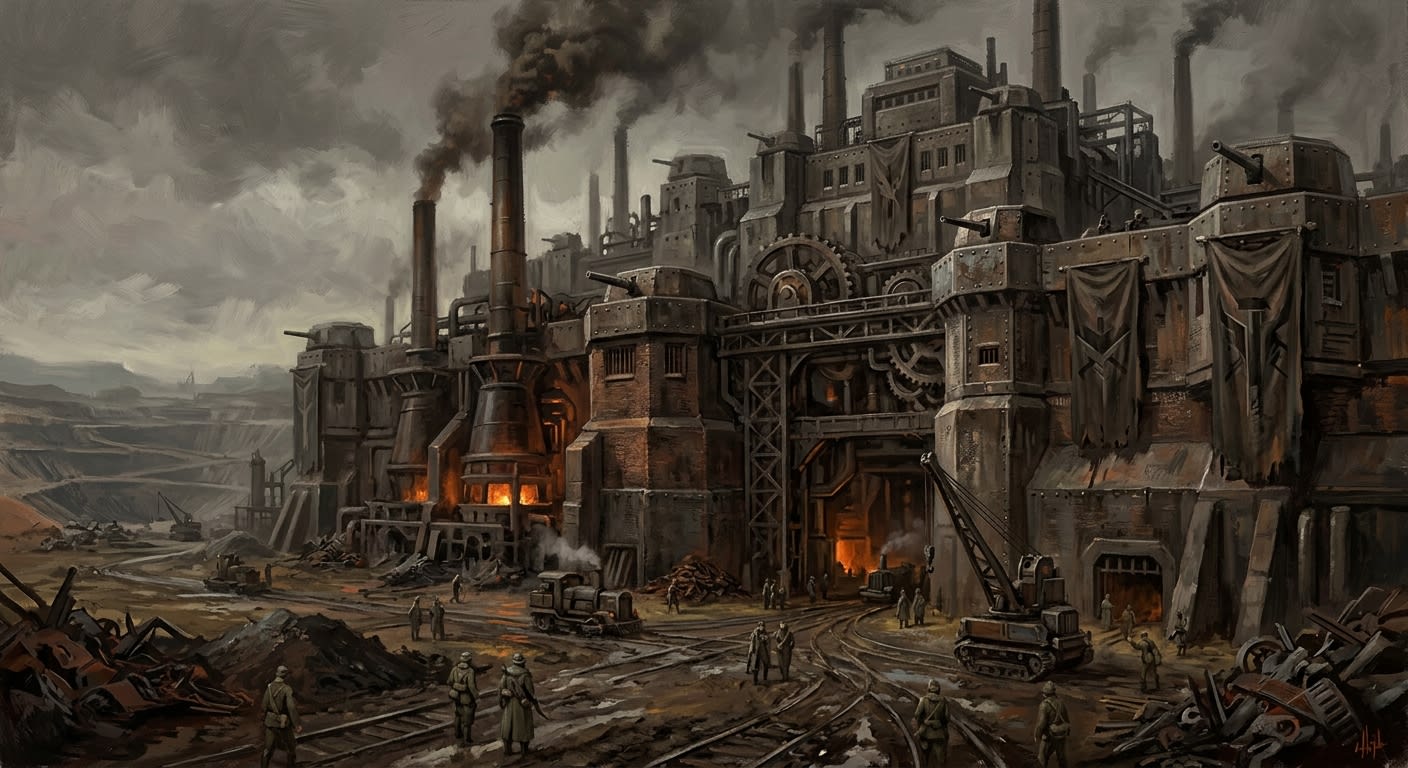
The Forge-Pyre Bastion rises somewhere near the central heat of the Iron Wastes, which is the most accurate sentence the Bureau of Cartography has approved and the most humiliating sentence the Bureau of Cartography has ever had to stamp.
A proper bastion has coordinates, foundation stones, gates, drains, garrison rolls, ammunition stores, chapel registers, water tables, and a clerk with spectacles who can produce a plan when threatened. The Forge-Pyre Bastion has anvils ringing under a black sky, slag walls that rebuild while watched, gates that glow without opening, and scouts who return with three maps, four burns, and one shared conviction: the fortress was north, north-east, and directly ahead.
Its first formation belongs to the Sundering. When Maldrake came through Thrace in A.S. 45, ore screamed from the ground, iron rose through field and road, and the old province learned the furnace grammar by which it is now governed. The Bastion was not built in the human sense. No masons took wage. No surveyor marked a square. No architect submitted a plan for revision, which is how one knows the Enemy lacks civilisation. The Bastion precipitated: wrath condensed into fortification, forge, temple, arsenal, and throne-shape.
The name is ours. The place has not accepted it. Soldiers called it the Anvil City after the A.S. 73 cartographic sketches arrived warm in Strasbourg. Engineers called it Central Furnace Mass, a phrase with all the poetry of boiled glue. War called it Objective Ferrum-Prime until three officers who used the term in the same tent began bleeding from the gums. Doctrine settled on Forge-Pyre Bastion because the words are pious, martial, and sufficiently theatrical to look deliberate.
#On the Walls of Slag and Anvil
The outer wall is described in every surviving deposition and never twice with the same measurements. This is inconvenient for geometry and marvellous for terror.
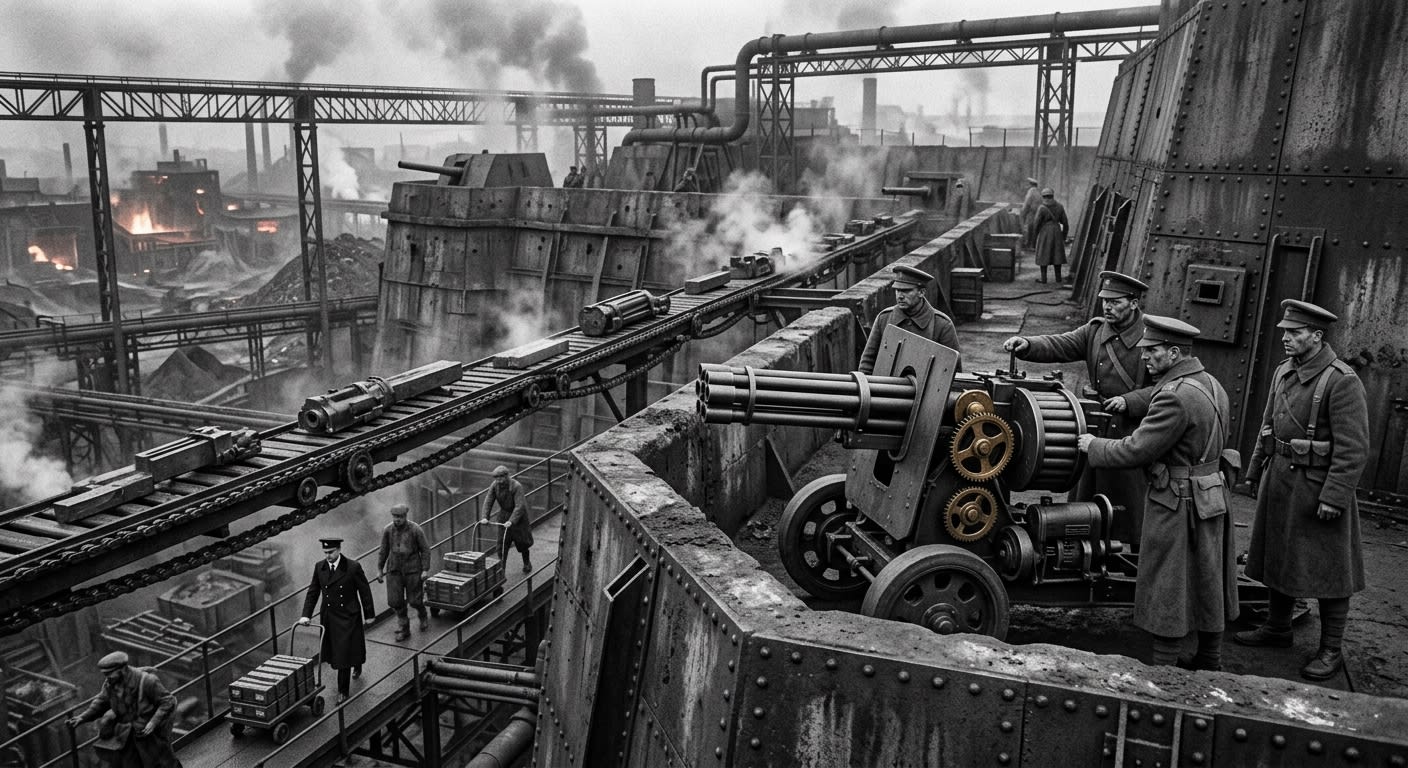
The wall appears hammered from slag plates, each taller than a chapel door and riveted with bones gone iron-hard. Some plates bear the softened impressions of faces. Some bear old Synod unit marks, reversed as if pressed from within. Some are blank and glow beneath the surface with the steady light of a banked coal. At intervals, towers jut from the wall like forge chimneys, breathing cinder in pulses timed to no wind. Walkways move. Buttresses settle and rise. A crack watched for one hour becomes a postern, a throat, a gun slit, a closed seam, and then a crack again.
At three miles, the heat strips varnish from rifle stocks. At two miles, teeth ache. At one mile, men report questions forming in their mouths before any voice speaks them. The questions are simple. Who wronged you? Who denied you? Who deserves what you have not yet done? Chaplains call this Wrath-pressure. Soldiers call it the Bastion noticing.
The gates are the most stable features and the least reassuring. Seven have been reported, though only three appear at any one time. Each is a vertical slab of dark iron banded in red heat, without hinge, handle, portcullis, or visible guard. The central gate glows at all hours and is said to open inward during campaigns, releasing hammer-hosts, Hellbow frames, pyre-smith trains, and walking siege engines whose legs strike sparks from their own shadows. No witness has seen the gate open outward. This has produced a small school of tactical optimism among officers who enjoy dying with theories.
Survey Abstract A.S. 189 described the Forge-Pyre Bastion as “a fixed enemy citadel of probable volcanic origin.”
Corrected. Fixed objects do not appear closer after retreat. Volcanic formations do not issue forged ammunition marked with captured Synod serials. The responsible abstractor was reassigned to humidity tables, where immobile things remain immobile out of pity.
Above the walls rise the anvils. I use the plural because every report does, though no observer agrees on number. They are black masses suspended in heat shimmer, mounted on towers, sunk in courtyards, or hanging from chains larger than bridges. The hammering never ceases. At five miles it is sound. At three miles it is almost speech. At two miles it is command.
#On the Forges Within
No faithful eye has entered the Bastion and returned with a report the Bureau will publish. What we know comes from distance, captured deserters, corrupted transmissions, Ember-Soldier autopsies, slag samples, and the recovered fragments of machines that had no business remembering where they were made.
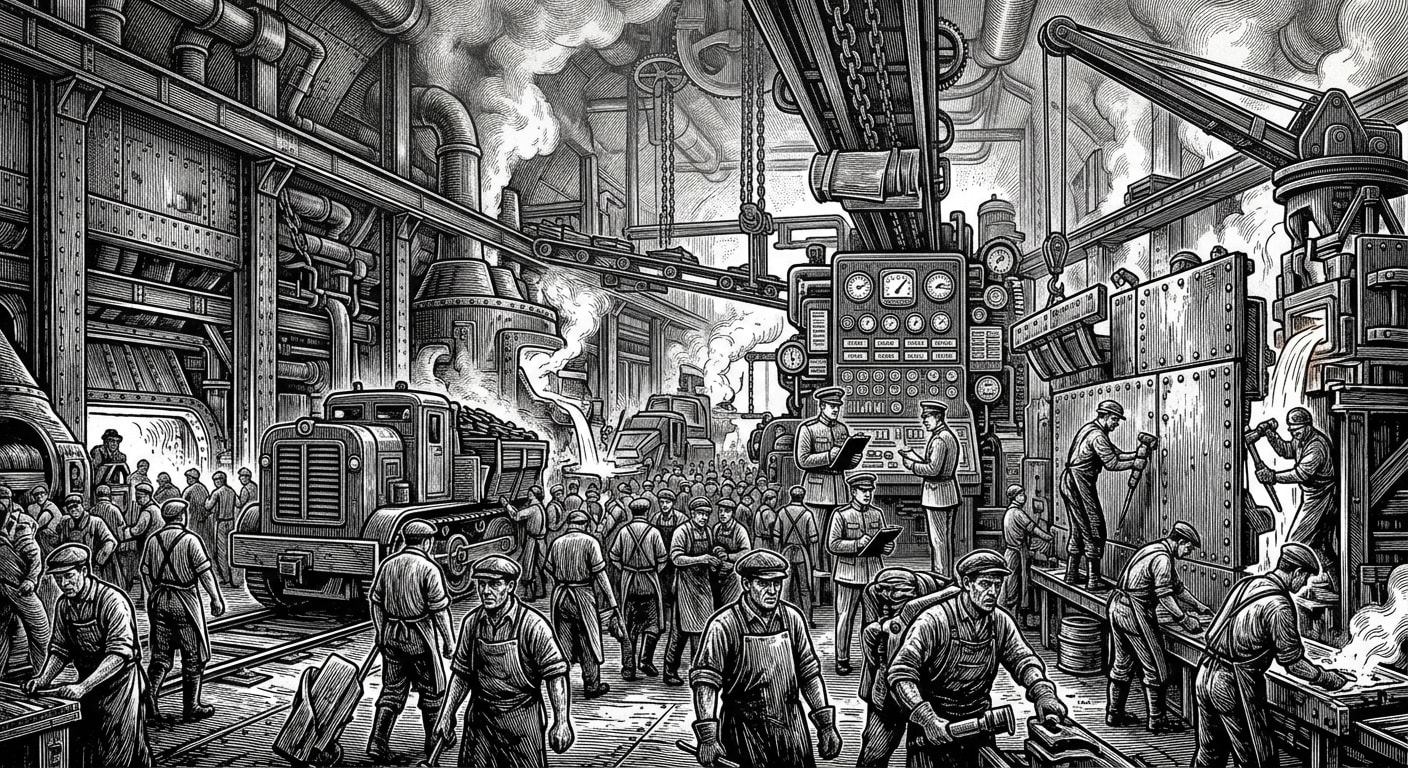
Within the Bastion stand the Eternal Forges, or one of their principal mouths. Weapons are produced there in quantities that insult supply doctrine: swords, spears, armour, siege components, slag-bow arms, furnace chains, ammunition of no approved calibre, gun-throats, corpse-pistons, pressure cages, and the metal ribs of Forge-Beasts before flesh is riveted into them. The forges do not require orders. They produce because Wrath, given heat and matter, experiences idleness as an enemy combatant.
The workers are not workers. Some are enslaved humans from Crucible Cities, lungs packed with ember-ash, skin cracked by heat, hands wrapped around tools they no longer have strength to release. Some are Ember-Soldiers used as clamps, haulers, bellows-men, fuel, and examples. Some are pyre-smiths (Unregistered), those doctrinal obscenities whose craft survived damnation and became more precise. The Hammered (Unregistered) stand where no unaltered body could stand, lifting metal that would boil a man through his gloves. Crucible-Born overseers direct processions with the patience Wrath should lack and the competence that keeps Constantinople awake.
There is no factory whistle. There is no shift bell. There is only hammering. The Bastion’s labour does not begin, pause, resume, or conclude. It continues through campaigns, defeats, ash seasons, slag-river diversions, and the rare intervals when Maldrake’s pressure against the Line recedes from assault to threat. A human arsenal sleeps at night. The Forge-Pyre Bastion considers sleep a species of treason.
The forge-heat alters what it makes. Captured plate struck from Bastion metal grows warm when anger is spoken nearby. Chains twitch under sermon. One gun breech recovered after the A.S. 182 bombardment developed a red seam whenever officers disagreed within earshot. Ordnance split it, cooled it, blessed it, and locked the fragments in separate vaults. Two fragments now point toward each other through stone.
#On Expeditions and Witnesses
The first formal witness to the Bastion was the Cartographic Expedition of A.S. 73, though “formal” here means fourteen survivors, six contradictory sketches, and one assistant surveyor who insisted the fortress had followed him home. The sketches arrived warm. The Bureau of Rites classified the warmth as residual kinetic sympathy. Doctrine accepted this because Doctrine enjoys phrases that sound like answers and require no action.
A.S. 143, the Year of Ash Rain, gave the Bastion its public silhouette. Maldrake ignited the Thracian forests; ash fell on Constantinople for nine months; and, through the red weather, northern observers saw tower-lights pulsing in a pattern later matched to Hellbow production surges. The Bastion became, in garrison slang, the Heart Behind the Smoke. War discouraged the phrase. Soldiers used it more.
The A.S. 170 Vigil of the Hollowed proved the Bastion’s function without requiring sight of its walls. Hellbow volleys, Forge-Beast screens, pyre-smith brands, and Hollowed columns struck with a coordination that implied a forge-citadel behind the assault, a place where ammunition, bodies, siege frames, and timing entered one furnace and left as doctrine’s headache. One hundred and forty metres of wall fell. Forty-seven volunteers entered cement. Chamber 7 held. The Bastion kept hammering.
FORWARD LISTENING POST — NORTHERN CONSTANTINOPLE, A.S. 170 Hour: prior to first Hellbow impact Recorded sound: hammering beneath ordinary hearing, three blows / pause / seven blows / pause / one sustained tone Bellwarden annotation: “It is counting the wall.” Disposition of slate: █████████████████████████ Bellwarden reassignment: unavailable
A.S. 189 gave the Bureau of Engineering another opportunity to be brave with someone else’s skin. Surveyor-Lieutenant Hadrien Vesk reached the western thermal margin and lost his instruments before taking a reading. The reprimand for lost property survives. The reading does not. Vesk’s private note, copied before Records sealed his field packet, states: The hammering came from under us, not ahead. Records disputes the copy. I believe the copy, which is why Records dislikes meals with me.
In A.S. 200, the subterranean survey detected slag-river routing beneath the Thracian trenchlines. The lines bent toward targets. One branch pointed not toward Constantinople’s wall but toward its ammunition lifts. Another curved under a shrine whose relic had been privately doubted for twelve years. The report was recalled. Three inspectors were transferred to Bastion-Brest. The Bastion, if the routing tables are to be trusted, had begun using geography as a conveyer.
#On Its Relation to Maldrake’s War
To call the Forge-Pyre Bastion Maldrake’s seat is to flatter furniture. A seat implies rest. Maldrake does not rest. The Bastion is his industrial will made stationary enough for fear to draw a circle around it.
From it come the siege forms that press the southern anchor: Hellbow frames whose strings scream like recognised warrants; forge-beasts assembled from captured Synod engines and crews; armour that closes around the wearer with the tenderness of a trap; furnace chains dragged by Ember ranks; slag-bolts packed with bone-char and command; gate-rams whose heads remember every gate they have struck. The Bastion arms the campaign, then the campaign feeds the Bastion. Wreckage returns east. Bodies return east. Captured guns return east. Grievances return everywhere.
The Bastion also rules by sound. Its hammering crosses the Wastes before its armies move. Garrison men at Constantinople count it when bells fail. Three slow strokes are ordinary production. Seven rapid strokes precede Hellbow movement. A flat continuous ringing, heard through teeth rather than ears, precedes Forge-Beast activity. This is field doctrine, not official doctrine. Official doctrine refuses to let soldiers take tactical instruction from enemy percussion. Soldiers, having a stronger affection for survival than for minutes, listen anyway.
Its rivalry with Syrion is visible in the Contact Zone, where furnace weather meets time-fog and neither sin admits defeat. When the Bastion’s hammering grows louder, Syrion’s fog banks thicken. Ember scouts return cold. Grey Heralds ignite without alarm. The Bureau of Inter-Infernal Analysis calls this accommodation because cooperation would require a fresh panic. I call it mutual hatred with borders.
#On the Present Threat
As of A.S. 201, the Forge-Pyre Bastion remains unentered, unmeasured, active, and offensively productive. The public may find comfort in the first two words. The front does not. Unknown things are not safer for being unknown; they are harder to invoice.
The current western estimates place the Bastion beyond immediate artillery reach and within strategic consequence. This is a vulgar condition. We can hear it. We can see its ash. We can count its outputs when they arrive at our walls and call the count intelligence after the dead have supplied the figures. The Bureau of War has requested deeper reconnaissance twelve times. The Bureau of Engineering has requested better instruments. The Bureau of Doctrine has requested more careful language. The Bastion has requested nothing. It hammers.
Public catechisms once described the Forge-Pyre Bastion as “Maldrake’s distant throne.”
Corrected. Distance in the Iron Wastes is provisional, and throne is too passive a word for a structure that manufactures assault. Current language: “Wrath-aligned forge-citadel of active operational consequence.” Children will not enjoy memorising it. Children rarely enjoy truth until it is too late.
There are plans in sealed drawers. Cooling bombardments. Relic-saturated rain. Subterranean counter-routing. Bell-quakes. A proposed Orison chord strong enough to crack slag from five miles away and every window in Constantinople with it. Each plan has supporters, costs, objections, casualty tables, and one private note in the margin asking whether provoking the Bastion is wiser than enduring it. The margin note is unsigned. Cowardice and wisdom often share handwriting.
The Forge-Pyre Bastion stands, if standing is what it does. Its anvils ring. Its gates glow. Its walls correct themselves. Somewhere inside, metal becomes weapon, weapon becomes sermon, sermon becomes assault. The Synod answers with walls, bells, cement, boys, and my prose, which is admittedly the finest of these materials but not yet approved for load-bearing use.