

#On the Thracian Designation
"Operational Zone Ferrum-North, contested." — Bureau of War classification of the Thracian Plain
"Thracian front" is a phrase, and I enter it as one. No charter constitutes it, no council named it, and no foundation seal hangs from its corner of the archive. Officers say it and quartermasters write it on requisitions. The Bureau of Shadows uses it in memoranda, and the Codex has twice referred to it without troubling to say where it is. This entry pays that debt.
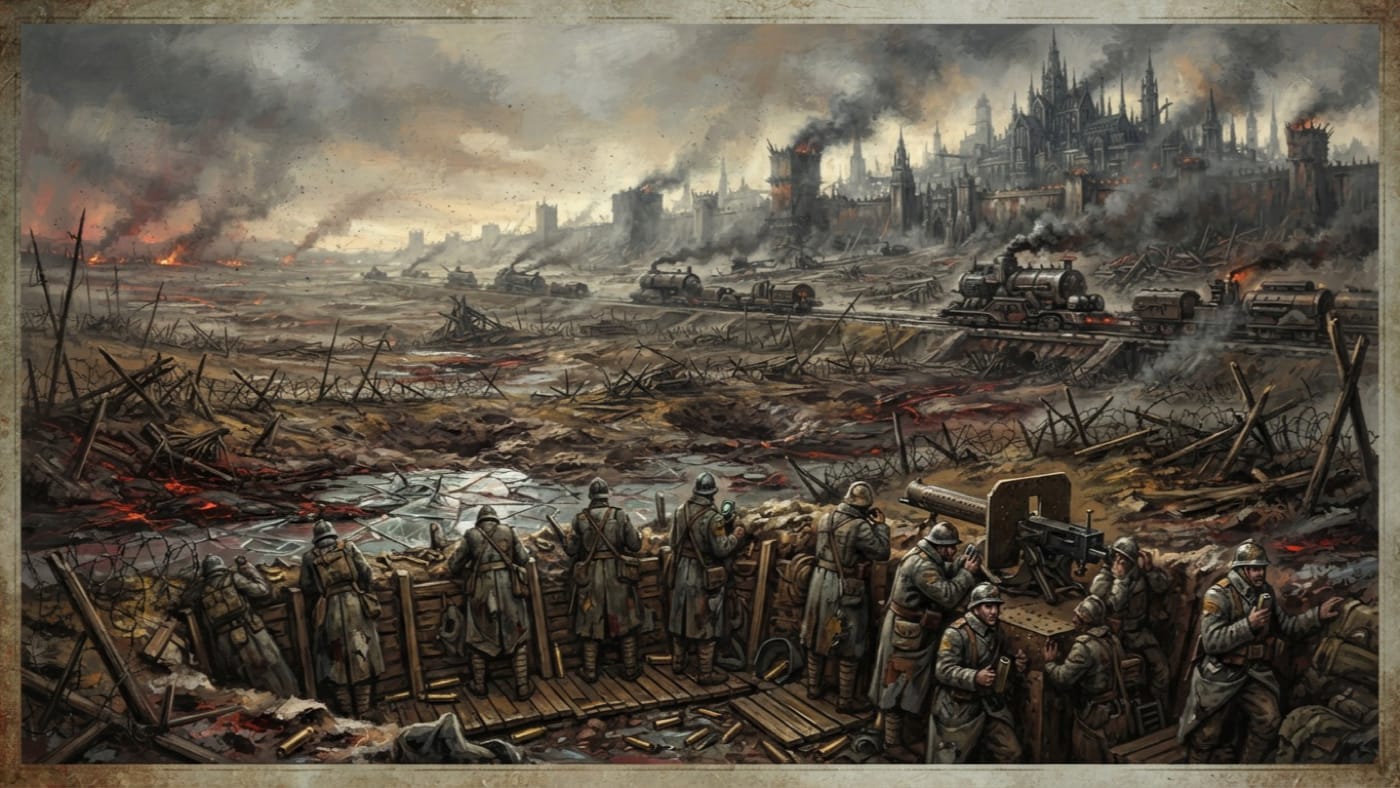
The front is the landward fighting north and west of Bastion-Constantinople, the southern anchor of the Sagittal Line, where the garrison faces Maldrake across open ground. Its nearest stretch is the Thracian Plain, the direct approach to the city. Behind the Plain lies the larger fallen province of Thrace. Inside Thrace burn the Iron Wastes, Wrath's deeper furnace-country, which no Synodal survey has crossed and returned to describe at leisure. The Southern Theater is a larger command sector again, spanning Irongate, Shipka and Constantinople. A clerk who uses these four names interchangeably will be issued a fifth, and it will be his own, on a transfer list.
#On Ground That Will Not Hold Still
The Constantinople survey says the Plain runs flat for some sixty miles north of the walls before the terrain begins to do anything interesting. That figure measures the Plain. It does not measure the front, which has no surveyed border and extends wherever the guns can reach and the wire can be renewed. The Bureau's zone bands lie across it in layers: Zone 4 for the defensive Line, Zone 5 for contested ground, Zone 6 for the hostile depth. On a bad morning a soldier forward of the parapet can stand in all three without moving his feet.
The ground is shell-cratered and dusted with ash. Trenchwork and dead-stake lines cut it, and the slag-rivers Maldrake leaves after his campaigns cross it. Glass fields lie where grain once stood. Most of that vitrified crust is only ruined earth, and men walk on it, curse it and forget it. Some of it is Wrath-slag in its translucent formations, copper-veined and warm under the hand. That is the matter the trade calls demon glass. Nobody can tell the difference from a saddle. It has to be learned on the knees, with tongs.
The pressure on the fortress does not all come down the northern approach. Kargath works the Black Sea and the Thracian marshes against the same walls, spoiling provisions and starving convoys, and those approaches belong to other ravelins and other ledgers. North-west, in the Balkan foothills below Shipka, Syrion's time-fog meets Wrath's heat. The front is Maldrake's, and its neighbours are not polite.
Older Lore Book passages and certain inherited filings describe the fortress at the Bosphorus as the western anchor of the Line, under the designation Bastion-Lorraine.
Corrected. The Sagittal Line runs north to south and ends at the Bosphorus. Bastion-Constantinople is its southern anchor, and the Thracian front lies to its north and west. A front misfiled by a quarter of the compass at least agrees with the enemy's opinion of our maps.
#On the Northern Command
As of A.S. 201, Marshal-Elector Galien Vaubret commands the Thracian theater from a reinforced bunker beneath the Ravelin of Fortitude. His dossier marks out his charge with care. He holds the north, and the marshes, the coast and the slow starving of convoys belong to other officers. Reports come down to his table from the parapets and forward saps. They give ground taken and ground lost, the gauge of wire still standing, and the drift of slag since the last observation. They go back out as dispositions: where the wire is renewed, which grid squares the guns will answer, which approaches are watched hardest when Wrath next comes south.
The enemy he answers is the Hellbow Legion, which War's correspondence calls the Wrath-Tide Primary Host. It is an assault host. Archery is the least of it. It brings slag-bow cohorts, pyre-smiths and Ember-Soldiers, and it brings siege machinery taken from the Synod and sent back corrupted, still wearing its old production stamps. Not every rank of it is demon. Enslaved crews labour in its slag channels, and the Hollowed march in its columns for reasons no confessor has managed to take down in writing.
The men who hold the line call the Plain "the Plate," and they hold it through ash and heat and a fatigue that sleep does not repay. Wire goes up at night and is cut down by morning. Bunkers are rebuilt on the footprints of bunkers. The Doctrine of Cool Hatred is required chaplain instruction in the sector. It teaches the soldier to kill from duty, to give up any pleasure in the killing, and to confess whatever pleasure remains. Cooling rites, breathing drills and rage fasts come after. The Bureau records a marginal drop in transformation rates and withholds the absolute figures. None of these practices puts out Wrath. They keep the soldier, for a while longer, on the Synod's side of his own temper.
#On the Campaigns and Their Residue
Maldrake does not press the way Kargath presses. Gluttony leans on the walls day and night. Wrath comes in campaigns. It deploys on ground broad enough to hold it, burns, and goes back to the furnace to be angry somewhere else for a season.
The front's ancestry is clear enough without inventing a birthday. The Sundering of 1 November A.S. 45 turned the Plain from grainland into a liability. The retreating army made its stand at the Bosphorus in the winter of A.S. 47. The Line was defensible, though incomplete, by about A.S. 65–68, and Constantinople received its designation in A.S. 68. The phrase "Thracian front" may be older or younger than any of these dates. Nobody stamped its arrival.
In A.S. 143, the Year of Ash Rain, Maldrake burned the Thracian forests. Ash fell on Constantinople for nine months, and the Ninth Bell Famine followed. The front learned that it could be besieged by weather. Wrath's pressure came again in A.S. 198, and that is nearly all the Codex can honestly say. The published record shows the push and what it did to supply and salvage. It names no battle.
#On the Glass Leaving the Front
A battlefield that fuses soil, iron and bone under heat grows two crops. One is casualties, which Records counts. The other is salvage, which Records prefers to count under other headings. The front yields both in proportion to its violence.
The Demon-Glass Scavenger goes out into slag-country with bone-mask, tongs and waxed wraps. He gathers the dark, copper-veined shards that the demon glass taxonomy assigns to Wrath, on ground the Bureau's cartographers refuse to map. The Demon Glass entry also lists Thracian Wound-sites among its sources. Scavengers call those seams "old eyes." I record the name and the rumour and certify neither.
From the front the glass goes to the water. Strait-Rats carry it in reliquary crates and salt-fish barrels through the channels facing the Bosphorus, and it lands at Thessaloniki in the Maskwright Lanes. There the Polishers grind and mount it. Their methods are recorded in their own entry, and I will not repeat a heresy merely because I have already learned it.
Then the circuit closes. The Bureau of War buys finished trench-mask lenses as Optical Supplies, Standard, and issues them to regiments on the Line, some of which stand on the very ground the raw shard came out of. War says the lenses let soldiers "see the enemy's soul." The phrase belongs to War and to the Lanes. No Bureau has said under oath whether the lenses do anything so reliable. Polishing quiets the glass but does not sanctify it. The Bureau of Purity condemns the substance as Category One Spiritual Contraband, then raids the workshops whose output War has signed for.
The figures need precision, or they will be stolen. A Bureau of Shadows memorandum, quoted in the Polisher entry, estimates that demon-glass distribution networks increased their operational capacity by about thirty percent across Zones 5 through 7 between A.S. 198 and A.S. 201. It ties the increase to demonic activity on the Thracian front by correlation. The figure estimates network capacity. It counts no shards, records no trench taken, sets no price and proves where no single shard came from. "Correlating" is the memorandum's own word, and I leave it where its author put it.
#On the Present Condition
As of A.S. 201, the front holds. Wire is counted beneath Fortitude. Ash lifts from the glass fields when boots disturb it. Hellbow formations bend along the northern heat, and the observation tables log every glow by its colour.
Beneath the trenchlines something harder to read persists. In A.S. 200, drainage works in Trench-Section 14 failed in sequences too regular to be chance, and Bureau of Engineering inspectors were sent. They recorded what they called "routing behaviour" in the slag-rivers under the front: flow moving toward specific points and avoiding others. The survey was recalled before it was complete, and the recall was filed under operational security. The targets were never determined, or never published. Three members of the team requested transfer to Bastion-Brest, and the Bureau of Conscription approved all three with unusual speed. That is the whole of the public record. Doctrine's official position calls it the natural thermodynamic behaviour of cooling magmatic material. I wrote that position.
Meanwhile the glass keeps moving. It comes up from the slag in scavengers' tongs and down the Bosphorus in crates that hum. It passes through Thessaloniki's lanes and returns north in iron mask-sockets, on the faces of men who will stand where it was found. Purity will raid and War will requisition, and the front will go on supplying both.