

I've finished checking the sources, so I'm writing the article now.
#On the Line That Is Not a Line
Compiled as a present survey, A.S. 201 / 1911 CE, Bureau of Doctrine. The date below is the date of this compilation. It is not a founding date. The Union never supplied one.
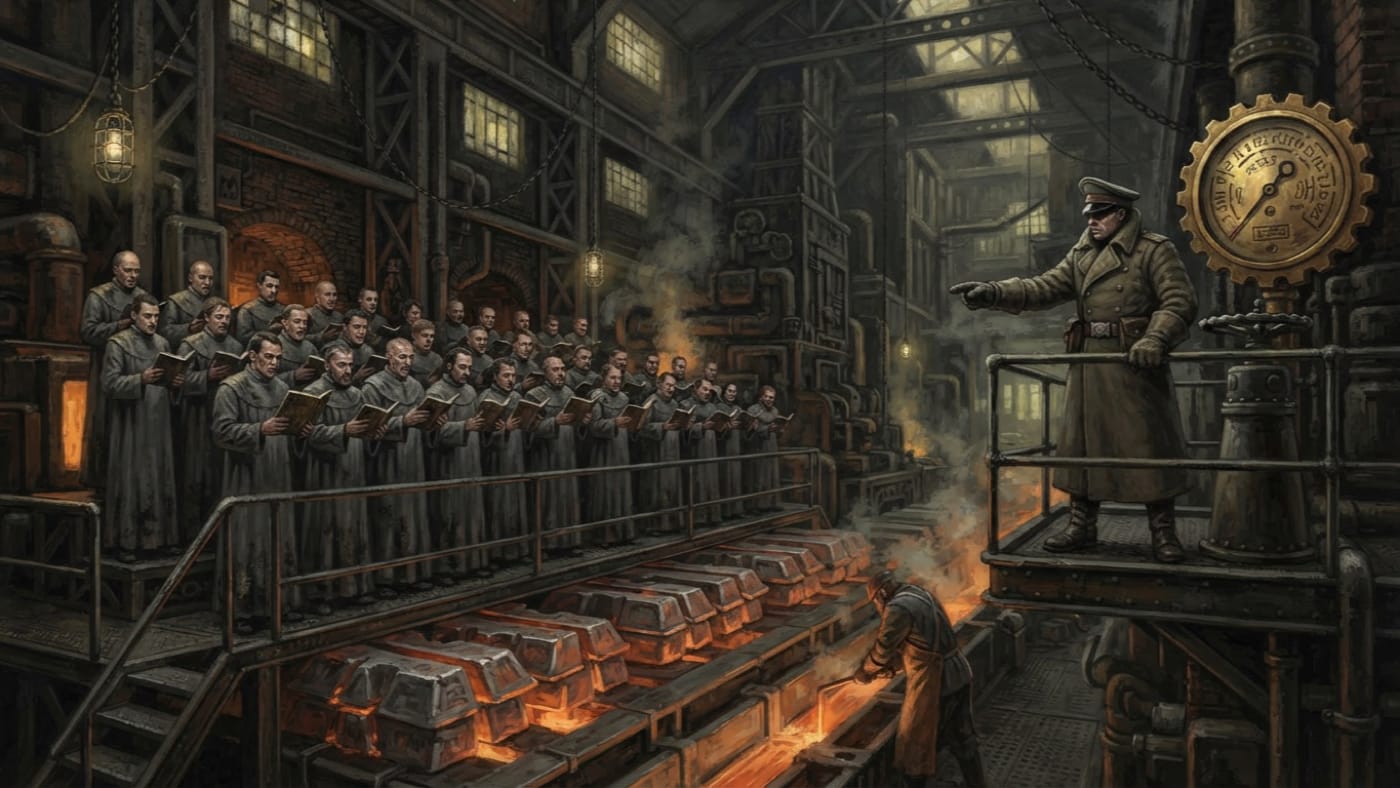
The Throat Line is the shorter name of the Choir Barracks Union of Essen-of-Hymnsteel. It is an unchartered association of calibration singers: half union, half monastery, and wholly unwelcome to the furnace-guards who say its name. It sits inside the Choir Quarters and sleeps in the Throat Dorms, and the Bureau's clerks confuse it with both. The district is a place and the Dorms are a building. The Line is a grievance that has learned to keep minutes in its head.
Archivists in the river offices should also be told that the Throat at Bend Ferry, Node Seven of the Rope-Ferry Chain, is a stretch of fast water with a tarred mainline over it. It has no connection to these singers that the Codex can find. Two trades chose the same word for the thing that swallows them. Nobody filed the coincidence because nobody needed to.
About two thousand calibration voices are maintained in the Choir Quarters at any given time. That figure counts the district. It does not count the Union. How many of those throats belong to the Line, Records has not established, and the Line has no reason to help.
#On the Origin in the Mouth
The Line arose from bleed shifts. Everyone who has written about the Union agrees on that point and on almost nothing else.
The Bureau of Orison and Song gives the technical account of calibration: paired choirs in the Hall of Measures sing the prescribed stanzas while the hymnsteel cools, and the vibration of the voice aligns the grain. I certify the sacrament. The grain I leave to men with burnt hands. Whatever the mechanism is, it uses up throats. The Dorms' own account gives an average vocal service of nine years for singers generally before reassignment to the slag hills, the lock-gates or the Ash Warrens. Orison calls this completion of service.
The Throat Dorms account describes a bleed shift as a pour in which singers stay at their stations after the surface of the throat has ruptured, because the metal has gone too far into cooling to abandon. The Union has never given the Codex a definition of its own. It has never needed to. Public language holds that bleed shifts were abolished. The A.S. 201 Choir Quarters survey says they continue.
Earlier Codex wording treated the Throat Dorms description of a bleed shift as the Union's own formal definition.
Corrected. The description belongs to the Dorms account, and the Line has given the Codex no definition. In Essen, a definition is the first thing the other side gets to amend.
The Line's founding year is unknown. The first Orison barrack block went up in A.S. 115, and the barracks were expanded in A.S. 118 when the city took its sanctified name. Those dates belong to the brick. When the singers began negotiating as a body, they did not tell the brick.
#On What Is Bargained
The Line does not bargain over dignity, which is just as well, because no Bureau in Essen keeps a ledger column for it. It bargains over four practical matters and has two larger aims.
Pauses. These are the minutes between stanzas, between pours and between a ruptured surface and the next sustained note. A pause costs the Bureau of Engines and Furnaces nothing it can easily name, and a throat can recover in it. The Line argues over pause length the way canonists argue over a comma, with the same result: whoever controls the comma controls the sentence.
Herbs. The herb rooms keep root, leaf, salt gargle and the steeped bitterness the singers drink before First Bell. Quality varies. Supply passes through ration schedules. A cheap root means a throat that tears sooner, so the Line negotiates over the grade of a weed and is right to.
Corpse routing. A singer who dies on the stage still has to leave the building. The Line disputes where the body goes, by which stair, through whose hands and under what entry. The Codex has no record of how any such dispute was settled. That the singers felt obliged to make it a bargaining matter says enough.
Family heat credits. In Essen, heat credits are duct-space rights: a claim to the warm floor and a place along the ducts in a city where cold is a sentence of its own. The Line negotiates over whether a failed singer's family keeps that allocation after the voice is spent. A voice gone flat should not leave a household on the cold grates. That is the argument, and Records accepts it about as well as Records accepts anything.
The Essen file gives two larger aims behind all this: permanent ration privileges for singers and an end to bleed shifts. Neither has been granted. This survey records the demands. It does not record any victory, because the Union has reported none and the Compact would not have filed one.
#On the Slowdown
The Line's method is the slowdown, performed as liturgical caution. The doctrine behind it is a tidy piece of work.
A stanza is taken a breath slower because the breath marks on the sheet look doubtful. A pour waits while a cantor confirms the pitch, and then waits again for a second confirmation, out of piety. Every delay can be defended in doctrine, and every delay costs Engines tonnage it has already promised to Strasbourg. The Line owns nothing but its members' voices and their ability to hold them back by a quarter-beat. In a city that bleeds hymnsteel into the Sagittal Line, that is wealth.
Treason gets hanged. Caution gets reviewed by committee. The singers know which room they would rather be in.
The barracks are said to keep strike hymns that never appear on an approved sheet. The Codex can report the rumour and nothing more. It holds no stanza, no oath and no procedure, and it will not invent any of them so that a clerk has something to burn. The rumour is a rumour. The slowdowns are measured.
#On Names, Teeth and Divided Chairs
Two names keep turning up wherever the Line is discussed. Mara Nine-Notes is known by missing teeth. The accounts disagree about how many and why: one Codex account gives a number and a cause, and another says the cause was never recorded. This survey leaves both open, because I will not settle a dental dispute on the strength of the more confident witness. What is attested is her range loyalty, which is enough that Sister Rauth is said to listen before refusing her. Brother Pell keeps time by scars. Neither holds an office the Compact recognizes. The Line has no title, election or charter for Records to file.
The Line has no master, and its standing with the three chairs of the Compact Council shifts with circumstance.
Furnace-Marshal Kord holds the Engine chair and treats the Union as an enemy. To him a slowdown is lost output wearing a surplice. Orison is an uneasy ally. Sister Rauth tolerates the Line's caution when it protects her singers from Kord, and her own scarred throat bears witness to what a hurried pour does to a choir platform. Her caution serves the singers. It also serves the steel and the authority of the Bureau that alone approves stanzas. She does not command the Union, and the Union does not obey her. Each finds the other useful for as long as their caution points the same way.
The third chair belongs to the Bureau of Records under Arch-Notary Veyl, whose clerks on Ledger Row hold every singer's work papers, ration chit and certified identity. If the Line wins a pause on the stage, a misspelled name can take it back in the ration queue.
Shift reports from the Foundry Core implied that Throat Line slowdowns and Mirror Choir stanza tampering came from the same hands.
Withdrawn. A slowdown proves caution, or the wish to be seen as cautious. It proves nothing about the Mirror Choir. The Choir Quarters survey records that Resonance Bloom activity predates the Mirror Choir's documented operations by about forty years. The singers were living beside that hazard long before anyone had a heresy to blame it on.
#On the Present Pressure
Strasbourg demands tripled output for hymn-drive siege engines. Sister Rauth refuses to accelerate calibration without liturgical stability guarantees. Furnace-Marshal Kord threatens conscription from the Ash Warrens, where voices are plentiful and untrained. These are a demand, a refusal and a threat. This survey does not record that the tempo has changed or that anyone has been conscripted. It records that bleed shifts continue while the caution is under review.
For the moment, the Line's caution and the Master-Calibrator's refusal sound the same, and the Union has never been better protected. The protection depends on Rauth. If she yields, or is replaced, the Line will be holding a slowdown with no approved stanza left to stand behind, and Kord will be left with nothing to argue about but tonnage.