

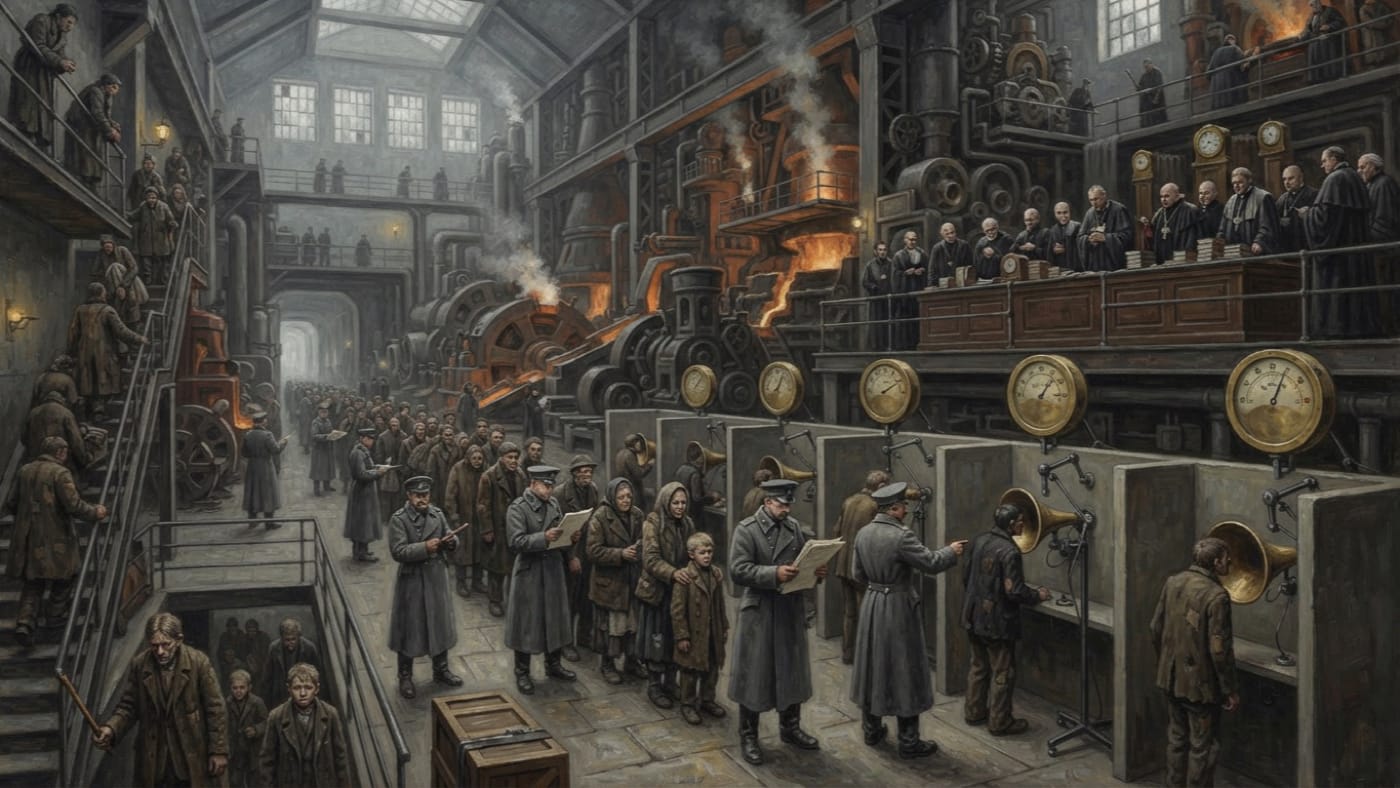
#On a Tax Paid in Breath
The voice tithe is the levy by which Essen-of-Hymnsteel collects its singers. The city's own register lists it with coin, steel quotas and labour-hours, and defines it as mandatory choir service for certain classes. Mark the word certain. The clerks of Essen would prefer that you skimmed it.
Essen exists to make Hymnsteel, and hymnsteel is steel poured under prescribed song. The song has to come out of somebody. Every bell-cannon throat, hymn-drive housing and reliquary fastener bound for the Sagittal Line meets a calibration voice before it meets inspection. The Bureau of Orison and Song licenses the hymns. The Bureau of Engines and Furnaces demands the output. The Bureau of Records writes everyone down. The tithe sits between those three desks and supplies the one material none of them can forge.
The singers call it the throat tax. Orison objects to the phrase on doctrinal grounds and has never troubled to refute it on factual ones.
#On the Origin, Which Nobody Has Found
I went looking for the founding writ of the voice tithe and found nothing. The tithe already existed when the record first mentions it, and the record mentions it only to say that it grew.
The dated sequence is short. In A.S. 110 the Tri-Bureau Compact ratified Essen as the Synod's hymnsteel city, and voices became infrastructure. In A.S. 115 the first Orison barrack block went up on the north furnace terrace, and that house became the Throat Dorms. In A.S. 118 Essen received its sanctified suffix by decree, and the voice tithe was enlarged.
Enlarged. Nothing can be enlarged before it exists. Whatever the tithe was before 118 lies outside every file I hold: its size, its classes, the year some clerk first entered a child's name beside a pitch mark. I decline to supply any of it. Records will forgive a missing date. It does not forgive an invented one, and on this point the Bureau and I are in rare and tender agreement.
#On the Three Gates of A.S. 118
The enlargement opened three routes into chorus labour. Pamphlets lump them together, and they should be kept apart. The first is a debt laid on a bloodline. The second is one sentence exchanged for another. The third is an offer made to the cold and hungry.
The families. Certain families in the Ash Warrens owed one child's throat per generation if the child's pitch marks met Orison standard. Every clause in that sentence is a separate condition. Certain families: the record does not name them, and it does not say how a household got onto the list. One child per generation: a long period on the ledger for an instrument that wears out quickly. If pitch marks met Orison standard: the debt applies only to a voice that qualifies. The record does not say what happens to a family whose children all sing flat. The debt might wait, lapse or pass to someone else. I will not guess on its behalf.
Every family in the Ash Warrens owes the Bureau one child's throat per generation.
Corrected. Certain families owe it, one child per generation, and only if that child's pitch marks meet Orison standard. The broader version is easier to say and easier to fear. It is still wrong, and the Bureau of Doctrine does not let fear do Records' arithmetic.
The condemned. Condemned labourers with tolerable hearing could commute lash sentences into chorus duty. The operative words are could and tolerable. The decree granted a right of exchange, and only to those whose ears had survived Essen well enough to hear the brass standard answer them. In a city where the poor go half-deaf by thirty, hearing is a scarce asset, and a convict with ruined ears kept the lash. The record does not say whether every lash sentence carried the offer. It does not say how many strokes bought how much singing, or whether chorus duty had an end that anyone wrote down.
The refugees. Refugees with clean voices received warm bunks and ration priority. In Essen that offer is generous. The city imports refugees with its coal and tallow, and it settles them in the Warrens, where families rent floor-space over the waste-warmth ducts and pay in heat credits that Ledger Row can revoke for a missed payment. A warm bunk is heat that costs no credit. Ration priority is bread before the queue thins. In return, as the Dorms entry records, the refugee won the right to ruin themselves for the Line at closer range. Nothing in the record compels a refugee to accept, and nothing has to. Hunger keeps its own roll.
#On What the Throat Buys
Whichever gate they come through, recruits enter Orison custody. The Throat Dorms stand above the Foundry Core, between the Hall of Measures and Ledger Row, and they house about two thousand calibration voices. That number is the barracks' population. It is no tally of the tithe. The Dorms entry lists the usual paths into those bunks as tithe, debt, sentence, family bargain, orphan transfer and the rare genuine calling, and no file I hold says how many came by each.
The same entry records the routine. Each day begins with steam and throat inspection at First Bell. In the Pitch Court each singer lifts a note toward the brass standard, which answers true, sharp, flat or silent. Then come the shifts down to the pours, and herb and gargle afterward. The entry records the costs too. The voice frays and the pitch drifts. Throats scar, and ears fail. A career lasts nine years on Essen's average, and some voices fail in three. A spent singer is reassigned to lock duty, slag sorting, clerical whisper work or the Warrens duct crews. These are the conditions of the house. No file tells me which tithed throat met which injury, and I will not hand any one of them a fate the record has not issued.
I note one path only because the record makes it possible. A refugee who sang for a warm bunk may finish on a duct crew in the Warrens, under the same warm pipes, without the voice that paid for the bunk.
#On the Language of the Thing
Municipal guidebooks once called entry into the Throat Dorms "voluntary vocational devotion." The Dorms entry has already struck out voluntary, and I endorse the deletion. Some choice exists among the three gates of A.S. 118. The condemned labourer may keep the lash. The refugee may stay cold. The family that owes a qualifying child has nothing to choose at all.
The tithe delivers its voices into a house where bleed shifts are abolished in every public word and continue in practice. The Dorms entry defines a bleed shift as any pour in which singers stay at their stations after the throat surface ruptures, because the metal is cooling and the batch is wanted. The steel cools true and the report praises the cohort's discipline. No new doctrine was needed for this. An old one simply got new phrasing.
The singers have their own answer. The Throat Line, their barracks brotherhood, bargains over the length of pauses, the quality of herbs, the routing of corpses, and whether a singer's family keeps its heat credits after the singer fails. For the tithe, the last item matters most. A Warrens family that gives up a qualifying throat and then loses its duct-space when that throat gives out has paid twice. I have no record of what the Line has won on this point. I record that it keeps asking.
#On the Present Application
The Bureau of Doctrine's A.S. 201 seal on the Throat Dorms states that the voice tithe continues. That is the present fact, and I add nothing the seal does not contain. The seal does not say whether the terms of A.S. 118 still stand word for word: the same families, the same commutation, the same bunks and rations. I will not pretend it does.
What the present record does show is demand. The Dorms are overfilled and under-rested. A Strasbourg procurement mandate calls for triple the output for hymn-drive siege engines. Sister Rauth refuses to speed up without stability guarantees, and Furnace-Marshal Kord threatens conscription. Records profits whichever of them wins. The tithe sits under that quarrel like a cistern under a mill. Every demand from Engines for more song is a demand for more throats, because Essen has no other source of song. Cartilage has never read a procurement mandate, and it takes no instructions from one.