

#On the Bench and Its Business
"Count sacks like sins." — Bureau of Tithes, Granary Inspection Manual
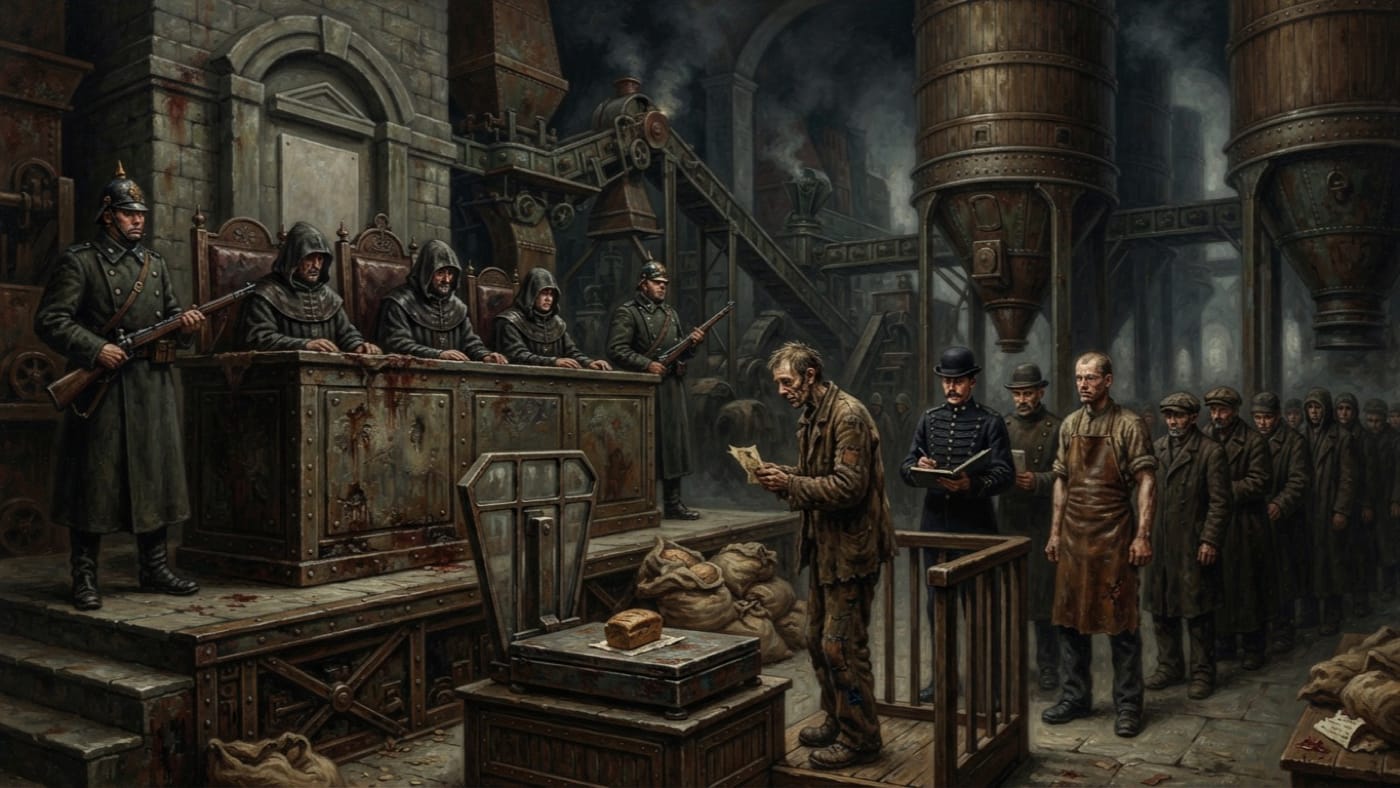
The Tribunals of Grain sit among the lesser organs of the Bureaucratic Synod. The Lore lists them below the Archons and alongside such offices as the Censorium of Taverns. Their written commission is one line long. They weigh disputes over bread-rations. In a Dominion where the loaf is stamped with Bureau wax, the queue walks like a procession and the chit is read like scripture, a quarrel over bread is also a quarrel over doctrine. The bench that settles it holds both sets of scales.
They are plural, and the Registry keeps them that way. I have found no headquarters for them, no founding charter and no map of their boundaries. Wherever bread is disputed, a Tribunal of Grain may be convened to weigh it. Wherever one is convened, the dispute already belongs to the Church.
Their scales are rumoured to tilt toward Strasbourg's granaries. The rumour is old and widely repeated, and no calibration report I have been allowed to read supports it. I record it because the Lore records it. I do not repeat it at table.
The record does not say who sits on these benches. Archons interpret Synodical decrees and deliver judgment across the provinces. Whether an Archon presides at a given grain hearing, or a canon does, or a clerk in a borrowed stole, depends on the province and the season. I will not invent a panel. The Bureau invents enough of them.
#On the Registered Loaf
You cannot dispute bread until bread has a number. The First Ration Reforms of A.S. 104 (1814 by the Common Era) gave the ration chit one design across eight provinces. From then on, a household's hunger had a printed shape. The household went into a ledger and its entitlement onto a chit, and its stores could be put on a scale in front of witnesses. Hunger had been a private matter between a family and the Creator. Now a clerk could read it.
That reform supplied the Tribunals with their arithmetic. It did not supply them with a birthday, and nobody should read one into it.
Collection belongs to the Bureau of Tithes, whose Assessors travel with scales, ledgers and an armed escort and preach that withholding a tithe starves the Synod's soul. Pursuit belongs to the Bureau of Purity, whose bone-white mantles make parents whisper obedience to their children. Whatever either Bureau brings in, the Tribunals weigh. They are the place where an entitlement on paper meets a sack on the floor and someone has to answer for the difference.
#On the Half-Portion
Purity issued the Order in A.S. 134, or 1844. It is the instrument that made the Tribunals famous among people who had never had a quarrel over bread in their lives.
Mind the words more than. A cellar holding exactly half a portion over its allotment does not meet the Order. That is the only mercy in the text, and it is a narrow one. The Order says nothing about grain below its line. Every other statute and every other officer who might take an interest in a smaller surplus still stands where they always stood. 22-H marks where its own reach begins. It does not mark where anyone else's reach ends.
The Order also leaves two things unwritten: how much a portion weighs, and how the registered allotment was reckoned. The chit knows what the clerk entered. The kitchen knows who actually eats. When the two disagree, the Tribunal has the chit in front of it.
Spiritual sabotage is Purity's phrase, and it was chosen with care. Theft has its own statutes. A thief wrongs a neighbour. A saboteur strikes at the Covenant, whose rations are liturgy. A private surplus turns a cellar into a second altar, and the Church keeps one altar.
The Order does not say how grain is to be found, because finding it was already an old craft. Inspectors weigh the bins. They check the seal twine and match chits to signatures. They question the queue captains about who ate well in a lean month. Against them stands everything a Grain Keeper owns that does not appear on an inventory: false-bottom bins, waxed sacks, forged chits and spoilage reports written for grain that never rotted. All of it exists to make a cellar weigh what its ledger says. The prudent Keeper keeps a sacrificial bin for the inspector to find and leave satisfied. When that trick fails, the paperwork moves.
The inspector finds, Purity refers and the Tribunal adjudicates. That makes three acts and three different hands, and everyone in the queue knows the sequence by heart.
The Tribunals of Grain were established by Standing Order 22-H.
Corrected. The Order refers spiritual saboteurs to the Tribunals. It does not create them. Their founding instrument is not on file with this office, and the claim that they were weighing bread before A.S. 134 remains, for now, a thing I have heard and not a thing I have read.
#On Sentence
Sentences run from public confession to immurement. The Order names those two ends and leaves the space between them unfurnished. I decline to furnish it for them.
Purity recommends immurement. A recommendation is a preference with a seal on it. Referral is Purity's act, judgment is the Tribunal's, and the recommendation travels between them. It is loud, it is official, and it does not bind the bench. Some defendants confess before the line and go home thinner. Others do not go home.
When the sentence is the wall, the writ leaves the court. An Immurement Mason checks the seal against the writ, cuts the niche, lays the courses and sets a plaque with the name and the charge. The Lore records that in the Bastions, those caught hoarding grain are punished as heretics rather than thieves and are walled into bakery walls, so that bread itself has witnesses. The bakers knead beside them every morning, and the loaves come out properly sanctified.
#On the Necessary Cellar
"No one audits a famine." — Keeper proverb
Every defendant is weighed on the same scale, and they are not all the same person.
The Mercy Keeper hides grain so that children eat first and takes nothing for it. The Quota Man keeps the official store immaculate and skims a little against the week the convoy fails. The Hunger Broker holds back sacks for recruitment, debt and obedience, and decides which family has earned its supper by its silence. Under 22-H all three are spiritual saboteurs, charged in the same words. That is the Order's only fairness. Behind them in the queue stand defendants who belong to no movement: a widow whose chit has not yet caught up with a birth, or a labourer whose allotment shrank when his lungs did. A cellar is a cellar, and the Tribunals do not hear sermons about motive.
The Bureaus do not want the same thing from these benches. Purity prosecutes. Tithes tolerates diversion that keeps the supply moving and the queues quiet, because a ward in riot pays no tithe. The Bureau of Shadows watches the Keeper networks with an interest it calls professional. None of this toleration is written down. A Keeper cannot carry it into a hearing and lay it on the table. It explains why one district's cellars are raided twice in a winter while another's go untouched for years, and that is all it explains.
Then came the Weevil Year, A.S. 157 (1867). The lawful stores rotted in their silos, and the hidden caches the Order had spent twenty-three years hunting kept whole districts alive. The Church stopped asking certain questions for a season. No statute I have read lets an accused plead that the ward needed the cellar. No statute forbids a bench from noticing which ward still has a pulse. In A.S. 158 the Bureau of Agriculture was dissolved. The Order was not.
#On the Present Condition
"Bread is obedience made edible." — Ration Catechism, opening line
The present survey, A.S. 201 (1911), finds the Tribunals sitting and the Order in force. Purity's sealed assessment of A.S. 199 claims seventy per cent of organised grain diversion in the western provinces eliminated. For the same period, Tithes' revenue figures show eleven per cent. The two Bureaus measured two different things, and both figures were accepted without comment. Neither counts a single verdict. I have no conviction rate for the Tribunals of Grain, and I will not mint one.
West of the Sagittal Line, the Keepers' cellars and the Tribunals' benches serve the same population. Purity refers. Tithes looks away when looking away pays. The Bureau of Doctrine keeps the larger ledger in which both entries balance.