
#On the Masks
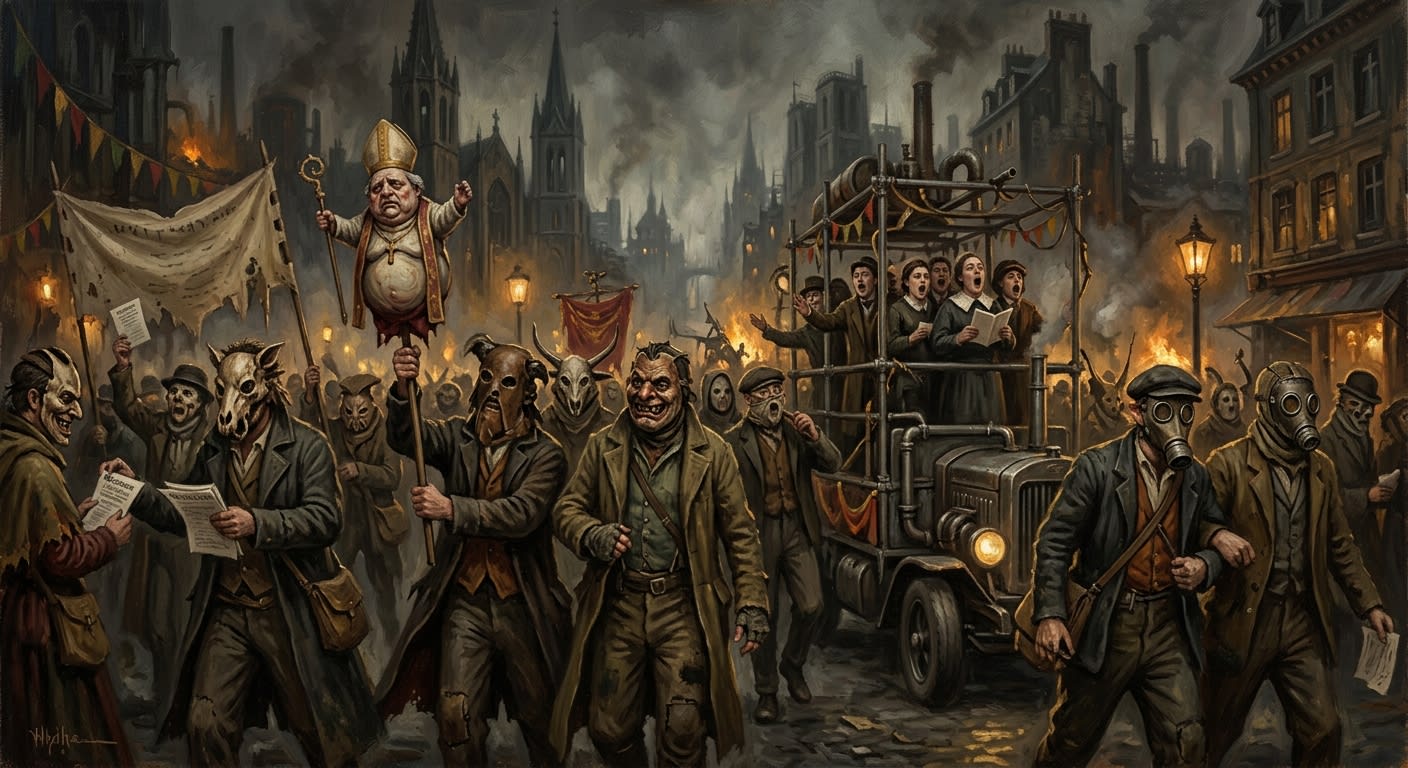
The Tumults of Lyon occurred in A.S. 170, during the licensed Carnival of Saint Bérard’s Misrule, a festival whose name alone should have condemned it to the corrective attention of every sane Bureau in Strasbourg. Lyon had always loved masks. Lyon loved masks the way debtors love aliases, the way actors love exits, the way heretics love any object with a face that can be blamed afterward.
Carnival masks in Lyon were officially devotional. The goat represented stubborn sin. The fox represented cunning brought beneath the Creed. The fish represented old Rhône superstitions drowned by proper doctrine. The blank white face represented penitential anonymity. The Bureau of Festivals approved these interpretations in A.S. 132 after receiving the customary licence fees and three barrels of local wine, which may explain the generosity of the ruling.
By A.S. 170 the masks had become civic infrastructure. Bakers wore flour-white saints with red mouths. Students wore painted bishops. Laundresses wore wolf-snouts. Children wore little demons whose horns had been softened by regulation to prevent eye injuries and theological confusion. Attendance Auditors tolerated the custom because masked citizens still purchased permits, and a permitted face, even a false one, remains legible to revenue.
#On the Pamphlets
The first pamphlets appeared in the Fishmarket Quarter beneath masks of Saint Bérard’s Laughing Goat. They were folded into sweet wrappers, tucked beneath garland knots, pinned inside cloak hems, and passed from gloved hand to gloved hand during the authorised Procession of Licensed Folly. Their title varied by copy. The Hierarch Dances Hungry. On Joy Without Permission. A Short Catechism for Men Tired of Being Counted. The Bureau of Silence later insisted there had been only one pamphlet, for singular nouns are easier to prosecute.
The texts attacked the Bureau of Festivals with the ugly precision of people who had read its forms. They mocked the Prescribed Ovation Index. They printed the fee schedule for mask permits beside the grain shortage tables. They described Attendance Auditors as “men who count laughter because they cannot produce it.” This line, though seditious, possesses craft. I record it under protest and with professional irritation.
The pamphleteers understood Carnival better than the Bureau. A mask turns distribution into mist. A man with a fox face hands a paper to a woman with a fish face; the fish hands it to a child dressed as a penitent bell; the bell vanishes beneath a procession cart; the Auditor records three costumes and no names. By the time the first seizure order reached the plaza, seven thousand citizens had read at least one forbidden line, and another twenty thousand had heard it shouted by someone whose face the law could not describe.
#On the Puppet Show
Every riot has its sacrament. Lyon’s was a puppet show.
At the third hour after Vespers, in the square behind the old silk exchange, masked celebrants gathered around a licensed booth operated under Permit LY-170-C/44. The booth had been inspected that morning. The puppets had been approved that morning. The script submitted that morning concerned Saint Rupert correcting a greedy miller. At performance, Saint Rupert failed to appear.
A bear entered instead, wearing a crimson mitre and a tiny chain of office. It capered. It demanded tithes in honey. It blessed a sausage. It mispronounced the names of three Bureaus and sat on a miniature Ledger while the crowd howled through wooden mouths.
Doctrine later classified the performance as creative blasphemy. Festivals classified it as unauthorised theatre. Purity classified it as contagion. Records, after three revisions, classified it as “a dramatic irregularity involving symbolic episcopal fauna.” I classify it as funny, which is why it was dangerous.
Transcript fragment from seized booth notes: BEAR-HIERARCH: “Bring me the Ledger. I have eaten the old one.” GOAT-CLERK: “Holy Father, the people ask for bread.” BEAR-HIERARCH: “Then count their mouths until they are full.” [Audience response excised. Names of laughing Auditors sealed. One Auditor subsequently ████████████.]
The first Attendance Auditor moved to halt the performance. Someone struck him with a plaster moon. The second Auditor blew a cue whistle. The whistle produced no sound because melted sugar had been packed into it. This detail delighted the mob, and delight, once armed with timing, becomes command.
#On the Tumult Proper
The violence lasted nine hours, though Bureau catechisms prefer “one afternoon,” afternoon being smaller and easier to fold into a moral lesson. Two Attendance Auditors were assaulted. Twelve festival stalls burned. Thirty-one registered masks disappeared from evidence wagons. Three Purity patrols were misdirected by false procession banners. A choir of apprentices sang the sanctioned refrain to Saint Bérard with one altered syllable, changing “obedience sweetens folly” into “obedience fattens fools.”
The Festival Chorus-Masters failed first. Their cue bells could not regain the crowd. Their planted shills were identified because they clapped with professional regularity. Their emergency creed-drills dissolved into laughter. One Grade VI Chorus-Master, name sealed by mercy or embarrassment, attempted the encore tax — one permitted chorus in exchange for a recitation of the Creed. The crowd recited the Creed backward. Incorrectly. With enthusiasm.
At the silk exchange, pamphlets rained from an upper window for forty-seven minutes. At the Rhône steps, masked women formed a cordon to keep Lictors from entering the square; three were arrested, six were recorded twice under different masks, and one appears in the file as “Wolf, elderly, possibly multiple persons.” At Saint Nizier (Unregistered), the bell rope was cut and replaced with a chain of tied festival sashes. The bell rang once before the chain snapped. The sound is described in witness accounts as “pleased.”
Initial Bureau reports described the Tumults as a spontaneous disorder caused by excessive drink and insufficient supervision.
Withdrawn. The distribution pattern, sugar-packed whistles, altered procession banners, and false permit stamps indicate planning. Excessive drink remains probable. Insufficient supervision is admitted only in sealed rooms.
#On Suppression
By nightfall, Lyon had received the kind of attention no city should desire. Purity sealed the bridges. Festivals locked the costume houses. Silence confiscated printing blocks, song sheets, puppet heads, mask moulds, tavern chalkboards, and six hundred blank sheets of paper on the grounds that blankness showed intent. Bells ordered three hours of corrective peal. Rites objected to the hour. War supplied men who did not object to anything they were not paid to understand.
The puppeteers were immured. The pamphlet printers were hanged in batches of four so the crowd could not make a rhythm of the drops. The two assaulted Auditors recovered and were promoted, which is the Bureau’s preferred balm for humiliation. The dancing bear puppet was burned under triple seal, though one inventory lists “charred ursine mitre, miniature” as transferred to Strasbourg. I have not seen it. I have looked.
The three provinces lost Carnival rights in perpetuity, a word the Bureau uses to mean “until revenue argues otherwise.” Lyon received permanent festival Auditors. Every major observance since has carried the second occupation: men in grey sashes at alley mouths, cue bells tied shut until authorised, mask stalls converted into confession kiosks, puppet booths inspected for hinges, hidden compartments, and satire.
#On the Aftertaste
The Tumults did not nearly topple the Synod. That phrase belongs to melodramatists and foreign pamphleteers. The Tumults did something worse. They proved that the Bureau’s own machinery could be used against it: licence forms forged, permitted costumes repurposed, sanctioned songs altered, processions rerouted, laughter converted from pressure valve into powder charge.
A later Lyonnais devotional print claimed that no citizen of good standing participated in the Tumults.
Corrected. Citizens of excellent standing participated. Bakers, apprentices, widows, students, choirboys, two minor clerks, one licensed mask-maker, and at least one Attendance Auditor whose laughter appears in three depositions despite his later denial. Good standing is not innocence. It is merely guilt with tidy accounts.
The Bureau of Festivals learned. After Lyon, the Prohibited Register expanded. After Lyon, Carnival masks became contraband across three provinces. After Lyon, puppet scripts required inspection of both text and joints. After Lyon, Chorus-Masters were trained to fear laughter that arrives too quickly, too evenly, or from behind a wooden face.