
#On the Pageant That Mistook Itself for a Nation
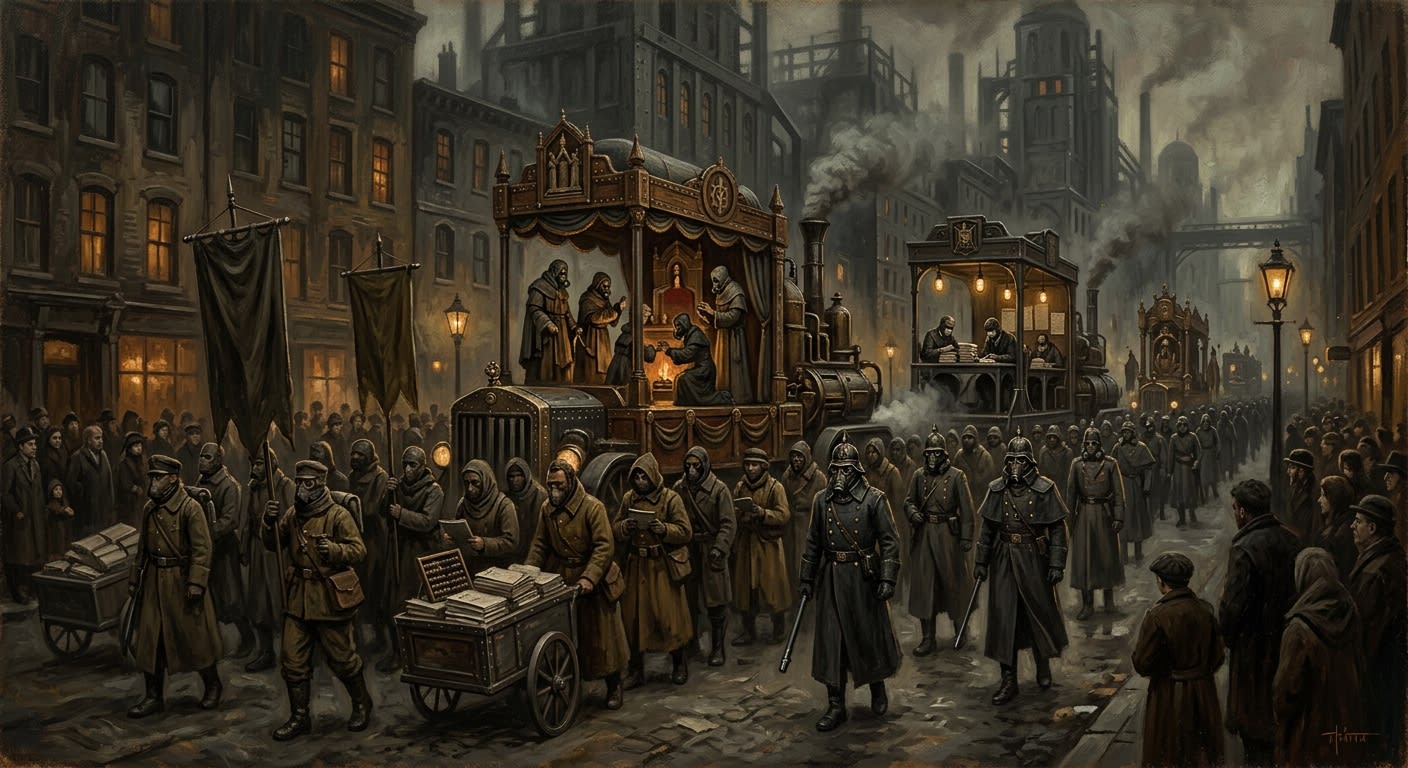
The Procession of the Triune Hearth was first staged in A.S. 175, five years after the Tumults of Lyon taught the Bureau of Festivals that a crowd in costume could become a weapon if not given heavier costumes, longer scripts, and more expensive supervision. This is the Bureau’s genius: when a thing threatens to riot, enlarge it until only a department can move it.
The Procession commemorates the Concordat of Strasbourg, by which France, Iberia, and the Rhineland were bound into the Triune Hearth beneath the Synod’s seal. The Concordat had already possessed ceremonies. It had bells, relics, oath renewals, schoolroom chants, mayoral kneelings, and the annual viewing of the black oak table in the Hall of the Triune Hearth by citizens who have filed Form 77-C and have committed no recent impropriety visible to Purity. Festivals judged this insufficient. The nation required theatre big enough to crush the memory of separate nations beneath its wheels.
#On the Route and Its Burdens
The approved route begins at Strasbourg, because all lawful movement begins at Strasbourg even when geography protests. It proceeds through eleven cities over forty days, binding the old Hearth territories in spectacle before terminating at the Pilgrim’s Gate (Unregistered) of Bastion-Constantinople, where the jurisdiction of Festivals touches the iron hem of War and wisely stops. The Bureau of Festivals once requested permission to process beyond the Pilgrim’s Gate. War replied with a map, a casualty table, and the words “No floats beyond this line.” Brevity is rare in War. Treasure it.
The route changes by revision, plague, rail capacity, bridge condition, episcopal vanity, and whether Tithes has discovered a province insufficiently grateful for last decade’s assessment. Strasbourg remains first. Constantinople remains last. Between them come the usual civic throat-clearing: Lyon with its watched masks, Cologne with its relic-streets, Mainz with Augustinian pomp, Marseille with salt accounts pretending to be hymns, Seville with auditors counting silence, and other cities whose mayors pretend enthusiasm while calculating street damage.
Forty days of passage require road repairs, stable requisitions, choir billeting, latrine trenches, food carts, water discipline, relic guards, horse surgeons, confession tents, floatwrights, rope teams, torchmasters, banner laundries, and clerks sufficient to give the Creator Himself a headache. The Procession employs four thousand participants: bishops armoured so heavily they require lifting crews, peasants chained in rehearsed misery to dramatise sin, saints’ bones borne beneath glass, licensed children dressed as virtues, penitent guilds, veteran contingents, pageant oxen, and ninety-seven floats, each more doctrinally swollen than the last.
#On the Ninety-Seven Floats
The floats are the Procession’s moving scripture. They creak, smoke, chant, leak wax, shed gilt, frighten horses, and teach history in the only form most citizens can survive: large, slow, and accompanied by drums.
The first float is always the Hearth Itself: three iron braziers labelled France, Iberia, and Rhineland, mounted around a central black seal of Strasbourg. Their flames are lit from the Basilica coals and guarded by six flame-keepers who have sworn not to blink during formal crossings. They blink constantly. Records pretends otherwise.
The seventeenth float bears the Table of Concord, a replica so heavy that eighteen oxen are required to drag it and one clerk is assigned solely to deny that it is heavier than the original. The thirty-third float presents the Atheist Wars as a pit full of paper snakes. Children love this float, which has caused Doctrine some alarm, because children love the snakes more than the saint who stamps them flat. The sixty-ninth float is Seville Corrected: taverns closed, mouths covered, cups raised in silent obedience. Seville watches it pass without applauding. The Auditors record this as compliance.
Earlier festival broadsheets claimed the Procession contains one hundred floats, a perfect number suitable to universal order.
Corrected. There are ninety-seven. Three planned floats were removed after Tithes refused funding for “allegorical duplication,” by which it meant that three separate floats depicting the generosity of Tithes struck even Tithes as dangerous overstatement.
Float LXXXIV, The Nations Yet to Kneel, is sealed from foreign observers. Its current form includes Italy in anticipated compliance, England in providential quarantine, and ████████ beneath a cloth of black velvet. During the A.S. 195 rehearsal, the covered section moved against the direction of the draft animals. The floatwrights filed a maintenance note. The note was eaten by the folder.
#On the Census Hidden in Incense
The theological purpose of the Procession is unity. The practical purpose is counting.
Every citizen who watches is counted by Attendance Auditors stationed at balconies, church steps, market gates, bridgeheads, tavern windows, rooflines, and confession queues. Every citizen absent from a compulsory viewing zone is entered on a secondary list. Every cheer is timed. Every genuflection is scored. Every failure to remove a cap before the Hearth float is cross-filed with parish tax data. A procession passes; a census remains.
The data flows to Records, Purity, Tithes, and Festivals under separate seals, because no Bureau trusts another Bureau with numbers until the numbers have been copied badly enough to become proprietary. Families discover old deaths corrected. Widows discover husbands reclassified. Apprentices discover they have been eligible for levy since last winter. Shopkeepers discover joy has square footage. Children discover attendance can be inherited as obligation.
#On Cost, Objection, and Glory
The first Procession cost more than Bastion-Brest’s annual defence budget. This figure has survived every attempted correction because it is too useful to all parties. War cites it as proof that Festivals is insane. Festivals cites it as proof that unity costs less than civil war. Tithes cites it when raising levies. Doctrine cites it in sermons on sacrifice. Bastion-Brest cites it with language unsuitable for pilgrims.
The expense is obscene. The expense is also productive. Roads are repaired before the floats arrive. Bridges are strengthened under threat of episcopal embarrassment. Inns are inspected, wells cleaned, streets swept, prisoners hidden, beggars relocated, heretics arrested, and civic façades painted a shade of public devotion that lasts exactly until the rains. For forty days the Synod sees itself moving, and for forty days each city behaves as though seen. Surveillance rarely arrives with so much bunting.
The Bureau of Festivals’ A.S. 185 accounting summary described the Procession as “budget-neutral after devotional yield.”
Rejected. Devotional yield is not legal tender, though Tithes has investigated the possibility with a seriousness that should worry the faithful.
The Procession recurs every tenth year. Children who first see it from their mothers’ arms later march in it chained as penitent guildsmen, then watch it as householders, then appear on absence lists when age has taken them indoors and the Auditor at the door asks whether infirmity has been properly certified. A pageant becomes a clock. A clock becomes jurisdiction. The Hearth burns on schedule.