

#On the Record Below
"Warmth is evidence." — Candle-Sump proverb, admissible in no court the Bureau maintains
This entry concerns what lies beneath Candle-Sump: the burial lanes, crypt routes and associated passages under the lowest and wettest quarter of Lower Vire, on the river's inner bend, in the western River-belt and well inside the safe heartland of Zone 1. The vent alleys and doors above them form a separate ward, the Crypt Mouths, and that ward has its own entry. A reader who confuses the two will be reading about the one while breathing the other. Nor has this entry anything to do with the Underwire of Przemyśl or any other city's tunnels. Every city keeps a cellar. Few keep one that talks.
What follows is a desk survey. The Bureau commissioned it in A.S. 201 / 1911 CE, and I compiled it from papers already in the Bureau's keeping. I made no descent to write it. I measured nothing, excavated nothing and questioned no one, and I would like that entered as method rather than cowardice. My only time in the district was the sanitation assessment of autumn A.S. 197 / 1907 CE. Wherever I draw on that visit, I say so. The papers include no surveyed plan of the underworks, and they do not say whether anyone ever drew one.
#On the Burial Routes
Before the Sundering of 1 November A.S. 45 / 1755 CE, this bend of the Vire held a riverside shrine district, and the shrine district buried its dead in lanes cut beneath it. That is the whole founding narrative, and I will not pad it. The published district account places the routes before the Sundering and establishes nothing else. It gives no year of excavation or first burial, no builder, no patron, and no power under whose warrant the stone was cut. The Bureau of Records lists the congregants as "pre-doctrinal population, unrecoverable." That heading records a filing decision. It is no theology.
The canal district above came later, and it came by accretion: lock-side housing first, then chandlers, then the bone trade. None of its dates applies to the stone underneath.
The record lists what survives below only by kind: burial lanes, crypt routes, maintenance passages and shafts, ladders, forgotten tag vaults and catacomb pockets, some of them marked collapsed. It does not say whether the tag vaults belong to the age of the shrine district or were added later for the Registry's convenience. On the surface the underworks are known by what they cause. Sinkholes open over old crypts. Grates stay warm in winter, and the poor call those spots warm corners.
Two isolated entries bear on the routes directly. One describes a hollow pier at Candle Bridge that is said to drop to an underworks ladder. The other is a concern, listed among the district's prospects, that Sluice Gate IX conceals underworks access. The record does not connect them, and I will not draw the line myself. In this district a line drawn on a page is a route by morning.
#On the Seals and Their Keepers
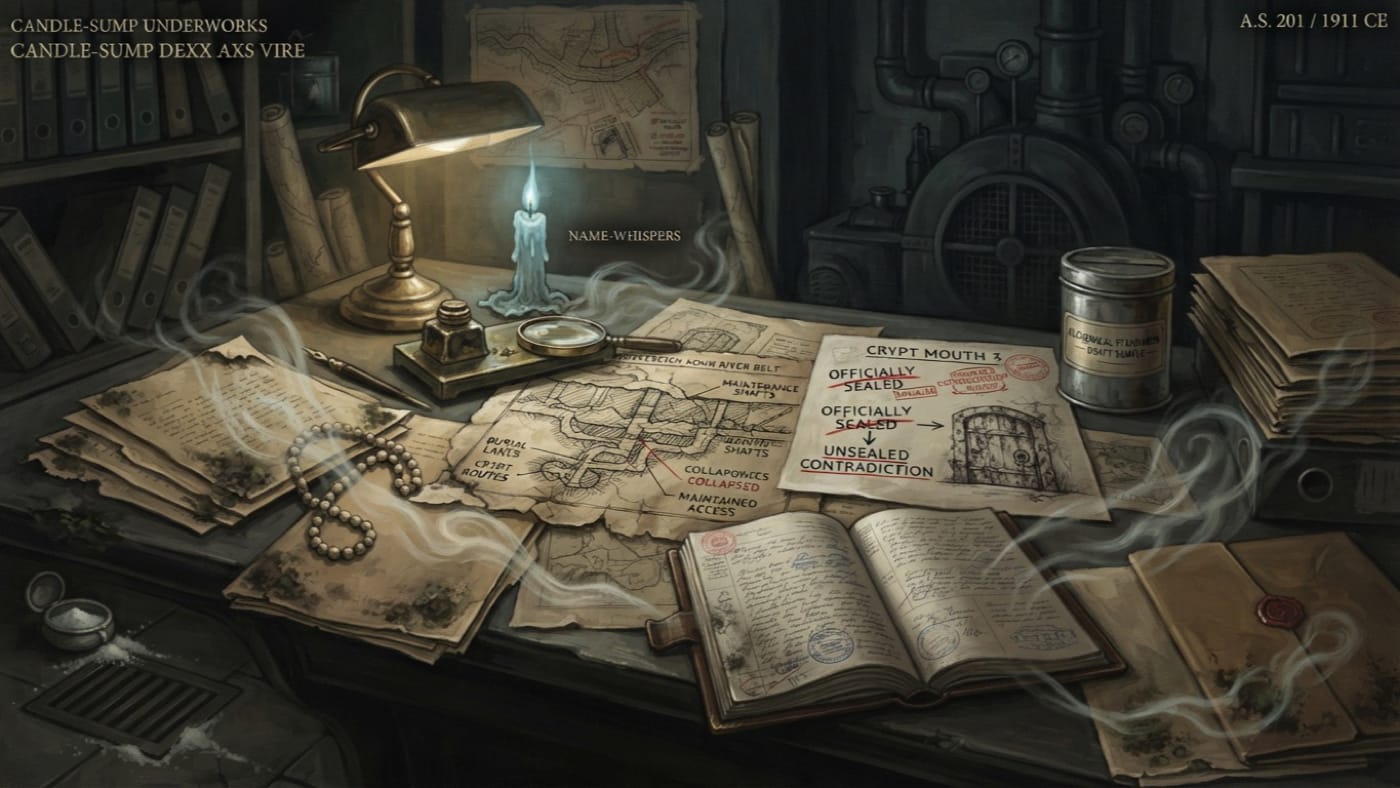
Officially, the routes are sealed. On Sluice Prefecture maps the tunnels are marked collapsed. The district record that holds both claims also describes the passages as maintained and in use. All three statements are on paper and under seal, and I have no authority to strike any of them.
Crypt Mouth 3 shows the whole difficulty. It is a vent alley of cold stone and sweet rot and a known site of rot-lung exposure. The district record lists its door as sealed, and the same record describes it as not sealed. Any reconciliation I offered would be my own invention, and nobody has commissioned me to build doors.
"The Synod sealed the crypt mouths. The seals hold." — Candle-Sump district assessment.
The record does not support so general a claim. The same assessment records maintained passages, a working registry in tunnels mapped as collapsed, and a door at Crypt Mouth 3 entered as both sealed and unsealed. Some seals survive on some doors. The underworks cannot be certified sealed. The companion entry has withdrawn the attribution of the sealing to the Synod, and this entry does not restore it. No record gives the date of the first sealing or names who carried it out.
The keepers are the Crypt-Mouth Wardens. Their public duty is vent maintenance: clearing the grates and keeping the shafts drawing. The record gives them keys, masks and maps. It says they work at night and in silence, and it states their purpose as keeping the underworks sealed, or selectively open. It does not say who does the selecting. None of their maps has been lodged with this compilation. A working crew's map is a note to itself. It is no survey. I found no roster, no commanding officer, no warrant and no founding date. The record places them among the "Underworks Touched," whom it calls erased-but-used, and that phrase is all the roster there is.
Nor should the reader conclude that every Warden who turns a key knows what passes behind it. A crew paid to keep air moving need not know what the air carries, and the record does not say how many of them do.
#On the Drafts
Air rises from the underworks through the vent alleys and maintenance shafts. It comes up warm, and fog collects where the draw is strongest. It carries rot-spores. It also carries what residents call name-whispers: faint sounds that resemble syllables, and then names. Near the vents, paper fuzzes at the edges and ink bleeds into illegibility. Coughing worsens at particular corners, and residents have known for generations which ones. When the draft turns sweet, the alleys call it vent-sweet and stop breathing through the nose.
Candles near the mouths gutter in patterns that resemble letters, and some are reported to burn blue. The record calls the flame a cold blue. I enter that as a colour only, because no one has measured its heat. The local rule is short: "If your candle burns blue, don't say your name that night." My report of A.S. 197 records a guttering candle in the Bone-Tag Arcade that I declined to read. I decline again.
Reports of blue flame deserve suspicion. The Wickmarket sells counterfeit blue-burn candles. The Quarantine Provosts act on blue-burn reports, and residents have learned to file one when they want a neighbour removed. A reported flame is a filed document, and nobody has shown how many of those documents describe a real one.
The drafts do their worst damage where they meet paper. Rot-lung strikes clerks and paper workers first, and the Bone-Tag Arcade loses staff on whichever side of its counter faces the vents. Vinegar baths and wax-sealed folders keep documents legible for longer. Residents lay salt lines around the vents and wear bone beads at the throat, and the record's verdict on both is that they help "sometimes." The Bureau of Doctrine has certified no cure.
In A.S. 194 the Bureau of Purity classified the draft complex as a Category Two Localized Atmospheric-Scribal Disturbance. In A.S. 201, seven years on, that classification is still pending review. The Bureau of Alchemical Standards holds a field notation with the same designation. It sent three survey teams, and their reports agree only that the phenomenon continues. The notation recommends a further survey, and its page of additional notes is marked as removed by the Sluice Prefecture. I have not seen that page and will not guess at it. The Prefecture also controls the gate timings and flood releases, and through them the airflow at the mouths. The record does not say how finely it can regulate that air.
Doctrine has not ruled on what the whispers are. Some in the alleys hold that the Creator permits them, some that the Great Deceiver contrives them, and some that the stone simply keeps them, as scraped vellum keeps the ghost of its first text. Each view has its advocates, and none has a seal.
#On the Names in Circulation
The parent assessment has already made the matter public, so I state it plainly. A shadow registry operates beneath the mouths, in tunnels the Prefecture's maps call collapsed. Names taken from the drafts are copied onto fresh paper and passed up through the Washhouse into the legitimate channels of the Bone-Tag Registry, and from there toward the Great Ledger of Souls. The clean slips that result carry accurate seals and regulation ink, on paper that matches the Registry's own stock. Street forgery cannot produce these things. They are evidence that someone has access to an institution's supplies. How the work is done is for an auditor's eyes alone.
Each party gains something different. Chief Clerk Dalen Voss's Registry gains control over who exists. The Washhouse gains profit. Through its gates, Prefect Sera Mott's Prefecture governs the air, and the names travel on the air. Below all three is a hand the record does not identify, and the record states neither its allegiance nor its purpose. None of these interests can be called sovereign over the underworks. Benefit does not prove control, and I certify no particular officer guilty.
The names themselves are less tidy than the parent assessment implies. That account calls them the names of the pre-doctrinal dead, but the Arcade's own entry admits deaths from both sides of the Sundering. I leave the origin of any particular name to whoever is unwise enough to audit it.
#On the Present File
In A.S. 201 the Registry and the Prefecture are disputing ownership of a stockpile of seized clean slips. Rot-lung reports are rising, and so are reports of blue flame, though the second figure carries every caution given above. The Washhouse is planning a mass identity swap with slip stock it claims came from below. The plan has not been carried out, and it has not been abandoned. A transfer order for Inquisitor Halvyr, called White-Lung, who carries a portable audit press and burn authority, is still moving through Purity's approval chain. I make no forecast about what Halvyr will do with an underworks whose own record lists it as both sealed and open.
The review begun in 194 remains pending. The Wardens are still at work, and the draft still rises.