
#On Silence as Contagion
Standing Order 22-D is the law by which the Bureau of Purity taught silence to incriminate itself.
Before the Order, the Synod possessed many instruments for punishing speech. Heretical pamphlets could be burned. False sermons could be transcribed, indexed, anatomised, and nailed back into the speaker's throat by men with clean gloves. Graffiti could be scraped from walls along with, when necessary, the wall. Words were splendid enemies. They arrived carrying handles. Silence had no handle. Silence stood in the chapel line with washed hands, lowered eyes, and no sentence sufficiently disloyal to seize.
A.S. 84 supplied the handle. Standing Order 22-D classified silence as communicable behaviour and made hesitation reportable. Its first wording concerned congregational delay: any pause exceeding Bureau Standard 7-C (Unregistered) between liturgical prompt and required response had to be recorded by a Variance Assessor. Its later force spread into confession abstracts, school recitation logs, brand marks, checkpoint benches, bodily proof, and the terrible little interval after a man is asked whether he believes and before he remembers who is listening.
Calling it a law against quiet is for children, and certain foreign salons, which are children with wine. 22-D is a law against withheld assent, delayed obedience, nonresponsive identity, false calm, scar-evidence, and all those absences by which treason hides beneath posture. It is Purity's answer to the fact that men can obey with their bodies while their souls keep bad accounts.
#On the Schism that Gave It Breath
The Schism of the Unspoken began in A.S. 78 with a pause, which is humiliating for everyone who prefers history to arrive wearing a banner.
Three southern regiments, variously filed under Irongate, Shipka, and the cowardly phrase “southern operational annex,” began delaying response during chapel rites. No preacher was found. No illegal tract circulated. No Rationalist catechism lay folded under barrack straw. The men drilled, saluted, ate, marched, bled, and stood at Mass with the dull excellence of soldiers who have learned to keep most opinions inside their teeth.
At communion they stayed still.
The first reports called it liturgical delay. Then reception refusal. Then communion abstention cluster. One junior Purity clerk, hungry or blessed or both, wrote “unspoken schism” in a margin. The phrase survived because it had the small brutal virtue of being true. The schism lived in the hinge between bell and amen, priest and tongue, call and answer. It made no counterclaim. It permitted Doctrine to speak alone.
The pause lengthened by half-seconds. This seems comic until one has governed garrisons by sound. A half-second lets a thought notice itself. A second lets a neighbour notice the thought. Three seconds make a congregation. By A.S. 83, the regiments still held trenches and carried ammunition; they merely refused sacramental assurance. War found this irritating. Doctrine found it obscene. Purity found it useful, because terror without a proper category is how new authority is born.
Early Doctrine circulars described the condition as “sullen barracks atheism.”
Withdrawn. Atheism speaks too much. The Unspoken spoke with no one, which made it harder to flog and more profitable to study.
Standing Order 22-D answered in A.S. 84: silence could spread; hesitation could be measured; delay could be reported; absence could carry doctrinal weight. The Bureau had not defeated the Unspoken. It had given the Unspoken a file number. In Strasbourg, this is often mistaken for victory.
#On the First Text
The first text of 22-D was narrow enough to pass as restraint.
“All instances of congregational hesitation exceeding Bureau Standard 7-C shall be reported to the nearest Variance Assessor.” The sentence wore a chapel robe: liturgical timing, congregational response, local report. A citizen reading it in A.S. 84 could imagine that prompt amen would preserve him. The citizen was innocent in the way livestock is innocent before the scale is calibrated.
Bureau Standard 7-C fixed the permissible silence at three seconds in ordinary worship, two seconds in garrison chapels, one and one-half seconds in forward-zone rites, and no measurable delay during oath renewal, execution litany, battlefield absolution, and emergency communion before assault. The timing was kept by bell-pause charts, thumb counters, chalk marks beside hymn boards, and chaplain's assistants whose moral formation consisted mainly of staring at other men's mouths.
The first prosecutions were gentle by later standards, which means no one important had yet discovered how useful the Order could become. Delayed parish amens earned correction slips. Garrison hesitations earned ration review, sermon duty, bench interviews, and rotation away from trusted duties. Persistent pauses produced names for Purity. The Order did not need executions to grow. It had forms.
By A.S. 90, several diocesan offices had asked whether hesitation outside liturgy fell under the same principle. Could a delayed oath count? Could a child pausing at the Fourth Article be flagged? Could silence before a Street-Vicar's square-stop indicate contagion? The Bureau answered with that magnificent little word beloved by cowards and empire-builders alike: provisionally.
The boot never left.
#On the Auditor Apparatus
22-D needed listeners. The Codex Auditor branch did not yet exist in name, but the room had already been furnished.
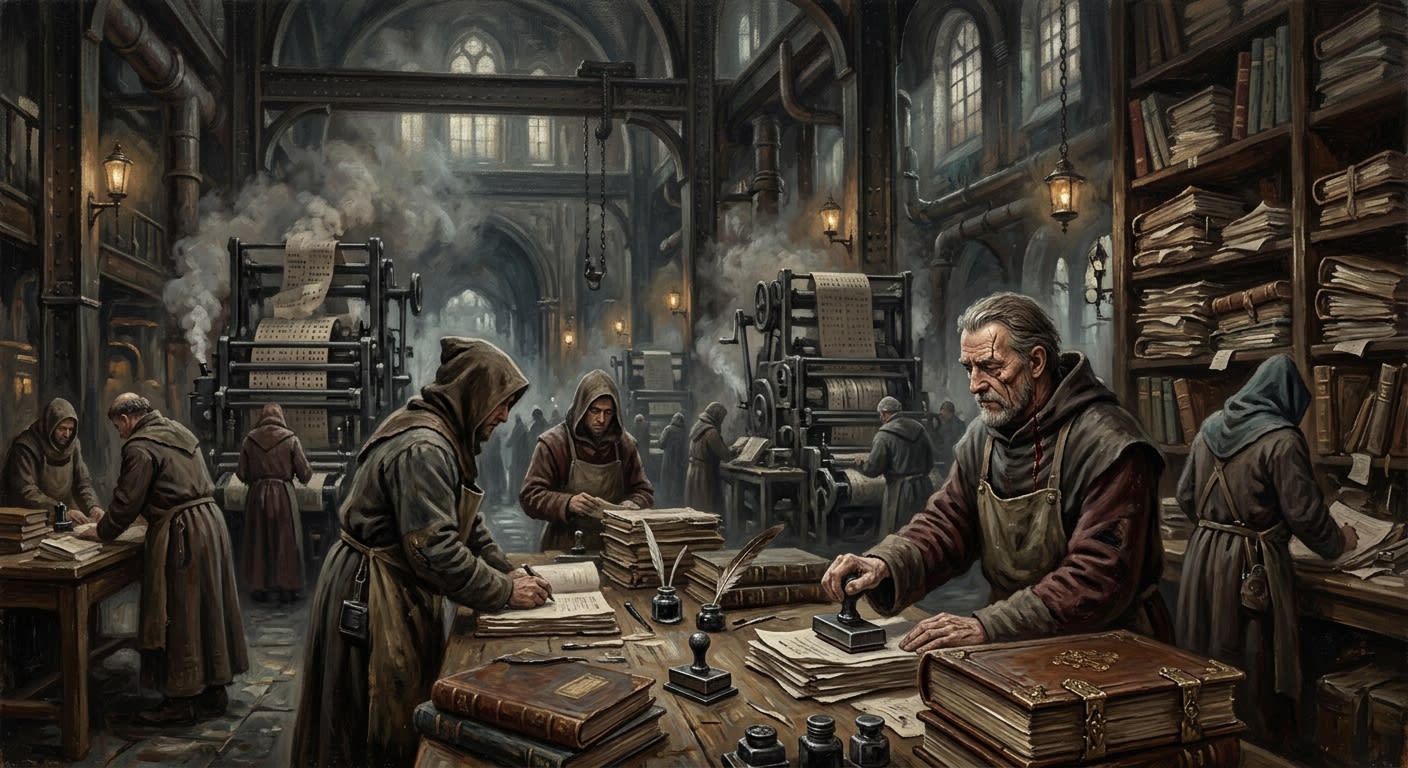
Variance Assessors, chapel liaison clerks, parish readers, confession abstract examiners, school-recitation comparators, hymn-cadence monitors: the titles multiplied because no Bureau likes admitting it has made a new office before budget doctrine has caught up. After the Unspoken, the Synod needed servants who could read delay as clearly as a scribe reads ink. After the Confession Reform of A.S. 104, those servants received cleaner instruments. Standardised confession phrasing made deviation countable. “Remorse” in place of “contrition” could be marked. A pause before naming sin could be timed. A penitent who spoke too smoothly could be compared against sanctioned misery.
The Confession Reform supplied the measuring grid. 22-D supplied the fear behind the grid.
The Quiet Purges of A.S. 112 proved the apparatus existed before it had the courtesy to announce itself. Four hundred and eleven Rhineland teachers, choirmasters, and Street-Vicars vanished from public duty without trial. The lists came from attendance sheets, phrase wheels, chapel timing logs, school recitations, neighbour reports, and confession abstracts. The old Inquisition hunted statements. The new apparatus hunted pattern.
In A.S. 114, Purity formalised the Codex Auditors under the High Interrogatrix, and everyone pretended naming was birth. Variance Clerk, Field Auditor, District Codex Auditor, Confession Pattern Analyst: polite titles for the heirs of A.S. 84. Their mandate was phrased with clean insolence: audit belief itself.
Bureau of Purity training digests once described Codex Auditors as “post-Schism observers of doctrinal health.”
Corrected in advanced instruction. Auditors are not observers. An observer watches fever. An Auditor takes the household temperature and then decides who counts as sick.
The Auditor's toolkit remains 22-D in miniature: bell-pause chart, phrase wheel, black-book, variance rubric, interview lamp, silence column. The subject's words are only the first column. The rest asks how long the subject took to say them, what word was avoided, what breath was held, who answered with him, and whether the delay recurred across enough mouths to acquire teeth.
#On Interviews, Pauses, and the Lie of Gentleness
Under 22-D, an interview is not an interrogation. Purity insists on this distinction with the anxious pride of a butcher calling his knife pastoral.
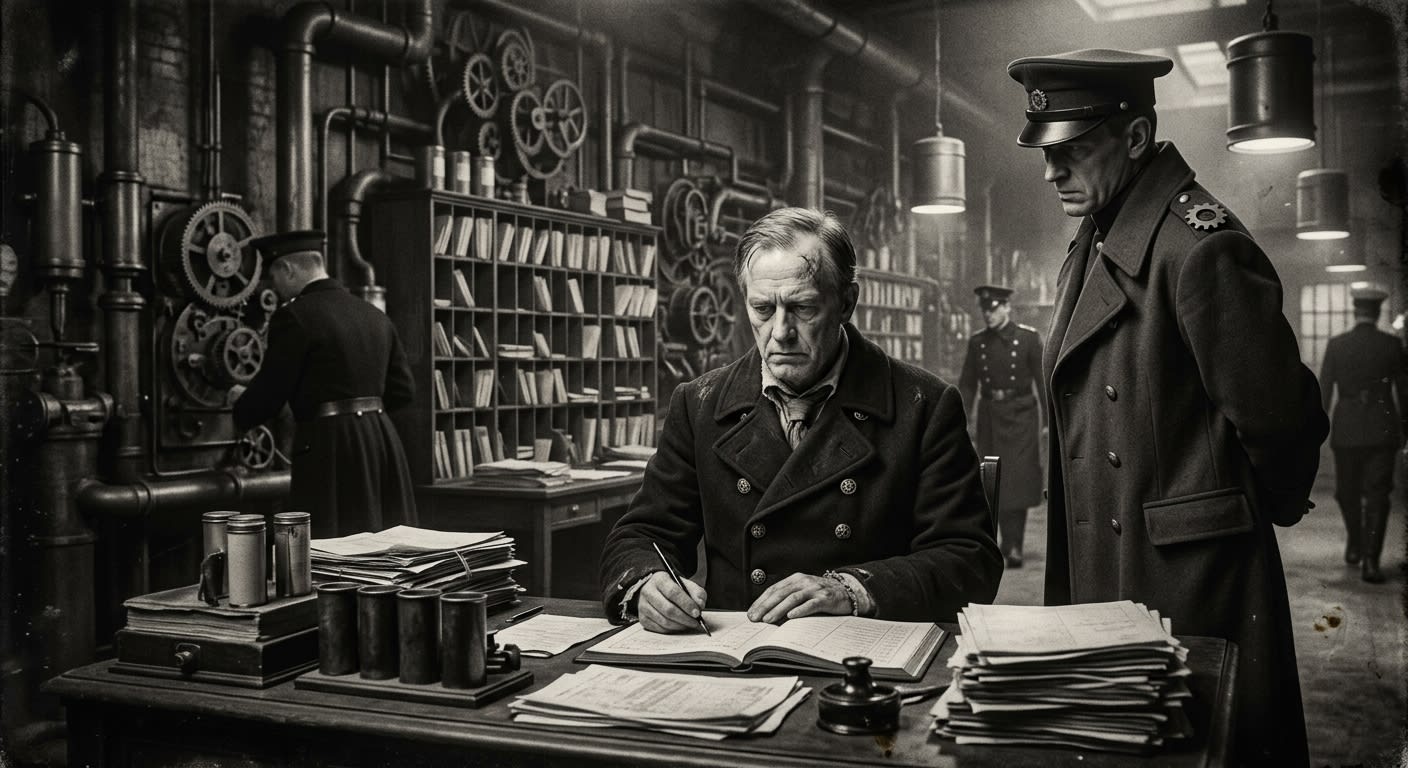
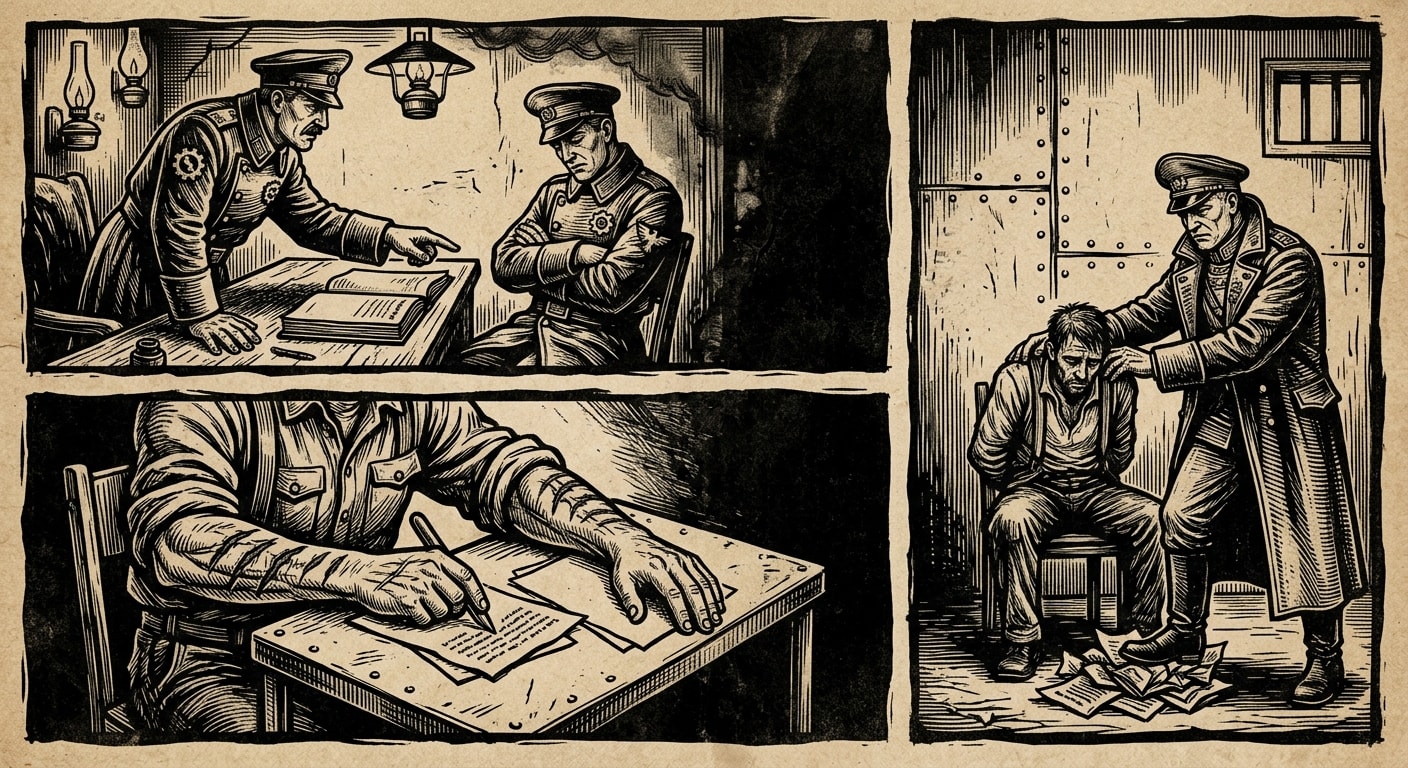
An interrogation compels testimony under flame-oath. An interview invites disclosure under silence. The Auditor sits in a clean room with a bright lamp, two chairs, a water cup positioned just beyond ease, and a timing slate. The subject is asked ordinary questions first. Tell me about your week. Name the last hymn you sang. Recite the Fourth Article. Which line comforts you? Which line troubles you? Why did you stop before answering?
The pause is written before the answer.
A good Auditor does not shout. Shouting produces fear, and fear contaminates timing. A good Auditor waits. Waiting is the cleaner cruelty. The subject fills silence because human beings hate empty rooms more than they hate danger. The Auditor lets the subject rescue himself into error. A spoken heresy can be seized. A delayed orthodoxy can be cultivated until it blossoms into variance.
The black-book receives the name before the subject leaves. Sometimes nothing happens for weeks. Sometimes the subject is assigned correction sermons, neighbour observation, re-confession, ration review, schoolhouse interview, guild mark inspection, or the little midnight visit in which a Street-Vicar and two Lictors prove that bureaucratic patience wears boots.
22-D made private tempo public property. Once timing became evidence, every conversation near authority acquired a hidden metronome. Citizens learned to answer promptly. They also learned to fear their own speed. Too slow suggested doubt. Too fast suggested rehearsal. The Bureau calls this devotional alertness. The common word is exhaustion.
#On the Mark That Acts Before the File
Standing Order 22-D began with silence and later discovered skin.
The connection appears perverse only to those who think laws remain obedient to their founding excuse. The Order's principle is absence-as-evidence and evidence-as-action before leisurely review. A delayed amen taught Purity that the gap before speech could incriminate. A bodily mark taught Purity that visible classification could move faster than paperwork. Both facts serve the same appetite: act before ambiguity hires counsel.
The Paper Plague of A.S. 112 at Bastion-Przemyśl made paper suspect. Forged transit passes carried two hundred refugees into the western perimeter; eighty-seven died; the fortress locked for three days; Heraldry blamed paper and won. The Compulsory Marking Decree of A.S. 113 answered with flesh. Seven forward-zone classes would carry bodily tri-marks: civilian, military, clerical, ward, penitent, pilgrim, condemned.
Here 22-D widened. Certain marks became self-executing evidence. The body bearing the sign could be detained, transported, corrected, or destroyed before documentary reconciliation when immediate security required action. Immediate security is a chalice with no bottom.
The Geometry Brand-Smith Corps loved the doctrine and feared it. Heraldry applied the mark. Purity acted upon it. Records reconciled after. War appreciated the speed. Settlement complained and was ignored, which is Settlement's main contribution to policy. The citizen stood between offices while his forearm spoke louder than his mouth.
The licensed chapels called bodily proof sacramental. Quick Burners called it throughput. Mercy Branders called it tragedy with a one-degree remedy. Shadow Angle crews called it business. 22-D called it actionable.
FORWARD-ZONE SECURITY ADDENDUM — 22-D / MARK CLASS If mark and mouth conflict, secure the body. If mark and paper conflict, secure the body. If mark appears altered, secure the body and anyone within witness distance. If mark is later invalidated, █████████████████████████████. Public language: provisional security action pending reconciliation.
The phrase “self-executing” is a masterpiece of cowardice. It suggests the mark acts by itself, as if iron, skin, guard, Lictor, cart, cell, rope, mine, and grave all vanished politely from the chain. No mark executes anyone. People execute. They prefer a triangle to take the blame.
#On Irongate and the Cost of Lawful Error
The Angle Riots of A.S. 119 are the wound through which 22-D shows its teeth.
During a Purity sweep through southern Bastion-Irongate, a team of hastily trained Brand-Smiths applied inverted doubles where identity singles should have stood. A miscalibrated iron leaned two degrees from obedience. 1,400 civilians were marked as second-category heresy when most held clean confession records. Three hundred were detained. Forty-seven went to the Paper Mines of Ulm. Eleven were executed before correction caught up with the truth.
Truth, one observes, owns no horses.
Purity's first abstracts called the marks valid until challenged. Heraldry later corrected the sentence: invalid at application, operational until challenged. There is a graveyard between those clauses.
The riot began, officially, when a gasket widow struck an arch clerk with a brand frame. The more accurate beginning was earlier: when the first guard believed the new scar more than the old ledger; when the first Lictor loaded a cart; when the first appeals clerk decided review could wait until after transport; when the first officer discovered that 22-D allowed action faster than shame.
The Re-inspection Brand-Smith was born from the aftermath: a specialist who burns correction through scar tissue without admitting the state erred. Tool-serial tracking followed. Licensed Chapel purists claimed Irongate proved speed's evil. Quick Burners claimed slow correction killed as surely as bad heat. Both were right enough to be insufferable.
22-D survived. Of course it survived. A law that kills eleven incorrectly does not die if it also moves thousands correctly through gates, cells, benches, mines, and appeals offices with satisfying speed. The Bureau corrected the tools, disciplined several men too small to defend themselves, revised wording, and left the hinge intact.
Public notices after the Angle Riots stated that affected citizens were “restored to prior standing.”
Corrected in restricted commentary. Prior standing cannot be restored to the executed, the transported, the infected, the scar-split, the widowed, or those whose neighbours learned the wrong reading before the correction seal arrived.
The Order learned from Irongate. It did not learn mercy. It learned serial numbers.
#On Licensed Heat and Purity's Cold Reading
The Brand-Smith chapels, especially the Licensed Chapel Brand-Smiths, resent 22-D while living from it.
They resent Purity's cold reading of marks because the Chapel imagines the brand as a sacrament of classification: full witness, fixed premises, swatch plate, serial custody, Triune Formula, re-read at nine days. Purity reads the finished scar as action code. It cares less about rite than consequence. A mark says detain; Purity detains. A mark says ward; Purity transfers. A mark says condemned; Purity simplifies the afternoon.
This offends Chapel vanity. It should. The Chapel spends its life making visible sentences and then complains when enforcement reads them aloud.
22-D's mark doctrine forces Chapel discipline into an uglier honesty. If the mark can act before review, the rite must be cleaner than conscience. Tool serials must match. Witnesses must stand close enough to smell hair singe. Ledger-Scribers must record authority before heat. Frame-Hands must not shift. The client must not move, which is a charming demand to make of a person discovering that theology has reached operating temperature.
The irony is almost pleasant: a law born from silence makes heat more verbose. Every scar now requires more paper, more witness slips, more swatch entries, more custody seals, more correction packets. The body became a document; the document multiplied to prove the body had been made documentary in the approved manner.
Strasbourg calls this maturity.
#On Exceptions, Fatigue, and Other Ways to Confess
22-D contains exceptions because no law can govern panic without leaving little rat-holes through which officials may later crawl.
Fatigue is noted. Battle shock is noted. Fever is noted. Acoustic distortion in bastion tunnels is noted. Time-fog at Shipka is noted with special irritation because Syrion's vapours make timing evidence behave like wet paper. Bell failure, priest error, language barrier, childhood stammer, deafness, throat injury, shell concussion, and grief are all acknowledged in annexes thick enough to stun a mule.
None of these defeats the Order. They merely alter the route by which suspicion reaches the subject.
A fatigued pause becomes repeat-observation. Fevered silence becomes medical custody with Purity notice. Language confusion becomes catechism retesting. Deafness becomes visual-response protocol. Grief becomes mercy supervision, and mercy supervision, by one of those elegant administrative trapdoors, creates new records for audit. The exception files are not exits. They are side chapels.
The mature state does not need every silence to be guilt. It needs every silence to be legible. Innocence may pass after forms. Guilt may pass after bribes. Fatigue may pass after retest. The important point is that nothing passes unrecorded.
The annexes created their own trades. Phrase instructors. Bell-pause clerks. Sign-response witnesses. Chapel timing assistants. Pattern reviewers. The small economy of suspicion is among the Synod's most reliable employers, and unlike grain, it never suffers shortage.
#On Schoolrooms, Choir Stalls, and Domestic Weather
The Order's most efficient theatre is not the interrogation room. It is the school bench.
Children answer before they understand danger, which makes them useful and pitiable in the precise ratio Purity prefers. A school recitation log under 22-D records the Fourth Article, the Ninth Bell response, the short Creed for ration halls, the obedience formula, the death prayer, and the child's delay before each. One child pausing means fatigue, hunger, a loose tooth, or the common stupidity of childhood. Six children pausing at the same clause means a household cluster. Twelve means the teacher has permitted infection to wear grammar.
Teachers learned to fear the bell-pause chart before several of them learned to spell its title correctly. A lesson that once sought understanding now sought simultaneous sound. The answer had to arrive together, cleanly, promptly, without the little ragged edge by which thought enters speech. The best classrooms became choirs. The worst became evidence.
Choir stalls suffered next. The Unspoken had travelled partly through collective rhythm, and so collective rhythm became a suspect instrument. Choirmasters marked late entrances, softened amens, diminished volume after burial weeks, and any habit of letting the second row breathe before the first. A beautiful hesitation, once praised as musical feeling, acquired a second life as doctrinal variance. The Bureau of Orison and Song claimed jurisdiction over pitch. Purity claimed jurisdiction over delay. The choirboy stood between them and learned that beauty is safest when punctual.
Households received the Order indirectly, which is how laws become custom without paying for enforcement. A father snaps at a child to answer faster. A mother rehearses the Creed before market because the Street-Vicar works Tuesdays. A grandfather with a cough is kept from feast Mass because his breath creates pauses the family cannot afford. Dinner talk shortens. Questions die before they acquire shape. The family becomes a chapel annex with soup.
No household is prosecuted for weather. Many are prosecuted for what weather reveals. A room that goes silent when the Doctrine Street-Vicar passes below the window may be tired, grieving, or guilty. Under 22-D, the difference is discovered by return visits. Return visits create neighbours. Neighbours create reports. Reports create pattern.
The Order's cleverest victory lies here: it made citizens police the interval before authority arrived. No Lictor need stand in every kitchen. The kitchen imagines him. No Auditor need time every child's mouth. The teacher does. No Purity seal need hang above every choir stall. The choirmaster hears it in the rests.
By A.S. 201, whole districts possess the Order in their muscles. They answer the Creed before the echo returns. They uncover arms before the guard asks. They laugh at approved jokes quickly, stop laughing quickly, and preserve a blank obedient face during phrases whose meanings have become too expensive to examine. That is governance at its finest: the citizen moves the leash for you.
#On Present Force
As of A.S. 201, Standing Order 22-D remains active in Purity's timing doctrine, Codex Auditor variance review, forward-zone mark enforcement, school recitation audits, chapel attendance protocols, garrison communion observation, checkpoint security, and every interview room where a citizen learns that answering late may be worse than answering wrongly.
Nine hundred Codex Auditors draw authority from its first principle. Roughly 6,400 licensed Brand-Smiths operate in a world where their marks can trigger Purity action before paper breathes. Re-inspection specialists exist because 22-D made erroneous scars lethal before correction acquired transport. Licensed Chapels polish their floors. Quick Burners heat irons in rain. Mercy Branders bend angles under the private doctrine that if the state may err harshly, the hand may err tenderly. Shadow Angle crews sell the illegal kindness of a lie chosen by the bearer.
The Schism that birthed the Order is filed as contained. This is convenient and false in the Bureau's preferred proportion. The first southern outbreak ended. The condition entered procedure. Every prompt amen is now a small descendant of A.S. 84. Every frightened citizen answering before thought can arrange its face participates in the Order's victory.
22-D is cruel. That is the least interesting thing about it. Cruelty, in Strasbourg, is common as damp. The Order's brilliance lies in making the unsaid administrative. It took silence, hesitation, scars, and delay — all the little human refusals to become tidy evidence — and taught them to file themselves.
At Mass, the bell rings. The priest speaks. The nave answers quickly enough to save itself from notation. Somewhere behind a pillar, a clerk counts the pause and writes nothing.
Nothing, properly timed, is the finest entry in the Ledger.