
#On the Season Without Trials
The Quiet Purges of A.S. 112 were quiet because the Bureau of Purity had learned, at last, that spectacle wastes labour.
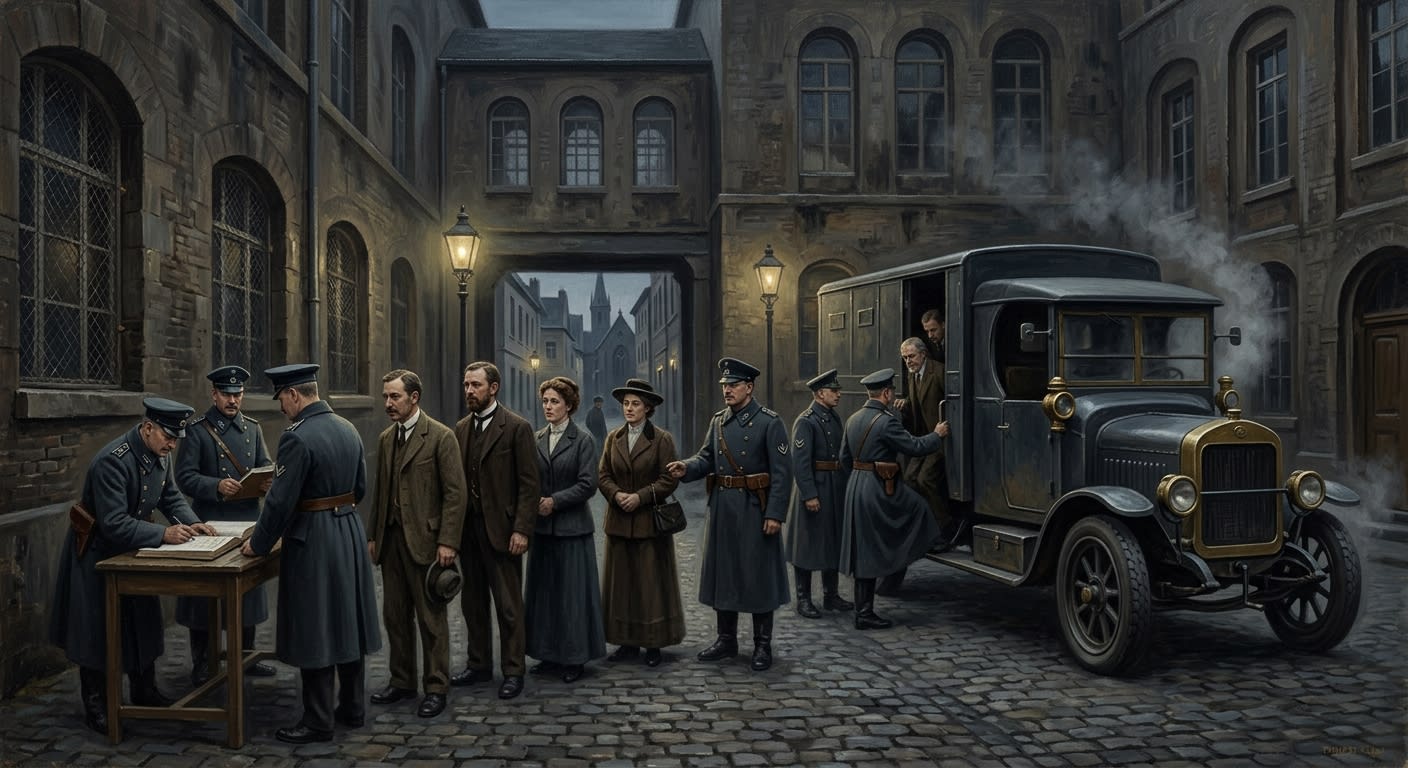
Fire draws crowds. Trials invite witnesses. Public confession gives the condemned a stage, and the condemned, being vain in proportion to their guilt, often use the stage badly. The Quiet Purges corrected this extravagance. Four hundred and eleven teachers, choirmasters, and Street-Vicars were removed from Rhineland postings without public trial, without posted charge, without the theatrical courtesy of screams in the square. Doors opened before dawn. Names left ledgers. Classrooms received substitutes. Choir stalls were rebalanced by Friday.
The public noticed the absence because publics are stupid in groups and sharp in kitchens. Children came home with new catechists who held the chalk too tightly. Choirs found their altos missing. Market corners once patrolled by familiar Vicars received younger men whose correction slips still smelled of fresh ink. No proclamation explained the substitutions. No proclamation was required. Explanation is for jurisdictions uncertain of their authority.
#On the Apparatus Before the Name
The Purges matter because they occurred before the Codex Auditors formally existed. This inconveniences tidy histories. Tidy histories are often written by men whose hands have never opened a night packet.
The Schism of the Unspoken had terrified the Bureau of Doctrine by proving that belief could fail without speech. The Confession Reform of A.S. 104 had made deviation countable by standardising the words with which men were permitted to be sorry. Between those two lessons grew a nameless office: readers of abstracts, collectors of pauses, parish statisticians with Purity seals in their desk drawers. They were not yet Auditors. They were liaison clerks, variance assessors, temporary examiners, field readers, special assistants to special assistants. Bureaucracy loves disguise the way monks love candles.
By A.S. 112, the nameless apparatus had enough teeth to bite. It compiled lists from confession abstracts, school recitation logs, chapel attendance sheets, hymn cadence registers, and private reports from correction-minded neighbours who confused malice with holiness and were rewarded for the error. The lists crossed district lines. They named clusters, not conspiracies. A teacher whose pupils paused before the Fourth Article (Unregistered). A choirmaster whose second row softened the amen. A Street-Vicar whose correction rate declined as his district's attendance improved, which Purity deemed suspicious because improvement without punishment suggests the wrong sort of love.
The lists went upward. The night packets came down.
#On the Removed
Teachers formed the largest portion, though no office will print the number. Teachers were dangerous because they touched children before doctrine had hardened. A misplaced emphasis in a primer can survive three generations and return as a pamphlet with spelling errors. Purity understood this. It removed teachers who taught too gently, too locally, too much by example, and too often without reporting the private questions children asked after lessons.
Choirmasters followed. The Unspoken had taught Strasbourg that harmony can hide refusal inside beauty. A choir can carry a district's doubt beneath perfect pitch. A choirmaster who permits a delayed response is a smuggler of breath. The Purges took the ones whose registers showed softness: late amens, diminished volume, too many mercy hymns after burial weeks, too few correction chants after feast-day disorder.
Street-Vicars were the scandal. To remove citizens is expected. To remove the removers admits contamination in the tool. The Purges stripped experienced Vicars from Rhineland corners and replaced them with Creed Runners (Unregistered) promoted before their chalk had dried. The Doctrine files later call this “personnel renewal.” The street called it what the street calls everything unpleasant and accurate, which is to say it muttered and closed its shutters.
Earlier parish summaries described the removed personnel as “transferred for regional instructional support.”
Corrected for internal use. Some were transferred. Some were interrogated. Some entered archives that do not return names. The phrase “regional instructional support” remains approved for widows, parents, and parish children.
#On the Rhineland's Instruction
The Rhineland learned quickly. Scribes lowered their voices before touching ink. Choirboys watched the choirmaster's hands instead of his face. Parents told children never to ask why a teacher had gone, because why is a hook and Purity keeps ropes.
In Cologne, the same year, the Knotwright districts endured the Lintel Pogroms, when false Triune Knots carved by unlicensed hands brought Sigil Inspectors into the river quarter. Doors were stripped. Residents were re-documented. Carvers reproduced geometry while Purity men watched their fingers for tremor. The Quiet Purges and the Lintel Pogroms were filed separately because separate files make coincidence respectable. On the streets, they arrived as one weather: the year every mark, hymn, lesson, and lintel became evidence.
The practical result was obedience with a cracked tooth. Attendance rose. Recitation improved. Confession language returned to approved forms. The number of reported variances increased, which Purity cited as proof that the Purges had uncovered sickness, not that terror had made informants prolific. The distinction has supported whole careers.
Rhineland Removal Ledger (Unregistered), packet 112-QP-411, contains the complete list of affected personnel, witness abstracts, and post-removal household monitoring notes. Access requires triple seal of Purity, Doctrine, and Records.
Current packet location: █████████████████████████ Known unauthorised readers: ███ Disposition of unauthorised readers: completed
#On the Office Born Two Years Later
In A.S. 114, the Bureau of Purity constituted the Codex Auditor branch under the authority of the High Interrogatrix. Doctrine pretends this was the beginning. It was the naming ceremony.
The child was walking already.
The new branch received a mandate broader than any Inquisitor's writ: audit belief itself. Its hierarchy gave polite titles to the work proved in A.S. 112. Variance Clerk. Field Auditor. District Codex Auditor. Confession Pattern Analyst, unacknowledged by public chart and known to every parish clerk who has watched a sealed carriage stop outside his office after midnight. The tools were already there: phrase wheels, black-books, attendance ledgers, seal tokens, interview scripts, bell-pause charts. The Purges had supplied the evidence that the Synod could remove four hundred and eleven instruments of public doctrine without riot, explanation, or apology.
Read that sentence twice, then wash your hands.
#On the Present Classification
The Quiet Purges remain officially narrow: Rhineland, A.S. 112, four hundred and eleven removals, no public trial. The consequences are wide enough to walk across Europe without leaving them. Every modern Auditor inherits the lesson. Every Confessor-Booth Clerk who sends a concern bundle upward participates in the machinery the Purges revealed. Every Street-Vicar knows his chalk hand can be judged by the marks he makes and by the mercy he withholds.
The Bureau of Purity never apologised. Apology would suggest error, and error would suggest that one of the four hundred and eleven might have been innocent, and innocence, once admitted into a purge, spreads faster than guilt.
Public devotional calendars once omitted the Quiet Purges entirely.
Clarified. Omission was not denial. It was silence under seal, and silence under seal is one of the Synod's oldest liturgies.