

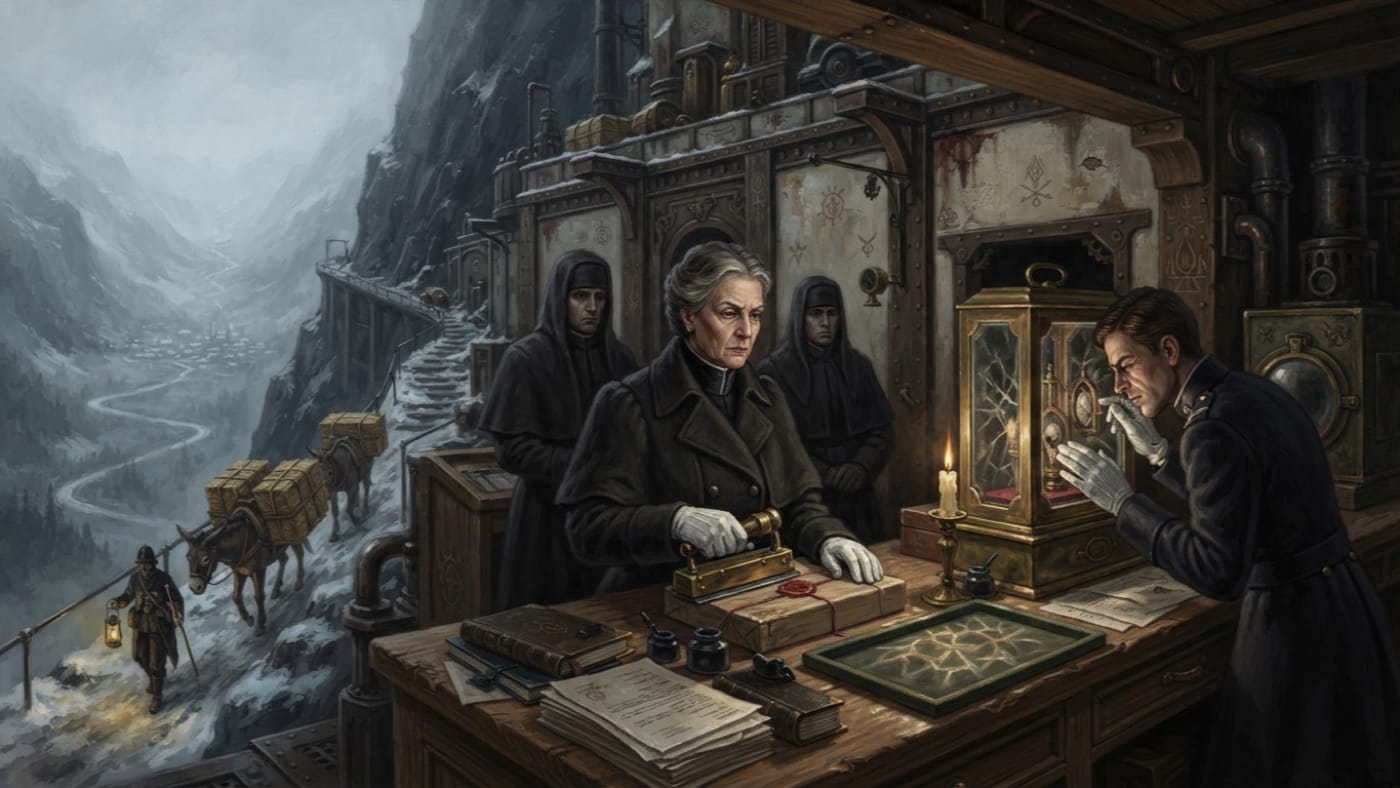
#On the Work of Verification
"The mountain gives truth to the faithful." — Inscription, Seal House lintel, Saint-Helm's Cut
A Verifier, as the word is used at Saint-Helm's Cut, is a trained reader of glass. The quarry account gives the Verifier two duties. The first is to read the patterns that candlelight makes when it passes through a properly cut and stamped pane of Oathglass with a relic set behind it. The second is to escort sacred material that may not travel without them. The surveys attest nothing beyond these two duties, and this compilation, commissioned in A.S. 201 / 1911 CE, claims nothing beyond them.
The word covers more than one hand. A Verifier reads a test. The Verifier-Provost authorizes a pane. The first is a skill and the second is an office, and the gap between them is the gap between an opinion and a tribunal.
The Ledger gives the site's history and leaves out the trade's. Prospectors registered the cleft in A.S. 96 / 1806 CE. A Verifier-Provost was dispatched some time afterwards, on a date the register does not give. The quarry was chartered under a Pane-Guild compact in A.S. 102 / 1812 CE, and the first verified pane went down the switchback to Strasbourg in A.S. 103 / 1813 CE. These are dates for a hole in a mountain and a crate on a mule. Nobody has filed the date on which the first person squinted at a candle and was paid for it.
#On the Pane and the Candle
Three things happen at a verification, and the Church does well to keep them apart.
The glass behaves first. Volcanic glass from the Cut bends candlelight, and a pane that has been cut correctly throws fractured light onto the plaster. That is mineral fact. It would happen in a stable with a goat for a witness.
The reader interprets second. A trained Verifier watches how the light falls and reads it as evidence for or against the relic behind the pane. This happens behind the reader's eyes. The Office can train those eyes and audit them, but it cannot open them for inspection.
The institution accepts the result third. On the question of who declared the patterns diagnostic, the accounts disagree. The quarry survey credits the Bureau of Rites. The Provost and Reliquary Office accounts name the Bureau of Alchemical Standards. I record both and settle neither, since settling jurisdictions between Bureaus is a sport for men with better pensions than mine. Either way the diagnosis is a Bureau's claim. Neither the training nor the wax gives anyone a private line to the Creator's opinion of a knucklebone.
The dedicated Provost account draws a distinction worth carving over a door. The relic authenticator judges the bone, while the Verifier-Provost judges the pane, which is the instrument by which bones are judged. Each trade has its own judgment and its own wax, and neither may borrow the other's.
The setting is plain and well attested. There is an oak counter, a candle, a plaster wall, a sheet raised from felt and lowered back onto it, and witnesses standing where they can see the hands. The surveys describe this much. They do not describe a syllabus, a fixed sequence of trials, or a book of patterns open to the public, and I will not draw one up for the convenience of forgers.
#On Certification and Custody
The stamp does nothing to the glass. Composition, clarity and every trick a candle can play through a pane are the same after the wax as they were before it. What the wax changes is the pane's standing at law, and in the Synod that is the larger alteration.
An unstamped sheet on Kiln Row, in the hands of a licensed worker, is simply work. Carry the same sheet past the licensed premises and it becomes evidence. The surveys use the phrase "makes glass real", but that is Seal House rhetoric. What happens in fact is that the same glass acquires a different legal status.
Three documents carry custody. The pane authenticity stamp travels on the glass, and pilgrims kiss it. The output manifest records what left the cleft and under whose seal. The shard confiscation receipt records what did not leave and whose hands it was taken from. The Bureau of Records files the last two, and nobody kisses those.
The escort is where the ordinary Verifier earns the second half of the title. Stamped panes go down the switchback in straw-packed crates on the mule trains, and the certification class requires a Verifier to go with them. The quarry's local transit rules list relics moving without Verifier escort among the things that may not pass through the settlement at all, alongside unstamped panes, black-glass shards and unlicensed hymn-sheets. The surveys give the rule and stop there. They record no complement, no arms, no handover rite and no timetable, and I supply none.
The arithmetic is unpleasant. An escorted crate is sacred cargo, and the same crate without an escort is a smuggler's load. The difference between the two is a person walking beside a mule.
#On the Detachment and Its Provost
The Synod Reliquary Office keeps a Verifier Detachment at the Cut. Its documented territory is the Seal House and the inspection decks beneath it, on a fortified platform midway down the eastern wall of the cleft. That is the full extent of the territory. The Office has not told this Ledger where it keeps its seat, who its superiors are, or how many other detachments it maintains, and I have learned not to ask an institution for things it has declined to volunteer.
At the head of the Detachment's certification sits the Verifier-Provost. The present holder is Maelin Rook, whom the A.S. 201 surveys report as eleven years in post. Her gloves are immaculate. No one has seen her handle glass without witnesses present. The local survey lists white gloves among Verifiers' dress generally, so the gloves are a habit of the trade. The witnesses are hers, and the surveys record no rule that obliges any other Verifier to keep them.
Rook is the Provost. That does not make every Verifier a small Rook carrying a borrowed seal. The surveys give the stamp to her office and give the candle-reading and the escort to the trained readers.
Her authority ends at the edge of her counter. Guildmaster Orr Vetch controls the tools, the kiln time and the quotas, and so decides which panes are cut at all. Sister Brethna of the Breath Chapel controls care and the right to burial. The Choir Wardens enforce song at the tunnel mouths. None of these answers to the Seal House, and the Seal House answers to none of them. Each needs the others' output to justify its own existence, which is a kind of mutual respect.
The quarry's own reckoning of rank puts the Synod's verifiers above the guild masters and everyone else below them, down to the cough-sick breath poor at the bottom. That ranking describes a class and confers no commission. Coughing cutters find the distinction academic.
#On False Proof
"Breathe shallow. Sing clean." — Oathglass proverb, origin: first cough-registry, A.S. 111
Fraud at the Cut comes in several forms, and they must be filed separately.
The first is counterfeit stamps. Copies of the Seal House impression, of impressive but imperfect quality, are sold in the Spoil Gardens and at the tunnel mouths. This is a lie told about the glass.
The second is calibrated proof panes. These are sheets prepared to authenticate whatever relic is placed behind them. They are rare, expensive, and the reason the Bureau of Purity sends its auditors up the switchback with the regularity of a seasonal illness. This is a lie told by the glass, which troubles a Verifier more than any forged wax.
The third is black-glass, a dark and flawed variant that is separately prohibited in every form. The Black-Glass Runners carry it down-valley regardless. It does not pretend to prove anything, which makes it the most honest contraband in the mountain.
The fourth is the True Pane, which the Flawless Claimants seek: a sheet that would sanctify whatever stood behind it. They are looking for it. No record shows that they have found it.
The danger to the trade is simple. A stamp is worth what the candle-test is worth, and the test is worth only as much as the glass's willingness to refuse a false relic. Every calibrated pane sold in the Spoil Gardens takes a little of the value of every honest reading. Rumour of a flawless pane takes more.
In A.S. 199 / 1909 CE, the Provost's office sealed a field memorandum touching the Resonant Vein. The Bureau of Doctrine holds it. Its contents belong to the accounts that are entitled to them, and this survey is not one of those accounts.
#On the Present Practice
In A.S. 201 the work goes on. Panes come up from the Shard Yards in straw. Candles are trimmed at the counter. Rook's wax falls, or it does not. Stamped crates go down the switchback with a Verifier beside the mules. Purity's scrutiny stands over the whole process, the fraud trade feeds on its refusals, and the lungs of the cutters supply the material.
The Verifier reads light. No Verifier reads lungs, and the record of the lungs has already been amended once.
ERRATUM — Bureau of Records, Annex Alp-7, filed A.S. 200: Previous production reports listed Oathglass Quarrytown output as "stable and healthy." The Bureau now classifies output as "stable." The word "healthy" has been removed from all prior filings.
No pane at the Seal House needed the same correction, since the stamp has no column for a cough.