

#On the Office's Warrant
"A relic authenticated is a relic made holy." — Maxim of the Bureau of Relics, repeated at the Seal House counter by clerks who have never seen the Bureau
Most of the faithful know the Synod Reliquary Office only by what it leaves behind. A pilgrim kneels at a shrine. Candlelight passes through a pane of clear glass and breaks into a pattern that the keeper pronounces favourable, and the pilgrim goes home consoled. The pilgrim does not see the gloves, the witnesses, the wax, the manifest or the mule escort. Nor does the pilgrim see the highland official who decided, months earlier and a long way off, that this particular sheet of glass was allowed to testify at all.
The Ledger knows the Office best through its Verifier Detachment at Saint-Helm's Cut. Its territory is the Seal House and its inspection decks, on a fortified platform midway down the eastern wall of the cleft. The Detachment describes its purpose as the protection of holy proof. The quarrytown describes it as the control of what counts as true. Both descriptions are accurate. Only the first is carved over the door.
The Office's wider establishment is the Office's own business, and it has not shared it with this Ledger. That includes its seat, its superiors and the number of its other detachments. I record what I can stamp.
What can be stamped is a sequence of three operations. First, the glass bends light, which is a property of the mineral and has been surveyed as such by the Bureau of Alchemical Standards. Second, a trained verifier reads the bend. That is interpretation. Third, the Office declares the reading admissible. That is law. The pilgrim sees only the first, credits the second, and lives under the third.
#On the Charter and the Cut
Prospectors from Alchemical Standards registered the cleft in A.S. 96 (1806 CE), and the Bureau of Records entered the site. A Verifier-Provost was dispatched afterward. The surviving papers record the dispatch without a date, and I will not supply one.
The first dated act to bear the Office's name is the quarry charter of A.S. 102 (1812 CE), concluded together with the Pane-Guild compact. In A.S. 103 (1813 CE) the first verified pane went down the switchbacks, consigned to the Basilica of the Ledgered Saints at Strasbourg.
These are a charter and a shipment. They are not a birth. Readers who would like the Office to have emerged fully vested from the Concordat of A.S. 90 may enjoy that idea in private. The Concordat was a constitutional settlement, and the founders whose memory it honoured were already entered in the Ledger's final column. Neither of them sealed anything at Saint-Helm.
In A.S. 111 (1821 CE) the tunnel cantors sang an incorrectly transcribed interval and three hundred yards of gallery ceiling came down, killing two hundred and fourteen workers. The charter survived the collapse, and so did the counter.
#On Examination and the Seal
Glass reaches the Office already sorted. In the Shard Yards the Guild's graders divide raw sheet by categories the Guild keeps deliberately obscure. The Guild owns the tools, the kiln time, the grading and the quotas. The Office owns none of these. It owns one decision.
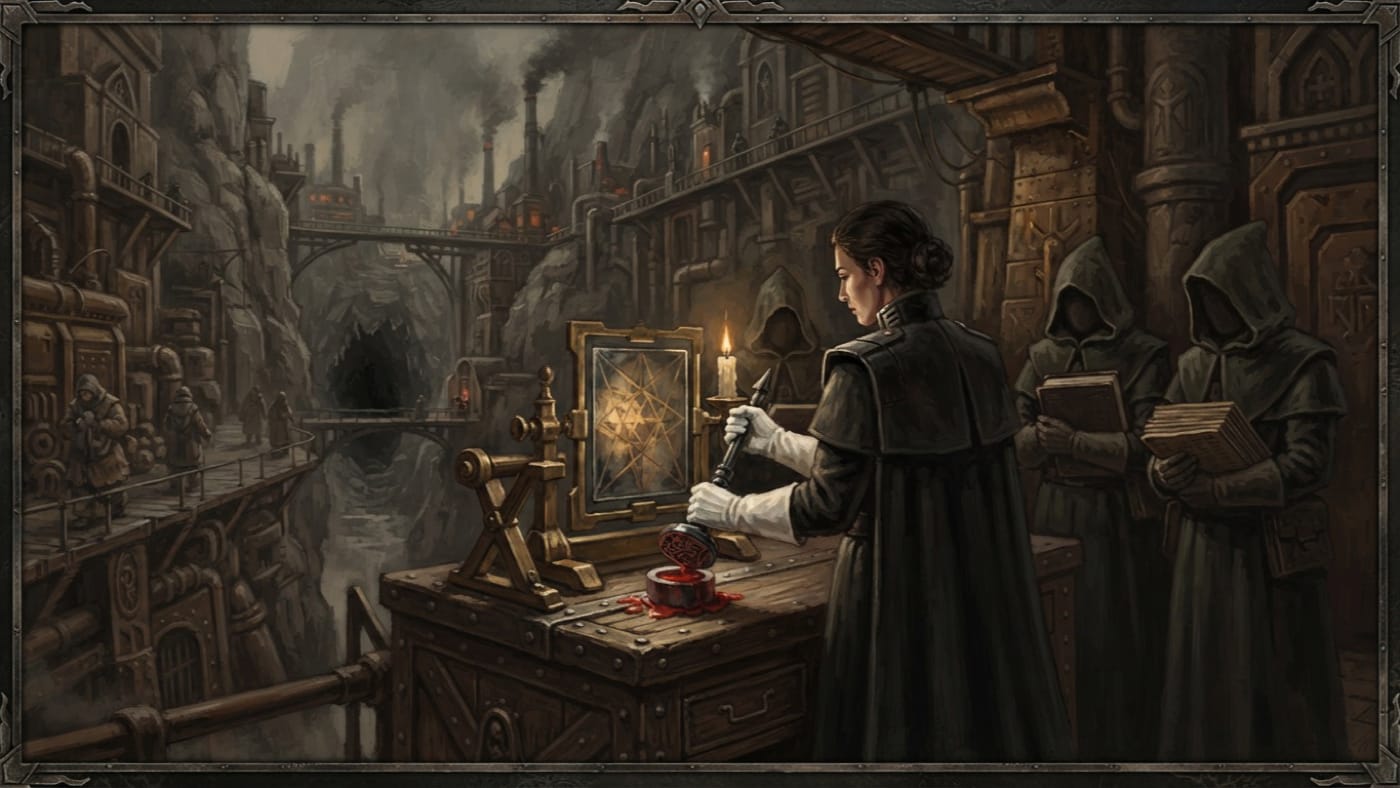
That decision belongs to Verifier-Provost Maelin Rook, who has held the Saint-Helm certification authority for eleven years. Her gloves are immaculately white, and she never handles glass without witnesses present. The pane goes up to the inspection deck and is placed between a candle and the relic or test object. The verifier observes the fracture of the light and the witnesses observe the verifier. When the reading satisfies, wax is heated, the stamp falls, and the sheet is entered on the output manifest. The procedure does nothing to the pane's composition. It changes the pane's legal standing absolutely.
A pane that fails or is never presented leaves the deck as restricted mineral. A pane found where it should not be leaves on a shard confiscation receipt. Stamped glass goes down the mountain under Verifier escort, packed in straw. Under that escort it is sacred material in transit. Without it, the same crate is evidence.
The restriction applies at the boundary of authorized production. A cutter holding an unfinished sheet on the benches is working. The same cutter holding the same sheet at the Switchback Gate is before a tribunal. Between those two places the glass has not changed. Only the paperwork around it has.
#On the Other Authorities
The Seal House is shared ground. The Guild's territory includes it, and the Office's territory is limited to it. Guildmaster Orr Vetch sets quotas and assigns kiln time. Rook certifies. The charter of A.S. 102 bound the two together without making either subordinate, and the arrangement has lasted ninety-nine years because each needs the other more than either would admit before witnesses.
The workforce is under further authority still. Sister Brethna of the Breath Chapel controls resin filters, care and burial permissions, and keeps a private ledger that the other powers of the Cut have learned to respect. The Choir Wardens enforce song compliance at the tunnel mouths and hymn towers. None of these answers to the Verifier-Provost, and none of them needs to. Each constrains the same lungs.
The Bureaus attach at their own points. Alchemical Standards surveys the seam and classifies its anomaly. Records registers sites and output. The Bureau of Doctrine rules on interpretation and keeps the sealed disclosures. The Bureau of Purity audits for forgery. The Bureau of Relics holds the broader charge of custody and the issue of Authenticity Writs. I am aware of no single instrument that sets out the Office's statutory relation to any of them. I have looked, and I hold a key to most of the cabinets.
The arithmetic is simple. Shrine demand rises and there is one stamp office. The Guild meets demand with longer shifts, workers draw their wages in pane-scrip, and the dust settles in the lungs that earn it. Rook did not write the quota, and she does not refuse it either.
#On False Proof
"Oathglass cannot be forged." — Saying current among pilgrims and the people who sell to them
The Ledger keeps five things distinct, and so must the reader. Certified Oathglass has passed the deck. Unstamped Oathglass is ordinary glass that has not, and it is restricted without being false. Proof panes are sheets calibrated to authenticate whatever relic is placed behind them, sold from the Spoil Gardens and the tunnel mouths by the Black-Glass Runners and their brokers. Black-glass is a dark, flawed variant that the Office publicly prohibits. According to the published account it is requisitioned unofficially by the Bureau of War under form 44-C, for a purpose that remains sealed and that I will not guess at in print. Last comes the True Pane, which is so far only a rumour.
ERRATUM — Hieromnemon's Office, entered with this survey, A.S. 201: An earlier draft of this entry repeated, without attribution, the saying that "Oathglass cannot be forged." The sentence is withdrawn. Proof panes are seized at Saint-Helm in the ordinary course of business. The Office's position is that forged Oathglass is not Oathglass. The Ledger's position is that it is frequently in a reliquary.
The Flawless Claimants are a clandestine circle of kiln workers, proof brokers and at least one disaffected cantor. They are associated with the backrooms of Kiln Row and with the deep galleries, and they seek a sheet said to authenticate any relic at all. Their aims are reported in several forms: to expose that proof is manufactured, to certify a false relic and sell the resulting miracle, or to hold the Synod to ransom. These reports are compatible with one another, and none of them is a manifesto. No leader has been named. No possession has been proved. Two sightings of a flawless sheet in the Shard Yards were reported within the past year, and on both occasions the sheet was gone before inspection.
The Office hunts them, and its reason is precise. A forged stamp defrauds the Office. A pane that authenticates every relic makes the Office unnecessary. Certification is a power to exclude, and a glass that cannot refuse leaves nothing for a verifier to do with gloves.
The local record also contains a sealed field report.
[EXCISED — Bureau of Doctrine seal, A.S. 199. Verifier-Provost Rook's field report on nomenclature and glass crystallisation remains under seal. This Ledger holds the docket number and the date of sealing. It holds nothing else, and asks for nothing else.]
The street says, and the parent survey repeats, that some harmonics in the Resonant Vein resemble names, and that the clearest glass comes from them. I set down the rumour and that the report is sealed. Which names those are, the Ledger declines to say.
#On the Present Certification
At this survey in A.S. 201 (1911 CE) the counter is open, the kilns are lit and the manifests are being signed. The Vein remains classified Category Two, Priority Amber. The Choir Wardens have strengthened their patrols at the tunnel mouths. The Claimants are still unaccounted for.
The Bureau of Purity has dispatched Inquisitor-Lux Thane Mire, a proof specialist, who is expected before the passes close. He has not yet arrived. Rook has prepared the inspection deck, the witnesses and her gloves, and it is not recorded whether she has prepared anything further.