

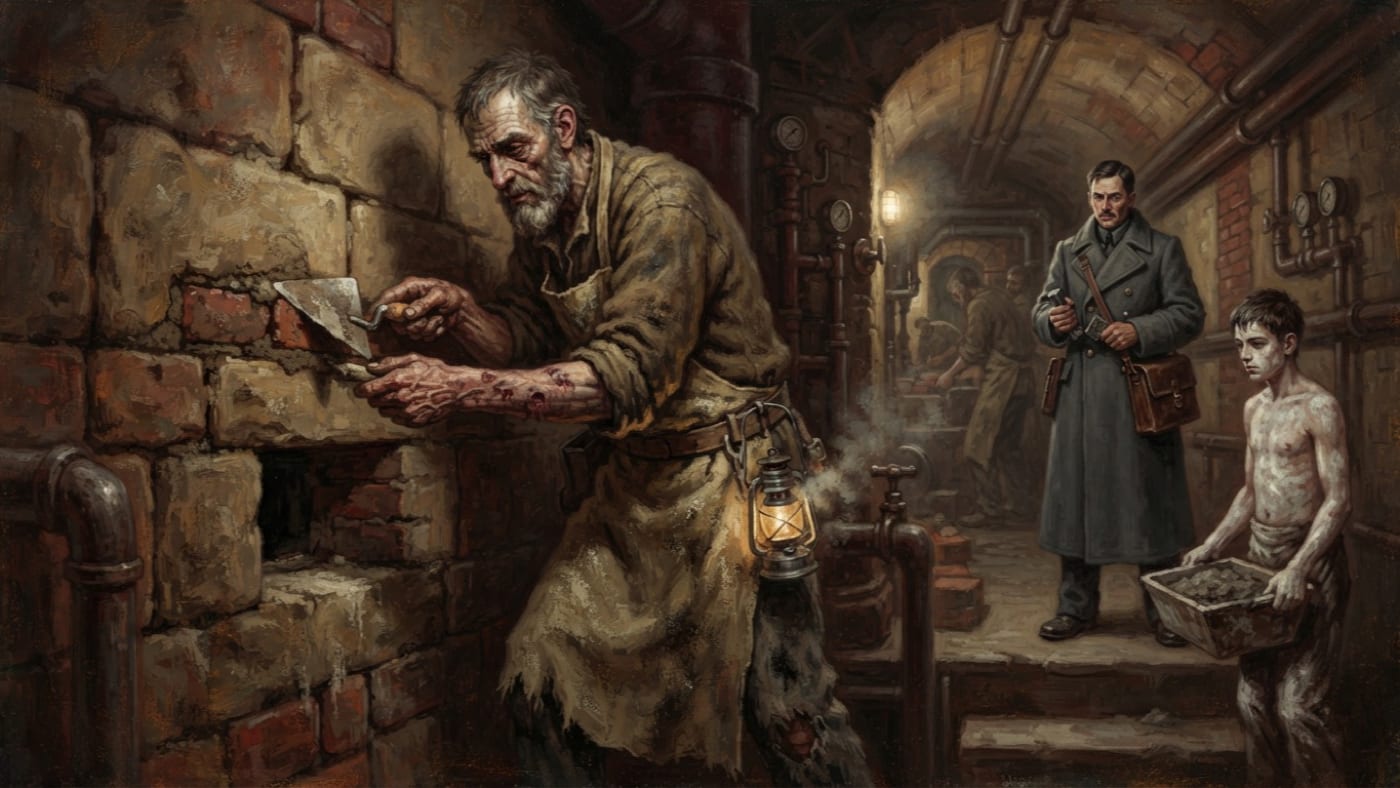
#On the Middle Rank
"A straight line saves lives." — trade idiom of the Masonry Corps
The word comes in two sizes. In the trench and the bastion yard, a soldier calls any Immurement Mason a Wallwright, from the boy with lime in his eyebrows to the supervisor with none on his cuffs, in the same voice he uses for the latrine detail. The registers of the Masonry Corps use the word more narrowly, and the Bureau of Records prefers its other name, Sentence Mason. There it marks the middle rung of three. Below it stands the Lime Boy, who hauls and mixes. Above it stands the Master Sealer, who supervises, verifies and stamps. The man between them builds the sentence.
This survey of A.S. 201 concerns that man. The profession as a whole has its own entry. No founding date for the rank has reached this office, and neither has an examination for it, an oath of appointment, a fixed number of incumbents or a complete licence code. Everyone leans on the rank the way they lean on a load-bearing course, and nobody remembers who laid it.
#On Cutting the Niche and Laying the Courses
The first thing a Wallwright works on is the wall he is about to weaken. A niche is an opening cut into a bastion curtain, a gate tunnel, a punishment alcove or a supply-yard retaining wall, and each of those was built to keep the Great Deceiver's hosts on its far side. The Corps' rule is punishment never outranks defence, and the Wallwright applies it with a brick hammer. He cuts the niche, or inspects one already cut, and he reinforces it before anything else happens. A niche that compromises the wall counts as sabotage whatever the writ says. Sabotage is answered with a vacancy cut to the saboteur's own measurements.
His tools are a bricklayer's tools: trowel set, brick hammer, plumb line, level, chalk, and a shielded lamp for passages where an open flame draws fire. Nothing about them is unusual except what they are used for. His apron stands up by itself, stiff with lime. Caustic has pitted his gloves through at the fingertips. No badge of rank has been documented. The Corps reads rank from the hands, and a Wallwright's hands are callus over burn over callus.
The mix comes up to him from below. The Lime Boy has hauled and tempered it, and a master has dragged a trowel line through the batch to see whether it stands. Mixing and passing the batch belong to other men. Laying it is the Wallwright's work.
He begins with the three locking bricks, bottom, left and right, each one set under measurement and then measured again. The trade says three bricks is forever, and it means this as procedure. Once the locking course is in, nobody at the wall has any lawful way to reverse it. The second course follows. The plaque goes in after the second course and not before: name, charge, hymn-line, and the imprint of the Judge's seal. Masons say that setting it earlier invites prying hands. The closing courses come next, keyed into the final seam. Every seam is lime-washed and the face is chalked with inspection marks. Two masons do the sealing together.
The Master Sealer has watched every course. At the end he presses the senior stamp into the wet seam. The Wallwright's hands built the wall, but the Ledger takes its author from another man's mark.
#On the Hands Above the Work
The Wallwright stands near the bottom of the authority and near the top of the labour, and the Corps likes it that way. The Judge issues the sentence. The bailiff brings the writ and the condemned. The Master Sealer checks the seal imprint against the presiding Judge's stamp and checks the particulars against the plaque slip. Custody passes to the Corps at the wall. By the time the Wallwright receives the sentence it has already been verified, and nothing in Standing Order 14-M lets him issue, commute or amend it. He may refuse to lay a course in a niche that will crack the curtain. He may not refuse the man.
Everyone else's work reaches him in some form. The quartermaster supplies lime or fails to. A vicar sanctions the binding mix of Appendix VII, which by hagiographical descent comes from Saint Karron the Trowel-Hand and contains lime, ash, relic dust and what the Bureau of Engineering calls "doctrinally sufficient calcium silicate." The Trench-Court Clerk keeps the paper that has to agree with the stone, and Engineering studies what the niche has done to the wall.
Responsibility divides along the seam. A Wallwright answers for his course: plumb, keyed, sound, and laid to the measured line. The Master Sealer answers for the whole wall and for every name under his stamp. A Wallwright may keep a completion log and show it, with every time and mix grade entered faithfully. The authority that certifies the log still sits with the stamp above him.
The trade says four things move a Wallwright upward: a structural record without fault, a patron's favour, command of the binding mixes, and steadiness under fire. This office knows of no examination for the next rank, and the trade does not appear to want one.
#On the Air Specified
The air is settled before the Wallwright picks up his trowel. If the writ authorises a slit, he cuts it to the writ, and his skill lies in making it exactly as much as the Judge allowed and no more. If the writ authorises nothing, the wall stays whole. The masons' rule is separate mercy decisions from craft decisions. They give that advice to men whose craft is the only instrument in the passage that could deliver mercy.
Two tendencies run through the Corps, and the Bureau acknowledges neither of them. Pure Sealers cut what the writ authorises and refuse every alteration it does not. Breath-Givers run concealed breath-threads through finished masonry in exchange for salt, fuel chits, morphine or favour. Some defend it as better deterrence: a man who dies in three hours is a rumour, and a man who lasts three days teaches the district. Neither tendency is a rank or holds a charter. No register this office has seen says which one a given Wallwright follows, and Wallwrights do not volunteer the answer.
The concealed channel is middle-rank work by its nature. It has to be laid inside the course, angled so it cannot be seen from the face, beneath a seam that the Master Sealer will certify and that an inspector will one day tap. The trade says a vent is a vow. The man who cut the vent holds the vow, and the quartermaster, the clerk and anyone else who knows of it hold the man.
#On Working in Pairs
In A.S. 163 at Bastion-Irongate, a mason working alone was found the next morning sealed into a niche, his trowel still in his hand and his name on the plaque in handwriting that was not his. The Bureau classified the event as administrative error. Nothing on file says who laid the courses or how. Paired sealing has been mandatory ever since, and Wallwrights keep the rule more devoutly than any choir keeps its offices. The rule requires at least two masons at seal-time. No instrument available to this office specifies the ranks the pair must hold.
The second mason is there to witness as much as to work.
When a seam starts to answer, the A.S. 199 instruction applies to masons generally: file Form 14-M(c), apply hush-powder to the affected seam, and refrain from speculating in writing. Hush-powder dates from A.S. 158. That year the Bureau of Bells confirmed that three niches on Przemyśl's southern curtain had tapped the First, Third and Fifth Peals in metrically exact cadence. The mix was revised within the month, and the tapping stopped. The instruction does not say what the powder does or what it acts on.
This office previously recorded that the A.S. 158 tapping at Bastion-Przemyśl "involved auditory hallucination among front-line personnel, subsequently attributed to shell-concussion." Withdrawn. The cadence was measured. A Wallwright laying the next course in the revised mix is entitled to know that much. Nothing further has been authorised.
#On the Present Work
Lime has run short in the Carpathian corridor, and Zones 4 and 5 feel it first. Wallwrights there lay courses in a mud-calcium blend that cracks within months and weeps in wet weather. The district says the condemned are crying. Engineering says the blend is deficient. The inspector taps the crack and writes down the Wallwright's name, because the course belongs to him even when the lime did not.
The Corps counts about two thousand four hundred licensed operatives across Zones 1 through 5. No register available to this office says how many are Wallwrights, how their crews are made up, what they are paid, or how long a man serves before the senior rank comes within reach. The Corps counts this rank's work by the niche.
The body keeps its own count. Lime burns the wrists, and calluses split and then harden over the splits. Dust settles in the lungs, and the back bends to the bottom locking brick until it stops straightening fully. Some men repeat the brine wash at the start of a shift more often than the work requires. Some measure a seam an hour after measuring it already. Most sleep in short, broken stretches between rulings. A Wallwright who believes mortar doesn't argue is useful to the Corps. One who believes only a straight line saves lives is useful to the wall.