
#On the Entry Rank
"Lime burns clean." — saying of the Masonry Corps, author unrecorded
Every wall in the Theocracy carries a signature, and it always belongs to someone else. The Master Sealer presses his stamp into the wet seam. The Wallwright's courses are measured, tapped and entered in the completion log. The Lime Boy leaves his mark only on himself.
He stands at the foot of the ladder the Masonry Corps keeps for its own people. Lime Boy, Brick Carrier and Chalk Mark Assistant make up the entry rank. Wallwright and Sentence Mason sit above it, and Master Sealer and Trenchworks Mason-Chief above those. The three entry titles name one condition from three sides. He carries. He mixes. He holds the chalk while a better man decides where the mark goes.
The Corps counts some two thousand four hundred licensed operatives across Zones 1 through 5. The Bureau of Records does not say how many of them are Lime Boys, and I have not asked. The answer would arrive as a column of figures, and the hands give a fuller account. Boy is a rank. It says nothing certain about the holder's years, and the Corps does not publish them.
The hands, then. The fingers are white with caustic. The knuckles have split and split again along the same lines, so that each crack has its own short history of scab. The nails are worn to thin crescents. A Wallwright's palm is leather, and a Master Sealer's hand shakes at night. The Lime Boy's hand is simply raw, because it touches the material before anyone has made it respectable.
#On the Trough and the Course
The work begins with a ruling, as all work in the Corps begins. A bailiff carries the writ, a Trench-Court Clerk supplies the docket, and the quartermaster releases materials against a signature that is never the Lime Boy's. What reaches him is the material itself. There is brick or cut stone, lime from the barrel, ash and water. There are also whatever binding additives the circuit's doctrine demands: salt in some sectors, relic dust in others, and in many the silicate that the Bureau of Engineering classifies and declines to name. He does not choose the formula. He is permitted to ruin it.
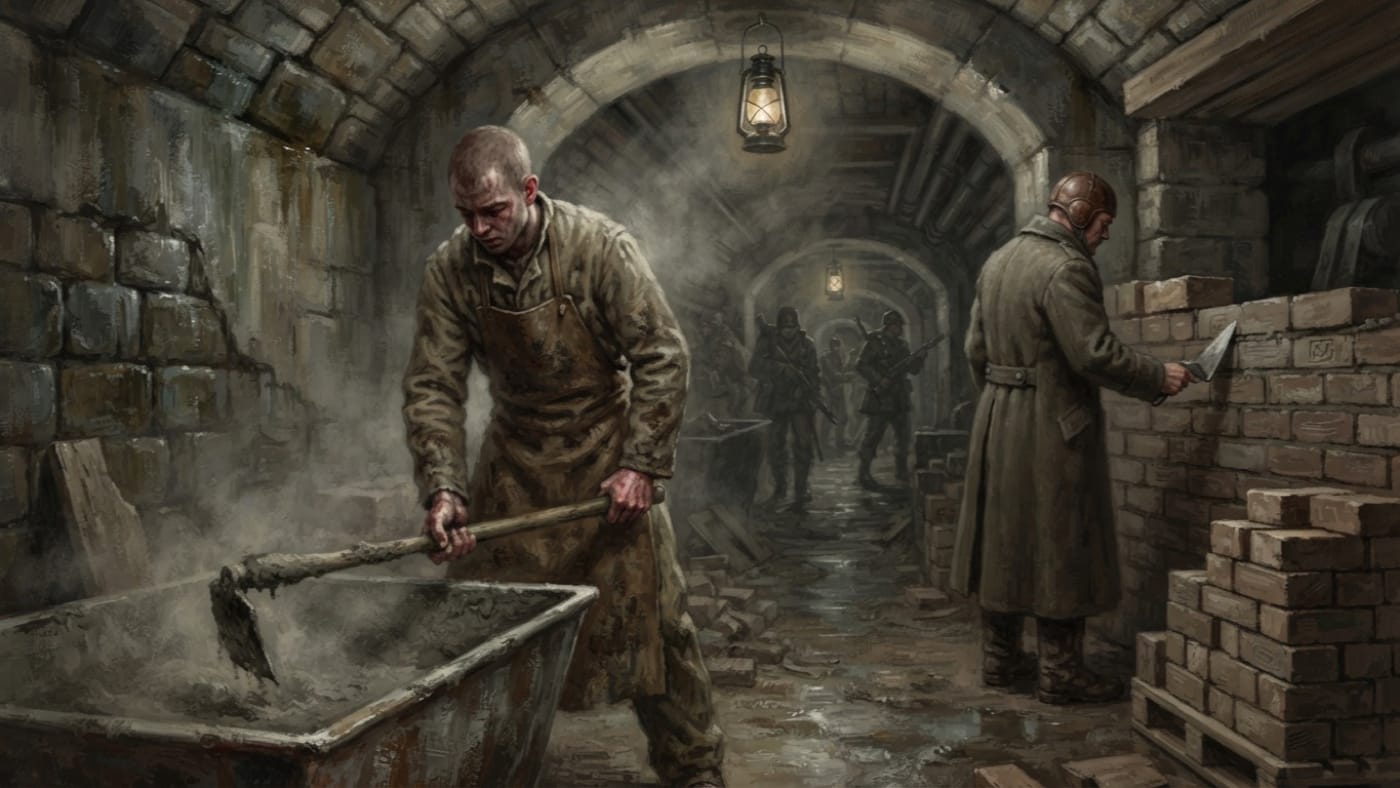
The trough sits in a bastion service passage or behind a firing step, wherever the wall is to be opened. There is cold mud underfoot and wet stone at the shoulder. A shielded lamp burns, cordite drifts down from the line, and the hoe drags gritty through lime that has begun to take water. The Lime Boy works the batch until it holds the shape the Wallwright wants. If it is too wet, it slumps from the course and cures weak. If it is too thick, it cracks in the first frost. Either way the result is a seam that an auditor will someday tap, and a tapped seam asks who mixed it.
Mud kills mortar, and the trenches are made of mud. Seepage from a wall face can spoil a batch before it leaves the trough. The trade's written best practice is to check for water constantly. In practice the trade has the Lime Boy check, and remembers afterward that he did.
Since the Demon-Listening Incidents at Bastion-Przemyśl in A.S. 158, many circuits have added the compound the masons call hush-powder. The carrier stirs it in. Nobody tells him what it is, which puts him on a level with this office.
Then comes the carrying. Brick goes to the Wallwright's left hand and mortar to the board at his right. The Wallwright cuts or inspects the niche, measures it against the crime class and lays the three locking bricks under strict measurement, while the junior keeps him supplied without getting underfoot. The plaque goes in after the second course. The closing bricks follow, with each seam lime-washed and the inspection mark chalked on the face. From the trough the Lime Boy can hear everything that passes through the narrowing gap: bargains, names, the Creed and muffled pleading. Trade taboo forbids talking to the condemned after the first locking brick. It says nothing against listening.
One illustration recurs among masons: a novice mixing in freezing rain while a master drags a trowel line through the batch, reads the consistency and orders it started again. The Corps records no such rite as an initiation and requires none. The weather sets the examination without help.
#On Instruction and Inspection
The Lime Boy learns by standing beside men who do not explain themselves. He picks up the shift customs before he learns why they matter. He washes his hands in brine, checks the plumb line, knocks the trowel three times on stone and recites the mix ratios like a prayer. At day's end the tools are cleaned with ash, and lime dust is spat away from the wall. These belong to the trade at large. No regulation I have been able to find prescribes a separate rite for the entry rank, and I have searched every shelf a Hieromnemon may enter.
He learns the slang too. Novices are "wet hands" and veterans are "dry trowels." Failures come as a cracked seal, a weeping wall or a bad cure. He learns that if it weeps, it speaks, and that one does not build on pity.
Inspection teaches him the rest. Auditors tap seams, measure plaque placement, test lime composition and read the stress lines in the wall, starting wherever rumour points. A hairline crack demands a name, and blame in the Masonry Corps runs downhill as reliably as water. The Master Sealer's stamp is on the log, the Wallwright's courses are on the wall, and the mix belonged to the apprentice. When pressure rises, the trade's own accounts name its usual sacrifices: an apprentice blamed for a crack, and a carrier "caught" stealing lime. Those quotation marks were in the original. I have kept them.
The theft charge has a simple logic. Lime is scarce. A barrel found short at audit must have gone somewhere, and the last man to touch the barrel is the man who carried it. The audit is not obliged to establish whether anything was stolen. It exists to account for the shortfall.
Advancement comes, when it comes, through competence and patronage: a flawless structural record, command of the mix, steadiness under fire, and a senior mason willing to speak the junior's name in the right room. The Corps publishes no examination and no interval for it. Masons have entered the profession by inheritance, by conscription, by debt to a works guild, or to get away from rifle duty. Any Lime Boy may have come in by any of these routes. None of them is the rule.
#On Mercy at the Wall
Standing Order 14-M leaves air provisions to the discretion of the presiding Judge. The Bureau of Doctrine recommends none. In the space between that discretion and that recommendation, the Corps has split into two undeclared factions. The Lime Boy fetches for both and is admitted to neither.
The Pure Sealers hold that mortar does not negotiate. They allow no mercy vent, no breath-thread and no straw routed through a crack. The Breath-Givers cut such channels in secret, and their reasons are less tender than their name. A condemned man who suffocates in hours teaches little. One who lasts for days becomes a lesson that spreads through the district. A breath-thread can draw out a death as easily as it eases one. No faction's preference overrides a writ, and a mason found with a vent the Judge never wrote faces the wall himself.
Mercy has a price list: salt, fuel chits and morphine. In the forward bastions it includes a forged mercy addendum, which needs a clerk's collusion and a seal that costs more than a month's rations. The masons say a vent is a vow, meaning that mercy given becomes a debt. That debt has a way of settling on the weakest man in the crew.
The Lime Boy stands closest to everything a breath-thread needs. He handles the materials and overhears the talk at the trough. He is there when a Wallwright shifts his body to block the mouth of the passage. That does not make him a conspirator, and it does not protect him from being called one.
The rule against sealing alone dates from Bastion-Irongate in A.S. 163. A mason who had worked by himself was found the next morning sealed into his own niche, his trowel in his hand and the plaque written in a hand that was not his. The Bureau called it administrative error. The rule that followed names masons. The carrier at the trough is present at seal-time and does not count toward it.
#On the Present Supply
Lime shortages in the Carpathian corridor have pushed masons in Zones 4 and 5 onto mud-calcium blends that crack within months and weep in wet weather. The weeping starts rumours that the condemned are crying. The Bureau attributes it to chemistry. The Lime Boy attributes nothing, in writing or otherwise. The inferior blend comes out of his trough, and his is the name the auditor will want when the seam opens.
The Bureau rates the Corps as a whole "operationally adequate." The official measures are structural integrity, compliance with the writ, completion speed, adherence to mix grade, plaque accuracy and the absence of unauthorized vents. None of them measures a knuckle. When I toured the niches at Bastion-Brest in A.S. 197, the oldest plaque dated to A.S. 102, and its mortar had held for ninety-five years. My report praised the stamp. The mix under the stamp was somebody's work. The log does not say whose.
Old walls offer the same lesson at greater scale. At the Silence of Târgu, thirty-one men went into a single wall and the masons worked for nine hours. Nine hours of laying requires nine hours of mixing. The Murmur Line is remembered for what it said afterward, and the log records the masons.
An earlier compilation of this office placed the Silence of Târgu in A.S. 228. The Silence of Târgu took place in A.S. 128. A.S. 228 has not yet arrived, and the compiler has been reminded of the calendar.
Before the Synod wrote its first standing order, during the Great Retreat, someone was already carrying lime to a wall with a man inside it. That person's name is not recorded either.