

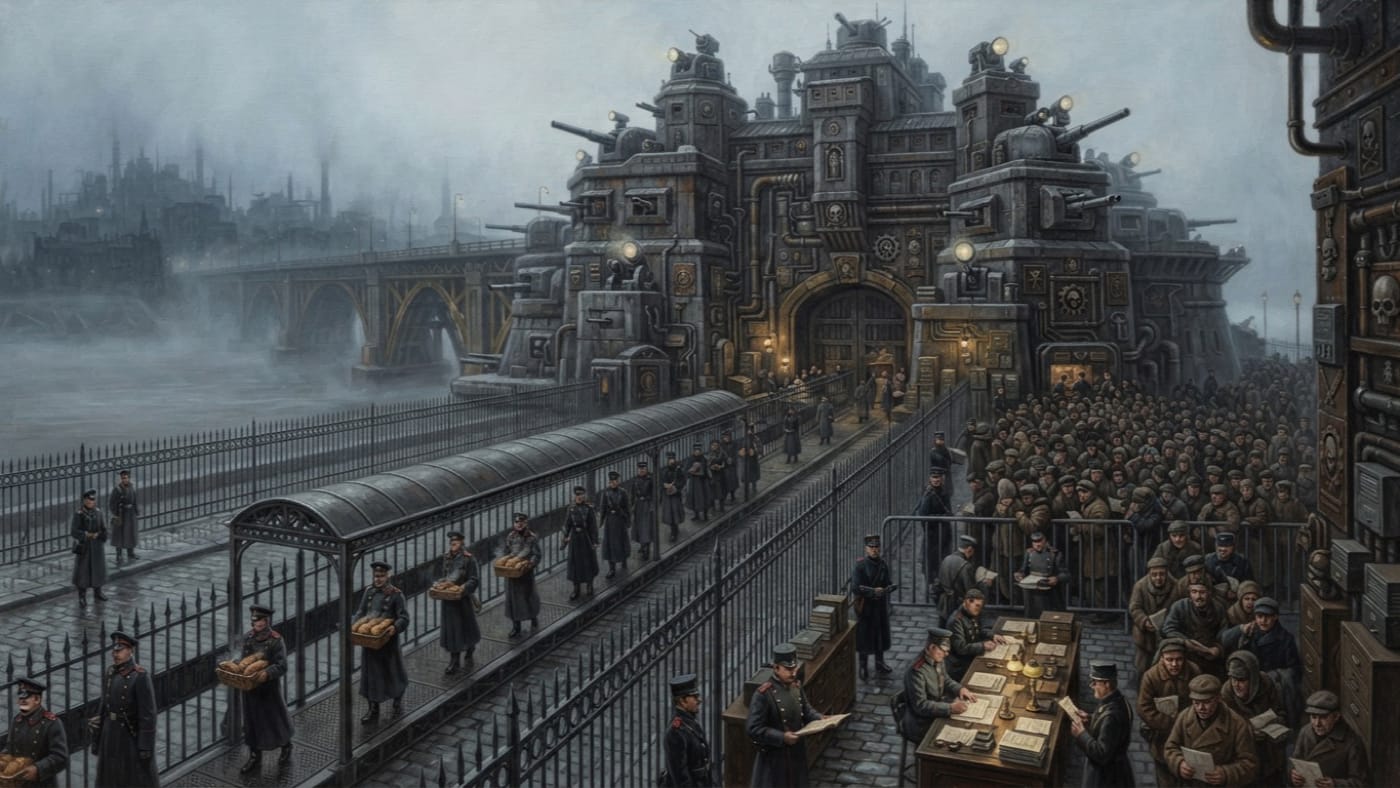
#On the Western Inspection
"The east asks who you are. The west asks whether you are still the same man." — Drax, marginalia on the Northern Theater Survey
By the time a crosser reaches the West Gatehouse of Bastion-Brest, the bridge has already done most of its work on him. The eastern intake has fumigated his papers in vinegar. The Ribwalk has queued him and the Confessional Lanes have made him speak. He has been handed a wax disc for his trouble. The lanes run one way. Whatever is left of him comes off the span at its western end, where Engineering begins its count of the Brass Ribs at Rib One, and stands before the last inspection between the Bug and the rest of the Church.
The building is granite clad in iron, and every face of it has firing positions. The clerks are as thick inside it as the guns. It matches the East Gatehouse in stone and differs from it in purpose. The eastern house takes in convoys, levies, pilgrims and prisoner details, and the western house lets people go: outgoing inspections, officers' crossings, and the arrangement the garrison calls the clean lane. Brest lies second of the seven great bastions counted from the north along the Sagittal Line. The Line runs north and south and the crossing runs east and west, so everything that leaves the bridge for Warsaw and the western bank has to pass through this one building.
The east end smells of wet paper. The west end smells of gun oil and hot bread, because the officers eat well and the guns eat better. A traveller standing on the outer stones in the river mist, with his receipt going soft in his fist, can smell the bread for an hour before he is called. He can also watch the men who are not made to wait walk past him.
#On the Clean Lane
The clean lane is for personnel whose confession files the Bureau of Doctrine has pre-certified. Most of them are officers, but rank does not admit anyone to it. A colonel whose file has not been cleared queues behind the carters and smells the same bread they do. Certification is what admits a man. Rank only makes certification easier to get, the way wealth makes good health easier to get, and it buys the same sort of grudging respect from the people who have neither.
The lane's name causes theological trouble at Brest. Under the bridge's governing doctrine, a living person who claims to be without sin commits heresy of the fourth category, punishable by immurement or by a winter on the dredge crews. Locals do not use the insult cleanmouth lightly. Yet the clean lane is staffed, stamped and in daily use by men who would be arrested for the word if they said it about themselves.
The Bureau of Doctrine resolves this with a distinction I admire professionally. What the lane certifies is the file. It makes no claim about the man. A pre-certified file records that the bearer's confessions have been heard, sorted and found consistent with his earlier confessions, so that no variance is pending, no Tribunal question is open and no correction is outstanding. It does not certify that the man is innocent. That remains forbidden, and the sinner is welcome to keep his sins as long as his paperwork is cleared.
The men waiting in the common queue do not appreciate this distinction. The dedicated surveys list envy violence among the standing hazards of the West Gate: fights started by the sight of a cleared officer walking past a forty-hour queue, stones thrown at a cart with the right seal on its tailboard, and provosts called to break heads over a matter of procedure. The lane is fenced from the queue by iron and from resentment by nothing at all. The bread makes it worse. It is carried to the officers hot, along the lane, past men who have eaten brine porridge since the eastern wire.
#On the Authority to Release
The outgoing inspector has one question to settle, which is whether this person may leave. He answers it from three instruments and a file. He must see a confession receipt stamped against the bearer's identity file and an absolution token from the booth that heard the confession. He must also see a transit seal from the Crossing Bureau certifying that the confessed sin agrees with the sins already on record. The toll is a separate matter, paid in coin, ration chits or labour-hours on the decking. A man can be square with the toll-takers and still be held, because paying tolls has never made anyone legible.
Each instrument belongs to a different power, and all three meet at the western counter. Seal-Registrar Hett Ruis of the Crossing Bureau holds the stamps, the identity corrections and the crossing writs, and nothing leaves the west end without his wax. Presiding Judge Elsbeth Krail sits at mid-span in the Absolution Hall, a long way from this building, and her Bridge Tribunal hears every crossing dispute and every manifest irregularity. The Tribunal holds that while a person's feet are on the bridge, the bridge owns the question of whether they may cross. Krail has never needed to visit the West Gatehouse, because her pause reaches it without her. Gun-Cantor Marshal Vonn holds the firing keys and the curfew. When the curfew bell sounds, the clean lane closes as surely as the common one, and for once the colonel and the carter are equal.
The provosts and clerks of the gatehouse exercise all three authorities on loan, and they do it in the confident manner of men who will not be blamed for any decision so long as it was stamped.
Pre-certification speeds a man through this machinery but does not exempt him from it. His file can still be reopened by a variance hearing at mid-span. Ruis can still withhold the seal, smiling throughout. The Tribunal has the power to halt a crossing over a single smudged token, and so far as I know it has never disowned that power. A cleared file only means the counter expects to find nothing.
#On Irregular Passage
Whatever the clean lane is meant to keep out, it is where smuggling pays best. Brest's own lore lists officer smuggling as the characteristic vice of the West Gate, and the reason is plain. Inspectors spend their care where they expect trouble, and a pre-certified officer's cart is the place they expect it least. Whatever leaves the bridge in that cart leaves under a seal. The black market beneath the Ribwalk has always known this. It sells forged tokens, edited transcripts, purchased corrections, name trades and pre-written sin scrip to anyone who can pay, and its best customers are the people for whom one correction is all that stands between a reopened file and a cleared one.
The worst threat at the western counter is paperwork that is perfectly valid. A forged token can be detected by a clerk who knows his wax. Detecting a genuine token issued against an edited confession, which a corrected file has made consistent and a real seal has made mobile, requires the clerk to doubt the whole bridge behind him, and clerks who do that do not stay clerks for long.
The Tribunal blames the Blank-Sheet Circle for the nameless crossings and has sharpened its seizure powers under Standing Order 14-B to deal with them. The Bureau of Purity raids the under-deck market every quarter, and the market is open again within the week. Neither office has published an estimate of how many illegible people have been released at the west end looking perfectly legible. I have asked for one and was not given it.
Since A.S. 199, the Confession Echo has made the counter's work harder. Confessions spoken in the booths return days later in the speaker's own cadence. Ink on crossing stamps beads like sweat, and candles in the lanes lean toward the booths. The bridge's surveys certify no Echo within the gatehouse walls, but every document the western clerks inspect has passed through the lanes where the Echo is active, and Booth 77 stands sealed on the north side at the third pylon from the west, close enough to be counted from the gatehouse. When a man's own confession is heard repeating itself on the deck, his receipt becomes a doubtful thing, and nobody at the Tribunal or at the Bureau has yet been able to say whose hand is doing it.
An earlier survey in this Codex stated that Bastion-Brest faces Velkara.
It has always been the case that Brest faces the Nameless Tide across the Bug. Velkara holds no fixed bastion, and her influence is classified as diffuse and internal to the Church. The Bureau of Doctrine's classification of a suspected Velkaran crossing-heresy complex in the Northern Theater still stands, but it is a classification. It does not establish that Velkara commands the Tide or that she causes the Echo. The author of the earlier survey has been consulted and agrees with the correction, since he wrote it.
#On the Present Condition
In A.S. 201, the year of this survey (1911 CE), the West Gatehouse functions. Outgoing inspections are conducted, officers cross, and the clean lane admits the files Doctrine has cleared. The bread arrives hot and the guns are kept oiled. Ruis's wax still releases people and Krail's Tribunal still holds them, and Vonn's bell still closes both lanes at curfew for everyone alike.
The bridge's confidence in its own records is weaker than it was. The garrison inspects valid papers with the care it once reserved for forgeries, and the officers in the clean lane are aware of it. Of all the West Gatehouse's functions, the clean lane depends most completely on the file being true, and so it has the most to lose if the file is false. The Bureau of War's word for the bastion's state is still "operational," a word whose definition it has already revised once.
The queue on the outer stones is as long as it was. The men in it still smell the bread.