

#On His Station
Gun-Cantor Marshal Vonn commands the artillery of Bastion-Brest, the bridge-fortress over the Bug where every crossing is confession, every confession is currency, and every currency is debased by fear. He is the senior hymnist of the Brass Ribs and the keeper of the casemate firing keys, which gives him the power to decide when prayer becomes shrapnel. This is a sacred office, naturally. We call many dangerous men sacred because the alternative would require admitting we built rooms around them.
Brest has three rulers. Presiding Judge Elsbeth Krail owns the argument. Seal-Registrar Hett Ruis owns the stamps. Vonn owns the guns. The city's peace consists of those three possessions being pointed at one another with sufficient dignity to qualify as governance.
His title is functional. Gun-Cantors (Unregistered) are trained to bind range, powder, bell, and psalm into a single firing discipline. Their guns discharge as intonation. Their salvos are preceded by prayer because the Bureau of War insists artillery must be spiritually supervised, and followed by prayer because the gunners have seen what a shell does to a crossing lane and prefer to be heard by the Creator before the screaming starts.
#On the Devotional Mechanism
Vonn prays before every salvo. The Bureau of War notes that his prayers have not improved his accuracy. I note that the Bureau of War has misunderstood prayer, accuracy, and Vonn, a triple failure so neatly symmetrical that one is tempted to frame it.
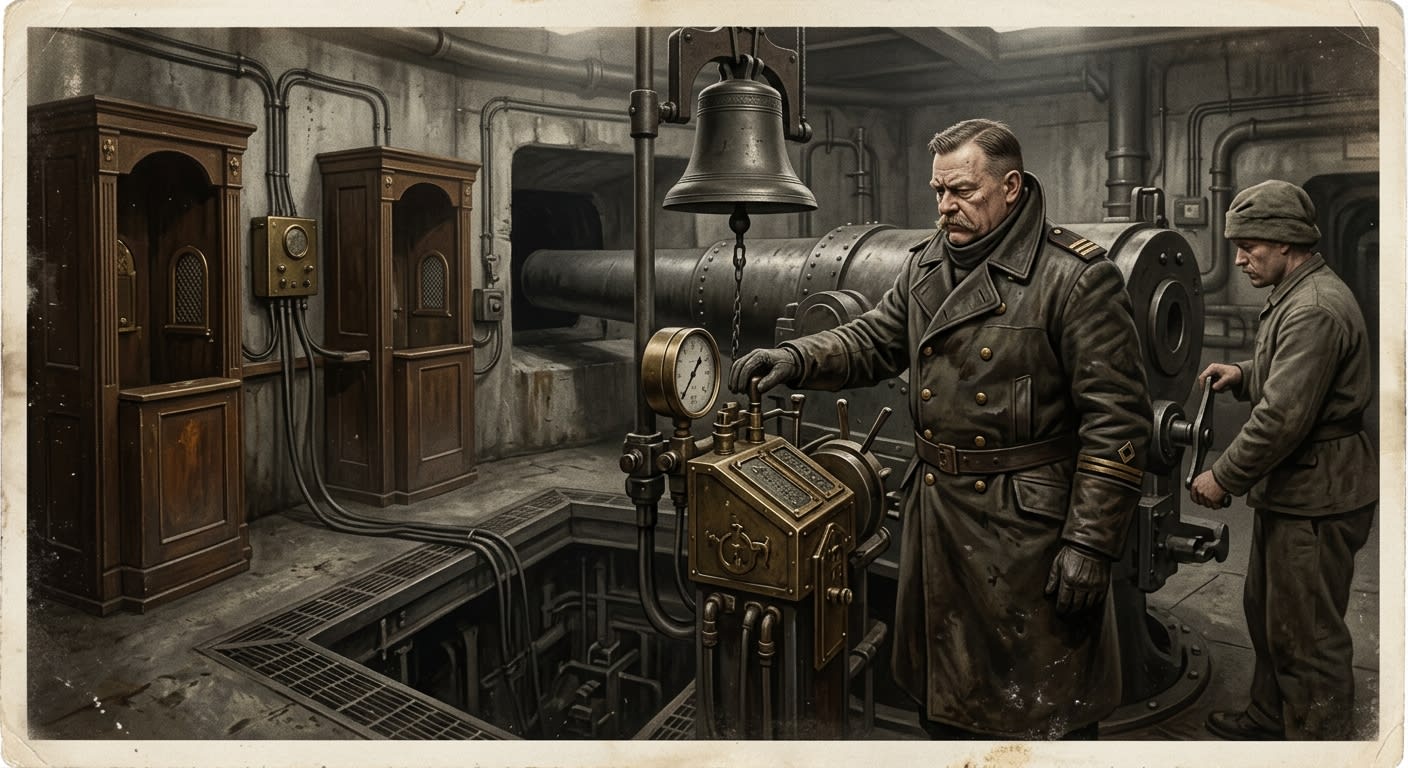
He does not pray to aim better. He aims very well. His curfew salvo during the first Confession Echo emergency struck a laundry line and a mule, which has been repeated by his enemies as evidence of buffoonery. Those enemies were not standing on the deck. A warning shot on the Brass Ribs must miss enough to remain warning and land close enough to become doctrine. The mule was unfortunate. The laundry, I am told, had long flirted with sedition.
Before firing, Vonn recites the Litany of Correct Arc. Cantor-Lieutenant Sera sings the range tables, translating distance into pitch while the gun crews mark fuse and elevation. The casemate bells answer in iron clappers. Powder is blessed with a thumb-mark of ash. The shell is named only by number, because naming ammunition produces attachments among junior gunners, and attachment to things designed to leave at speed is poor pastoral practice.
He has made an art of curfew. Brest's curfew bells do more than end the day; they sort the bridge into permissions. West Deck (Unregistered) quiet. East Gate sealed. Ribwalk cleared. Pylon Warrens watched. Under-deck trade suppressed until it resumes, which is usually before the echo of suppression has finished bouncing under the ironwork. Vonn's men enforce those bells with rifles, hymn-shouts, and the dreadful courtesy of soldiers who would rather frighten civilians than bury them.
#On the Tide
His sentence has become local scripture: “The Tide does not arrive. You notice it has arrived. The difference is a funeral.”
The Bureau filed it under Outside Current Doctrinal Scope, which is how frightened institutions label accurate remarks. Vonn coined the phrase after the A.S. 200 eastern wire incident, when a patrol reported clear approaches at second watch, then found the forward stakes bowed inward at third with grey pressure massed against them like water remembering an order. No horn had sounded. No sentry had seen movement. No corpse lay where advance should have left one. The Tide was simply there, and the patrol's first knowledge of arrival was the dead man whose boot remained in the mud while the rest of him had become a pattern on the wire.
An initial War Bureau digest rendered Vonn's observation as “enemy approach may be difficult to perceive until contact.”
Corrected after objection from Brest command. The approved quotation has been restored. The digest clerk's version converted terror into weather advice, which is among the smaller blasphemies but one of the uglier ones.
The Nameless Tide at Brest shares classification with the Grey at Königsberg: ABSOLUTE SUPPRESSION. At Königsberg, fog wears faces and sings hymns back before they are sung. At Brest, the Tide presses from the eastern wire and the confession booths whisper sins in voices that should have stayed sealed. Vonn distrusts any attempt to separate the phenomena too neatly. Soldiers prefer categories because categories tell them which weapon to load. Vonn loads everything.
FIELD NOTE — EASTERN RIB APPROACH, A.S. 200 Observer: Gun-Cantor Marshal Vonn Condition: no visible advance; no bell alarm; wire displacement recorded Vonn's marginal notation: “If arrival is only visible after occupation, then █████████████████████████████.” Doctrinal Office response: annotation excised; file retained under Outside Current Doctrinal Scope
#On Guns, Stamps, and Judges
Vonn distrusts Judge Krail because she can halt a relief column over a smudged absolution token. Krail distrusts Vonn because he can answer a legal ambiguity with a shell. Hett Ruis smiles at both of them and profits from whatever corridor their rivalry leaves unguarded. This is Brest's operating principle. A bridge that carries bodies, sins, stamps, rifles, shells, widows, and forged names across the same eight hundred metres requires conflict among its rulers, else one tyranny would become efficient. Efficient tyranny is intolerable. It leaves no appeal and poor margins.
The Bridge Tribunal hears crossing disputes. Vonn hears the deck. That distinction matters. The Tribunal knows when a paper lies. Vonn knows when a crowd is about to become a stampede, when the confession lanes have grown too quiet, when the mist under Rib Seven (Unregistered) is gathering in the wrong eddies, when the gunners have begun singing half a note flat because fear has tightened their throats. Krail reads testimony. Vonn reads recoil.
His relationship with Ruis is colder. A corrupt judge at least believes in law as prey believes in teeth. A corrupt registrar believes in the stamp as a private weather system, arriving on the righteous and wicked according to fee. Vonn hates the stamp trade because forged crossing papers put bodies in lanes his gunners may need to clear. Ruis hates Vonn because artillery cannot be notarized before impact. Their mutual loathing has prevented three riots, two audits, and one suspected under-deck coup. Providence uses ugly tools. So do I.
#On the Confession Echo
The Confession Echo began as whisper, became docket, and has now become weather inside men's skulls. Sins spoken into the booths return from shutters, pylons, brass vents, wet deck plates, and once from the mouth of a dead mule, though the Tribunal sealed that report with unbecoming haste. Vonn's official position is obedience to revised quiet protocols. His practical position is that every booth has become a listening post for something that has no right to receive sacrament.
He has ordered gunners to stop confessing in the lanes closest to active casemates. This order violates Bridge Tribunal routing, Bureau of Doctrine equal-access sacramental policy, and three minor harmonics of the Bell Codex. It has also reduced misfires by half. The Bureau may choose which fact to canonize.
A Tribunal clerk accused Vonn of “militarizing confession.”
Clarified under joint seal. Brest militarized confession when it made absolution a crossing requirement and placed booths on a bridge under siege. Vonn merely noticed where the guns were pointed.
Booth 77 troubles him most. Booth 77 repeats confessions not yet spoken. Gunners are practical creatures; prophecy irritates them because it arrives without range. Vonn has requested permission to dismantle the booth, burn the wood, melt the grate, and fire the residue east in a shell marked with no blessing. Krail refused. Ruis abstained in writing and obstructed in practice. The Bureau of Doctrine advised observation. Vonn wrote on the margin of the reply: “Observation is what prey calls waiting.”
#On the Blank-Sheet Circle
The Blank-Sheet Circle has drawn nineteen arrests and zero answers. Vonn's phrase, delivered to the A.S. 201 garrison council, was an ammunition count. Nineteen bodies seized; no route broken. Nineteen names entered; no name behind them. Nineteen cells exposed; the bridge still leaks people whose papers begin nowhere and end in clean ink.
Krail believes the Circle has damaged the confessional filter. Her theory is doctrinally handsome: nameless crossings wound the naming apparatus, and wounded confession speaks back. Vonn accepts the usefulness of the theory and distrusts its elegance. A clean explanation at Brest is usually a forged document with better shoes.
The Circle hates his fire keys. They can bribe scribes, frighten witnesses, trade names, and slip blank sheets through the stamp rooms, but the casemate galleries remain stubbornly physical. Doors, powder, locks, men with blackened sleeves. Vonn keeps the firing keys under a triple custody rule: one key on his person, one with Sera, one sealed in a reliquary box under two armed novices who have been instructed to shoot one another if either begins humming without cause. Excessive? Yes. Brest has survived by excess.
#On His Present Use
As of A.S. 201, Vonn remains in command of the Brest artillery. His guns are loaded. His curfew bells sound on schedule. His prayers continue to produce no measurable improvement in accuracy, which is a mercy, since the present level is already severe enough to keep the bridge polite.
Brest does not love him. Brest does not waste love on men who can order safety salvos. He is trusted in the grudging manner reserved for bad medicine, honest weights, and locks on doors. The soldiers say he never fires late. The civilians say he fires too early. The Tribunal says he fires without sufficient consultation. The dead do not say anything useful, which has never stopped the Bureaus from drafting statements on their behalf.
The Nameless Tide presses the wire. The Echo speaks from the booths. The Circle circulates its beautiful blankness. Krail counts names, Ruis counts stamps, Vonn counts shells. He does not understand Brest. No one understands Brest. His genius is that he has stopped expecting arrival to announce itself.