
#On the Crime of Blankness
"The most dangerous document in the Synod's jurisdiction is the one with nothing on it." — Drax, annotation to the Bridge Tribunal's Quarterly Arrest Folio, A.S. 200
The Bureau of Doctrine has spent one hundred and eleven years perfecting the principle that identity is a function of paper. You are what the Ledger says you are; you go where the stamp permits you to go; you confess what the booth assigns you to confess. The entire crossing system at Bastion-Brest — those two hundred and fourteen confession booths, those candle-lit lanes, those duplicate transcripts filed in vaults beneath the Absolution Hall — rests on a single architectural assumption: that no soul passes the Ribs without first offering its name, its sin, and its paper to the machinery of transit.
The Blank-Sheet Circle is the heresy of that assumption's inverse.
They do not preach. They do not proselytise. They hold no services in marshside barns and distribute no pamphlets in the Ribwalk markets. What the Blank-Sheet Circle does — and what it has done, by the Bridge Tribunal's reckoning, since at least A.S. 196 — is manufacture blank crossing papers. Unsigned, unstamped, unfiled. Paper that carries no name, no sin, no confession receipt, no absolution token number, no identity trace of any kind. Paper that permits what the Synod's entire crossing architecture was designed to prevent: the nameless crossing. A soul on the bridge that the Ledger cannot see.
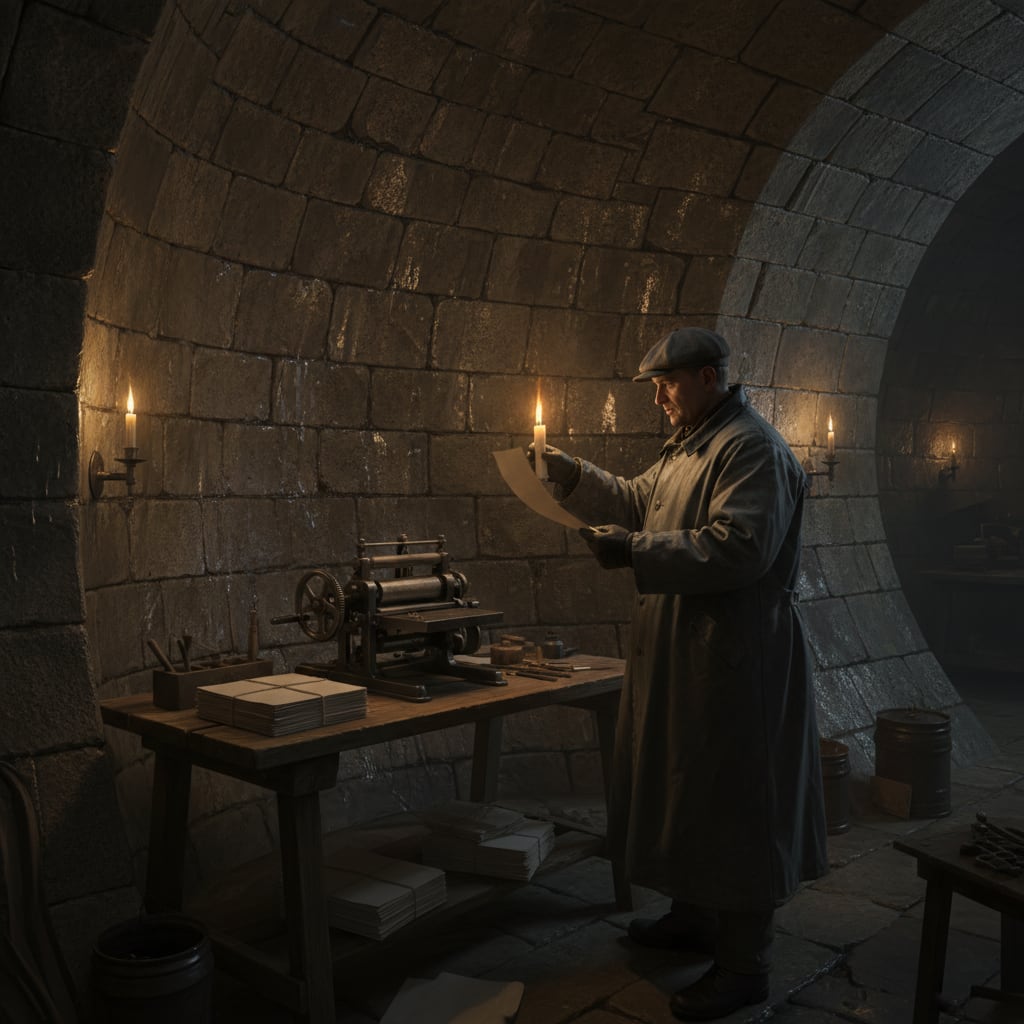
The Circle operates from the Pylon Warrens — the vertical slums inside Brest's fourteen bridge pylons, where the damp never dries and the population density exceeds anything the Bureau of Settlement has authorised. The Warrens are ideal for clandestine work: they are poorly lit, poorly mapped, and populated by people whose relationship with the Tribunal's crossing system is, at best, one of exhausted compliance. A printing press can be disassembled in minutes and reassembled in a different pylon before the provost patrols complete their rounds. The Circle knows this because the Circle has done it at least seven times, according to Tribunal records, and the Tribunal suspects considerably more.
#On the Membership and Its Methods
"You cannot arrest a blank sheet. You can only arrest the hand that made it blank." — Judge Elsbeth Krail, Bridge Tribunal memorandum to the Bureau of Shadows, A.S. 200
The Circle's membership is, by design, difficult to enumerate. Judge Krail's office has arrested nineteen individuals in the past six months on charges ranging from "manufacture of proscribed documentation" to "conspiracy to enable nameless transit." The arrests have produced confessions — Brest produces confessions the way the Bug produces mist, which is to say ceaselessly and to no one's particular satisfaction — but the confessions are contradictory. One prisoner names four members; another names forty. One describes a cell structure with a leader called Moth; another insists the Circle has no leader and Moth is a title that passes from hand to hand like a counterfeit token.
What the Tribunal has established is this: the Circle's core operation requires three capabilities. First, a source of raw paper stock — unsized, unwatermarked, unregistered with the Bureau of Records' paper census. Second, a press or presses capable of producing documents that pass visual inspection at the gatehouse checkpoints. Third, access to the confession system itself, because a blank crossing paper is useless without a method of bypassing the confession lanes, and the lanes are the only route through the bridge's interior corridors.
The first capability is solved by the Pylon Warrens' proximity to the Sluice Yards. Dredge crews haul river debris from the pylons daily, and among the river debris — the logs, the ice fragments, the things the Bureau of Records classifies as "river salvage" and the dredge hands classify with vocabulary the Bureau would not endorse — is pulp. Raw, cold-water pulp from the upstream paper mills that serve the Warsaw dispatch corridor. The mills lose a percentage of their stock to the current. The Sluice Yards recover it. The Bureau of Engineering has calculated the recovery volume at three to four hundredweight per season. The Circle needs perhaps a tenth of that.
The second capability is where Irena Vale enters the record. The Tribunal identifies Vale as the Circle's primary seal technician — a former assistant in the Crossing Bureau's stamp room who was dismissed in A.S. 197 for "irregularities in die maintenance." The irregularities, upon subsequent investigation, proved to be the systematic duplication of stamp dies using wax impressions taken during routine cleaning. Vale carried the impressions out in her apron. The apron, the Bureau of Purity notes, was never searched, because the checkpoint guards at the stamp room's exit were trained to inspect hands and pockets and had received no instruction regarding aprons. The Bureau has since revised its checkpoint protocols. The Bureau's checkpoint protocols now include aprons, sashes, headwraps, and — following a separate incident at Bastion-Przemyśl — prosthetic limbs.
An earlier annotation in the Bridge Tribunal's files identified Irena Vale as "Irena of the Warrens," suggesting she was born in the Pylon district.
The Bureau of Records has determined that Vale was born in Warsaw, educated at a Synod scribal school, and posted to Brest on a standard Bureau of Records administrative rotation. She was, by all accounts, a competent clerk. The Bureau does not speculate on what transforms a competent clerk into a heretic. The Bureau merely notes that the transformation occurred and files it under Personnel Anomalies, Category: Regrettable.
The third capability — access to the confession system — is the one that troubles the Tribunal most. A blank paper can be manufactured in a pylon cellar. A stamp die can be duplicated from a wax impression. The confession lanes cannot be bypassed without inside assistance, because the lanes are single-direction corridors with scribes stationed at every third booth and provost patrols at every sixth, and the physical architecture of the bridge makes alternative routes a matter of climbing, swimming, or dying. The Circle, therefore, requires confederates among the Confession Scribes (Unregistered).
The method, as the Tribunal reconstructs it, operates thus: a client approaches the Circle through intermediaries in the Pylon Warrens — typically through the under-deck market, where the word "blank-sheet" functions as both slang for a nameless person and a coded request for the Circle's services. The client pays in ration chits, labour-hours, or information — the Circle does not accept coin, because coin is traceable through the Bureau of Tithes' serial-mark system, and the Circle's entire philosophy is the erasure of traces. The client receives a set of blank crossing papers — unstamped but stampable, carrying no identity but ready to receive one — and is directed to a specific confession booth at a specific hour. At that booth, the scribe on duty processes the client through the confession system using a pre-written "safe sin" — a minor offence, formulaic, indistinguishable from the hundreds of rote confessions the lanes process daily — and stamps the blank paper with a valid absolution token. The client crosses the bridge as a named person whose name is fiction, whose sin is theatre, and whose paper trail terminates at the far gatehouse in a file that leads nowhere.
#On the Tribunal's Theory and Its Insufficiency
"Nineteen arrests. Zero answers." — Gun-Cantor Marshal Vonn, addressing the garrison council, A.S. 201
Judge Krail has attributed the Confession Echo — the phenomenon whereby sins spoken into the bridge's confession booths re-emerge as whispered voices on the deck — to the Circle's activities. The theory is this: the confession system functions as a spiritual filter, sorting named souls from unnamed ones, and the presence of nameless crossings has damaged the filter. The Echoes are the system's malfunction — confessions returning to claim what confession was denied, sin seeking its proper owner the way water seeks its level. The theory is doctrinally sound. The theory has the endorsement of the Bureau of Doctrine's Northern Theater office. The theory does not explain why Booth 77 repeats confessions from the future, or why the Echoes began in A.S. 199 while the Circle has been operating since at least A.S. 196, or why the nineteen arrests have had no measurable effect on the phenomenon's intensity.
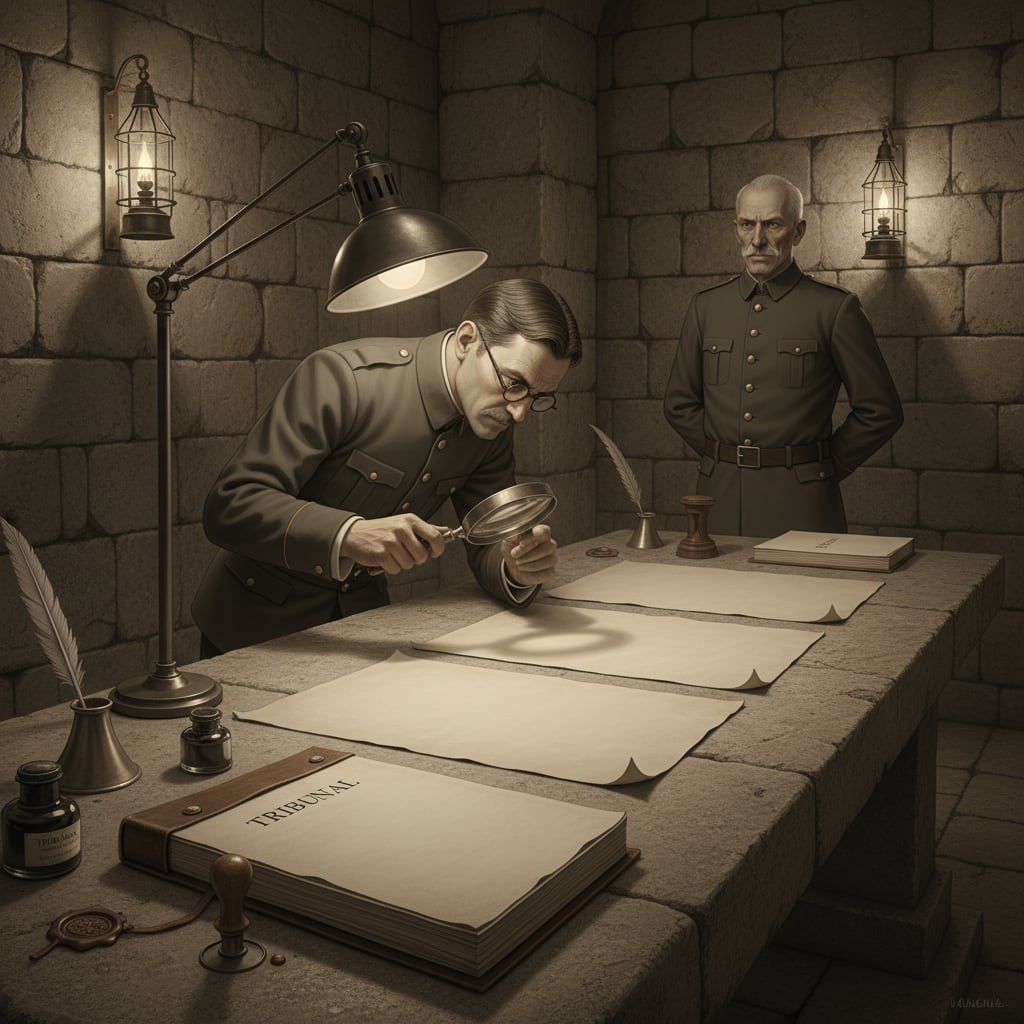
I have spoken with Judge Krail. She is intelligent, precise, and convinced. She showed me the arrest transcripts, the confiscated paper specimens, the Crossing Bureau's crossing-anomaly reports — a catalogue of discrepancies between the number of souls entering the east gatehouse and the number exiting the west, a discrepancy the Bureau's statisticians have placed at between four and eleven per day, which over the course of a year amounts to a population of ghosts large enough to staff a small parish. She showed me the tribunal's map of the Pylon Warrens with the suspected press locations marked in red ink. She did not show me the Bureau of Shadows' file on the scribe confederates. She told me it was sealed. I told her I could unseal it. She told me the seal was not the Bureau's but the Tribunal's own, and that the Tribunal's seals were not subject to Hieromnemonic override.
The Circle persists. The arrests have not diminished it and may have strengthened it — each arrest produces a public trial in the Absolution Hall, and each trial produces a confession that the Tribunal broadcasts to the Ribwalk crowds as a demonstration of justice, and each broadcast confession contains, embedded in the rote language of guilt and submission, the precise vocabulary of the Circle's ideology: nameless, unwritten, free crossing, paper is the chain. The Tribunal is, in effect, conducting the Circle's recruitment campaign for it. I have mentioned this to Judge Krail. She received the observation with the enthusiasm one might direct at a confession echo that repeats your own voice back to you in a register you do not recognise.
[SECTION REMOVED — BRIDGE TRIBUNAL JUDICIAL SEAL — CONTENT RELATES TO ONGOING COUNTER-HERESY OPERATIONS IN THE PYLON WARRENS — RESTORATION PENDING BUREAU OF SHADOWS CLEARANCE THAT THE BUREAU OF SHADOWS HAS NOT CONFIRMED IT WILL PROVIDE]
#On the Theology of the Blank Page
The Bureau of Doctrine classifies the Blank-Sheet Circle as a heresy of the Second Order — a denial of institutional authority through practical subversion rather than doctrinal argument. The Circle does not claim the Synod is wrong. The Circle does not dispute the Catechism of Obedience or challenge the authority of the Seven Seals. The Circle's theology, such as it is, fits on a single sheet of paper, and the sheet is blank.
The heresy is the blankness itself. To cross the bridge without a name is to assert that the Ledger is optional — that a soul can exist, move, act, and matter without being written down. The Synod's entire architecture of governance rests on the opposite proposition: that the unregistered soul is a soul uncounted, and the uncounted soul is, in every sense that the Bureau of Records recognises, a soul that does not exist. The Circle's blank paper is an ontological argument conducted in linseed and cellulose. It says: I am here, and your Ledger does not contain me, and I crossed your bridge anyway.
The Bureau of Purity has proposed reclassifying the Circle as First Order — direct opposition to the Synod's sovereign authority — on the grounds that the manufacture of blank papers constitutes an assault on the Great Ledger of Souls itself. The Bureau of Doctrine has declined the reclassification, because First Order heresy requires a doctrinal position, and the Circle's position is the absence of one, and the Bureau has not yet determined how to condemn an absence without first defining what should be present, and the definition of what should be present is the Ledger, and the Ledger is what the Circle denies, and the circle — I use the lowercase deliberately — closes.
I have filed a recommendation with the Bureau of Doctrine suggesting that the Blank-Sheet Circle be studied rather than merely prosecuted. The recommendation was received. The recommendation was classified. The classification was Outside Current Doctrinal Scope, which is the Bureau's way of saying that my recommendation exists in precisely the condition the Circle advocates: present, unwritten, and invisible to the machinery that governs what is real.
A previous draft of this entry included a census estimate of the Circle's total membership, sourced from the Bridge Tribunal's quarterly intelligence summary.
The estimate has been withdrawn at the Tribunal's request. The Tribunal's stated reason is that the estimate was "provisional and potentially misleading." The actual reason, which the Bureau of Shadows has communicated to me through channels the Tribunal does not monitor, is that the estimate was embarrassingly large. The Bureau does not specify what "embarrassingly" means in numerical terms. The Bureau trusts that the reader's imagination will suffice.