
#On the Bones That Learned to Conduct Traffic
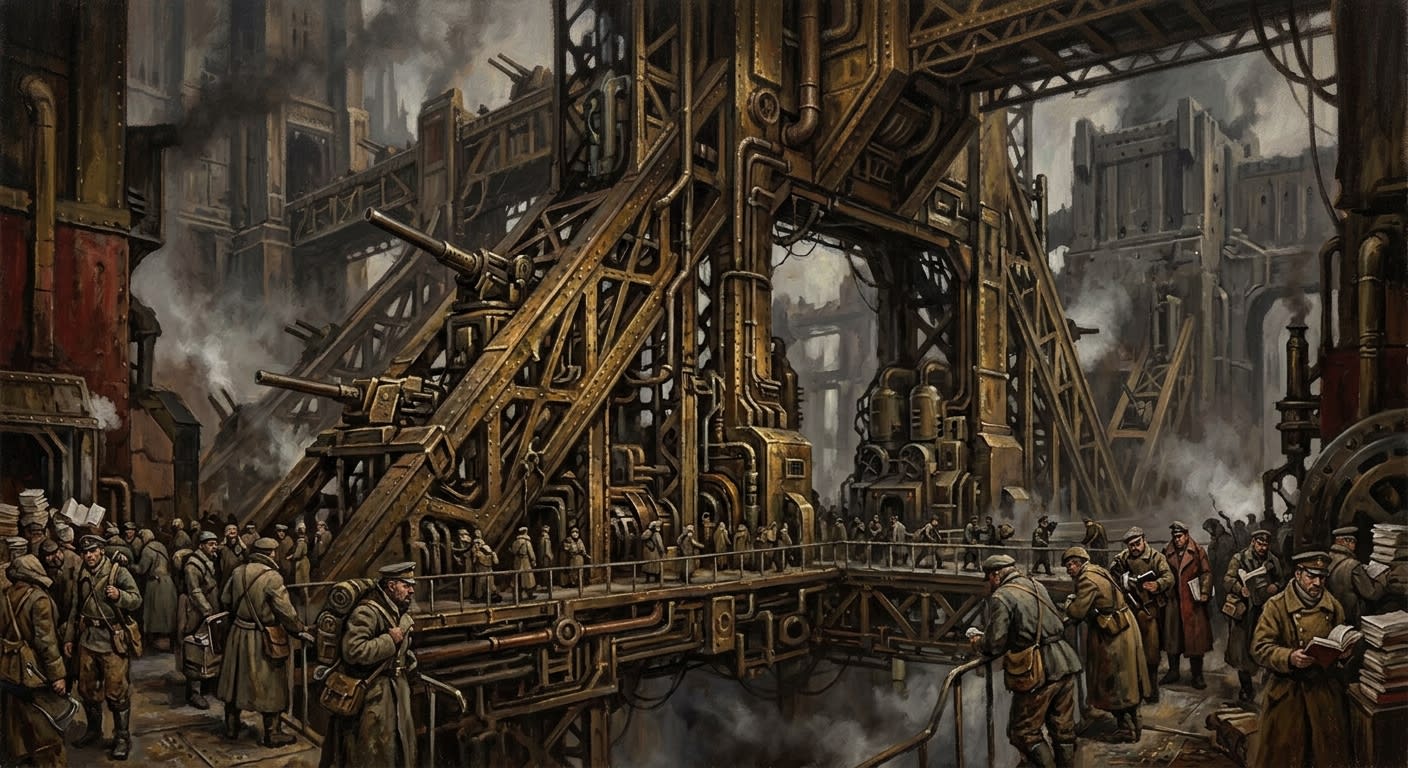
The Brass Ribs are the thirty-two arched trusses of Bastion-Brest, riveted iron plated in old brass, spanning the Bug River at the only bedrock pinch for fifty miles and carrying over their backs the weight of soldiers, convoys, absolution tokens, wet bread, artillery crews, forged names, court summonses, unlucky mules, frightened pilgrims, and every sentence the Synod has ever mistaken for control. Outsiders use the phrase as a nickname for the whole bastion. Locals use it more precisely and more superstitiously. The bastion is the legal fiction. The Ribs are the body.
Each rib rises from pylon to pylon like a cathedral arch that has been denied stained glass and given gun shutters as consolation. The outer face holds casemates. The inner hollows hold confession apparatus, service ladders, oil ducts, speaking tubes, inspection slits, and those narrow maintenance passages where boys with small shoulders carry bolts, messages, bribes, lice, and panic through the metal anatomy of the span. Men sleep inside the pylons. Clerks record sins beneath the deck. Gun-Cantors sing above them. The bridge exhales mist through seams in winter and heat through brass seams in summer. It has acquired a pulse by collecting too many human systems inside one length of metal.
The Bureau of Engineering insists that the Ribs are structural members. The Bridge Tribunal insists they are jurisdictional compartments. Gun-Cantor Marshal Vonn insists they are firing galleries with civilian inconvenience attached. Scribe-Mother Hal insists they are dangerous resonant chambers in which two hundred and fourteen booths must still operate by dawn. The people who live under them insist, more quietly, that the Ribs listen.
The last claim is unofficial. Unofficial claims keep better hours than official ones.
#On Their Raising and the Lies of Completion
The first Brest crossing was a stone bridge, old and Prussian, adequate for carts and insultingly fragile before the war that arrived at the Bug in A.S. 66. Six companies held that bridge for nine days against the eastern pressure. The journals say pressure because the men had no better noun and because the Bureau later found pressure easier to file than fear. On the tenth day the stone failed. The companies burned their pontoon behind them and dug into the western bank.
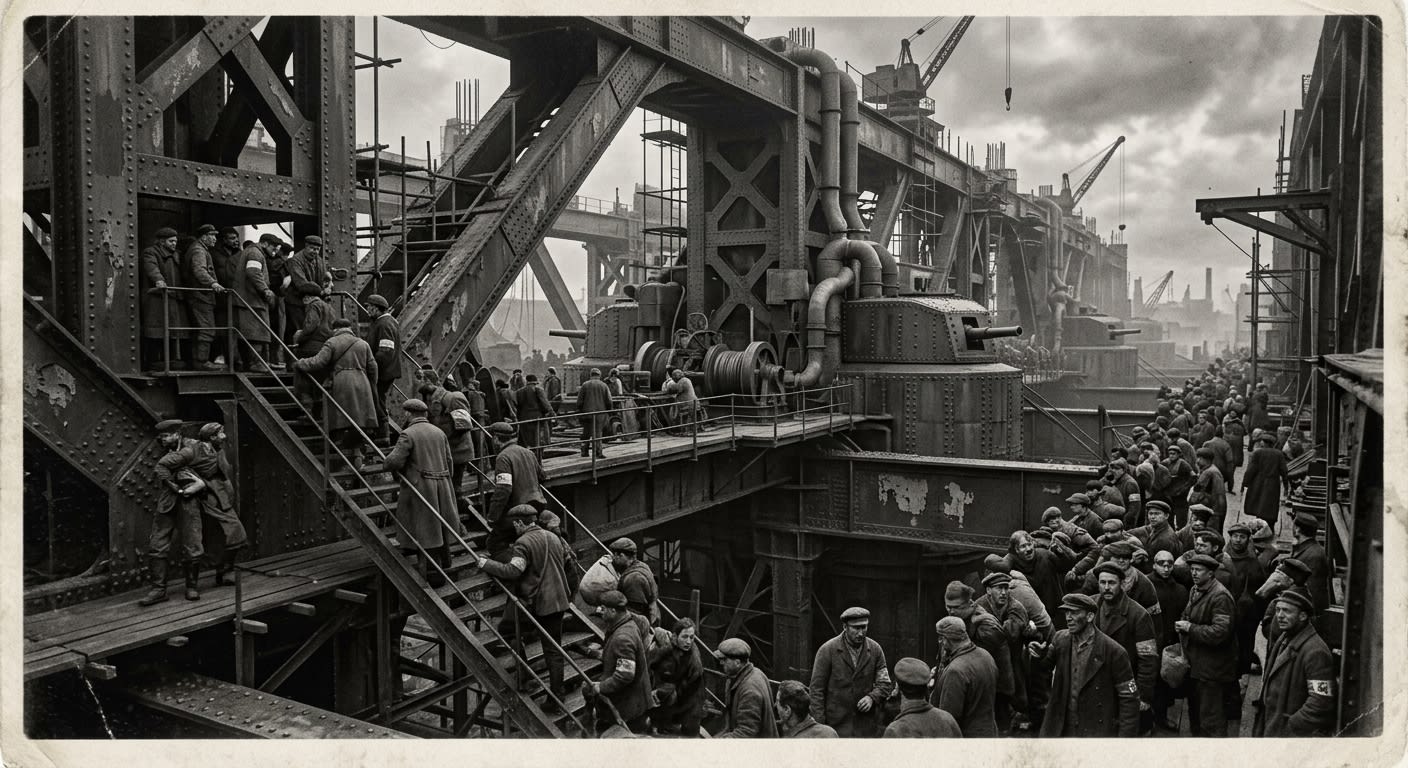
A.S. 67 gave the site its first permanent works: timber forts, mud revetments, gun pits, toll sheds, a chapel tent, three rope booms, and a ledger table that travelled from office to office as each authority discovered it could charge fees from a seated position. The bridge was still absent. Its paperwork had arrived.
The present brass-ribbed bridge-fortress began under Bureau of Engineering plan in A.S. 92 and entered official completion language in A.S. 98. Completion language is a beautiful sin. The Ribs have been patched, plated, braced, rewired, shored, reblessed, retarred, widened, audited, sealed, drilled, sung over, spat upon, and partially rebuilt every year since the first convoy crossed. A thing under perpetual repair is complete only in the same sense that a sinner under perpetual penance is saved: the clerk has decided to stop asking until next quarter.
Public works tablets at Brest describe the Brass Ribs as “completed A.S. 98.”
Clarified. The A.S. 98 notice certified the first full military crossing under load, artillery, confession, and tribunal supervision. The Ribs have never ceased being worked upon. The word completed remains on the tablet because chisels cost money and lies already paid for remain assets.
Procurator-Engineer Hallam's design joined three appetites. War wanted guns facing the eastern approaches and the river channel. Doctrine wanted every crossing made penitent. Records wanted movement made legible. Hallam gave each rib an outer weapon and an inner mouth: a casemate facing outward, a confessional compartment facing inward, a truss between them strong enough to hold both the shell and the sin.
The approval came from War and Doctrine within the same week. Records opened an inquiry into forgery, since agreement between Bureaus is inherently suspicious. No forgery was found. This has troubled me longer than forgery would have.
The material history remains uglier than the tablet permits. Early brass sheathing came from stripped church plate, condemned guild stock, melted rail fittings, seized Rationalist mathematical instruments, and three consignments of metal whose provenance Records marked as acceptable after the witnesses drowned. The bone-lime grout in the pylon seams came from plague ossuaries emptied under emergency writ. The original rivets were stamped with tiny Triune Knots by apprentices paid in ration chits and funerary priority. Every clean arch on the skyline contains these economies. Beauty often does.
#On the Anatomy of Thirty-Two Ribs
The Ribs are numbered west to east by Engineering, east to west by the Confessional Lanes, and by local profanity according to whichever one currently leaks, creaks, jams, whispers, or blocks a ration queue. This has produced three incompatible numbering systems, two deaths, one Tribunal hearing, and a field guide printed on waterproof paper that nobody trusts because it was approved in Strasbourg.
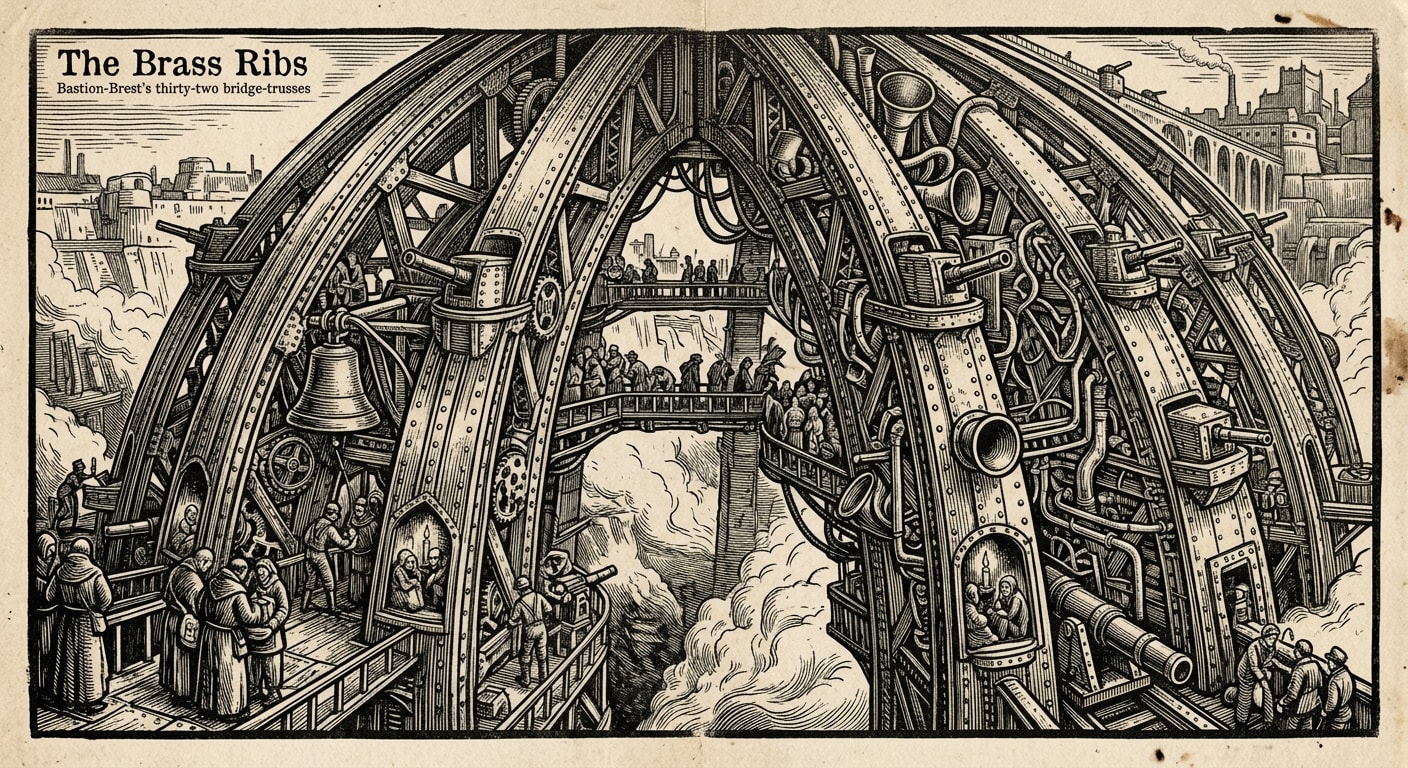
Engineering count begins at the West Gatehouse: Rib One, Rib Two, Rib Three, proceeding toward the eastern wire. Lane count begins where penitents enter from the east. Gun-Cantor count begins at the nearest usable fire position. The Tribunal recognises all three systems depending on which system makes a warrant harder to contest. This is not confusion. It is local law with bad shoes.
The upper deck is the Ribwalk, a market corridor, troop road, queue channel, gallows approach, gossip artery, and stampede waiting for permission. Its brass plates are worn dull by boots and polished bright at the lane edges where hands grip during winter. Vendors operate from folding stalls chained to deck rings. Bread, tallow, ink, boot nails, bitter tea, lamp cord, confession scripts, river fish, warm socks, and counterfeit courage pass hand to hand beneath the ribs. At convoy surge the Ribwalk becomes a throat too full of bodies. At curfew it becomes a single-file sacrament.
Below the deck sit the Casemate Galleries, hot with powder stink and bell discipline. Every fourth rib holds primary guns; the intervals hold ammunition lifts, recoil dampers, range tables, chapel nooks, stretcher hooks, and listening stations where gunners hear the deck through metal and guess whether the crowd above is angry, afraid, or about to become arithmetic. Vonn's men claim they can identify a forged-token panic by the rhythm of feet through brass. I believe them because they bet on it and soldiers do not gamble on acoustics unless acoustics pay.
Below the galleries: the Confessional Lanes. Two hundred and fourteen booths in double rows, their grilles set into rib compartments and pylon throats, their candle flames turning toward active anomalies with the obedience of dogs hearing a whistle. A person crosses the Ribs by speaking guilt into wood and receiving wax permission to continue walking. At Brest, morality is a traffic device. Strasbourg pretends to be shocked by this and then asks for the throughput figures.
Beneath the Lanes are the Pylon Warrens, vertical housing chambers inside and around the fourteen stone-and-iron piers. Pride sleeps higher by old allocation custom, sloth lower, envy in windowless rows facing richer bunk ladders, wrath near the casemate vibration zones where sleep is already punishment, and miscellaneous sins wherever the night supervisor can fit the breathing. The system began as a joke by a tired quartermaster in A.S. 103. It became policy by A.S. 104, proving again that the Synod's true enemy is an annotation left unattended.
Maintenance passages run through the ribs like capillaries for small disasters. Brasswright apprentices enter with tool rolls and chalk tags, tapping rivets, listening for hollow notes, measuring heat, scraping verdigris, and tightening bolts while gunners shout above and confessors sweat below. A stopped shutter can blind a casemate. A warped receipt drawer can halt a lane. A cracked pylon vent can make the Echo audible in sleeping quarters. At Brest, minor faults acquire theology by lunchtime.
#On the Ribwalk and Its Civilised Filth
The Ribwalk is the public face of the Ribs, and public faces at Brest learn to keep smiling while missing teeth. It is never empty. At dawn it carries toll clerks, soup boys, priest-runners, first convoy carts, drenched soldiers from west-bank billets, and penitents who have rehearsed a safe sin all night and will forget it when the grille opens. By noon it carries traders, ammunition trolleys, bailiff squads, widows selling candle cups, children chasing dropped tokens, and officers cutting through with escorts whose boots have never learned mud properly. By dusk the curfew bells herd the whole span into lanes of permission.
The market is licensed in theory and negotiated in fact. The Crossing Bureau issues stall tags. The Tribunal revokes them. Vonn's provosts overturn tables during security sweeps. The Brasswright Guild claims emergency access through every stall line and has once demolished a sausage stand to reach a vibrating bolt. The sausage seller filed suit. The Tribunal ruled against him on the grounds that sausages are replaceable and bridge collapse is inconvenient.
A trade circular described Ribwalk commerce as “orderly, supervised, and confined to marked lanes.”
Corrected after the A.S. 200 convoy crush, in which forty-six marked lanes, nine unmarked lanes, three funeral processions, and a goat occupied the same thirty yards of deck. The approved phrase is “supervised under changing pressure.” The goat survived and is now more famous than the clerk who wrote the circular.
Ribwalk custom requires that a host offer a warm candle cup and a safe sin. The candle cup is tallow-water with pepper if fortune has smiled and boot grit if fortune has behaved normally. The safe sin is a brief confession appropriate to the visitor's station: impatience for soldiers, pride for officers, envy for traders, minor theft for children, discourtesy for clerks, gluttony for anyone fat enough to make the booth suspicious. Hospitality at Brest consists of helping a guest lie in the proper category.
The insults are local and sharp. Blank-sheet. False-absolved. Token-swine. Mist-rat. Pylon-born. Cleanmouth. The last is the worst, because claiming cleanliness at Brest is either innocence, heresy, or strategy. All three attract inspection.
The under-deck moorings carry the Ribwalk's shadow: skiff men, token brokers, sin-script sellers, debt informers, river boys, stamp thieves, and small, hard women who know which queue captain can be bought with shell primers and which cannot be bought until his child needs medicine. The market below sells things the market above publicly condemns and privately requires: forged absolution tokens, altered lane assignments, warmer bunks, name substitutions, queue slips, sealed broth, and silence by the hour.
#On the Tribunal Rib and the Law of Weight
Mid-span lies the Absolution Hall, set into the heavy rib cluster where the bridge's stress, traffic, and guilt meet with courtroom decorum. The Hall is stone-faced inside brass, its bench raised, its petitioner's rail low, its transcript vault below, its windows too narrow for escape and too wide for comfort. Judge Elsbeth Krail presides there with her soft voice and her talent for making a pause feel like a locked cell.
The Tribunal calls the Ribs a span-sovereign jurisdiction. Translated from legal vanity, this means: while your feet stand on the bridge, the bridge owns the question. A central writ may arrive with Strasbourg wax, War urgency, Purity flame, Records correction, Doctrine indignation, or all five in a little parade of seals. Krail may still ask whether the crosser has confessed in proper sequence. If the answer displeases her, the bridge waits.
Standing Order 14-B sharpened this authority after the Blank-Sheet Circle learned to move people across the Ribs without making them legible to the system. Blank papers humiliate Brest in a way direct assault cannot. A shell acknowledges the bridge. A blank sheet ignores its priesthood. Krail's answer was seizure, halt authority, interrogation, requisition, Purity co-seal, sealed annex, and every other tool a magistrate can fit beneath a phrase while keeping her gloves clean.
The Ribs carry law as weight. A halted convoy does not merely wait; it loads the deck, blocks food, chills pilgrims, crowds confession queues, backs artillery carts into market lanes, and gives the Bug time to fog over every sensible thought. Krail knows this. Her cruelty, when it appears, is measured against load tolerance. She can strand three hundred men at the West Gatehouse over one smudged token and still be correct if the smudge conceals a missing name. This is the kind of correctness that gets magistrates hated and cities saved.
Hett Ruis, Seal-Registrar and smiling knife of the Crossing Bureau, maintains the stamps that make Tribunal judgments mobile. Without his wax, Krail's sentences remain theatre. Without Krail's seal, his stamps remain commerce. Their courtesy is one of Brest's greater lies. It has the stiffness of two duelists bowing over a pit.
#On Guns in the Ribs
The outer ribs face east and riverward with gun mouths set into brass shutters. Those shutters open like eyelids when the bells permit. Behind them Vonn's Gun-Cantors tend their pieces, clean recoil rails, bless powder, sing range tables, chalk fuse lengths, and argue with Tribunal runners about whether legal ambiguity is sufficient cause to delay canister. It often is. It often is not. Men die in the interval, which is why both offices keep records and neither likes comparing them.
The Ribs turn artillery into liturgy by necessity before choice. A gun fired inside a truss shakes the confession booths below it, the market above it, the pylon braces beside it, and the stomachs of everyone within three ribs. Vonn's firing discipline binds bell, psalm, range, and recoil because unsynchronised gunfire in the Ribs can crack shutters, drop ceiling dust into ink, throw penitents into panic, and make the bridge sound like something beating from within.
The safety salvo is Brest's most polite atrocity. It is fired across or near the deck during riot, breach, or crowd crush, close enough to terrify, far enough to leave the official corpse count manageable. Vonn's famous curfew shot during the first Echo emergency killed one laundry line and injured a mule's dignity. His enemies call this incompetence. His gunners call it surgical. The mule, unable to file, achieved martyrdom by anecdote.
The guns also hear. This is not doctrine. It is garrison fact. Casemate crews identify pressure by sound: ice striking pylons, skiff hooks under fog, queue unrest, brass expansion, shutter fatigue, the wrong hush before Echo activity, and the low wet gathering beneath Rib Seven that Vonn has never managed to explain to Doctrine without being told his phrasing is unhelpful. His phrasing is excellent. Doctrine dislikes excellence when it arrives armed.
During Nameless Tide pressure, the Ribs become less a fortification than a diagnostic instrument. Stakes bow east. The wire bends without visible assault. Mist thickens under the span. Confessions return from brass vents. The deck crowds inward as if every body on it has remembered gravity at once. Vonn loads everything. Krail seals the variance packets. Hal revises rotations. Ruis smiles in a smaller radius.
#On Voices in the Brass
Since A.S. 199 the Ribs have carried more than weight, traffic, and gunshock. They carry voices.
The Confession Echo began in the Confessional Lanes and soon learned the structure. Sins spoken into booths returned hours or days later from brass shutters, wet rope, pylon vents, token bowls, and the underside of the Ribwalk. The first recorded return near Rib Seven repeated a levy corporal's bread theft, then corrected it into hunger with the intimacy of a creditor whispering into a child's ear. By month's end the bridge had become less a route than a throat with memory.
The Echo's spread through the Ribs proves that the bridge is not merely containing the anomaly. It is conducting it. Engineering hates that sentence. Doctrine hates it more. The Brasswright Guild refuses comment because comment creates liability and liability does not tighten bolts.
Booth 77, north side, third pylon from the west, has made the matter worse by hearing confessions before they are spoken. Its planked front warps toward the grille. Its nail heads crust salt. Its guard stands under review as evidence. Adjacent ribs carry sympathetic tremors at third watch. Candles lean toward it even through closed compartments. A structure designed to make movement orderly has developed a witness that disobeys time.
MAINTENANCE NOTE — RIB THREE NORTH SERVICE PASSAGE, A.S. 201 Apprentice reported whisper from sealed conduit: “Count the ribs from the bank you regret.” Follow-up inspection found no speaker, no leak, no mechanical fault. Chalk mark left on inner brass: ███████. Mark returned after scraping. Guild response: “surface contamination.” Tribunal response: sealed. Doctrine response: mine.
Hal's clerks know which ribs are now sour. They avoid leaning their heads against inner plates. They scrub booth seams with brine until their hands split. They carry red chalk and vinegar cloths. They learn the difference between warm ink, wet wax, and borrowed breath. They sleep badly in pylon bunks while artillery vibrates overhead and the bridge murmurs through bolts in phrases too low for indictment.
The people of the Ribwalk have adapted, because civilians always adapt faster than offices. They do not repeat Echoes aloud. They repeat them in altered form, as songs, jokes, vendor cries, children's counting rhymes, and insults. This is forbidden. It is also unstoppable. Horror enters speech the way damp enters walls: by routes no inspector admits exist until the plaster falls.
#On Living Inside Load-Bearing Doctrine
Fourteen thousand souls live in and around the Brass Ribs during ordinary season. Convoy season pushes the count past twenty thousand and turns every stair into a negotiation conducted by elbows. Residents measure status by warmth, dryness, lane priority, distance from artillery, nearness to bread, and whether one's bunk assignment requires climbing past a family with fever. Money matters. Tokens matter more. A clean pass is wealth. A remembered true name is inheritance. A tribunal-friendly sin can feed a household.
Marriage in the Ribs is a shared crossing writ. Coming of age is first confession before witness. Death is sealing into the toll ledger if respectable, weighting for river release if poor, unnamed pit if inconvenient, brass plate if heroic, transcript if legally useful. Children learn to count by ribs, bells, tokens, and missing persons. They play at Tribunal by accusing one another of smudged identity. They play at gunners by shouting ranges through drainpipes. They play at Echo by whispering under doors until an adult slaps them, which remains the only sound pastoral practice at Brest.
Rib superstition begins young and matures into civic procedure. Do not sleep beneath a numbered joint that matches your birth day. Do not spit through a gun shutter unless you have paid for the privilege with service. Do not tap twice on a pylon after curfew, because two taps answer themselves. Carry a candle stub when crossing Rib Twelve in fog. Never buy bread from a vendor standing with his back to Booth 77. If Rib Seven feels warm underfoot in winter, step aside and let an official discover why. Most of these rules are nonsense. Enough are not. That ratio governs half the Synod.
Food is brine porridge, bitter bread, smoked river fish, hot fat broth on lucky days, officer bread if stolen, and candle cups at night. The Ribs smell of all of it, plus rust, vinegar, wool, powder, tallow, wet paper, lamp soot, human fear, and the faint sweetness of wax seals softened by too many hands. No propaganda plate captures smell. This is why propaganda prefers distance.
Work is everywhere. Deck scrubbers scrape mud and blood from brass plates after queue crush. Lantern keepers trim truth-lane lamps. Dredge hands clear ice and bodies from pylon nets. Seal-stampers ice their wrists after convoy surge. Pylon masons listen for cracks. Provost runners carry orders through crowds that hate them. Confession scribes copy guilt until their own voices become thin. Gun riggers sleep beside tackle. Brasswrights tap ribs in the dark and tell no one which notes worry them.
The Brasswrights deserve their own warning. They are not nobles, priests, magistrates, or soldiers, which means the bridge depends on them without knowing how to flatter them. Their guild stores replacement plates behind locked grilles, marks suspicious rivets with blue chalk, and keeps a private book of stresses the Bureau of Engineering has requested three times and received three polite refusals to surrender. When a Brasswright says a rib is tired, captains stop carts. When a Brasswright says a shutter is offended, gunners cease joking. When a Brasswright says nothing and only writes a symbol near a pylon stair, locals change routes before the official notice is drafted.
The Bridge teaches obedience through congestion. A man may hold radical opinions in private and still queue where told because there is nowhere else to stand. A woman may curse Krail, Ruis, Vonn, Hal, Doctrine, War, Records, the Bug, and every saint with a ferry patronage, then present her token correctly because the wrong lane can take her child. The Ribs do not require love. They require sequence.
#On the Present Strain
As of A.S. 201, the Brass Ribs hold. This is the official statement, the engineering statement, the military statement, the doctrinal statement, and the phrase every administrator repeats while looking at different cracks.
The Ribs hold the weight of artillery, court, confession, housing, commerce, bribery, smuggling, Echo, Tide pressure, Blank-Sheet intrusion, Booth 77, and a population trained to treat delay as weather and terror as surcharge. They hold with patched braces, tired winches, overpolished shutters, stressed pylon stairs, brine-warped booth wood, and thirty-two arches that have carried too many contradictory authorities across the same river.
The next catastrophe will not announce itself as catastrophe. Brest's disasters are courteous at first. A receipt drawer sticks. A shutter opens half an inch late. A pylon room smells of river where no river should be. A child presents a token stamped tomorrow. A gun crew sings half a note flat. A judge pauses too long. A registrar smiles too little. A maintenance apprentice taps Rib Seven and hears a hollow note answer from Rib Four.
At fourth bell the Ribwalk narrows under curfew ropes. The booths open. The gun shutters breathe. Krail's clerks carry sealed folders toward Absolution Hall. Hal's scribes wet their cracked fingers and straighten receipt stacks. Vonn's gunners hum range prayers into metal that hums back. Ruis's stamp room glows warm behind guarded glass. Under the deck, the Bug shoulders the pylons and takes whatever falls.
Thirty-two ribs. Fourteen pylons. Two hundred and fourteen mouths. One bridge pretending that names, sins, shells, stamps, and bodies can cross the same eight hundred metres without becoming each other.
The brass creaks. Everyone listens.