

#On the Ward and Its Instruments
"not discharged." — line on the White Ward Three slate at morning bell, A.S. 200, attributed by the published account to the Marrowwind
White Ward Three is one of the numbered wards of the White Ward, the principal infirmary block of Marrowgate. Until A.S. 200 it had no history worth the ink, and the Bureau prefers its wards that way. A ward with a history has produced an exception, and at Marrowgate an exception must be stamped, countersigned, weighed and billed to someone not yet dead.
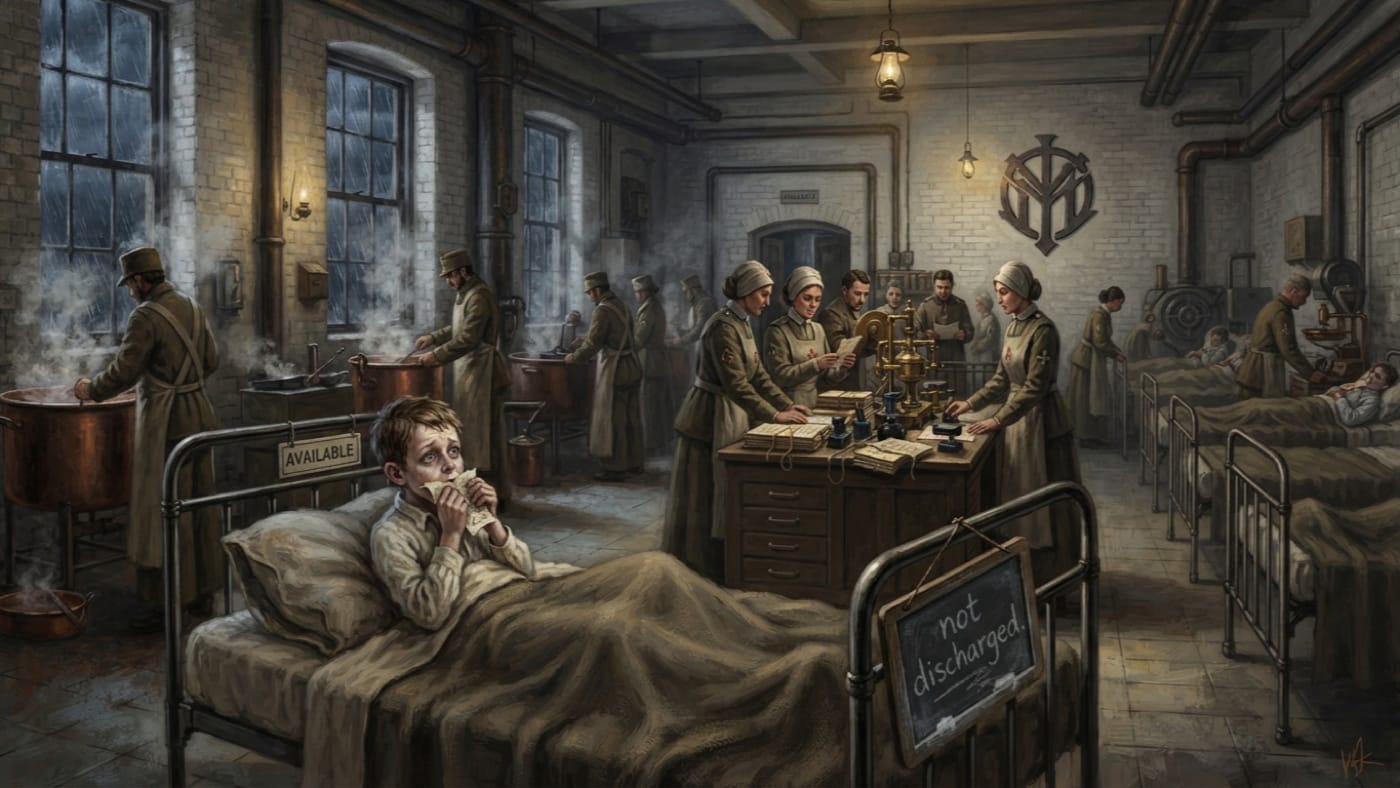
Three has the same air as the rest of the White Ward: vinegar smoke from the fumigation pans, boiled linen from the coppers, and whitewash on every surface the Sanitation Chapter can reach with a brush. It also uses the same instruments as the rest of the complex. A patient comes through intake with a confession and a receipt. The Civic Triage Tribunal allocates the bed. A licensed surgeon-notary makes legal whatever is cut. A bed token marks the cot occupied or available, and the ward slate records in chalk what the morning requires the ward to know.
These objects exist so that the body and the file never disagree. When they do disagree, the file wins, and the body is corrected by discharge, transfer, burial or invoice.
#On Names Kept Outside the File
The ward staff of Marrowgate keep the official record by the methods of their licence: the ink-stamp, the string-tied ledger, bowls matched to bodies and deaths matched to transfer tags. The Ward-Mothers keep another record. It is smaller and carries no seal, and in my judgment it is far more dangerous.
These are the true-name slips. Each is a scrap of paper written in a family's hand rather than tribunal script, bearing the name a patient carried before intake converted him into a case number. Ward-Mothers place them beneath pillows. The published account of the Marrowwind reports a second and worse practice seen on wind-nights, in which the patient holds the slip beneath the tongue and refuses to swallow. The name is said to anchor memory against the wind. The paper is also paper. It softens, it dissolves, and it goes down.
What the slip protects, and how, is a matter of attributed belief rather than settled Doctrine. Ward-Mothers credit it with holding a patient to himself through a correction. The Sanitation Chapter credited it with nothing at all and banned it anyway.
Of all the clauses, mouth inspection tells you most about Marrowgate. A city that will put a finger into a feverish child's mouth to recover a scrap of family handwriting has already decided which record it fears.
#On the Wind-Night of A.S. 200
During a wind-night in A.S. 200, a boy in White Ward Three swallowed his true-name slip. The account does not say who wrote it, who placed it, or whether he meant to swallow it. I decline to supply those details. Invented particulars are how lesser chroniclers win promotions they have not earned.
The rest came in sequence, and each item falls to a different office.
His fever broke. That is a clinical fact for the ward and its surgeon. In any other bed it would have been entered as recovery and charged accordingly.
His file vanished. That falls to the Bureau of Records, whose clerks are trained to regard a missing file as a theft, a misfiling or a sin. They have no column for a file that has simply ceased to have been.
His mother remembered him, and his assigned surgeon did not. The record splits here along the line of kinship. The woman who bore him kept him in memory. The licensed man who had examined him, entered him and presumably meant to bill him kept nothing. The account names neither of them, and neither will be named here.
His bed token read "available." The boy remained visibly asleep in the bed.
At morning bell the ward slate bore one line: "not discharged." The account attributes that line to the Marrowwind. I keep the attribution and certify no author, because current Doctrine forbids treating the wind's hand as a signature.
That these events happened together is documented. Their mechanism is not. No living office has determined whether the swallowed name removed him from the file, or whether the wind removed the file and spared the name, or whether the breaking fever belongs to either cause. Some Ward-Mothers will tell you the slip worked. The Chapter will tell you the slip was contraband. Both statements can be true at once, and that is the Chapter's difficulty.
#On the Revised Guidance
The Bureau of Doctrine answered the incident quickly, with a single change of wording.
Prior Doctrine guidance: true-name slips to be destroyed on sight as "superstitious impediments to correct patient classification."
Revised after the A.S. 200 White Ward Three incident. Slips are still destroyed on sight. The stated reason is now "excessive efficacy outside licensed sacramental channels." The policy stands. Its theology has been corrected to match its fear.
Doctrine has always held that the slips work. The earlier wording was an economy of phrasing, adopted to spare the Ward-Mothers the vanity of being right. At Marrowgate even the Creator's grace requires a licence, and grace that arrives without one is a smuggling offence.
What remains is a problem of evidence. Marrowgate holds three kinds of evidence in this matter, and each fits a different intake form.
The mother's recognition is living testimony, which current Doctrine requires before any Marrowwind correction can be credited. It is also testimony from the person with the greatest interest in the outcome, and Records discounts kin by long habit.
The surgeon's failure to remember is no testimony at all, only an absence in a licensed head. It is, however, an absence that agrees exactly with the vanished file.
The slate line is anomalous, and Doctrine does not accept anomalous corrections as self-authenticating. By the published account, the wind's corrections are almost always true. Every career in this matter now rests on "almost."
Each office holds one piece of the boy. The Chapter oversees the ward that holds his body. The Tribunal allocated the bed his token now offers to someone else. Records owns the file that no longer exists. The Bureau of Mercy has a standing interest in patients who survive. According to the account, none of them has accepted jurisdiction. Each has an excellent reason. To accept him is to accept that the record failed, and an office that admits the record failed has, in effect, filed its own resignation.
#On the Present Occupant
In the account's present reporting, the boy has survived. He lives in the laundry annex and answers to no name twice. No office has accepted jurisdiction over him.
Those four statements are all the published account gives, and they are enough to unsettle the whole complex. The account does not say who feeds him, who keeps the annex where he sleeps, or under which column his bread is charged. I suspect the answer to the last question would embarrass someone of rank, and I suspect it with great pleasure.
He should not be confused with the child a Ward-Mother once hid in the linen bins for six hours to keep him out of quarantine. That was concealment from a file. This is the absence of one.
It would be convenient to file him beside the condemnatory true names pronounced by Judges, or beside the administrative dissolutions recorded against sorcery. Neither fits. No sentence was pronounced on him, and no sorcerer has been named. The only name in the matter was his own, written in a family hand as such slips are, and then swallowed.
Nor should any clerk mistake his condition for a privilege. The account does not say his file's disappearance made him invisible, exempt or holy, or that it erased his debts. It says only that the ward cannot reconcile him. A body without a file, at Marrowgate, is no saint. It is an error with a pulse.
The White Ward goes on with its ordinary work around him. The coppers boil, the pans smoke, intake confessions are taken and receipted, and beds are let and relet by token. Every morning the ward's whole machinery confirms its own correctness, and every morning a boy in the laundry annex goes unrecorded in it.