

#On Ward Authority
"Sealhand. Prefect. Ward-Mother." — The titles a Marrowgate patient is expected to pronounce correctly. Offices confer the first two. A ward confers the third.
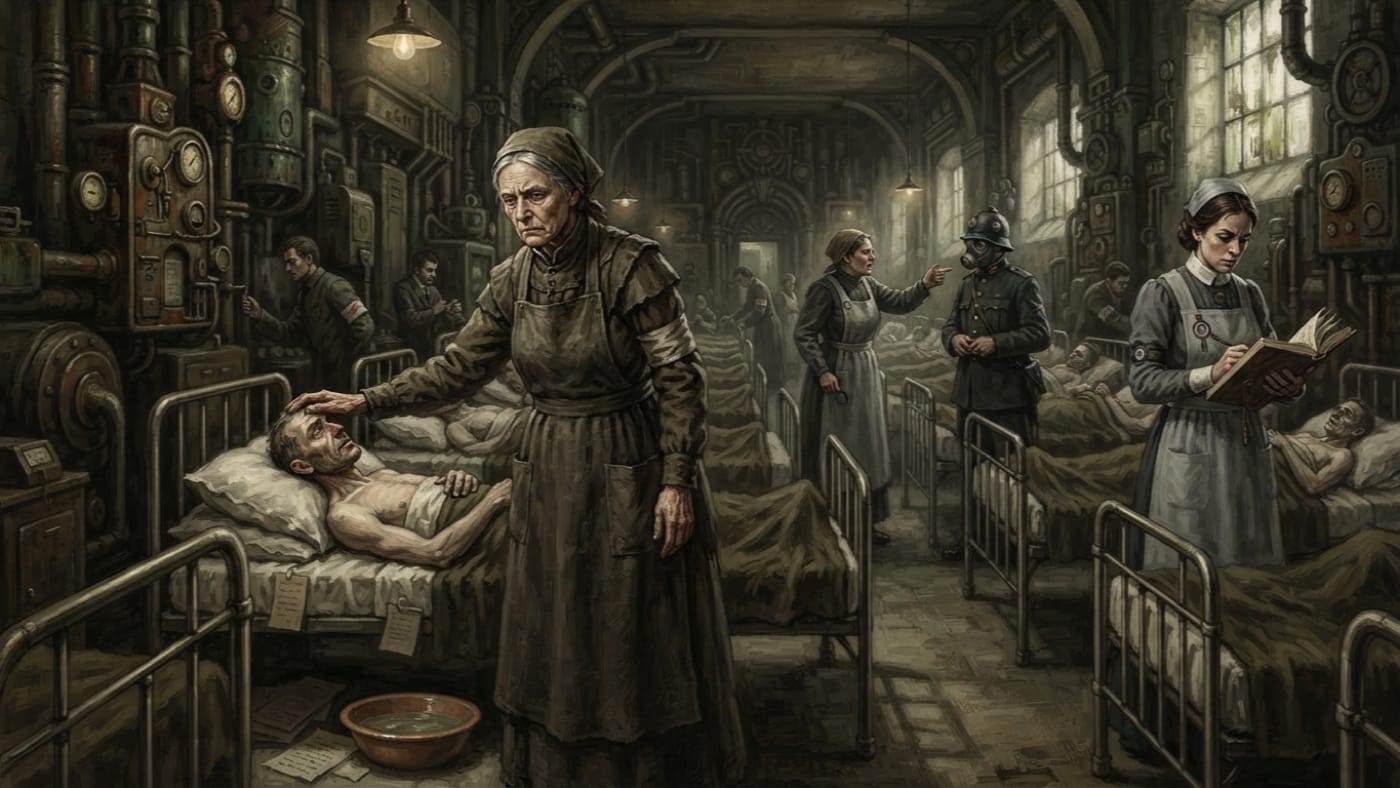
The Ward-Mother of Marrowgate holds no licence and has sworn no registered vow. She wears no ring and keeps no stamp the Bureau of Records would recognise as an instrument. She governs a ward, and that is the whole of her title and the whole of her jurisdiction: one room of cots, one stretch of corridor, one linen cupboard. Her subjects are the broken who arrived by wagon from the Sagittal Line and will leave by discharge slip, debt prescription, or lime cart. Inside those walls she is obeyed. Outside them she is an unlicensed woman with opinions.
The city's working lore defines her in a single line: she runs a ward like a household and trades mercy for obedience. I have tried to improve on the sentence because it offends me, and I have failed. It admits that mercy at Marrowgate is a commodity held in private hands. It also admits that the price is paid in submission to a person instead of to the Ledger.
Ward-Mothers have no order. They have no chapter house, no founder, no charter, no membership roll and no common programme, and nobody has recorded the year the first of them took a ward in hand. Each holds her room as a separate fief, and the fiefs do not federate. The name is a form of address and a description of work, and a city that reduces everything else to paper has never found a form to reduce it to.
#On the Ward as Household
A Marrowgate ward is a long room of cots set close enough that a man can hear his neighbour's stitches pull. When the stores are full it smells of vinegar smoke and boiled linen. When they run out it smells of nothing, and the staff learn to fear that clean absence the way sailors fear a flat sea. The intake bell governs the day. Bed allocations post at midday. A confession receipt must exist before treatment. Paper travels down the aisles faster than the people meant to sign it, and clerks lay it across damaged flesh as if a page could close a wound.
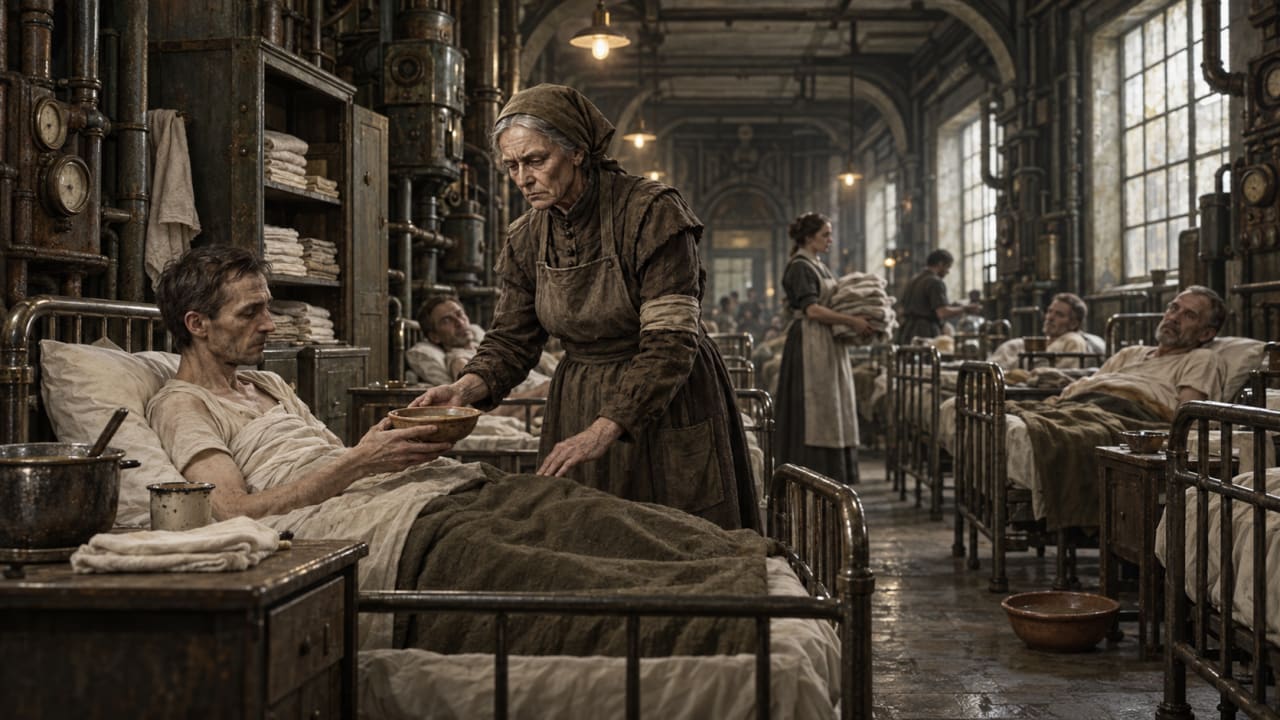
Into this room the Ward-Mother introduces the one institution Marrowgate's administrators forgot to license, which is the household.
The record attests the exchange and very little of its machinery. She gives mercy and she takes obedience. The rest has to be read out of the word "household," and every patient knows from his own parish what a household contains. Somebody decides who is fed first. Somebody decides whose linen is changed tonight and whose waits for the morning boil. Somebody knows which washer owes a favour, which orderly is drunk by the third bell, and which surgeon will answer a summons sent by name. Somebody keeps quarrels inside the room before a provost hears of them. I cannot produce a ledger of these decisions because none exists, and their value lies in the fact that none exists.
Obedience is the coin. A patient who keeps his voice down, takes his draught when told, holds his tongue before the clerks and lets himself be moved without argument can be helped, because help depends on the room staying governable. A patient who does none of these things learns that a household hands out mercy the way households always have, to the children who mind.
The patients value this, and I record it without sentiment. A man who has watched his intake confession being transcribed while his bandage reddened knows what it is worth to have a person he can ask instead of an office he must petition. He can ask the Ward-Mother. She can refuse him, and she can refuse without a form, which is a power the Tribunal itself lacks. Her rule is personal and immediate, and it answers to nobody the patient could name in a complaint. Patients prefer it anyway. That preference says less about her than about the alternatives.
#On Licensed Mercy
Follow a patient in. The Sanitation Chapter decides with its white lines, its cordons and the provosts in its doorways whether he reaches the ward at all. The Civic Triage Tribunal decides whether there is a bed, at which bell it opens, and what it will cost him once he is well enough to owe. If he must lose a limb, a Sealhand takes it off and then stamps the removal, and the cut-stamp amends his name along with his body. If he wants the pain to stop, the Mercy Chapel of the Unburdened will give him a draught for a confession and file the confession. Wherever the licensed Mercy Ward-Sisters and Ward-Brothers serve, they attend him under the authority of the Bureau of Mercy. They are vowed and registered, they wear grey aprons, and each carries a stamp and a string-tied book in which every act is recorded.

All of these hands are licensed, and the Ward-Mother's are not. She cannot open the cordon, allocate the bed, authorise the cut, absolve the sin or stamp the chart. She sits among the people who can, in the room where their decisions land on a body.
She should be confused with none of them. Sister-Matron Ilka presides over the Chapel's draughts and its confession archive, and the "Matron" in her title is a chapel office. Nothing in the record makes her a Ward-Mother or places any Ward-Mother beneath her. The licensed Ward-Sisters climb a ladder of ranks, wear a corded badge, swear a vow, and gain full stamp authority at the top. The Ward-Mother has her ward and nothing else. The two may share an aisle, a linen room or an exhausted night, but a shared corridor does not merge two titles into one. The record gives them no common hierarchy and does not give them a feud either, and I decline to invent one for the reader's entertainment.
The Ward-Mother's peculiar advantage over the licensed hands is that she can be wrong without being audited. A Ward-Sister who gives an extra ladle of broth to a dying boy has committed an allocation error and must enter it. A Ward-Mother who does the same thing has run her house. I record this preference in favour of the unlicensed with real reluctance, because it is the sort of sentence heresy is built from.
#On Bed Tokens and the Stitchmarket
A bed token is a promise of time: a cot, a ward, a scribe, a cup, and the chance that a surgeon arrives before rot does. At peak intake a token is worth more than a month's wages. During a quarantine lockdown it is worth whatever the seller asks. Lawful allocation belongs to the Tribunal, and the Ward-Mother has no power over it. Her patients still need windows, and the bell rings without regard to anyone's need.
The Stitchmarket's own account states her position in one sentence: Ward-Mothers confiscate illicit tokens when they can and use them when they must.
Both halves of that sentence are true, and the same hand performs both. Confiscation keeps the ward governable. It keeps a frightened family from spending their last coin on a forged window, keeps a patient from being cheated by a runner, and keeps the room from turning into a market floor. Use follows when the lawful bell will be too late and the man in the third cot will not survive the queue. The token she seized on Monday may be the token she spends on Thursday. The Tribunal calls the trade a parasite. The Ward-Mother lives off it in the strict sense, because her patients live off it.
Washer-runners show the same pattern. They carry messages folded into bandage hems, move through every ward because every ward needs linen, and pass unseen by officials whose authority depends on not noticing filth. The market reports that Ward-Mothers denounce them in public while employing them. Nothing else could be expected. A ward has no licensed courier after curfew, and a Ward-Mother who needs a draught, a surgeon or a token by morning has only one post office open. The Stitchmarket's account of the present trade says Ward-Mothers still curse the market at noon and send for it after curfew. I have no better evidence and no reason to want any.
Needle-King Pavo understands this better than anyone in Notary Row. His trade, according to the market's own chroniclers, lies in matching false paper to real desperation so exactly that the buyer becomes his accomplice and his shield. One account tells of a Ward-Mother who received the bed token she had prayed for and then learned that the prayer had been overheard from below. The token was real and the patient lived. A debt came into being that no Tribunal will ever assess and no Ward-Mother can ever report, because reporting it would mean confessing the rescue. Pavo collects payment in the form of silence.
The record names no Ward-Mother as a broker and no Ward-Mother as a member of the market. It shows a practice and no membership. Some matrons surely deal more readily than others, and some may never deal at all. I will not supply names to make the picture tidier.
#On Names and the Marrowwind
The Marrowwind comes in stages, and the second stage is the one that falls on the wards. Sutures reopen in straight lines. Scars pale as if waiting for fresh ink. Patients forget wounds the Ledger says they carry, or remember wounds the Ledger denies. Here the published account of the anomaly includes a short observation: Ward-Mothers put salt water on the thresholds and refuse to meet the eyes of Sealhands.
The salt water by itself is unremarkable. Salt-water washes are among the approved countermeasures, mandatory precisely because they do very little, so in this case the Ward-Mother carries out an approved rite with an unapproved hand. The averted eyes are another matter. The record gives no reason for them. I could offer three readings, ranging from caution through contempt to fear of being counted, but they would be mine and not hers, so I leave the gesture as it was reported.
The same account records a second practice of heavier consequence. Ward-Mothers keep true-name slips beneath patients' pillows, written in family hands instead of tribunal script. The slip carries the name a man was baptised under, before his battle abbreviation, his amputation amendment and his debt revision, and his own kin wrote it. This should be kept apart from the slip under the tongue, which dissolves and has been known to take the name with it, and apart from the approved recitation of the Seven Names of Proper Intake, which is a liturgy of admission and has nothing to do with a personal name. The pillow slip is a parish roll of one, kept in the bedding.
The Sanitation Chapter prohibited true-name slips in A.S. 198 in every ward, corridor, quay, slum, chapel precinct and auxiliary space, and listed its exceptions as none. Doctrine then revised its own guidance on the subject in a manner worth reproducing:
Prior Doctrine guidance advised that true-name slips be destroyed on sight as "superstitious impediments to correct patient classification."
Guidance revised after the A.S. 200 White Ward Three incident. Slips are still destroyed on sight. The stated reason is now "excessive efficacy outside licensed sacramental channels."
That revision is the closest thing to an official compliment the Ward-Mothers have ever received, and it arrived together with a confiscation order.
Does the practice work? The published account claims the unofficial countermeasures work better than the approved ones. Whether they work reliably, by what means, and in every ward or only in some, nobody has established. Doctrine has weighed three explanations of the wind and sealed the one it found most plausible, and the Bureau of Doctrine has not opened that seal for this entry.
One more report remains. According to the published account, the voices carried on the wind know which Ward-Mother hid a child in the linen bins for six hours to keep him out of quarantine. The record does not say who she was, which ward it happened in, in which year, or what became of the child. This is also not the boy of White Ward Three, who swallowed his slip in A.S. 200 and is a separate case.
#On the Limits of Mercy
A household ends at its own walls. The Ward-Mother's ends at the threshold she has salted.
She cannot move a patient across a white line, and the provosts who stand in doorways answer to Prefect Salvius, not to her. She cannot declare him clear of fever, because only a sealed certificate does that. She cannot cancel his debt, which the Tribunal assessed and the Tribunal alone revises, generally upward. She cannot restore a name the cut-stamp has amended, since the Sealhands hold that privilege under notarial seal. She cannot overrule a quarantine. A child in a linen bin is hidden for six hours and remains unfiled at the end of them. A patient who obeyed her in every particular still leaves the ward owing the Prosthetics Guild a maintenance contract and the Chapel a confession on file.
Her protection is real, and it lasts as long as he stays in her room. The rest of the city holds a different kind of power over him: the power that goes on deciding after he has left.
The clean paper plague of A.S. 199 showed what that power produces when it decays. Health certificates passed through Marrowgate stamped, sealed and false. Ward tallies showed zero infection while bodies in the cots argued otherwise. The fraud ran through Notary Row, Mercy Market and the Wagon Quays, travelling outward toward supply towns whose officers trusted a seal more readily than a cough. A household cannot audit a certificate. The correction came from the Lime Yards on a dry wind, and from the audits that followed. In both cases the instrument was the Ledger correcting itself, and nothing a matron can do by hand.
I record her limits without contempt. Personal mercy was never meant to govern a city of ninety thousand registered souls and a third again unregistered. It was meant for a room. Marrowgate has many rooms and no mercy at the level of the city.
#On the Present Condition
A.S. 201. Marrowwind incidents are rising. The dry gust now reaches past the Lime Yards into the Wagon Quays, the White Ward, the Mercy Chapel steps and the washhouses of the Suture Slums. Ledgers correct themselves overnight. The Sanitation Chapter wants a full emergency lockdown, and its stated reasons are less convincing than its ambitions. If the lockdown comes, a bed token will be worth whatever its seller asks, and the Ward-Mothers will be bidding in a market they publicly despise. The beds are as scarce as they have ever been, and the tunnels are as busy.
The Ward-Mothers are present in every account of the city and on no roll of its offices. The Tribunal does not allocate to them. The Chapel does not ordain them. Sanitation does not license them, Records keeps no file under their name, and Purity does not list them as carriers. Patients address them correctly all the same, because the city's code of manners requires it and because the man in the third cot knows exactly whose word decides when his linen is changed.
I have spent my career defending the principle that obedience belongs to the seal. At Marrowgate I find it owed to a woman with a salt bowl, a pillow slip and no stamp at all, and I find that the patients who owe it are generally better attended than those who do not. That finding is inconvenient, and I file it accordingly.
Nihil obstat. Filed, under protest, in the household of the Ledger.