

#On the Written Name
A true-name slip is a scrap of paper with one name on it, and that is all the object is. It has no seal, stamp, countersignature or wax. Someone who knew the patient before Marrowgate knew him has written the name he answered to at home, and the paper goes into the bed with him.
The name in question is the old one. The published account of the Marrowwind calls it the birth name. The Ward-Mothers survey calls it the name a man was baptised under, before his battle abbreviation, his amputation amendment and his debt revision. I do not certify that the two are always identical. Parishes are careless and mothers are inventive. Both descriptions point the same way: back past the intake desk, to the name the family and the parish kept before the city began correcting it.
The hand matters more than the ink. Tribunal script is upright, uniform and taught. Family hands slope, blot, misspell and press too hard. A slip written in a family hand is a document produced outside every office in Marrowgate. In the only grammar its author commands, it says that someone outside the file still holds a claim on the person inside it.
No source records a required relative, any wording beyond the name, a blessing, an ink or a size of paper. The Codex supplies none.
#On Pillow and Tongue
Two placements are recorded.
The first is the pillow. Ward-Mothers keep slips beneath patients' heads on the ward floors where they already salt thresholds and confiscate bed tokens. These are the floors where the second stage of the Marrowwind lands hardest. In that stage sutures reopen in straight lines, scars pale as if awaiting fresh ink, and patients forget the wounds the Ledger says they carry. The wind carries chalk dust into sealed rooms and speaks earlier names out of basins and folded sheets. A patient renamed three times by three offices hears a fourth voice, dry and exact, and the bedding is the nearest place to keep an answer.
The second placement is the tongue. During Marrowwind hours the patient holds the slip in the mouth and refuses to swallow. The published Marrowwind account calls this the most dangerous of the unofficial practices and says plainly that the name anchors memory. I record that claim as it was published. The Ward-Mothers and Suture Slums surveys both decline to promise reliable protection or name a mechanism, and official alarm, however loud, has never been an experiment.
The danger is wet paper. Spit softens it, and the hours soften it further. If the slip breaks down, the patient swallows his written name, and Marrowgate has no settled doctrine for what follows.
Use does not stop at the bedside. Labourers in the Lime Yards keep slips in their mouths through wind hours, while others refuse names altogether and answer to job numbers until the gust passes. In the Mercy Chapel queue, people carry them folded small. The practice belongs to Marrowgate. I have found no evidence of it beyond the city, and I will not build a continental tradition out of one town's spit.
#On the Prohibition
In A.S. 198 the Sanitation Chapter declared the slips contraband.
The order is admirably short. It names no fines and no sentences, and I invent none. The record gives three instruments, and three are enough. Confiscation takes the paper. Debt adjustment takes the future. Mouth inspection takes the rest.
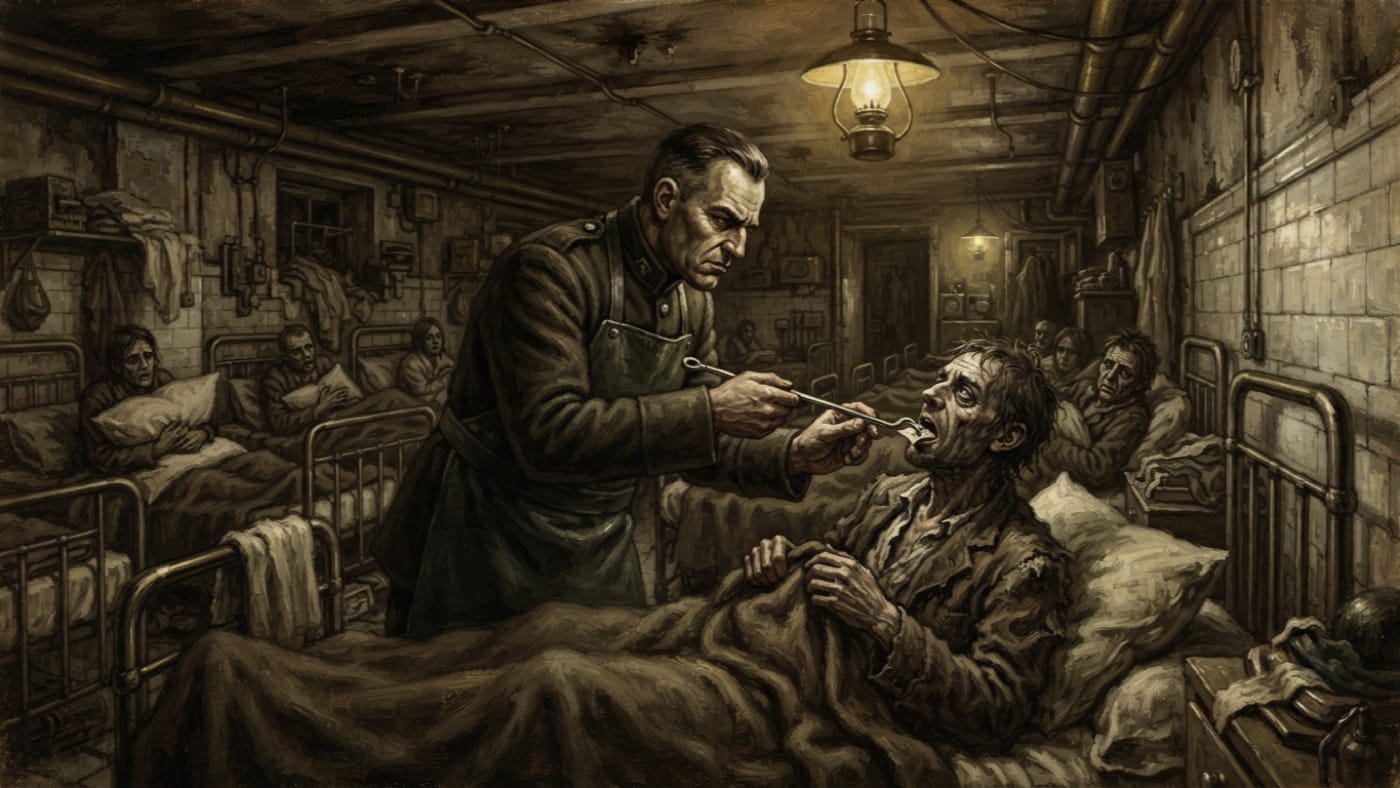
Prefect Salvius orders the inspections during Marrowwind hours. The tool is the mouth hook. It opens the teeth, lifts the tongue and catches whatever is there: a prayer strip, a hidden coin, a fever sore, a small wet rectangle of a mother's handwriting. Sanitation calls this inspection. The wards call it something else. Salvius objects to the slips more than to counterfeit clean papers, and quarantine is only part of the reason. A forged clearance cheats his office. A slip denies that his office may rename a body at all.
The basement of his Chapterhouse holds the confiscated slips, filed among counterfeit papers, retired seal presses, broken fever sticks and jars of suspect dust. Doctrine's guidance is destruction on sight, yet the basement and the guidance coexist. I have found no retention exception that reconciles them, and I will not write one in to spare either office.
#On the Offices of a Name
Marrowgate runs on the premise that a person admitted becomes a file, and that a file may be amended for safety, labour, debt or statistical peace. The Civic Triage Tribunal rules on beds and cut-stamps by docket name. Sanitation moves bodies across lines by roster name. Debt follows whichever name the creditor last spelled correctly. Each amendment is lawful, and each is a small new baptism performed by a clerk.
The slip refuses the series. It asserts an earlier name, written by an earlier authority, and the only authority it cites is kinship.
Three neighbouring objects must be kept apart from it. The Seven Names of Proper Intake are an approved recitation with a public title and unrecorded contents. They form a liturgy of admission and contain no patient's name. Counterfeit clean papers forge the city's own documents in the city's own script. The Stitchmarket's uncorrection seals are merchandise, mostly useless and sometimes dangerous. The market has also tried shaving slips thin enough to hide beneath the tongue yet thick enough to outlast the wind. Most fail and some work once. That is a report of commerce and experiment. It is no recipe, and the Codex prints none.
Nor should the slip be confused with higher matters. A sorcerer's lost name, the name a Judge pronounces and the name a mother writes on scrap paper belong to three different ledgers. Nothing on record shows that the third protects against the first two. I say so as the man who would be blamed for the inference.
#On White Ward Three
The case that changed the paperwork appears in the Marrowwind account, and I give it as reported.
In A.S. 200, during a wind-night in White Ward Three, a boy swallowed his slip. His fever broke and his file vanished. His mother remembered him, but his assigned surgeon did not. His bed token read "available" while he lay asleep in the bed it described. At morning bell the ward slate bore one line: "not discharged."
Count the witnesses. The mother was for him. The surgeon and the token were against him. The file was absent. The slate, written by no recorded hand, declined to let him go. That makes five testimonies on one child, and the only two in agreement are the two Marrowgate trusts least.
The boy survived. He lives in the laundry annex among the boiled linen and answers to no name twice. No office has accepted jurisdiction over him. His name is not in the record, and I have no wish to add it.
The case proves no cure, immunity, sanctity, possession or release from debt. He is to be kept apart from the six-year-old girl who told an inspector the white line moved, and from the child hidden six hours in the linen bins. One boy, one slip and one night left an archive in disagreement with itself.
Doctrine responded with its customary courage and changed the reason.
Prior Doctrine guidance: true-name slips to be destroyed on sight as "superstitious impediments to correct patient classification."
Revised after the A.S. 200 White Ward Three incident. Slips remain destroyed on sight. The stated reason is now "excessive efficacy outside licensed sacramental channels." The earlier reason held that the slips did nothing. The later reason holds that they do too much. The policy found both reasons equally sufficient.
Both texts bear the seal of my Bureau. Doctrine does not apologise for its reasons. It replaces them, and the fire is lit with whichever is current. Salvius's later advocacy uses the A.S. 200 phrase as though it had governed since A.S. 198. Whoever accepts that is reading a man's memory, which compresses, and not the record, which does not.
#On the Present Disposition
As of A.S. 201, the slips are still being written. They are folded into queues, kept beneath pillows and held under tongues in the Yards when the kiln flame flattens sideways. Sanitation still hooks them out. The Chapterhouse basement still keeps what it seizes, under guidance that says it should keep nothing. Doctrine still burns whatever reaches it, now for the newer reason.
Salvius seeks permanent emergency authority. He has not declared the full lockdown he contemplates, whose draft requires the surrender of every slip in the city. Until he declares it, the prohibition stands at its present reach. The families of Marrowgate go on committing, in their own handwriting, the only crime in the city that consists entirely of spelling someone correctly.
No office has determined what the paper does in the mouth during the wind. The Church has not ruled whether the Creator honours a name written by a mother over a name written by a clerk, and I am not paid enough to anticipate the ruling. Those who find the slips inconvenient have suggested that the Great Deceiver takes an interest in them. A suggestion is not evidence.