

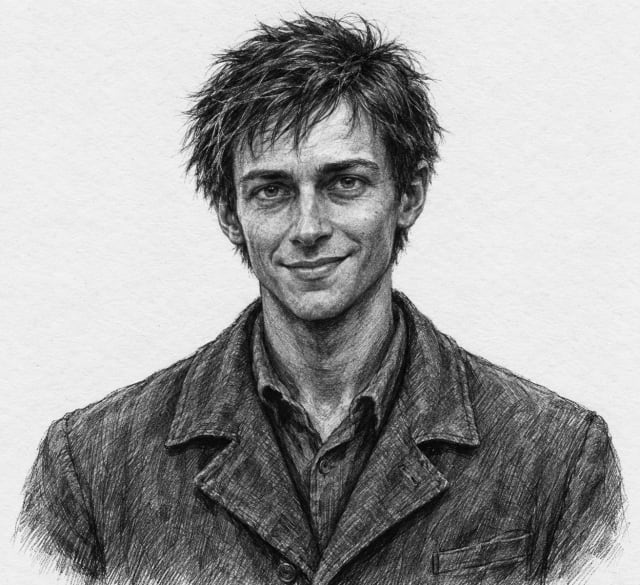
#On Sarnek's Place in the File
Witold Sarnek takes up a few lines in the Kraków file and far more of my memory of it. The Ledger allows this imbalance because an honest imbalance is better than a dishonest symmetry. A dossier begins with what the Bureau holds, so I begin there.
He was an astronomer of the old university quarter of Kraków. Every account calls him young, and so did his conduct. He was a named accused in the prosecution that the Bureau of Doctrine sealed in A.S. 199. That is all of his civil existence this office can certify. The file gives no birth date, parish, parents, degree or chair. The hearing gave him no title, whatever the university may have called him, and I do not promote the accused out of courtesy. He was one of twenty-one defendants carried under guard to Strasbourg: six principal astronomers, twelve assistants, two lens-grinders and a clerk. The file does not settle where he stood within that arithmetic. Its abstract names him beside Doctor Aniela Rudzka among the key figures, which is how the Bureau says a man caused trouble.
He was good at his work. I state it the way a surgeon states the size of a growth.
#On the Instrument and the Apology
The Kraków observatory stood in a rebuilt lecture hall with a roof that opened on mechanical shutters. Its charts were bound to the approved cosmology of the Seventh Catechetical Supplement. Its students worked under the regulated arrangement every university in the Church enjoys: they were free to calculate whatever Doctrine had already printed. The defendants had calculated something else.
The first mention of Sarnek in the record comes from the instrument assessment. One confiscated instrument carried a sliding scale engraved with fractions so fine that the Bureau of Purity assessor examining it got a headache and accused the brass of whispering. Sarnek laughed at him. Anyone who laughs at a Purity assessor in front of his own impounded equipment has misread the room, the season and the century.
He apologized later. The file does not keep the wording of the apology, only that it came late. An apology made after seizure is devotional garnish. I wrote that in the condemnation and have found nothing to improve.
The same file names him as the owner of a telescope bearing an Amsterdam maker's mark. The inventory lists that tube separately from the instrument with the troublesome scale, and I keep them separate here. In Bureau correspondence Amsterdam usually smells of the Rationalists, and lesser prosecutors wanted the mark entered as evidence of the owner's sympathies. It shows where the brass was cut. What it shows about the man who bought it was a question for Purity, and Purity never answered it. The charge never needed it answered.
#On the Sealed Table
The hearing in the Tower of the Quill lasted two days. On the first the astronomers presented calculations. On the second the Bureau presented jurisdiction. Rudzka was the senior accused, and she met both days with a composure I have since used as a teaching example. Sarnek met them with delight. He took pleasure in being correct, and it showed on his face. The Bureau classes that pleasure as aggravating evidence and calls it insolence. I am the officer who did the classing.
At the turning of the case he produced a table, a folded sheet of figures predicting an occultation three nights ahead. He put it to the tribunal as a proposition: if the table proved correct, the Bureau would hold evidence that the printed cosmology needed revision. Then he smiled.
I ordered the table sealed unread.
The reasoning deserves to be set down for younger clerks. A table read before the event is an argument. A table opened after the event is an exhibit. I had no intention of debating a defendant's arithmetic in my own Gallery while his arithmetic was still waiting on the sky to agree with him. The sheet was folded, wax was pressed over the fold, and the seal of Doctrine went onto it in front of him.
Sarnek objected that the sky itself would read it aloud. The phrase went into the record. Since then it has gone into several other records, and I have stopped trying to recover it from them.
Three nights later the occultation took place at the hour he had predicted. I watched from the Tower roof with observers whose names this folio does not carry. Afterwards the wax was broken and the table opened. It matched.
Notice what the Bureau did and did not concede that night. It conceded the hour. It conceded the figures, because figures that match the sky leave the reader little room. The question of who may say what those figures mean was never on that roof. Accuracy settled the occultation and left the case exactly where it had been. Sarnek had staked his proposition on the event. The tribunal had staked its authority on something no event can reach. By morning the decree was drafted.
Index slip, Astrum series: SARNEK, W. — occultation proof, one folio, opened after event.
Corrected to read occultation table. Doctrine does not catalogue proofs submitted by defendants. It catalogues paper. The clerk responsible has been reminded that a noun can concede a case the tribunal won.
#On the Sentence
The decree laid down three principles, and Sarnek's table is the hinge of each.
First, natural philosophy falls under Doctrine's jurisdiction whenever its conclusions touch catechism, liturgy, calendar, omen, feast day or approved metaphor. An occultation that bears on a printed chart touches all six before breakfast.
Second, instruments confer no interpretive licence. However clean the Amsterdam brass and however true the table, neither ordains its owner.
Third, celestial bodies observed moving against the approved charts are to be treated as provisionally in error until the Bureau issues corrected language describing their obedience. Sarnek proved the sky was punctual. He never established that the sky had permission to be.
The sanctions fell on the defendants together. The telescopes were confiscated, presumably the Amsterdam tube with them, since the inventory leaves nothing out. The charts were burned in the Cloister furnace while Records copied down their titles. The astronomers were sentenced to reassignment at the Paper Mines of Ulm, where eyes that wasted themselves on stars now count pulp for the printing of approved truth. In the case's wake, the Index Claritatis restricted lay use of orbit, parallax and retrograde. I like to think Sarnek's table did its share of the damage.
SARNEK, Witold — reassigned to the Paper Mines of Ulm, A.S. 199.
Struck from the draft abstract. The sentence of reassignment was pronounced on the astronomers collectively, and the Kraków city file says only that several were sent. This folio holds no intake receipt in Sarnek's name, no mill roll and no later report. The Bureau certifies the sentence. It does not certify where the man went.
#On What Remains of Sarnek
The Kraków file sits in the Tower of the Quill, Cabinet Astrum-3. Inside are Rudzka's last deposition, a brass gear from the dismantled clock that Records keeps asking to move elsewhere, and Sarnek's table, its wax broken, its fold gone soft from handling, and its figures still correct.
The table is the only document in the Bureau's custody that is entirely Sarnek's own work. The laugh survives in the minutes and the apology survives as a date. The smile survives only in my testimony, which the Bureau considers sufficient. His birth, his teachers and his rooms in Kraków never reached a Strasbourg folio. What became of him after sentence is beyond what this office can certify, and I decline to fill the space with rumour because rumour breeds faster than paper.
Visitors to the cabinet with the proper permit sometimes ask to see the table. I let them. It has never changed anybody's mind about jurisdiction, because the decree already holds what it proved and needs nothing further from it.