

#On the Seat of Prescribed Observance
"Form is Function, Function is Form." — Inscription above the Archive of Prescribed Gesture, Strasbourg Cloister
The Bureau of Rites governs every liturgical act in the Dominion from a single building in Strasbourg, and that building is the Strasbourg Cloister. The Liturgist-Primus keeps his chamber there and seventeen Sub-Priors of Form keep their cells beside it. Under the same roof is the Archive of Prescribed Gesture, where the Church files the lawful angle of every knee it owns. Strasbourg lies in the heartland, west of the Sagittal Line and well out of its reach. The Cloister is the safest place in the city in one respect only: nothing inside it happens at an unscheduled hour.
This office knows what the Bureau does in the Cloister and nothing else. I cannot say who laid its stones, to whom it was first dedicated, whose it was before Rites moved in, or what street a cabman should be given. I asked. My request came back under Standard 7-C with one line in the reply field: The history of a building is not a rite. I record the answer in full because it is the most complete account of the Cloister's foundation the Bureau has ever issued.
The survey below is dated A.S. 201, which is 1911 by the old reckoning, because that is the year I walked the corridors. The date is the date of my visit. The Cloister has not supplied one of its own.
#On the Rooms
The chamber of the Liturgist-Primus has no window. Corvin Marche objects to daylight on procedural grounds. It is, he says, "an unregulated illumination source inconsistent with the prescribed candle-schedule," and the schedule was there first. The room holds a desk, a chair, an unoccupied cross on the plaster, and the Codex Liturgiae. That is eleven volumes and thirty-seven supplementary annexes, the master reference for every rite the Church has authorized. The chamber has not been redecorated since A.S. 72 (1782). Rites would say it was never decorated in the first place. The chair is furniture and the cross is doctrine. Everything else in the room is paper, and paper is jurisdiction.
The cells of the Sub-Priors of Form adjoin the chamber, all seventeen arranged identically. I looked into four of them, and it was like looking into the same cell four times. The present arrangement does not say whether the Cloister was built for seventeen, or for nine, or for an abbot and his goat, and I will not say it on the arrangement's behalf. Seventeen is the number in the cells today. They are not the whole house. The Archive's clerks, auditors and apprentices sleep and eat somewhere under this roof. Where exactly is not a Codex matter.
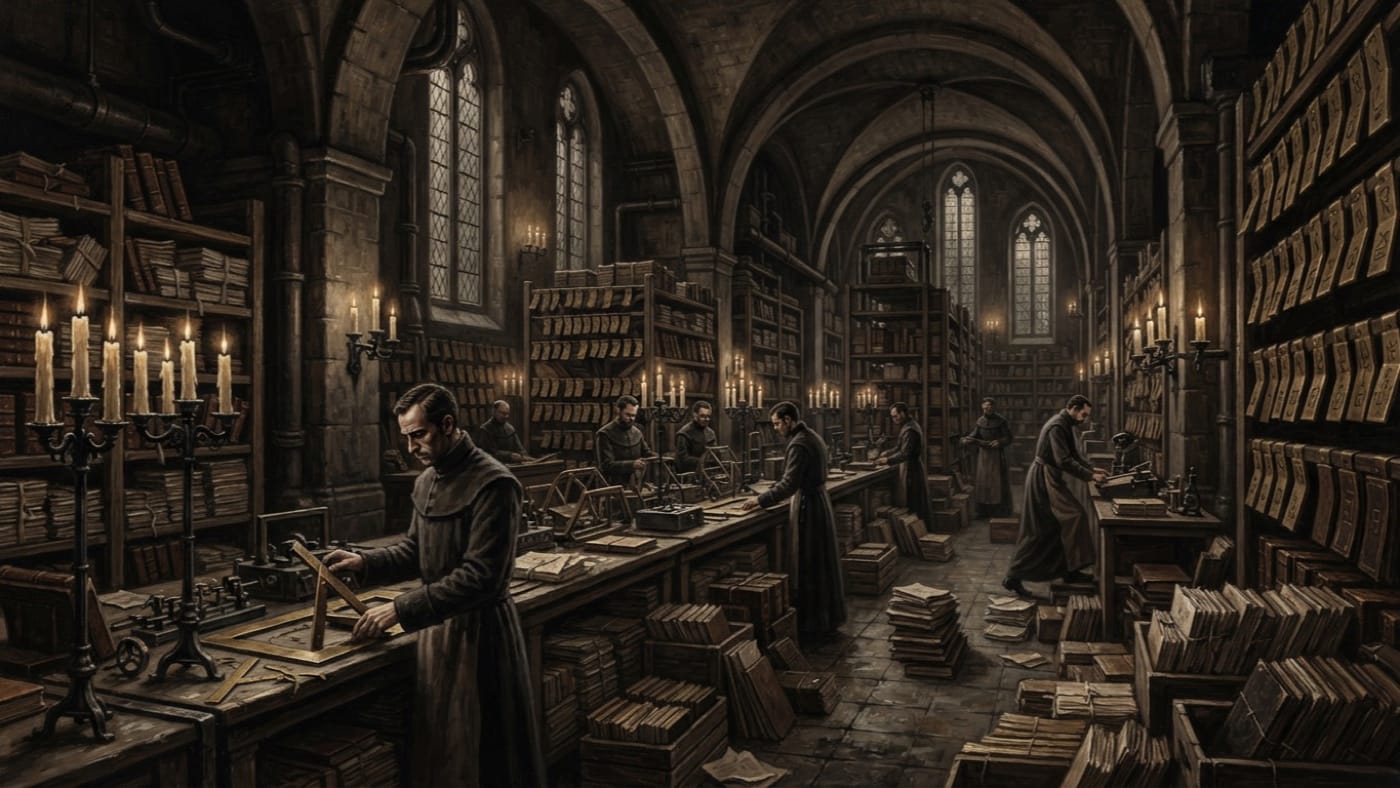
The Archive is the only room in the Cloister with any height to it. Its candles stand under the vault on iron stands, spaced at intervals set by annex. Brass hand-position plates hang in racks by the hundred, each one cut to an approved attitude and stamped with its rite and season. The tables carry censer-angle frames with knee gauges beside them. Then there are the timing tables, which express reverence in seconds, the exception folios, and the correction slips that come in from the parishes by the sackful. The Bureau puts the distance from Marche's chamber to the Archive at forty regulated paces. I walked it once at my own pace, unregulated, and counted thirty-eight. Nobody has told me which of us was wrong.
I give no route between these rooms. The Bureau gives routes only in answer to a written query, and my query came back.
#On the Written Query
The Sub-Priors do not converse. They exchange written ritual queries formatted to Bureau Standard 7-C, revised in A.S. 187 (1897). Each slip is ruled, drafted, signed and pushed under the next door. The answer comes back by the same route, corrected. All day the corridor outside the cells sounds like a mouse working through a ledger, and it stops only when the last candle on the schedule is pinched out. Marche writes queries too. His go forty paces to the Archive and are handled exactly as a curate's would be. That is the only humility the building has ever shown.
The Cloister's paper does not stay inside its walls. Questions come in from every corner of the Dominion and go back out as rulings. One I saw asked whether a priest who had lost his right arm at the Line could swing the censer with his left. The reply took four days and two annexes. It permitted the left hand and prescribed a corrected angle for the wrist, and it said nothing about the arm.
My own file of correspondence with the Cloister is thick. My entry on the Bureau went in three times. The first draft came back for insufficient citation of canonical precedent and the second for misuse of the subjunctive. The third came back with Adequate. Narrowly. written on it in the Liturgist-Primus's own hand. Every letter I have sent to that house has been answered by return of post or sooner. None has been answered the way a man hopes a letter will be answered.
This Codex's entry on the Bureau of Rites stated that the Liturgist-Primus "does not correspond with anyone."
Corrected. For its number of occupants, the Strasbourg Cloister produces more correspondence than any building in the Dominion, and Marche's own output is considerable. He returns letters, he issues corrections and he sends written queries to his own Archive. The earlier wording described his manner, and its author mistook that manner for a fact about the post.
#On What Leaves Strasbourg
Nothing made by hand leaves the Cloister. What it sends out is signatures.
The Bureau of War cannot open a campaign until a clerk here has certified the date as liturgically permissible. The Bureau of Bells cannot alter a peal schedule without a countersignature from these desks. Since the Bell Codex was ratified in A.S. 115, every change of cadence has also meant recasting brass for the Archive's timing racks. The Bureau of Purity cannot try a man until Rites has certified the oaths of the judges who will try him. So a general in his tent, a bellmaster in his tower and a judge already robed all wait on a Sub-Prior with ink on his cuff.
The authority behind those signatures is the six hundred and fourteen articles of the Charter of Prescribed Observance, ratified in A.S. 58 (1768), together with the commentary that has grown up around each article since. The Bureau files that commentary under the Seven Pillars of Prescribed Form. In the Cloister the Pillars stop being headings in a treatise and become numbers.
The genuflection gives the plainest example. An ordinary genuflection lasts no less than four seconds and no more than nine. The infirm may hold eleven, by dispensation in triplicate. The auditors take the rule into the parishes with pocket watches, and the results come back here as slips. I once watched a congregation hold at nine and sweat. Nine is lawful. Rites does not regulate sweat, so the congregation may sweat as much as it pleases.
The quarterly assessments of devotional debt are also issued from these desks. Grace has a cost, the faithful pay it in their bodies, and the Cloister keeps the record. The Bureau's catalogue of symptoms is short. Dulled taste turns bread to ash on the tongue. Insomnia hymns are phantom bells that ring through the skull at night. Brittle joy is laughter that cracks in the throat. Clerks file these reports against parish and tithe registers and grade each community accordingly. The forms set no price in prayers for any symptom. If the Bureau has such a price, it does not write it on the forms.
#On the Present Condition
In A.S. 201 the Archive is active and overfull. New racks have been cut into the old plaster of the north wall. Correction slips from the last audit cycle lie in tied bundles along the nave, and the apprentices step over them in cadence. I can testify to the overcrowding of that one hall and to nothing beyond it. The cells are full at seventeen. The chamber is as it was in A.S. 72, down to the cross.
Marche has held the Chair of Prescribed Observance for nineteen years as of this survey. In that time he has gathered the whole Codex into his head, along with seventeen rites the Church has suppressed. Their names and texts appear in no file I have read, and the files do not say what they would do if performed. The Cloister keeps them as it keeps everything else, in one place and without comment. I walked past his door with the same lack of comment, and I walked a little faster than regulation.
The house has its testimony too. The Bureau says that Aldric the Unbending, who held the Chair for thirty-one years, was found dead at his desk with his quill still moving, and that the sentence was grammatically complete when the quill stopped. I repeat the account as the Bureau gives it. It does not say which desk, and I did not ask.
The Cloister's work goes on at the hours fixed for it. Its candles are lit and trimmed on schedule, and slips pass under its doors as they did the year before. Its rulings leave Strasbourg by every post, and somewhere on the Line, on a date this house certified, a soldier kneels for exactly as long as he is permitted.