
#On the Pits Beyond the Account
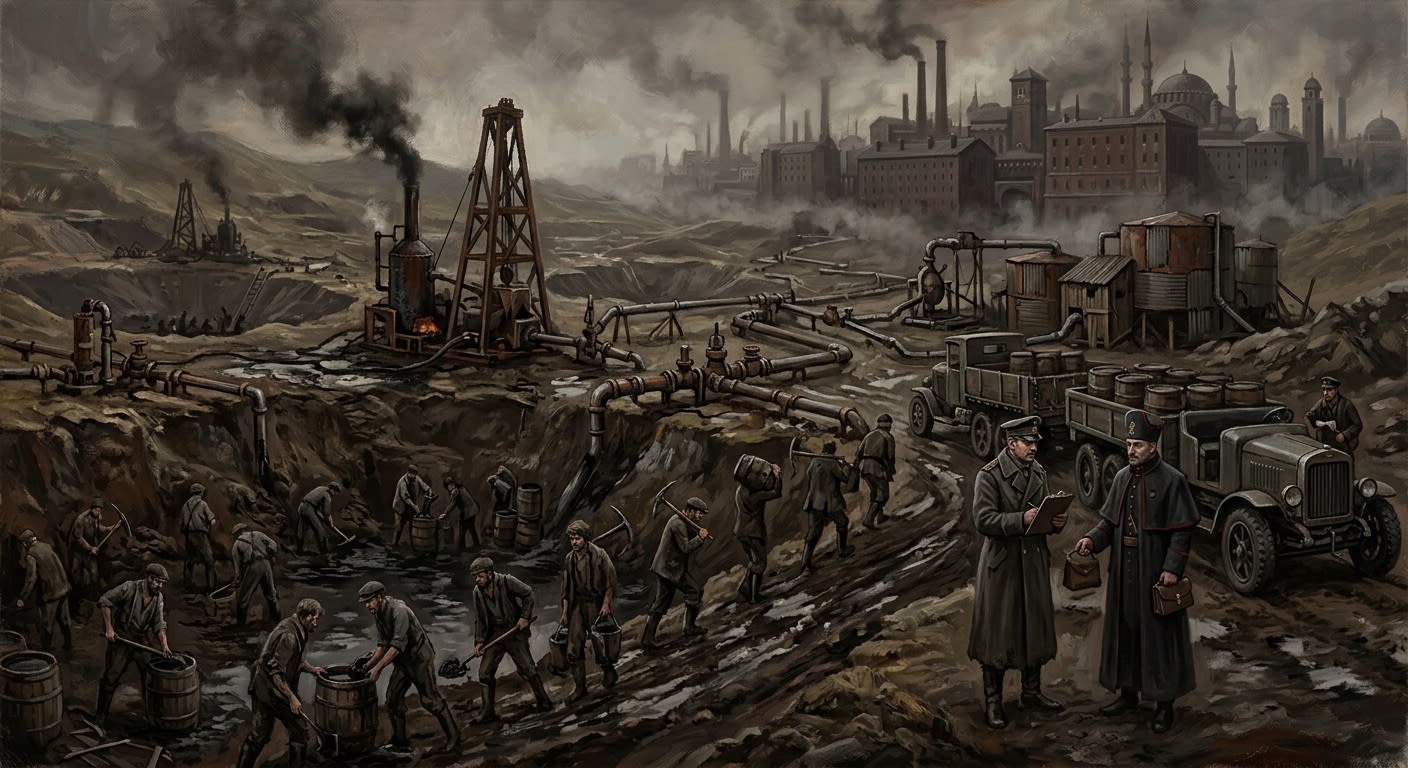
The Anatolian Pitlands are the crude seams east and south of Bastion-Constantinople, where the earth sweats black fuel through cracked stone, goat paths, abandoned wells, ruined cisterns, and the sort of unregistered human hands the Bureau of Records finds easiest to deny because it has never had the courtesy to count them. The Pitlands have no provincial charter, no licensed industrial standing, and a stain's full complement of labour.
From those seams comes the raw sludge that becomes black diesel: contraband heat, illicit engine-blood, winter's little felony, the fuel the Synod condemns at noon and purchases after dusk through six intermediaries and a priest who has learned to misplace receipts. The Chrismole Furnaces of Brast sing over their sanctified product. The Pitlands cough theirs from the ground.
#On Extraction Without Persons
The first rule of the Pitlands is that no one works there. This rule appears in four separate Bureau filings, each stamped, witnessed, and false enough to deserve a little chapel. The second rule is that the convoys must arrive on time. Between those two rules lives the workforce: men lowered into seam-cuts by rope, children sent through vents too narrow for shoulders, widows who stitch skin-bags from goat hide and prayer-cloth, muleteers who learn which bridges take bribes and which take bodies, and pit foremen whose ledgers contain only marks because names create obligations.
A raw seam is opened with pick, heat, wedge, and blasphemy. The black seep is scraped into troughs lined with beaten copper, then ladled into cooled jars, skin-bags, broken water casks, reliquary crates, empty chrismole drums, and, in two recorded cases, baptismal basins stolen from chapels that later reported improved attendance. The sludge stinks of tar, salt, old meat, and a sweetness like fruit kept too long in a sealed room. Fresh workers vomit. Experienced workers do not vomit because they have lost the courtesy of their stomachs.
A Bureau of Purity digest describes the Pitlands as “minor Anatolian seepage sites exploited by scattered criminal elements.”
Corrected. The sites are numerous, organised by route and bribe, and large enough to heat districts whose official allocations would otherwise freeze. The criminal elements are scattered only when Purity needs a parade.
The Pitlands do not issue wages in coin where coin can be traced. Payment comes in flour, salt, lamp-cuts, passage tokens, false baptismal chits, and silence. A worker who dies in the seam is left in the seam unless the body blocks production. A worker who survives long enough to cough black threads into a rag is promoted, which means he stands above the pit and sends others down.
#On Routes, Bribes, and the Warmth Tithe
The sludge leaves Anatolia in skins, casks, sealed devotional crates, false corpse-carts, pilgrim packs, and the bellies of boats whose captains have never once transported fish despite smelling powerfully of it. The southern routes feed Constantinople first, because the great city is a mouth that cannot stop eating heat. From there the sludge passes into warren stills, hidden pipe networks, contraband lamps, trench stoves, and engines whose official fuel manifests remain as pure as an altar cloth nobody has washed.
The Hidden Pipe-Runners call Anatolian crude first sin. Distillers call it mother black. Purity calls it Category Sigma precursor matter. Tithes calls it nothing in public and something billable in private. Every cask pays: one cut to the route guard, one to the harbour clerk, one to the local Warden, one to the official who will later sign the confiscation order, one to the informant who will identify the expendable convoy, and one to the widow who knows the second road when the first becomes doctrinally crowded.
The confiscation theatre begins far from the pit. A marked convoy is surrendered. Canisters are stacked. A Wick-Kid cries at the correct volume. Purity officers stand white-cloaked before a population whose lamps are burning the same fuel in every shuttered room. The seized casks are displayed, counted, denounced, and then, with administrative modesty, misplaced. The Bureau calls this enforcement. The Pitlands call it shipping loss.
#On the Fuel's Memory
Pitland crude is not inert. It bubbles under bells. It thickens near relic bone. It forms skins in the shape of script if left uncovered beneath certain moonless winds. The Distillers insist the fuel remembers pressure, song, and death; Engineering denies this with the strained face of a man whose boiler has just answered him in Wallachian. The A.S. 136 scripture-smoke quarter in Constantinople began with Anatolian crude from a seam the smugglers called Saint No-Name's Throat (Unregistered). The name is offensive. It is also accurate enough to have been banned.
PITMASTER TESTIMONY — ROUTE SEVEN, UNDATED “The lower pool spoke when the bell rang from the coast. No words at first. Bubbles. Then letters on the skin. We skimmed them with ash. One boy read before I struck him. He said the pool had counted us wrong.”
[remainder sealed under Standing Order 14-K]
A pit that has produced scripture-smoke once is never abandoned. This seems foolish until one remembers that dangerous fuel sells dearer. The hotter seams are marked with bones, bottle glass, red thread, or small icons nailed upside down, according to local superstition and available materials. Distillers pay extra for them. Plumbers curse them. Fume-Inspectors build careers on finding their residue after everyone has already warmed themselves by it.
#On Present Denial
As of A.S. 201, the Anatolian Pitlands remain officially unregistered, unofficially mapped, morally condemned, fiscally useful, and operationally indispensable. Three surveys have failed to locate the main seams. All three survey parties returned with diesel on their boots. One cartographer submitted a blank map with the annotation no stable extraction geography verified. The map smelled of tar for nine months and was later used to light a sanctioned stove.
Standing Order 14-K declares the extraction, transport, distillation, sale, purchase, storage, ignition, inhalation, reading, or theological interpretation of black diesel products punishable by immurement. Enforcement is immediate where convenient, ceremonial where profitable, and absent where winter has sharpened its teeth. The Pitlands continue to seep. The convoys continue to arrive. The records continue not to carry the workers' names.
The Bureau of Records states that no registered Synod citizen is currently employed in Anatolian black-sludge extraction.
Confirmed. Registration would spoil the sentence. The dead are easier to omit when they were never admitted to the page.