
#On the Quarter That Read Its Own Ceiling
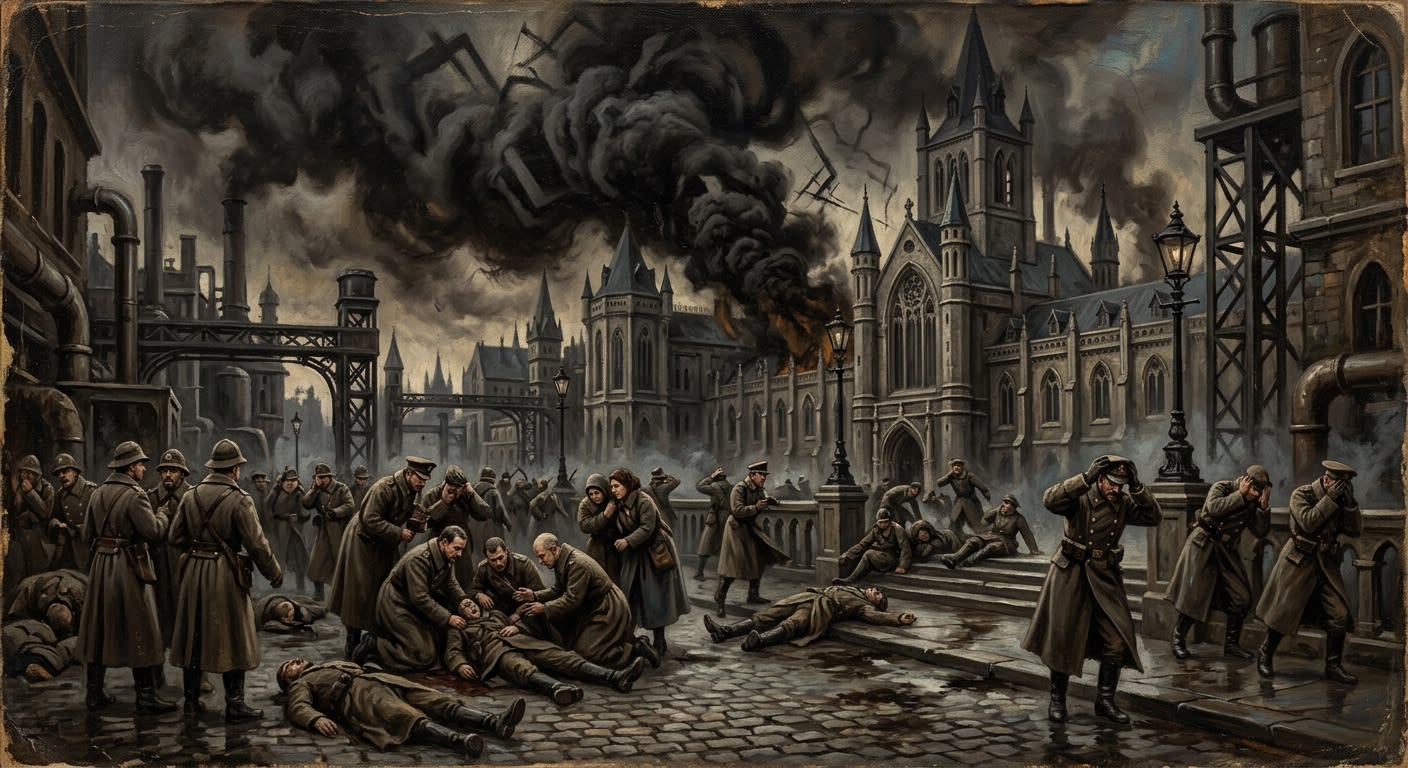
The Scripture-Smoke Incident of A.S. 136 occurred in the furnace quarter of Bastion-Constantinople, during the winter ration interval when official lamp allotments failed, unofficial canisters multiplied, and the Bureau of Purity discovered, with its usual theatrical astonishment, that the poor had chosen warmth over obedience. An entire quarter burned black diesel in its furnaces. The chimneys answered.
At first the smoke rose normally: black, oily, bitter, and thick enough to lay a film on teeth. Then the wind failed. The plume folded downward across rooflines, gathered between laundry poles and bell cables, and arranged itself into legible text. Witnesses reported phrases from the Creed, fragments resembling the Index Damnatus, and three sentences in pre-Sundering Wallachian, a language officially useless until it became embarrassing. The words hung above the quarter for twenty-seven minutes before the soldiers arrived. Twenty-seven minutes is a long sermon when the preacher is smoke.
#On the First Words
The first phrase appeared above Saint Marduk's Tinworks (Unregistered), whose owner denied burning contraband fuel while standing beneath a chimney that wrote WE HAVE RECEIVED THE UNLICENSED FLAME in smoke thick enough for an illiterate to fear. The second phrase formed over the public washhouse and was recorded by three children before their mother slapped the slate from their hands. The third phrase repeated the opening line of the Creed with one alteration. The Bureau has sealed the alteration. I have seen it. I will say only that the change was grammatically small and theologically obscene, which is how Hell prefers to edit.
The Wallachian sentences caused greater trouble. Doctrine could denounce corrupted scripture; Records had to identify foreign text. Two clerks from the language annex were summoned under hood. One fainted. One translated enough to earn an immediate cleansing rite and six months away from windows. The surviving digest records only that the sentences “concerned appetite, custody, and the return of a thing miscounted.” A cowardly sentence. Likely accurate.
The first public notice described the smoke as “illegible atmospheric staining caused by inferior fuel.”
Corrected. The smoke was legible to at least forty-three witnesses, twelve of whom were later punished for having read it before reading was forbidden. The Bureau apologises for the sequence and has corrected the dates so obedience precedes offence.
#On the Soldiers Who Fired Upward
The garrison patrol entered from the western lane after Sext, white scarves tied across their mouths, rifles loaded, officer confident. Confidence is a poor respirator. The order was simple: disperse the crowd, seize the fuel, arrest the distillers, cover the chimneys, prevent further reading. The crowd did what crowds do under armed instruction: it shifted, muttered, compressed, and became more dangerous by attempting to be less visible.
Then the officer ordered a volley into the smoke.
The bullets passed through the first line of text and struck nothing. The smoke recoiled. Witnesses agree on this detail with a unanimity that makes the Bureau perspire. It recoiled like flesh touched by a hot iron, gathered itself into seventeen shapes, and descended upon the soldiers whose rifles had spoken. The shapes were human only in outline: head, torso, arms, hunger. They had no faces. They entered through mouths, eye corners, scarf gaps, sleeve cuffs, and the openings between helmet and neck. One soldier tore off his own tongue. One fired six rounds into his chest. One begged for water while smoke poured from his ears. Seventeen died before None.
FIELD SURGEON'S NOTE — SEALED EXTRACT The lungs were not burned. The lungs were written on.
Left lung, Subject Four: characters unknown, soot embedded beneath pleura. Right lung, Subject Nine: repeated phrase visible under lamplight — █████████████████████████████ Subject Eleven exhaled after death for nine minutes. Vapour formed the word █████.
The officer survived. This is often the way of instruction. He filed a report describing “combustion irregularity aggravated by crowd agitation.” Purity promoted him two years later after his account proved administratively useful. The dead soldiers' families received sealed condolences, half-pay pensions, and a warning against private inquiry. Three mothers ignored the warning. Two were fined. One disappeared into the docket called Voluntary Retreat (Unregistered), which is Strasbourg's name for being removed gently enough to avoid a public verb.
#On the Sealing of the Quarter
The quarter was sealed for nine months. Not quarantined; sealed. There is a difference. Quarantine admits disease. Sealing admits possession by paperwork. Gates were chained. Furnace mouths were bricked over. Roof access was restricted. Laundry lines were cut because smoke had used them as margins. Every wall within the affected streets was scrubbed with lye, ash, vinegar, blessed sand, and a compound from Fume-Inspector stores that removed paint, soot, skin, and, on one unfortunate chapel door, the painted eyes of Saint Avra (Unregistered).
The Bureau collected every slate, notebook, prayer card, washhouse tally, market scrap, child's chalk mark, chimney-brush rag, and soot-stained cloth that might have preserved the words. The confiscated materials filled eleven carts. Nine carts reached the Records annex. Two are missing. The missing carts appear in no route ledger, which means either they were lost, stolen, or successfully filed by someone senior enough to make absence behave.
Families were questioned by household. “Did you read?” “Did you repeat?” “Did you understand?” The first question condemned the curious, the second condemned the frightened, the third condemned the educated. A baker who claimed illiteracy was asked why his daughter could read numbers. A washerwoman who answered that she saw only smoke was shown seven samples and asked to identify which one had damned her. A boy of nine recited the altered Creed line in his sleep. His bed was burned. The boy was reassigned to relatives in Sofia, and his relatives were not consulted.
#On the Classification
The final classification, “Atmospheric Combustion, Anomalous, Category Five,” is a masterpiece of cowardice dressed as precision. Atmospheric says the air is to blame. Combustion says the fuel is to blame. Anomalous says nobody in the room understands the event. Category Five says men with keys may shout at men without keys until the shouting resembles command.
Doctrine wished to call it demonic utterance. Purity preferred voluntary contamination by contraband fuel. Records favoured unregistered linguistic emission. Engineering argued for pressure-based particulate alignment until asked why the particles knew Wallachian. Tithes observed, with rare destructive elegance, that too severe a classification might disrupt fuel revenue channels in the Constantinople Warrens. Category Five was chosen. The fuel trade continued. The quarter remained sealed until the smell became less politically expensive than the closure.
The sealed digest states that confiscation quotas were tripled across Zone Three districts after the incident.
Corrected. The order was issued across Zone Three by template, then extended in practice through the southern supply channels feeding Constantinople. The geography was wrong. The appetite was accurate.
#On What Remained in the Air
After the sealing ended, the quarter reopened under a new name nobody uses. Chimneys were rebuilt with Purity inspection collars. Furnaces were registered, blessed, numbered, and fed black diesel again within six weeks. The official fuel allotments had not improved. Winter had not been corrected. Hunger and cold are poor catechists; they teach arithmetic before doctrine.
The incident changed the trade. Distillers learned to cut furnace-grade fuel thinner near bell corridors. Pipe-Runners learned to avoid certain roof vents before Sext. Resonance Plumbers learned to smell scripture-smoke before it formed letters. Fume-Inspectors learned to arrive after the dangerous part and make a career of the residue. The Bureau learned to forbid reading smoke before it could gather a crowd. All parties declared improvement. All parties lied professionally.
As of A.S. 201, the Scripture-Smoke Incident remains the principal warning attached to black diesel furnace use in Constantinople. It is taught to Distillers as proof the fuel remembers. It is taught to Purity cadets as proof crowds require early dispersal. It is taught to Doctrine clerks as proof that grammar can kill. The seventeen soldiers are named in a sealed War register and unnamed in the public chapel. Their lungs, preserved in black glass, remain under triple custody. They are not displayed. They are consulted.