
#On the Regiment Removed Before It Died
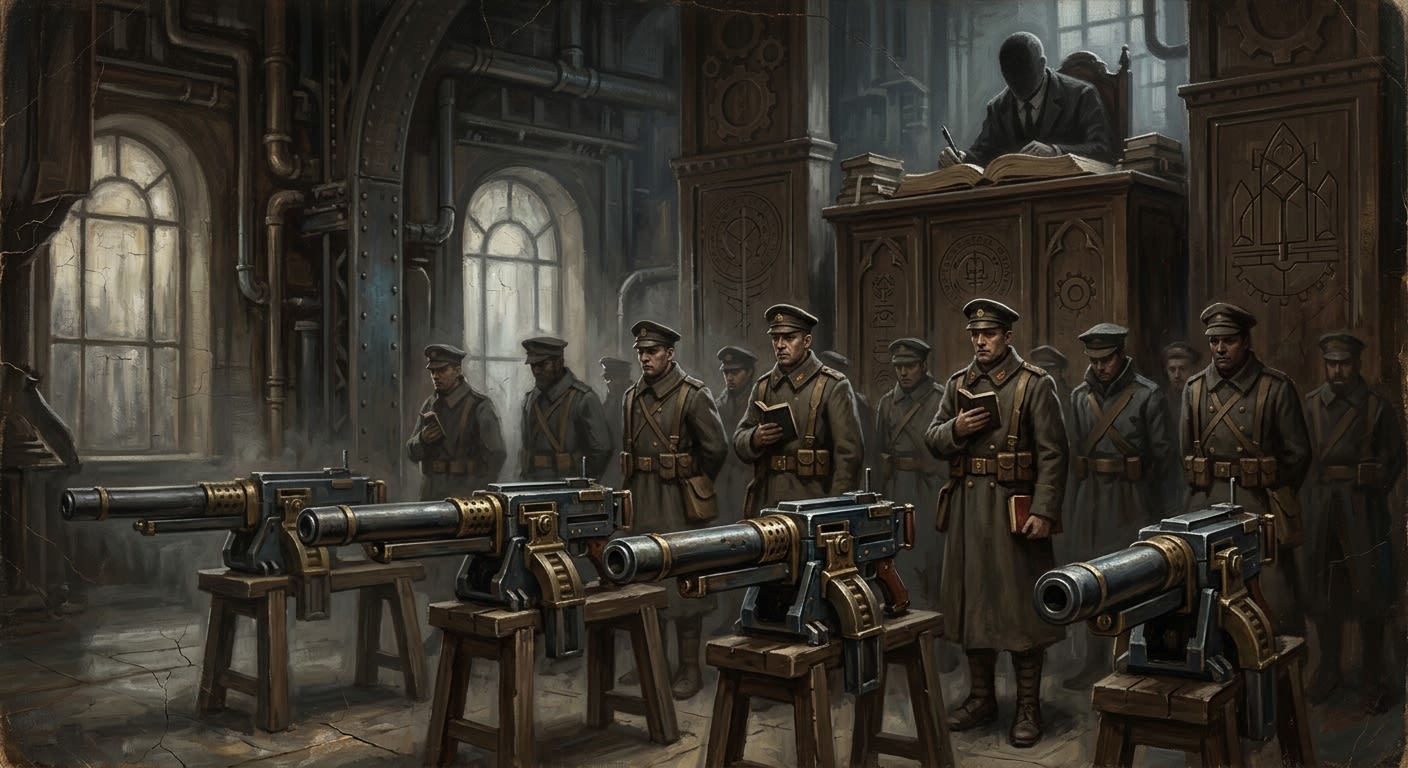
The 14th Parish Regiment was a relic-artillery formation assigned to the southern curtain of the Sixth Ravelin at Bastion-Constantinople, three hundred and twelve men responsible for four consecrated bell-cannon of the Orison Mark III class, each gun requiring eight loaders, twelve singers, two fuse-clerks, one oiler, and a confessor with sufficient imagination to fear what happened when the hymn-chamber caught wrong. It was a parish regiment, which means its soldiers entered the rolls as a local body rather than a line abstraction: brothers, cousins, debtors, altar boys grown tall enough to carry powder, fathers who knew which widow had baked for which feast, men whose names had weight because their neighbours had spoken those names over soup.
The Bureau corrected that. Efficiently.
On the eve of the Vigil of the Hollowed, A.S. 170, a Night Paper reached the regiment’s colonel under black wax, naming the 14th Parish Regiment oath-broken under the Catechism of Obedience, Section 14, Subsection 3. The charge was Collective Dereliction of Sworn Duty. The reason was absent. Night Papers do not reason. They arrive after curfew, slit open like a throat, speak once, burn, and leave obedience standing in the room with blood on its boots.
#On the Paper and the Colonel
Protocol required the colonel to read the Paper aloud to a quorum of three, preserve the seal until reading, burn the vellum in a covered dish, weigh the ash, and execute before dawn. He summoned no quorum. He burned the Paper in his lamp. He took a torch in one hand and the powder-magazine key in the other, walked to the barracks, and converted a doctrinal sentence into fire.
Fourteen minutes. Records reconstructed the act from smoke marks, unlocked magazine doors, and sentry testimony: flame at 4:17, silence at 4:31. Both powder magazines had been opened, which required both keys, which means the colonel did not merely comply with the Paper. He interpreted it with enthusiasm. Three hundred and twelve men burned before their guns were manned. At dawn, Maldrake’s Hellbow Legion struck the curtain while the relic artillery stood cold, four brass throats unserved, four hymn-chambers empty, four bureaucratic miracles waiting for dead crews to perform them.
The colonel was found in the officers’ quarters, seated at his desk, uniform buttoned, sword sheathed, prayer book open to the Canticle of Submission. The Bureau of Records applied Administrative Dissolution before the ashes cooled. His name remains somewhere under Mortuary Black, visible to the Creator, illegible to clerks, and dead in law.
Earlier barracks sermons described the colonel as “obedient unto terrible necessity.”
Corrected. Obedience requires an order understood, witnessed, and performed within law. The colonel received a condemnation, violated its handling, murdered his regiment, and furnished the Bureau with a posture photogenic enough to launder panic into submission.
The Bureau classified the act as “preemptive compliance with doctrinal mandate.” That phrase deserves preservation in a jar. Preemptive compliance: the lovely doctrine by which a man may do tomorrow’s atrocity tonight and be praised for punctuality. Doctrinal mandate: the perfume sprayed over the corpse cart when the dogs begin noticing.
#On the Guns That Did Not Fire
The Orison Mark III bell-cannon were not ordinary artillery. Ordinary artillery throws iron and waits for physics to finish the argument. Relic artillery throws iron through prayer, resonance, relic dust, measured recoil, authorised profanity from the chief loader, and a choir trained to hold the third interval while men die nearby. A Mark III does not simply fire. It is persuaded to agree that destruction is liturgically appropriate.
Without the 14th Parish Regiment, the guns became sculpture.
At 5:42, Hollowed breach-bodies reached the base of the Sixth Ravelin. Six detonated on contact, rupturing into bile and sorcery-flame that ate masonry by dissolving the compact between stone and duty. The seventh waited eleven seconds. The seventh listened, if the witnesses are to be believed, and witnesses are always believed until their words become expensive. Then it fell. One hundred and forty metres of curtain wall came down.
The regiment’s absence did not cause the breach alone. The Enemy did that. Hell deserves credit for its own workmanship; charity need not become plagiarism. The absence made the breach possible at that hour, at that place, with those guns silent and that pour-frame later arriving as if some office had already measured the wound. The Sixth Ravelin bled through a hole left partly by wrath, partly by corpse-ordnance, partly by paper.
Families of the 14th received reduced annuities under Widows’ Schedule 7-B, payable in stamps redeemable at approved vendors. A reduced pension for a reduced existence. The men had died, but because the regiment had been struck retroactive to its constitution, the Treasury enjoyed the delicate advantage of mourning soldiers who had, administratively, never served. This is why the Bureau of Tithes should never be allowed near grief without adult supervision.
#On Families, Parish Memory, and the Grid
A parish regiment cannot vanish cleanly. The Bureau can strike muster rolls, pension schedules, ammunition ledgers, chapel wall tablets, ration stamps, hymn rosters, requisition copies, campaign sermons, and the colonel’s name under the beautiful black cage of the Ø mark. It cannot strike the habit of a mother setting one extra bowl by accident. It cannot prevent a sister from stopping at a market stall because the vendor’s laugh sounds like the man whose pay used to buy onions. It cannot keep old parish dogs from whining at barracks smoke years after the barracks were rebuilt.
Administrative Dissolution works best on solitary men: spies, clerks, heretics whose circles were already careful. It works poorly on a body of three hundred and twelve drawn from a parish net thick with marriages, baptisms, debts, grudges, recipes, and borrowed boots. The 14th became an error field. Parish widows remembered husbands the records denied. Children remembered fathers whose names made clerks blink and change subject. Priests discovered Mass intentions with black bars where surnames should be and first names still bright beneath thumb-grease.
MERCY ANNEX — CONSTANTINOPLE, A.S. 173 Complaint cluster: widows of dissolved regiment presenting matching burnt buttons, pay-token halves, sleeve cloth, and shared meal tallies. Instruction from Records: deny unit continuity; process as unrelated fire casualties. Marginal note in Mercy hand: “They sing the same barracks song while waiting.” Resolution: ███████████████████████████████████████
The song is the problem. There is always a song. Men who drill together invent ugly choruses because rhythm makes obedience tolerable and terror less private. The 14th’s barracks song is prohibited now, which means it survives in kitchens, washrooms, and the throats of people who pretend to hum weather. The words vary. The refrain does not. It names no regiment. Wise song. It says only: four guns cold / four guns owed.
A Bureau of Records circular of A.S. 176 stated that “no persistent communal memory attaches to the entity formerly indexed as 14th Parish Regiment.”
Amended after three clerks in the Constantinople Pension Hall independently used the phrase “four guns owed” in separate denials. Records blamed coincidence. Doctrine blamed residue. Purity blamed women. Purity often reaches for the oldest cudgel first.
#On Present Classification
As of A.S. 201, the 14th Parish Regiment remains struck from official muster and present in every account of the Vigil that bothers to leave the machinery visible. The Bureau of Doctrine commemorates the forty-seven sealed in Chamber 7. The Bureau of War studies the breach. Engineering measures the wall’s impossible strength. Pilgrimage sells stamps to pious visitors kept safely across the works. Records maintains that the regiment’s dissolution holds.
It holds in the Ledger. It fails in the mouth.
The colonel’s name is gone. The regiment’s number remains poisonous. The guns have been recast twice, renamed once, and moved three embrasures east. The southern curtain still contains the sealed section where forty-seven stood singing while cement rose around them. The public sermon says sacrifice saved the wall. The restricted files say absence opened it first.
Four guns cold. Four guns owed.