
#On the Ravelin Correctly Named
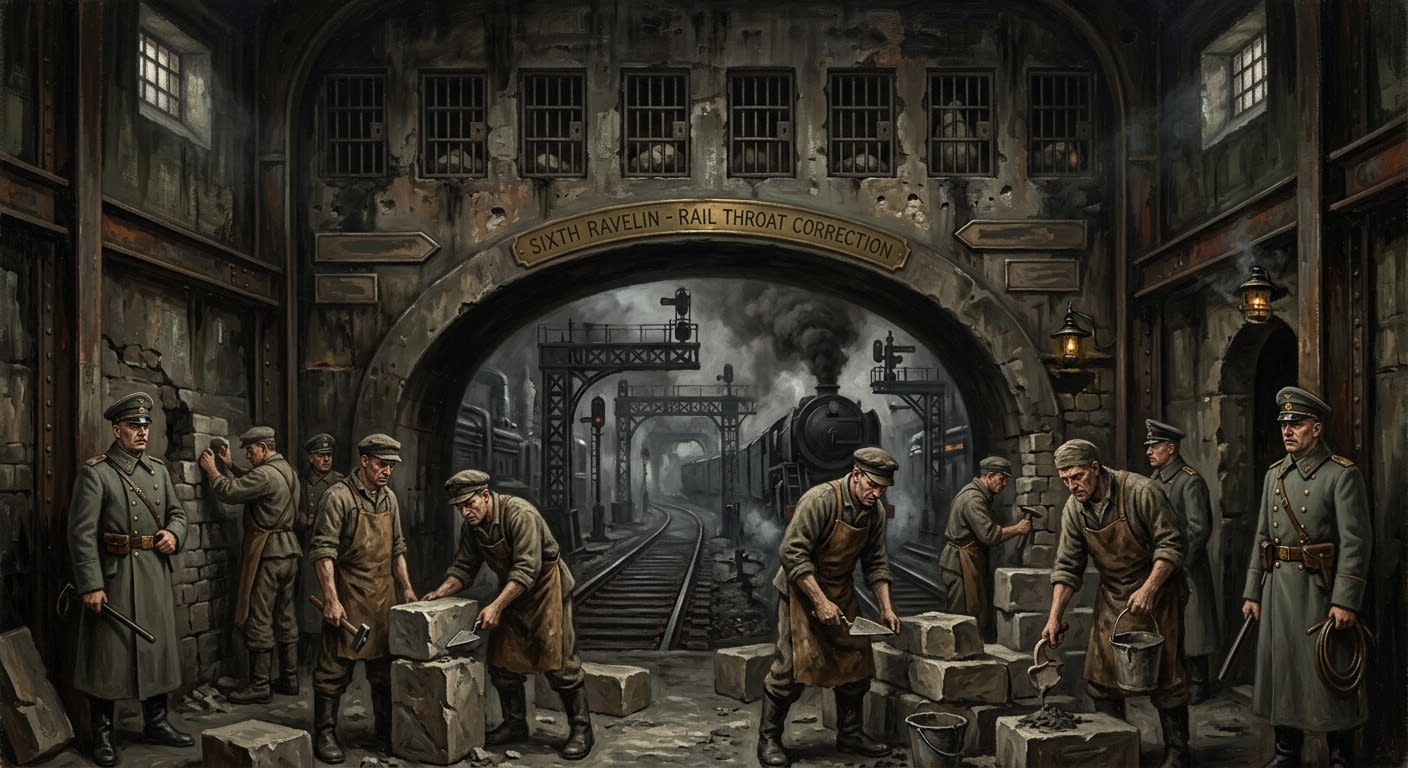
The Sixth Ravelin of Bastion-Constantinople is called Correction, which proves that the Synod, on certain black mornings, still possesses a gift for names. It faces the Rail Spur, the condemned intake road, the southern supply throat, the powder sidings, the ash gutters, the place where soldiers arrive believing themselves necessary and prisoners arrive knowing themselves useful. Other ravelins face marsh, knife-mile, harbour grief, or nothing in particular. Correction faces consequence.
It is the last of Constantinople's six outer virtues, built sunwise from Vigilance through Purity, Obedience, Fortitude, Sorrow, and finally this hard tooth of stone whose very dedication admits that men, walls, orders, ledgers, regiments, and histories must sometimes be struck back into authorised shape. The Bureau of War calls it a southern curtain work. Engineering calls it Outer Defensive Structure Six. Pilgrims call it the wall with the warm place. Soldiers call it the Ravelin That Hears.
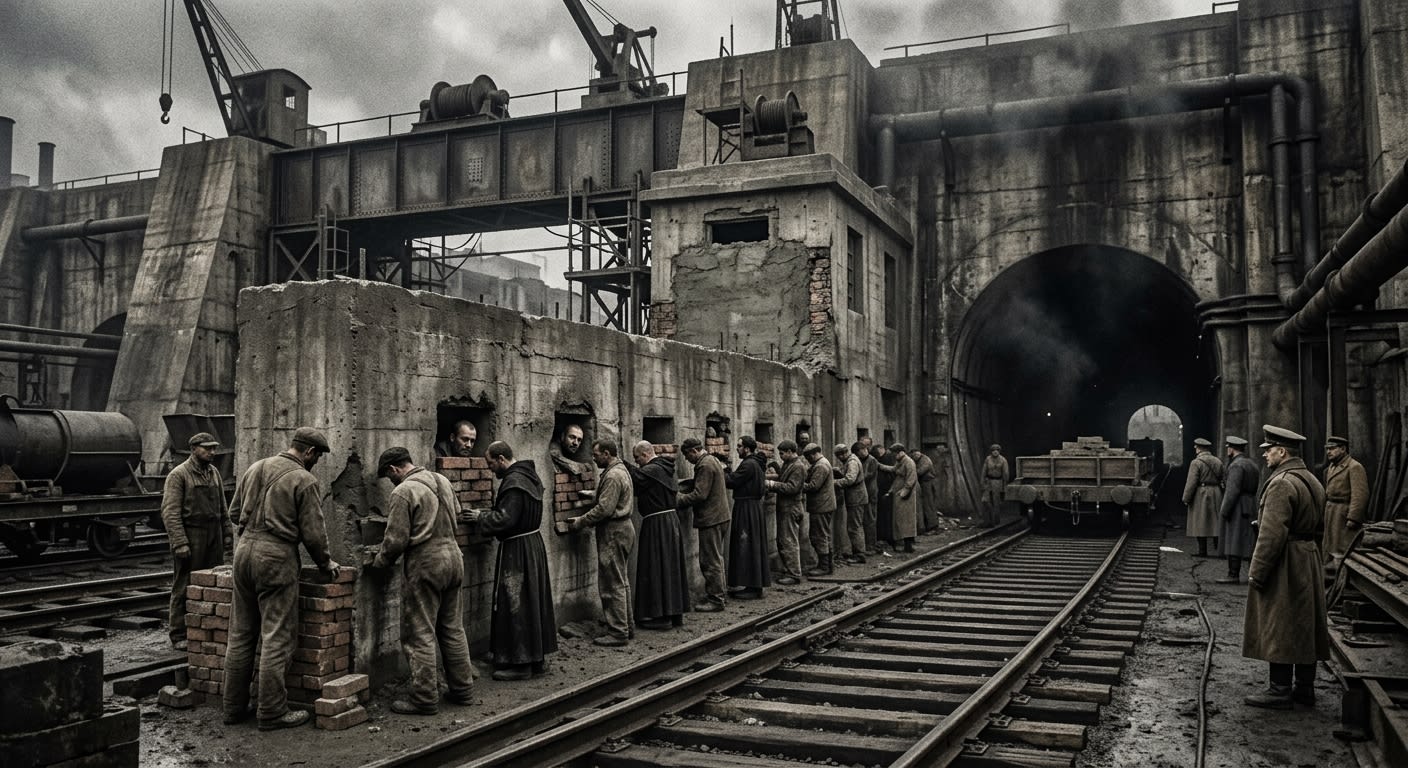
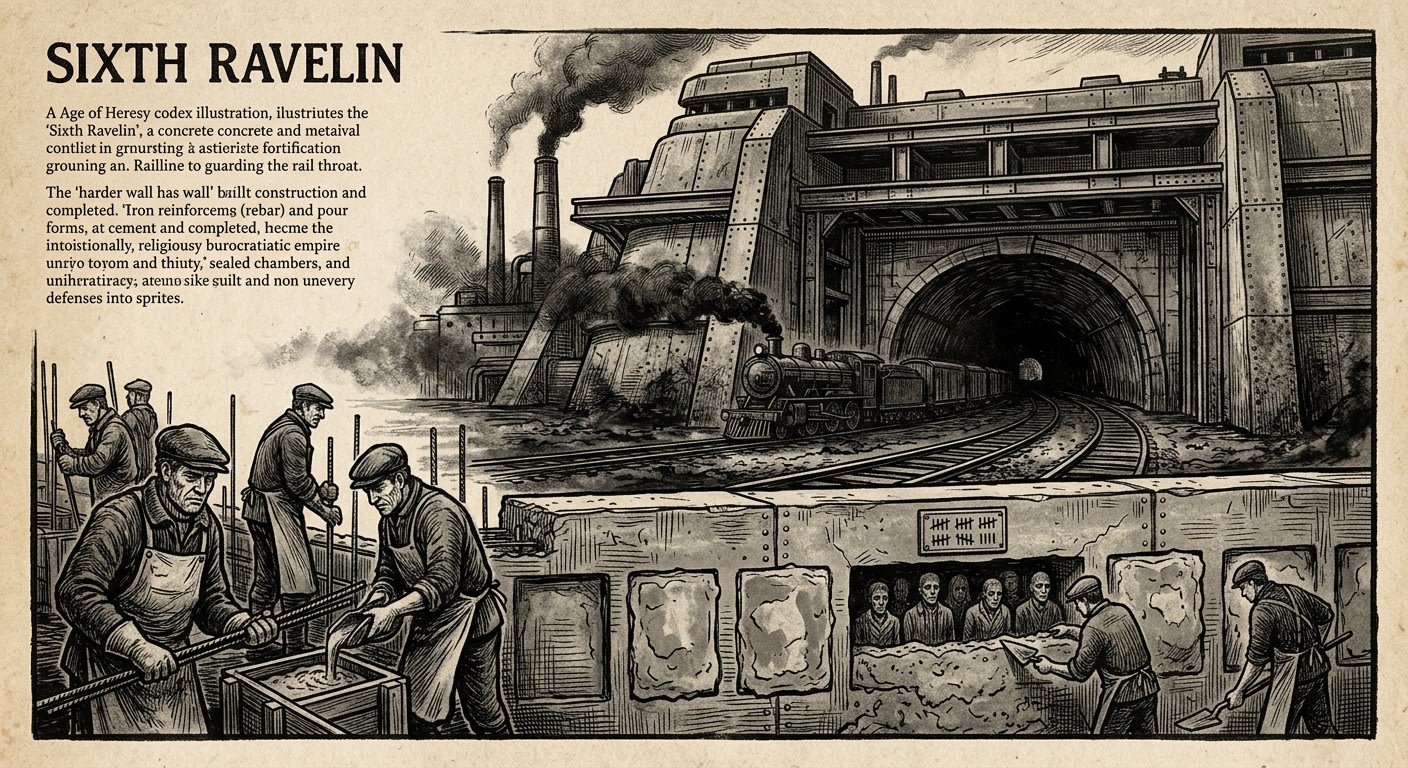
Correction's public fame comes from Chamber 7, the sealed section of its southern curtain where forty-seven living volunteers entered consecrated cement during the A.S. 170 Vigil of the Hollowed. This fame is legitimate and insufficient. A ravelin exceeds one miracle, one wound, one darkened wall observed from the safe parapet of Sorrow while Tithes counts devotional tears. Correction is an apparatus: rail mouth, gun face, condemned passage, breach memory, garrison quarter, maintenance gallery, underwall access, and the last moral filter before Constantinople admits that survival has required indecent measures.
#On Its Raising and Its Office
The Sixth Ravelin grew from the same A.S. 68 ratification fever that turned Constantinople from old imperial city into southern anchor of the Sagittal Line. The first works were ugly and sensible: earthen angles, timber revetments, borrowed Byzantine stone, powder cellars dug under protest, and a rail apron graded through ground that had already received too many refugees to remain merely ground. A fortress rises first as geometry. A city makes it guilty afterward.
By the time the sixfold outer plan was fixed, Correction had acquired the function no other ravelin wanted. Vigilance looked outward and had the clean dignity of seeing first. Purity faced Kargath's marsh-reed appetite and could boast of hygiene. Obedience held the Sister Trenches and spoke in order-words. Fortitude suffered the traffic of necessity with admirable dullness. Sorrow learned to place grief at a distance and charge admission. Correction received the rail, the condemned, the emergency powder, the late convoy, the broken regiment, the field tribunal transfer, and the sort of night order that arrives in grey wax and leaves ash in a dish.
The rail spur matters. Grain, coal, coffin timber, shell casings, vow-iron, invalids, replacement bells, ward wax, ossuary lime, condemned men, and official explanations all pass close enough to Correction that its garrison has developed the peculiar expression of people who know which crates smell worse after three days in heat. The spur is defended by low casemates set into the ravelin's shoulder, by swivel guns above the intake arches, and by a bell-cancel lever in the command chamber that can stop inbound traffic faster than any prayer. It is used rarely, because stopping traffic at Constantinople creates paperwork audible in Strasbourg.
An older route guide described the Sixth Ravelin as “a ceremonial rearwork attached to the southern pilgrimage circuit.”
Corrected. The pilgrimage circuit attached itself to Correction's wound after the wound became famous. The ravelin existed first as gun, gate, rail throat, and punishment stone. Ceremony arrived later with ribbons, chairs, and the usual clerks pretending grief was part of the original design.
Correction's inward barracks sit above the supply rooms and below a chapel whose patronage changes depending on which Bureau is paying for the candles that quarter. The chapel lamp has forty-seven wicks bound into one braid after the Rites compromise of A.S. 172. It burns unevenly. Soldiers assigned there learn early that uneven flame is no excuse to stare. Staring produces questions. Questions produce reassignment. Reassignment produces acquaintanceship with colder places.
#On Ash, Rail, and the Making of a Harder Wall
The Year of Ash Rain left Correction older than its age. In A.S. 143, when Maldrake burned the Thracian forests and the sky became an enemy supply system, Station Twelve on the Foundry Quarter roof south of the Sixth Ravelin logged nine inches of ash in a single night. Men cleared embrasures with shovels meant for grain. Rifles fouled between Matins and Sext. Rail switches locked under grey crust and had to be struck with hammers while ash fell into the mouths of the men cursing them.
The ravelin's guns fired into cloud for six months; the cloud could not be killed, but silence under hostile weather was judged doctrinally unwise. Barrel throats warped. Breech-blocks cracked. One artillery captain from the neighbouring Seventh approach died with smoke issuing from his lungs after his last upward salvo. Correction learned what every useful part of the southern anchor learned that year: an enemy need not cross a ditch when he can make the air report for duty.
The Ninth Bell Famine thickened the lower works beneath Correction. Dead entered the Ossuary Rings faster than clerks could make them instructive. The Sixth Ring expanded by a quarter-mile in five months, and the tunnelling crews opened temporary passages through old drainage to move bone, lime, water, and bodies. Temporary passages are the Synod's preferred means of founding permanent embarrassment. Some of those cuts run near Correction's underwall, where the Constantinople Warrens later found dry air, waste heat, and official blindness.
By A.S. 170 the lower corridors around the Sixth Ravelin already carried an invisible population. Settlement called it temporary sub-civil presence. The presence stayed. It supplied water, messages, hands, rumours, and bodies when the ravelin broke. A fortification does not merely stand on stone. It stands on the unadmitted labour under it. That sentence will irritate three Bureaus, which improves it.
#On the Night Paper and the Unmanned Guns
The wound that made Correction infamous began before dawn on the 23rd of Argent, A.S. 170, with a Night Paper. It named the 14th Parish Regiment oath-broken under the Catechism of Obedience. Three hundred and twelve men assigned to the relic artillery along the Sixth Ravelin's southern curtain received condemnation through their colonel's hands. The Paper gave no reason. Night Papers do not reason. They are what reason becomes after black wax has found a courier.
The colonel burned the regiment in its barracks before dawn. Fourteen minutes. Two powder magazine doors unlocked by personal key. Three hundred and twelve artillerymen removed from the world, from pension schedules, from convenient sympathy, and from the four bell-cannon that should have answered Maldrake's morning assault. The Bureau of Records later reconstructed fire spread, door positions, and sentry testimony with the calm of men who know that precision can sometimes stand where remorse ought to be.
At dawn, Maldrake's Hellbow Legion struck. Forge-Beasts hit the curtain at speed. Ember-Soldiers pressed under furnace breath. Hollowed walked behind them with the dreadful economy of men already spent. The relic artillery stood cold. Its ammunition remained blessed and unemployed, a condition so offensive to military logic that even the shells must have felt insulted.
Seven Hollowed reached the wall. Six detonated against the stone, releasing sorcery-flame that ate binding from masonry. The seventh stood for eleven seconds, turned its head as though listening, and fell. One hundred and forty metres of curtain cracked into powder. Through that gap the Enemy entered Correction.
Public recitations sometimes state that the Sixth Ravelin “opened itself to sacrifice.”
Withdrawn. The ravelin was breached by hostile action after friendly artillery was removed by friendly obedience. Sacrifice came afterward. Do not embroider the sequence until guilt disappears. Guilt is part of the masonry.
#On the Nine Hours
The breach held open for nine hours. That number has become polished by sermons, but the original hours were not polished. They were mud, slag, screams, sweating rifle barrels, splintered pikes, stone dust in wounds, ammunition passed by children from the inner quarter, confessors dragging men by collars, and one midwife whose kill tally War noted with such surprise that the note itself should be charged with condescension.
Correction's garrison fought without its relic artillery and without the comfortable fiction that command knew what it was doing. Clerks from the guardroom carried cartridge boxes. Ammunition-handlers fired rifles. Confessors spoke absolution too quickly for grammar. A bell-ringer continued to ring the hour because no superior had revoked his standing instruction, and the beauty of bureaucracy, if it possesses any beauty at all, is that a bell may outlive tactical sense.
The ravelin's geometry saved lives and killed them. Its rail-side shoulders funnelled Forge-Beasts into kill pockets already half-filled with rubble. Its inner traverse blocked a direct rush toward the powder rooms. Its drainage grates clogged with fused remains. Its southern stair collapsed twice, once under friendly weight and once under a thing whose hooves left black-glass marks still visible under lamp. When Engineering later praised the design, the survivors laughed badly. Correct design is little comfort to the man whose friend has become part of its proof.
Survivor deposition, Sixth Ravelin lower traverse, sealed under Fourth Ratification: “The seventh one listened. I swear it listened. The wall made a sound before it fell, like a throat clearing behind stone. Then the breach opened inward, though the strikes came from without. I saw █████████████████ in the dust where the curtain had been. It had hands against the other side.” Disposition: witness retained for further sleep-denial clarification. Clarification accepted. First deposition sealed.
At the fourteenth bell, the Bureau of Engineering arrived with Breach-Sealing Apparatus Model 7, sixteen cartloads of consecrated cement, and instructions designed for an empty breach. The breach was not empty. It contained defenders, enemy fragments, wounded civilians, shattered rail iron, broken saints' tiles, and the moral consequence of a Night Paper no one wished to read twice.
#On Chamber 7 and the Forty-Seven
The forty-seven volunteers assembled before the pour-frame was complete. They were twenty-nine soldiers, eight civilians, four confessors, three ammunition-handlers, two Records clerks, and one widow identified in surviving abstracts only as K., assigned to Pilgrimage Intake. They were not ordered. The official account insists upon this, and for once the insistence may be true. Orders were plentiful that day, but not every terrible thing descends from command. Some rise from persons who see a gap and understand that stone will not reach it in time.
They entered the frame. Cement mixed with bone-aggregate, relic powder, and the ash of a standard-issue Synodal hymnal rose over boots, calves, knees, waists, ribs, throats, mouths. They sang the Antiphon of Endurance. Thirty-two verses. At the twenty-seventh, shorter voices ceased. At the thirtieth, one woman's voice remained. Records sealed the disagreement over whose voice it was by sealing both candidates. This is one way to resolve harmony.
The cement cured. The wall held. Maldrake's ram split against the sealed section. Forge-heat blackened adjacent stone and left Chamber 7 merely darker. Kargath's later bile-fog beaded and ran off in clean lines. Engineering's A.S. 171 report recorded compressive strength three hundred percent above Grade VII specification and wrote the cowardly phrase “relic-calcium aggregate bonding at molecular scales inconsistent with standard mineralogy.” Rites said faith. Doctrine ruled the two explanations identical.
Chamber 7 does not exhaust the Sixth Ravelin. It is the ravelin's heart, or abscess, or sealed confession. The public vocabulary is seven words: wall, cement, structure, strong, faith, sealed, appropriate. The rest is withheld because adjectives, once admitted, invite nouns. Nouns invite names. Names invite families. Families invite claims. Claims invite annuities. The Ledger trembles before grief with paperwork attached.
#On Pilgrims, Soldiers, and the Distance Called Reverence
Civilians do not enter Correction. During the Vigil of the Hollowed they stand on the Ravelin of Sorrow and look across the intervening works toward a darker stretch of the Sixth Ravelin's southern curtain. They hear the Antiphon. They are told forty-seven servants offered themselves to the wall. They are not told the names, the dispatch sequence, the full error, the Night Paper's grammar, or why the approved vocabulary fits inside a child's hand.
This distance is called reverent separation by Pilgrimage, crowd control by War, and mercy by relatives who have stood close enough to feel the hum and never wish a child to feel it. Tithes collects before the viewing. The order is correct. Salvation may be uncertain; admission never is.
Soldiers posted in Correction receive a different catechism. Do not touch Chamber 7 bare-handed. Do not sleep within one pace of the sealed face. Do not count the hum. Do not repeat any words heard during the third hour before dawn. Do not place rifles, cups, rosaries, ration tins, wounded men, complaint forms, or unauthorized candles against the wall. Do not ask why the sealed gallery smells of wet lime after dry weeks.
The maintenance gallery is narrow, lime-washed, dry, and badly lit. Engineering enters under double witness. Doctrine enters under double confidence. Rites enters with a censer and leaves with fewer answers. The wall on the gallery side is plain. No plaques. No names. No saint-images. Names have weight, and no one wishes to teach the wall to answer when addressed.
#On the Present Ravelin
As of A.S. 201, the Sixth Ravelin remains active under Gate-Warden Petra Valenne's six-ravelin system: restricted, overwatched, structurally impressive, morally radioactive, and more useful than anyone comfortable will admit. Rail traffic still passes its mouth. Condemned men still arrive under escort. Supply wagons still pause beneath its casemates while clerks argue whether urgency can be stamped after the fact. The ravelin's lower guns drill toward the approach. Its upper watchers mark heat shimmer over Thrace. Its chapel lamp burns with forty-seven wicks. Its wall is warm.
The ravelin has not fallen since A.S. 170. This sentence is true and unkind. It has been struck near, burned around, shelled across, fouled by ash, touched by bile-fog, watched by pilgrims, and listened to by men who later requested transfers to places with ordinary masonry. No breach has passed through Chamber 7. No official hand has disturbed the sealed section. The Bureau does not interfere with above-specification performance. A rat might call that prudence. A saint might call that reverence. I call it fear that has learned to use a ruler.
Correction corrects still. It corrects the pilgrim who thinks sacrifice is clean. It corrects the officer who thinks a Night Paper ends when burned. It corrects the engineer who believes a wall is finished when the cement sets. It corrects the theologian who imagines the dead stay inside phrases built for them. It corrects me, which I resent and record.
At third hour before dawn, the ravelin sometimes hums. The soldiers do not count it. They all know the number.