

#On the Office and Its Record
This survey was compiled in A.S. 201, 1911 by the old reckoning, for the Bureau of Doctrine's standing file on the British Crown. That year belongs to the compilation alone. It does not mark the office's founding or any holder's appointment, and no Strasbourg official stood in the office's presence that year. The Bureau knows none of those dates, and I will not manufacture one to make the heading look furnished.
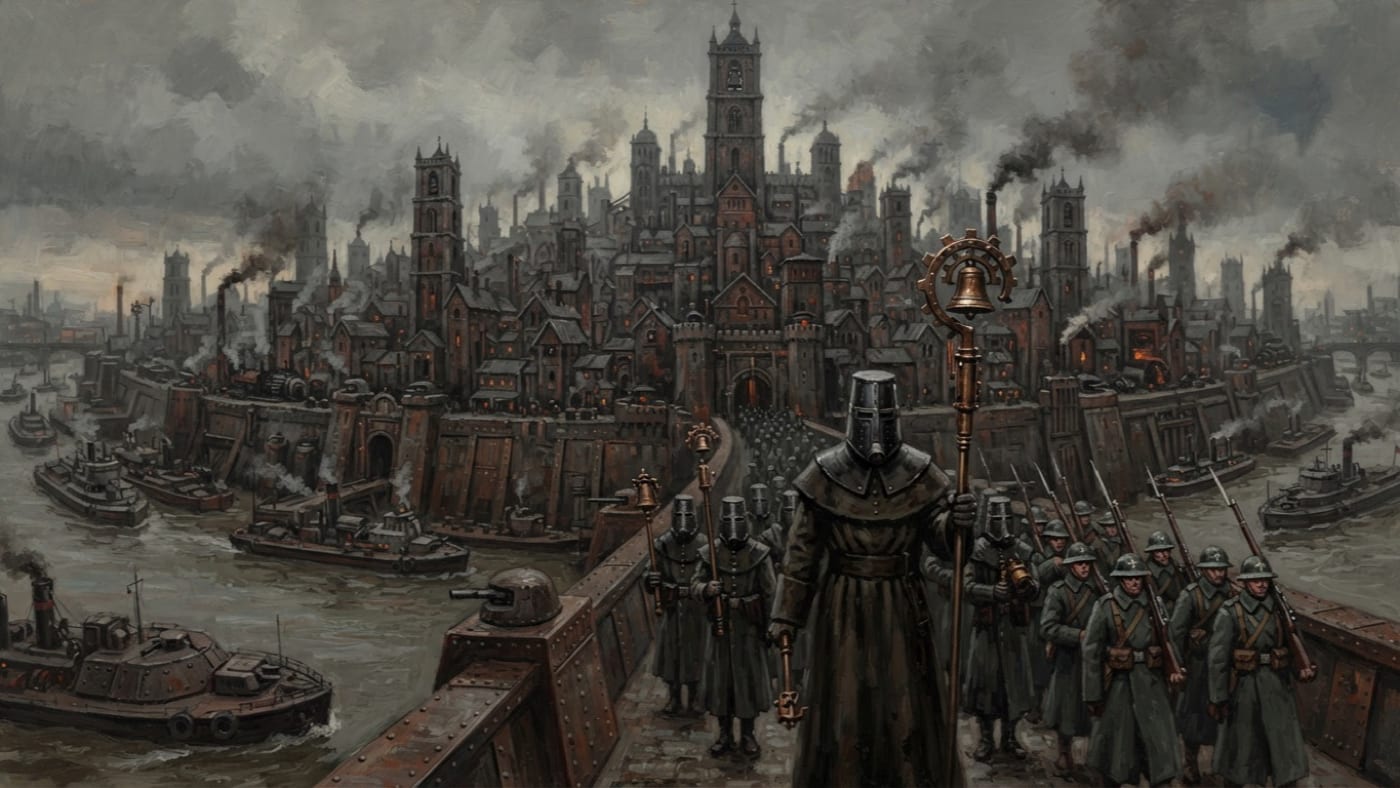
The office is the Abbot-Commander of the Thames. It governs Lunden-Kirk, the London that survived, which sits walled and washed on its river in England. My subject is the chair. The person who sits in it is named in no document the Bureau holds, and the British have never shown any wish to correct that omission.
What follows is assembled from the city file, the Crown file, the England file and the dispatches behind them. It is a continental reading of an island institution, made from outside the walls, and it gives the British no voice they did not choose to use.
#On the Chain to Canterbury
The Abbot-Commander of the Thames reports to the Warden of the Southeastern Shore. The Warden reports to the Crown.
That chain has three links, and the reader should keep them separate, because Strasbourg's clerks keep fusing them out of habit. The Abbot-Commander governs one city. The Warden of the Southeastern Shore holds regional authority above it. Neither the present Abbot-Commander nor the present Warden is named in any paper I possess. The Crown is King-Warden Aldric III, styled Rex Custos, who reigns from Canterbury. Canterbury is the seat of the Crown, and Lunden-Kirk is its river citadel. A governor of the Thames is no king, and no reader should picture a crown on that head.
The Table of Nine gathers the Wardens of Britain under Crown summons, and it explains how the island thinks about authority: charter, oath, and a single hand that holds both garrison and chapel. It is not a fourth link in this chain. The record does not say which seat at the Table, if any, belongs to the Warden of the Southeastern Shore, and I do not propose to assign one for neatness.
A further caution. In A.S. 194 I left Dover carrying a protest from the Warden-Marshal of the Kentish Shore, and the sovereign's long style includes Keeper of the Kentish Shore. Whether either title names the same office as the Warden of the Southeastern Shore is unestablished. Shores are plentiful in Britain, and so are titles.
The city file says the Abbot-Commander governs under Crown charter. The Wardens' own charters are reported to be old, older than the Sundering by British account, and the Bureau of Records has never obtained a copy. Those statements concern different instruments. Neither one tells us when the Thames office was created, which monarch granted it, or what its grant actually says.
#On the Parish Command
The city the office governs is built in cells. Every district is a parish, and every parish keeps a bell tower, a garrison house and a wall. The lanes between them are narrow by design, so that a crowd can be stopped, a cart can be watched, and an attacker who forces one gate has taken a single parish and now faces the next tower already ringing. This is the reports' description. It is not a surveyed plan. The Bureau holds no count of the parishes, no names, no boundaries, no construction dates and no garrison strengths.
The title says the rest. An abbot answers for souls and a commander answers for walls, and the British have given both answers to one office. Across the island that combination is ordinary. Abbots sit in council with governors, and the Lantern Way does not separate the chapel from the armoury. In Lunden-Kirk the combination has a precise address: a walled parish whose tower calls to prayer and keeps watch on the street, and whose garrison house empties into the lanes when that same tower rings for alarm.
What I can describe is the office's responsibility in outline: worship and defence in one city, answerable upward through the Warden. What I cannot supply is a schedule of powers. No British text tells me whether the Abbot-Commander appoints parish clergy, sets the watch rota, hears causes, or musters the garrison houses directly or through officers below. In the city entry I suggested that the office might consecrate bells and post sentries in a single morning. That was my conjecture, offered as conjecture. Nobody witnessed it, and it should not be filed as a procedure.
#On Discipline Within the Walls
The bells keep the city's hours, sound its alarms and toll for its dead. Across Britain those duties belong to the Lantern-Ringers, ordained bell-warriors who carry maces cast from bell-bronze, functional maces, because warning and enforcement are done by the same hand. How many Ringers serve in Lunden-Kirk, and what their relationship to the Abbot-Commander is, I cannot certify. The Bureau of Bells would like to know both things. Its curiosity has fared no better than mine.
Every seventh day the streets are washed with lye and with prayer. The reports agree on this so unanimously that I find it offensive. They do not name an ordinance, and they do not credit any Abbot-Commander with the custom. The washing is done in common, by parish, on a fixed day. A street washed that way has every door open and every householder accounted for, and anyone who is absent becomes known by the evening bell.
The national practice is harsher than clean streets suggest. British penances last for months. British dissenters are bricked alive into monastery walls by judicial sentence under Crown authority, and the Bureau of Purity condemns this in public and admires it in private. For Lunden-Kirk itself I hold no sentencing register, no list of names, no totals and no location. I will not invent a condemned man to give this paragraph a face. Even so, the arrangement has a face. A parish that prays together, drills together and scrubs its lane together will notice within a day when one of its members has stopped doing any of the three. In this city the neighbours keep watch alongside the tower.
#On Strasbourg's File
The Bureau of War files Lunden-Kirk under Zone 0: independent British Crown territory. The Synod has no jurisdiction there, and it keeps no tithe-office, Purity station or bell inspector on the Thames. The Crown is a co-belligerent and a non-signatory to the Concordat of Strasbourg of A.S. 90. The Abbot-Commander's authority does not wait for a Synod licence and has never asked for one. In Strasbourg that fact is treated as rudeness. On the Thames nobody has thought to notice it.
Access is poor and always has been. My own eleven days in A.S. 194 were spent at Dover and Canterbury, under hosts who chose the route. I did not see Lunden-Kirk and did not meet its Abbot-Commander. Every sentence in this survey therefore rests on paper that other men carried out of Britain, and the British decided what they were allowed to carry.
The Bureau of Doctrine's designation for the Crown, "Schismatic by Omission," remains in force, and my objection to it remains unratified. The faith of the parish towers has a separate classification, and older copies of this file have it wrong.
The religion observed under the Abbot-Commander of the Thames is classified as "Schismatic Heresy, Category Two."
Corrected. In A.S. 199, the Bureau of Doctrine revised the Lantern Way's classification to "Non-Standard Observance, Diplomatically Accommodated." The revision was a change in Synod terminology, driven by diplomatic need and by dependence on British convoy escort. It records no conversion, request or submission by the British, and none by any Abbot-Commander. The correction is entered in this A.S. 201 compilation. The revision itself dates from A.S. 199. Amend your copies.
#On the Present Office
As of this compilation, the Abbot-Commander of the Thames governs Lunden-Kirk, reports to the Warden of the Southeastern Shore, and through the Warden answers to the Crown at Canterbury. It combines ecclesiastical and military charge within one walled city. It operates wholly outside Synod jurisdiction.
The Bureau does not know the present holder's name. It does not know when or by whom the office was founded, how holders are chosen, succeed one another or are removed, or how many have held it. The title should not be read as command of the whole Thames basin or of any part of the Royal Fleet. It governs a city, and that is what the record shows it doing.
I envy its shortness. I distrust its reach. Both remarks go in the file.