
#On the Watch Above the Ledger
"She has never fired a shot at us. She has never needed to." — Alpine Watch Commander's Annual Assessment, A.S. 199
The Alpine Watch is the part of Bastion-Sibiu that still believes in the enemy's front. It is one of the garrison's four commands. The Plateau Guard keeps the rings, the Convoy Escort Corps keeps the roads, and the Bureau Detachment keeps the minutes. The Watch keeps the passes. It faces east across the Transylvanian Alps, where the Sagittal Line closes the seven-hundred-kilometre gap between Bastion-Przemyśl and Bastion-Irongate. It does this with rifles, guns, wire, snow and a professional contempt for anything that arrives on wheels.
No writ of establishment for the Watch as a named command has been filed with my office. The Bureau of Records says the command was formalised with the Sibiu pass-fort system. It declines to say when. The passes were fortified because Sibiu was designated, Sibiu was designated because the passes existed, and the Watch has stood on them ever since. The paperwork will catch up with the mountain in due course.
The Watch's quarters lie along the northern arc of the Barracks Ring. Its men spend little time there. The command's real estate is the high country: three redoubts, the goat tracks between them, the Saxon roads that forgot they were military, and a scree of listening huts whose occupants are relieved on a schedule the Bureau of War calls rotation and the men call parole.
It is not the largest command at Sibiu. That honour belongs to the Convoy Escort Corps. At any hour, more of the garrison is walking supply roads than standing on stone. The Watch regards this as an insult to soldiering. Velmora regards it as an accurate reading of the war.
#On Turnu Roșu, Bran, and Predeal
"The mountain does not care who holds it. The mountain is the hold." — Bureau of Engineering Field Manual, Section 14
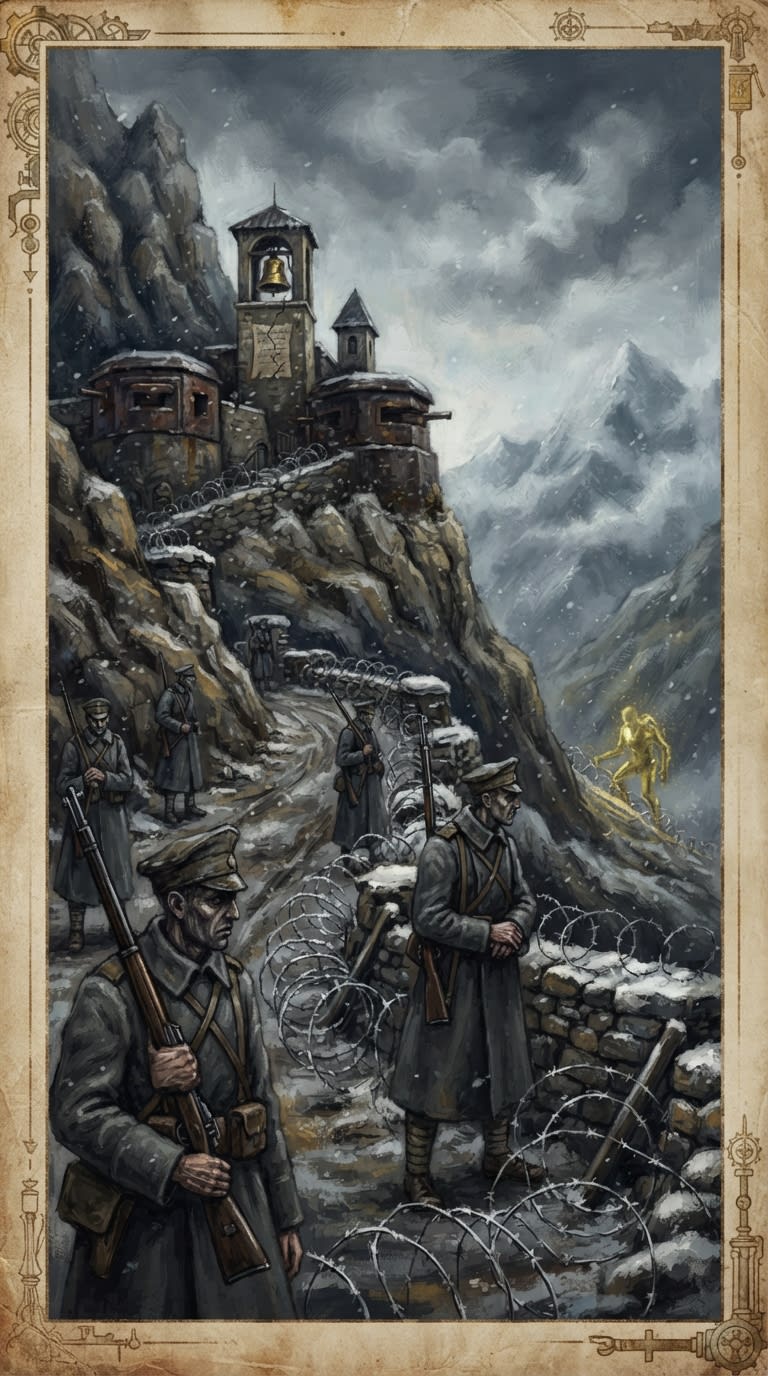
Three pass-forts answer to the Watch. Turnu Roșu guards the southern pass, Bran the corridor to the northeast, and Predeal the eastern gap. A battalion of the Alpine Watch garrisons each one. They are where Velmora's domain actually touches the Synod's. Everything east of the redoubt wire is priced. Everything west of it is merely for sale.
Each fort follows the Sibiu pattern, cut to fit the rock: gun-redoubts sited to seal the road in three salvos, wire strung across the approaches, and a catechism-tower from which the Bureau of Doctrine broadcasts hymnal suppression down the valley. Demolition charges sit packed into the road cuts and avalanche shelves, primed to bring the mountain down on whatever climbs it. Signal towers link the three forts to one another and to the plateau. A crack in one tower bell (and one has cracked) goes into the dusk log before the sergeant is permitted to swear.
The duty is fixed. Daily patrols go into the high country. Weekly reconnaissance sweeps go down the eastern slopes, into the treeline where the gold-veins begin and the Synod's jurisdiction becomes a matter of opinion. Layered Death is drilled in every fort. The first layer braces behind stone, the second packs charges, the third raises relic-ash against the wind, the fourth beats rhythm against the echo, and the fifth is already entered in the casualty book, ruled and numbered, waiting only for names.
The reporting chain begins honestly and ends in arithmetic. A pass-fort reports to the Alpine Watch commander. The commander reports to the garrison commander. The garrison commander reports, in theory, to the Bureau of War's Transylvanian Desk in Budapest. In practice he answers to the Bureau of Tithes' Sibiu Comptroller, because the Comptroller holds the pay-chests and the pay-chests hold the garrison.
#On Enemy Contact
"The walls sing when the gold moves." — Alpine Watch sentry report, classified A.S. 199
The Watch was raised to repel an assault. None has come. Velmora does not storm passes that a battery can close. She lends to the villages below them. Her Ten Thousand Keys creditors hand out warm brass keys in exchange for signatures under Contract Theurgy, and the terms are fair, which is the horror of it. Her agents buy toll clerks, quartermasters and teamsters. Her counterfeit Crowns and forged scrip go west by road. They pass beneath the Watch's guns in wagons the Watch is ordered to escort, and they are inspected somewhere else by someone else, hours later.
What the Watch has seen is a walking treasury. The Avarice Engine first appears in an Alpine Watch dusk log: a gold mass below the Bran redoubt, moving without escort, half-hidden in cloud. The signal-tower bell cracked from crown to lip. The next morning the redoubt's emergency strongbox held one slip of soft silver stamped RECEIVED. In A.S. 194 the Engine stood on the Predeal ridge for eleven minutes and did not advance. In A.S. 196 it recited garrison payroll in order of arrears, and the western pay-chest emptied inside locked iron.
Earlier Sibiu circulars dated the first Avarice Engine sighting to A.S. 191, citing the Bran dusk log.
The dusk log reconciles to A.S. 190. Two copies carry A.S. 191. One carries an allegorical gloss by a clerk who has since been corrected. The Bureau of Records certifies A.S. 190 and reminds all personnel that copying a sighting does not make it happen twice.
Every sighting ended in withdrawal, and none was a retreat. The Engine left once its business was done. The Watch has changed its dress to match. Detachments on Engine watch carry no loose coin, medals, family rings or private reliquary fittings. Brass is stripped from their rifles wherever function permits, and their buckles are black iron. Their pay is held in remote custody at the plateau. The Doctrine of Sufficiency is posted in every fort: Desire nothing beyond thy ration. The Crown provides. The Crown suffices. The men recite it on the wire at minus twenty. Their ration is late.
#On Weather, Pay, and Suspicion
The Watch keeps two sets of seasonal tables. One is sent to Strasbourg. The other is believed by men wearing boots. The first records snowfall, closure and thaw. The second also records which week the convoy will be late, which fog will hide a patrol and which will hide a merchant, and which thaw will show the mule bones that last winter misplaced.
Most of the Watch's hunger is made on the plateau. Every convoy that reaches Sibiu is held at the Weighhouse for four to eleven hours under Serial Reconciliation Protocol while the Tithes, Doctrine and Purity examiners compare, scratch, burn and argue. Supplies for the pass-forts wait behind that queue. The Bureau of Tithes now counts eleven corrupted convoys a season, up from three in the A.S. 190 figures. It estimates that twenty-two per cent of the Crown scrip in circulation is false. Only forty-three per cent of transactions are verified at all. The Assay Chamber clears ninety-six items in every hundred, which still lets four hundred compromised items into the economy every week. A soldier on a ridge is paid in that economy.
The Watch's grievance is exact. It holds the passes by every standard a war college can examine, and it is still hungry, still in debt, and suspected by clerks who have never seen snow fall upward. The Bureau Detachment audits its ration books, inspects its keys and questions its chaplain-attendance. The Watch's unofficial assessment of the Detachment's combat contribution is "calligraphic." The word has been reported upward four times. It has been denied on each occasion and repeated in the mess on each occasion.
The debt goes up the ranks. The Sibiu Anomaly file for A.S. 199 includes a brass key, numbered 31-S, recovered from the account of a Watch captain. The captain had no recorded Concord exposure and had attended eight sermons at a relief-kitchen chapel on the south market road. His last words before he was transferred to Silence are on file: "If peace is sin, who priced it?" The pass-forts had done nothing wrong. His loan had been generous. That loan came from a Keys creditor, and the Concord's sermon slips made taking it seem sensible.
#On the Gold Beneath Them
The Watch has its own view of the weeping gold. Since A.S. 178 the Citadel Ring walls have sweated a warm film of pure gold, which the Assay Chamber tests and clears. That same year the Bureau of Engineering confirmed that the Southern Carpathian veins run beneath the Line and beneath Sibiu itself, and the survey was sealed. A classified Watch sentry report of A.S. 199 records that the men collect the gold and trust it less for being clean.
The men in the pass-forts face east all day. Their families in the Barracks Ring face nothing in particular. Their theory reached the plateau before any Bureau could stop it. Velmora's workings reach west from the Gilded Chasm and its shifting highland seams, under the passes and under the walls. The walls weep because they have already been bought. The Watch guards the door of a house whose cellar was sold years ago.
The Bureau of Doctrine's standing position is that this theory does not exist. The phrase Velmora is beneath us may not pass from barracks talk into an official report. A fear that appears in a report becomes eligible for a budget.
#On Present Duty
As of A.S. 201 the passes hold. Turnu Roșu, Bran and Predeal stand garrisoned, gunned, wired and drilled. The daily patrols go out and the weekly sweeps come back, mostly complete. There has been no assault. None is expected. The Watch stands in the snow and does everything a mountain command can do. The war goes on in the kitchens and ledgers behind it, in currency the Watch is paid in and cannot inspect.