
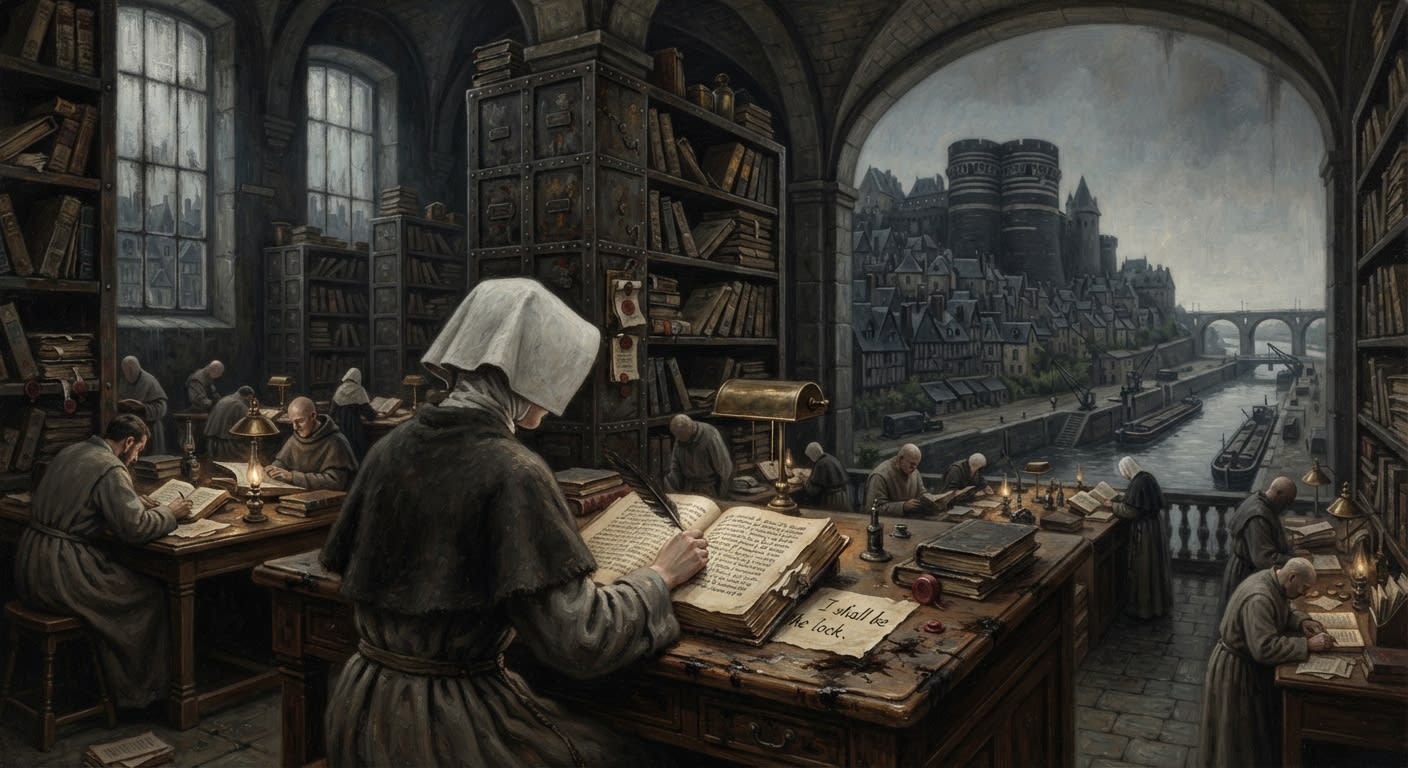
#On the City in the Margin
Some cities earn their place in the Ledger by surviving a siege. Others earn it by losing one gloriously, or by producing a bishop, a plague, a relic, or a sufficiently expensive fire. Angers is a slate-roofed city on the Maine, a short march above where that river meets the Loire. It has entered the Codex on the strength of one line of handwriting in the margin of a psalter.
Handwriting. The Ledger has admitted provinces on less, though rarely with such municipal enthusiasm afterward.
The dedicated file on Angers is thin. It holds a river, a castle of banded dark stone that has stood longer than anyone has thought to be offended by it, a quarry trade in roofing slate, a cluster of convent houses outside the walls, and one sentence. Thin files are dangerous. A fat file contradicts itself and teaches its readers humility. A thin file lets every parish fill the empty leaves with whatever it would most like to have been.
#On the Novice Outside the Walls
The chronology is short and will be kept short. In A.S. 10 the Massacre at Saint-Malo put forty-three pilgrims under Republican bayonets on the Breton coast. Thirty-one were certified dead. Among them was an elderly nun of the Blessed Thorn who knelt on the cobbles holding a common psalter. By A.S. 14 an ecclesiastical tribunal had recognised her as Saint Margaux. The Bureaus that now own her ratified that judgement later, once there were Bureaus to do it. By A.S. 15 her woodcut face was travelling the western roads faster than grain.
It came out of Brittany along the pilgrim roads and the river traffic. It was pinned to tavern posts, folded into saddlebags and pasted beside the tollhouse notices of the Rationalist prefects. It reached the convent outskirts of Angers the way every broadsheet reaches every convent: late, damp, and already argued over.
A novice saw it. She took up a psalter and wrote in its margin, I shall be the lock.
That is the whole of the attested record. The novice is unnamed, and so is her house. No document the Bureau of Doctrine will consent to hold records her age, her family, her vows, her fate, or whether she ever stood upon a bridge. The archive describes the hand as "youthful, careful, and pressed hard enough to mark the facing leaf."
The phrase is five words long. It is no vow. Later chapel versions append "against the Great Deceiver's passage, unto fire." That is third-generation embroidery, stitched by women who never saw the page.
Margaux died holding a psalter, and the novice answered her in one. The devout never point this out; the engravers took it up within a decade. I record it without affection. Coincidence is the favourite food of cults.
#On Bridges, Locks, and Local Pride
In the war years Angers was a crossing-town. Barges came down the Maine past the walls. South of the city, the long run of arches at Les Ponts-de-Cé carried the road over the Loire, the kind of crossing that makes a staff officer's pen move quickly. In the west during the Atheist Wars, the roads carried pilgrims, guns, relic carts, mercenaries and bridge-repair crews. They also carried provincial loyalties that had not yet been told they belonged to a single cause. A Rationalist column moving into Anjou needed the bridges. The faithful needed it not to have them.
Lock is a river word. On a navigable river a lock holds water back, admits a boat on the keeper's terms, and refuses it on the keeper's whim. A novice who lived within sight of barge traffic did not need a theologian to tell her what a lock does. She needed one to tell her she should not become one, and none appears in the file.
Whether she did become one is where Angers and the Ledger part company.
The Sisters of the Martyrdom are attested from A.S. 15 through A.S. 25, and their fiercest years ran from 15 to 18. Their theatre covered the Rhine, the Rhône, the Meuse, the central corridors and the Loire. Their first confirmed action came at the Pont des Tanneurs in the Montreval approaches in A.S. 15. Three women in grey stood at midspan before Lucien Artois's column. Meanwhile Severin of Avignon was either blessing them from a tower or vomiting in a tannery cellar. Montreval has the three women, the six lost hours and a recovered Rationalist note. Angers has a margin.
The city has never accepted the difference. Within living memory of the war, Angevin families told their grandchildren that the novice had been the first. They said the Sisters were an Angers order the rest of France had borrowed, and that a Loire span had burned under a girl in grey before Montreval ever heard of oil. Which span it was changes with the teller. The girl never acquires a name. On that one detail the storytellers have kept faith with the evidence.
A parish almanac printed in Angers, and reprinted without licence in three neighbouring dioceses, states that "the holy Sisters of the Martyrdom were founded at Angers by the novice of the psalter, whose vow was the Order's first Rule."
Withdrawn. No founding charter of the Sisters survives from Angers or from anywhere else. The psalter note is a sentence, and a sentence cannot found anything larger than a grammar. The Picardy powder record and the ferry-chain record near Lyon are filed separately and carry equal weight. The almanac's printer was fined in candles.
#On the Bureau's Classification
Doctrine classifies the Angers material as useful and unratified. It is useful because a young woman answering a martyr's image with a promise is exactly the story Doctrine wishes to tell schoolrooms about zeal. It is unratified because the promise is all there is. A promise without a bridge is a devotion. A bridge without a name is a rumour. Angers has offered Doctrine each in turn and never both at once.
Doctrine has also refused to join the Angers note to the Picardy and Lyon records as a single origin story. Joined, the three would make a genealogy. A genealogy invites the question of who stood at its head. Later sealed dossiers of the Bureau of Shadows try to attach other hands to the Sisters' organisation. None of those hands reaches Angers in A.S. 15 by any evidence I have been shown. Five words name no sponsor, no purse and no handler.
What Doctrine permits is the usual compromise. Angevin chapels may keep bridge-charms. On the Saint-Malo memorial, the faithful may tie black ribbons to the parapets at Ponts-de-Cé, provided no plaque names a Sister-action there. They may light candles shaped like a small arched span for "the novice of the lock." The Bureau of Tithes collects its levy on each one. At that point, and only at that point, the Synod treats the girl as a fully documented person.
#On the Psalter
Nobody can tell me where it is.
The Bureau of Relics does not hold it. Relic 23-M, Margaux's own psalter, sits in Strasbourg with its lacquered bloodstains and its working clasp, and the clerks there grow irritable when asked to confuse the two books. One Angevin convent claims to have surrendered the novice's book to a diocesan visitor. The visitor's name is illegible, and the diocese has no receipt. A second house claims the book never left its library and declines inspection on grounds of damp. I have no reason to believe either house and no authority to search both.
A copyist's facsimile of the page hangs in a side chapel of the city, the five words traced in brown ink. On the fourteenth of Corvus the faithful kiss the glass over it so often that the glass must be replaced each spring. The facsimile is a copy of a margin. The Church has canonised on less. It has also burned people on less, and the sacristan has read both kinds of file. He keeps the frame dusted and his opinions to himself.
#On the Present Condition
In A.S. 201 Angers lies in Zone One, the Western Heartlands, well behind the Line. It conducts itself as heartland cities do: loyal on feast days, watched on market days, profitable on all of them. Its slate goes out on barges to roof other people's churches. Its pilgrim trade is modest and stubborn. Its schoolmasters teach the Sisters from the approved catechism, where the hymn's third verse praises obedience. Its grandmothers teach them in kitchens, where the verse still praises the flame. The Bureau of War's recruiters pin Margaux's broadsheet to the same tavern posts that carried it in A.S. 15. They have not yet learned to leave the psalter out of the sermon.
The city still wants the founding. It will not get it. It has a phrase that is beyond dispute its own, a girl who belongs to no one, and a Bureau that will lease it both for the price of wax.