
#On the Vessel
"Residue of the Sundering, collected at the moment of rupture. Sealed. Authenticated. Not to be opened for any purpose, including authentication." — shelf card, Vault of Sacred Custody, lower level
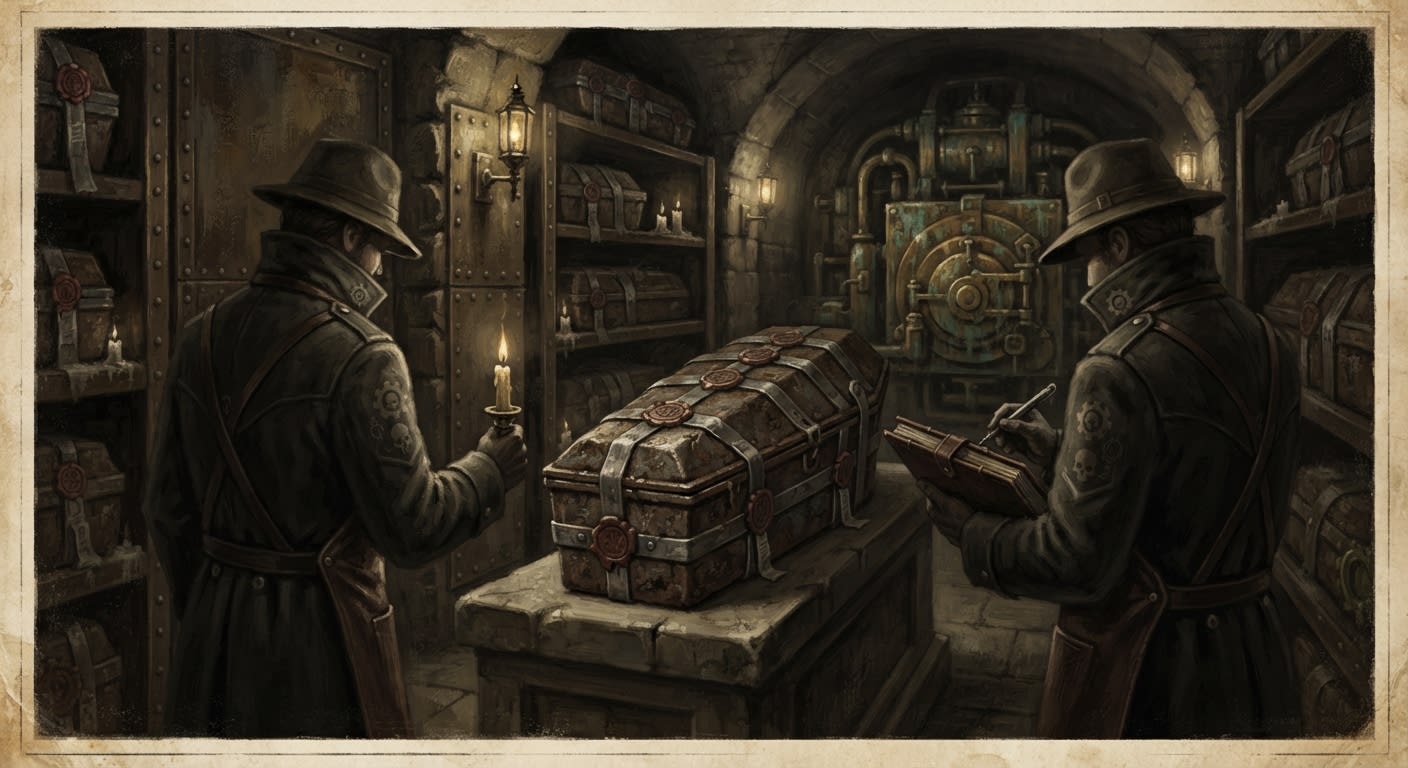
The Ashes of the Sundering sit in an iron vessel about the size of a child's coffin laid on its end. Some registers call it a casket and others an urn, and the object has never shown a preference. It is banded in lead and sealed in three waxes, one for each of the offices that hold a key, and it stands in a niche beneath Strasbourg Cathedral where the camphor is thickest and the candles are changed by a custodian who is forbidden to look at it directly. He looks at it directly. Everyone does. The prohibition exists so that looking can be confessed.
The Bureau of Relics holds that the vessel contains residue from the very moment the Sundering tore the world open. I copy the claim as the Bureau states it. The Bureau does not say the ash commemorates the moment, or that it was gathered during it, or that it came afterward and was honoured by proximity. It says the ash is the moment, reduced to something that can be weighed. The greatest wound in the Church's history has been swept up, put in a box and given a number.
I have always admired the ambition of it. Every other relic in the Vault is a saint, or a scrap of a saint, or a chalice a saint once drank from. This one belongs to no saint. It belongs to a day. The Bureau, having authenticated the bones of the holy dead, decided at some point that an event also has bones and that the Bureau would keep them.
#On the Floor of Saint Stephen's
The ash was collected in Vienna, which is the first difficulty, from the floor of the former Cathedral of Saint Stephen, which is the second.
In A.S. 45 Saint Stephen's had not been a working cathedral for fifteen years. The Treaty of Regensburg dissolved the Holy See in A.S. 30, and the building passed to the Academy of Vienna, which put demonstration tables where the benches had stood and hung a brass orrery where the high cross had been. The Academy's men lectured on the altar step. Their students looked up and saw gears. Below them the crypt went on behaving like a crypt full of relics, which the Rationalists recorded as a problem of storage.
Vienna was not where the world tore. The rupture opened in the east, among the mountains of Thrace and the fogged plains beyond them, hundreds of miles from any lecture hall. Vienna stood in the path of what came west afterward: the panic, the carts, the broken Republican officers, the hidden priests coming up out of cellars with bones wrapped in shirts. Saint Stephen's crypt then burned white-gold for six months and twelve days while the Great Retreat went past it, and when the light stopped, the garrison carried off the bones that could be carried and burned what could not be surrendered.
At some point in all this a priest knelt on that floor and swept ash into a vessel.
Nobody knows which ash he took. The possibilities are the cold ash of Rationalist bonfires, the soot of a garrison burning its own stores, the fall that eyewitnesses say came down over the eastern provinces, whatever the crypt left when its light burned out, and ordinary dust from a building that had lately housed natural philosophers. Doctrine permits one answer. The floor permitted all of them.
#On the Chain of Custody
Nobody recorded his name. The priest carried the vessel west, or passed it west, or hid it and was found. His name went into the Atheist Wars and did not come back. The public account adds that his own ashes are now presumed to be mixed with the ashes he gathered. The Bureau of Records calls this recursion distressing, and in the Records vocabulary that is a scream.
The recursion rests on no evidence. It persists because it is too elegant to abandon: the witness dissolved into the evidence, the collector filed with the collection. Pilgrims repeat it. Examiners deny it in a tone that suggests they would like it to be true.
Older Lore Book sequences date the Sundering's opening to A.S. 51 and place the relic's collection in a Siege of Vienna during the late Atheist Wars.
Corrected. The Sundering is 1 November A.S. 45 (1755 CE), and the ash belongs to that season. Vienna was reclaimed in A.S. 95, when Clemens Stahlhand brought the Saint Aldebrand reliquary down on Althazar of Pest. The vessel is older than the reclamation, older than the Concordat of Strasbourg, and a good deal older than the Bureau that holds it.
From here the provenance runs from impossible to official. No transfer between the Vienna floor and the Strasbourg Vault was witnessed, notarized or sealed at the time. There were no Bureaus to do it. The formal Bureau of Relics took its charter in A.S. 92, and the vessel came into its custody some time after that. Relics has never published the year, and I will not supply one on its behalf.
A parish near Ulm once lost a tibia because one signature was missing from a transfer in the reign of a forgotten bishop. The same Bureau guards a sample of the world's end whose first witness is unnamed, whose route is unrecorded, and whose contents may include the witness. It has authenticated both decisions. The tibia went to the lime pits. The ash went into the Vault.
#On Examination Without Opening
The Ashes are examined every year and have never been opened. Both statements are correct.
The procedure is conducted by an Examiner of the Third Degree, attended by a Records witness and a Rites deacon, and follows the Liber Examinationis in every particular except the one that matters. The Examiner weighs the vessel on brass scales calibrated that month by the Bureau of Engineering. He records the weight, then records that the weight differs from the previous year's, then records that the difference is within tolerance. The tolerance was set after the difference was observed. Then comes the Candle Proof: a taper is held at the lead band. By the Bureau's own reports the flame has leaned toward the vessel, leaned away from it, and in one year stood perfectly upright and refused to move at all. Relics recorded all three results as passes. The reagent ampules stay sealed, because reagents require a sample and a sample requires an opening.
Engineering has asked for a sample through ordinary channels eleven times. Each request was denied on the ground that the vessel's contents are "not material for the purposes of materials analysis." Engineering finds this answer uniquely offensive. The Bureau of Rites supports the denial for its own reason, which is that it classifies the unopened vessel as a liturgical hazard and has no rite ready for the opened one. When a Rites deacon was asked what the opened vessel would be, he said, "An event." He asked that his answer be struck. It was not.
#On the Uses of Residue
Each office has found its own use for the vessel.
The Bureau of Doctrine treats the Ashes as proof. Preachers along the Central Corridor describe the vessel in sermons as the place where Reason ended up, the confident philosophy of the Academy of Vienna reduced to a grey film at the bottom of an iron jar. It is a good sermon, and I have given it myself. Doctrine's commentaries also attach meanings to the Sundering, and those are Doctrine's to attach. The ash does not settle what caused the day, and no honest Examiner claims it does.
Relics treats the vessel as custody, which to Relics is the same thing as ownership. The Bureau of Records treats it as a file it can neither close nor keep: an event with no author, one lost witness and a date nobody disputes. The Bureau of Bells, which has never agreed with Records about what the bells did on the morning of 1 November, declines to ring within the vessel's corridor. Bells gives no reason, and Bells is right.
#On the Seal
The difficulty is the Bureau's own axiom. A relic authenticated is a relic made holy. On that principle the stamp comes first and the sanctity follows. If the Ashes are what Relics says they are, they were holy, or terrible, or both, on the floor of Saint Stephen's in A.S. 45, forty-seven years before the Bureau had a charter to stamp anything. The ash does not need the writ. It was there before any clerk arrived. That is the only reason anyone fears it, and it is also the one fact the Bureau cannot admit.
The Bureau's answer was to seal the vessel more heavily. It added a third wax, a second lead band, an annual weighing, a candle that is allowed to do whatever it likes, and a prohibition on opening that has itself become part of the relic. What the Bureau now guards is the seal. The ash inside is residue, which is exactly what it claims to be, and the whole apparatus of Strasbourg's custody exists so that no one has to find out residue of what.