

#On the Present Compilation
This file is a documentary compilation, made in A.S. 201 / 1911 CE at a desk from papers already in custody. Nobody walked the road for it. I say so at once because corridor files attract readers who want a dotted line on a map and a commander's portrait at each end. They will get neither here.
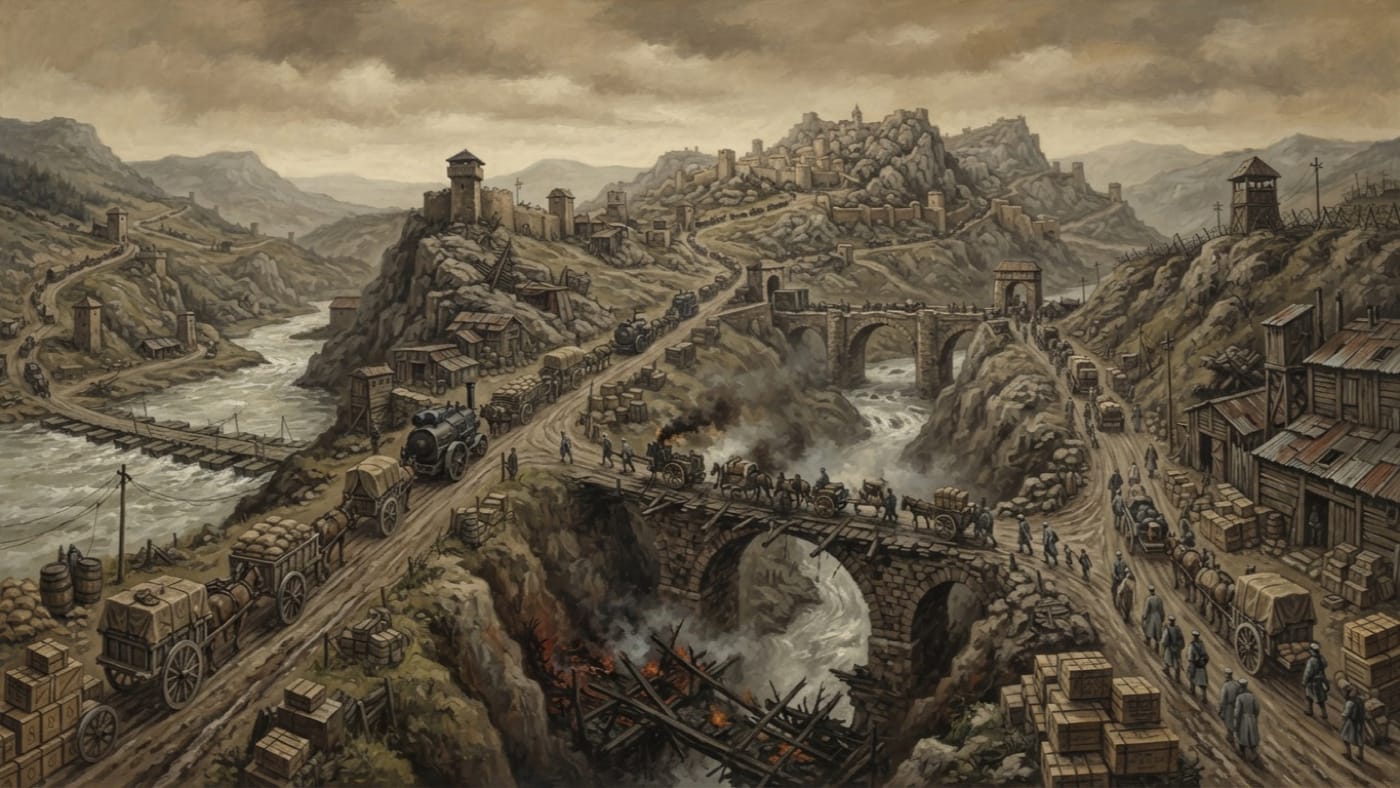
The phrase "the Avignon corridors" is plural in most wartime hands and singular in the later filing index. It names the passages by which the old Church fed, emptied and defended Montreval during the Atheist Wars. The references describe a practice. Grain went up. Clergy, relics, archives and evacuees came down. Crossings were kept open or destroyed as the week required. Nothing in them describes a chartered authority, a continuous surveyed road, a jurisdiction of its own or an appointed officer of the corridor. Several devotional guidebooks supply that officer. He does not exist. Regrettably, the guidebooks do.
#On the Country and Its Claims
The Bureau of Cartography lists Montreval as a historical fortified site of the southern faithful front, probably in south-eastern France. Probably is Cartography's word, and it stays. Older registers file the town under an "Avignon–Lyon pass corridor." That label is more confident than any map behind it, so this compilation ranks it below Cartography's hedge.
What the record gives is direction. Avignon lay behind, as the ecclesiastical rear. Ahead, the contested roads bent north toward Lyon, Vienne and the Rhine. Those are destinations named by men who were worried about them. They are not stages on an itinerary. No surviving account fixes the corridor's length, its halts, its days of travel, or the point at which a mule driver could say he had left it. The corridor should not be read as the Rhône either. A river is an obvious line to draw, and drawing it would be my invention. The Ledger did not draw it.
The ground was argued over before the first Rationalist gun arrived. Montreval's pre-war jurisdiction was muddied by episcopal claims, noble toll rights and monastic pasture privileges. The record names none of the bishops, keeps no toll schedule, draws no pasture boundary and reports no settlement. It does show why this file keeps three questions apart. Who held a cart while it moved was a matter of custody. Who might let it through was a matter of passage. Who owned the road, the bridge or the grass beside it was a matter of ownership, and on that question every party with a fence believed itself sovereign.
#On What Passed Through
Avignon was the rear organ of the southern front, a hinge for passage and a harbour for archives. Its use to Cardinal-Marshal Severin was plain and unglamorous. It sent grain, oil, chapel cloth, field priests and replacement horses, and it arbitrated the quarrels that clergy carry with them the way other men carry lice.
To the extent the traffic had another end, it was the old episcopal receiver's house above Montreval's second terrace. Severin made it his field seat. It had thick walls, bad windows and cellars deep enough to please a quartermaster. From it he managed grain, oil, horses, relic custody, priests, ammunition, surgeon rotations, refugee packets, bell schedules and demolition supplies. A building raised to collect episcopal revenue became the counting-house of a front. The bishop's collectors would have recognised the work, though not the arithmetic.
The corridors kept the garrison alive and carried clergy, relics, archives and evacuees out of range. Severin's dossier says his orders held them open long enough for archives to escape. Avignon's record agrees, and has the plaques to prove it. Nobody kept a complete manifest. There is no numbered convoy list, no figure for what passed, and no clerk of the road whose ledger I could take down and quote.
What survives instead is the record of shortage. Severin's letters ask Avignon for flour, salt, linen, lamp oil, mule shoes, axles, shovel heads, and priests who could hear confession without fainting. He complains about abbots hoarding sacramental wine. He threatens a merchant guild with anathema over underweight candles. Every item had a claimant before it moved and another on arrival. The old Church was still generations away from any formal Synod, and no single office could tell the claimants apart. Bishops, abbots, parish companies and quartermasters kept their own books, and the books disagreed. The carts kept moving anyway.
#On Passage Denied
A corridor also consists of the roads denied to the enemy, and the Rationalists needed roads more than the faithful did. Lucien Artois mounted his clockwork guns on spring carriages that wanted firm ground, sound bridges and a dry week. For the Pont des Tanneurs in A.S. 15 / 1725 CE, the town account explains the problem in a sentence: the higher road went slick in rain, and the lower ford swallowed wheel hubs. That left a timber span over the tannery ravine and an artillery column that needed it.
Three women in grey habits died on that bridge, and the bridge burned. The Sisters of the Martyrdom count it as their earliest confirmed action. The women's names are disputed. Whether each of them chose the bridge has not been established, and this file will not decide it for them.
The Rationalist column lost six hours and two spring guns. Nobody recorded how the guns were lost.
What the six hours bought survives in two accounts, and I keep them in separate columns. Severin's field account counts the relic transit as two carts, one chest and one object sealed. The object has never been identified. Montreval's town account adds grain wagons brought in through the west mule gate and the relief of a parish company before it broke apart. Merged, the two would make a handsome convoy record. Nobody wrote that record, and I will not forge it for the sake of tidiness.
On the question of command, the papers contradict each other. Six letters preserve Severin's denial that he sent the women to the bridge. Supply manifests record oil, cord, white linen and a chapel custody transfer. Severin's own dossier states flatly that he ordered the Sisters to the bridgeheads. No original order for Tanneurs has been authenticated. The manifests prove that materials left someone's custody under his authority. They prove nothing about what was said on the bridge. This compilation leaves the contradiction where it found it.
#On Aachen and the Broken Approaches
Ten years later the corridor learned a harder discipline. News of the Betrayal of Aachen reached Montreval at vespers in A.S. 25 / 1735 CE. Severin finished the psalm and called for ink. He ordered the western courier routes doubled and told the garrison to destroy two western bridges it had been defending. The northern faithful front had been cut, and approaches that once carried relief now offered the enemy a road.
These were different bridges from Tanneurs, on the western side of the town, burned a decade later under an order Severin never bothered to deny. Records keeps that order in three versions. One reads "burn the bridges." One reads "cut the roads." The third is water-damaged after "bless the—". All three are filed.
The order shows the corridor's real shape. It was a set of selected passages, defended until they began to serve the other side and destroyed when they did. Couriers were doubled to the west and crossings were removed to the west, so that Avignon's rear stayed usable a little longer at the cost of Montreval's own approaches.
Local Montreval tradition holds that the western bridges burned blue in A.S. 25, proving divine approval of Severin's order.
Unratified. The colour of a flame is not a seal of the Creator. No preserved paper explains the colour, and this compilation supplies no chemistry to replace the miracle. Divine approval of the order remains doctrinally available and evidentially unnecessary.
Holding on did not win the war. The Rationalists won it at the Treaty of Regensburg in A.S. 30 / 1740 CE, and the passages the southern front preserved did not change that result. They changed what was still standing when it came: which archives, which priests and which relics survived for later Bureaus to argue over.
#On the Name Retained
After Regensburg, Montreval came under Rationalist occupation and served its new masters as a garrison school and calibration hall. The Sundering of A.S. 45 / 1755 CE broke that arrangement along with a good deal else. According to the town account, the old fortifications were back in ecclesiastical hands by A.S. 48 / 1758 CE. Montreval never became a primary bastion of the Sagittal Line, and the corridors were not an early draft of it.
The Avignon of the war years must also be kept separate from the present ruin. Severin's rear was a living city. The Schism and Razing of A.S. 111 / 1821 CE turned it into what the index calls a former terrain feature. The docket correction of A.S. 145 / 1855 CE burned its remaining rolls into agreement. A corridor named for a city outlived the city. Paper permits such things.
As of A.S. 201, Montreval is described as a fortified memorial town under Avignon corridor supervision. The receiver's house holds a small Severin archive, which includes three disputed bridge directives. The Tanneurs abutments are fenced and restricted. "Supervision" is a present classification. It does not prove that any institution has run unbroken from Severin's day to this one. It places no command among the ruins of Avignon, and it fixes no corridor boundary anyone has surveyed.