
#On the Name Before the Boy
The banner of Saint Hermas is older than the boy whose name now hangs from it, and the Bureau of Records has never forgiven either of them. The cloth first belonged to a Breton road-saint, a weather-patron invoked against wet shoes, swollen fords and bad bridges. What survives of his life would not fill a hymn. Pilgrims out of Dinan carried his banner toward the coast long before Strasbourg had a desk from which to object.
Hermas of Dinan was a different person. He was seventeen years old and the second son of a rope-maker, born about 1703 CE (A.S. −7, counted backwards by a calendar nobody had yet adopted). He did not appear on the banner, did not inspire it, and was not commemorated by it while he lived. His only office was to carry it. Then the cloth tore at the Porte Saint-Vincent during the Massacre at Saint-Malo, and the two names ran together like wet ink on a baptismal page.
Popular devotion fused the saints within a decade. An ecclesiastical tribunal sitting on the Saint-Malo sequence in A.S. 14 declined to separate them and declared "Hermas" a convergent devotional office. Formal cult followed in the years after, and Bureau clerks ratified the whole arrangement much later, in vocabulary the tribunal would not have recognised. This file concerns the object. The boy has his own file under Saint Hermas. The older saint has a beam, a road and the weather.
#On the Cloth and Its Bearers
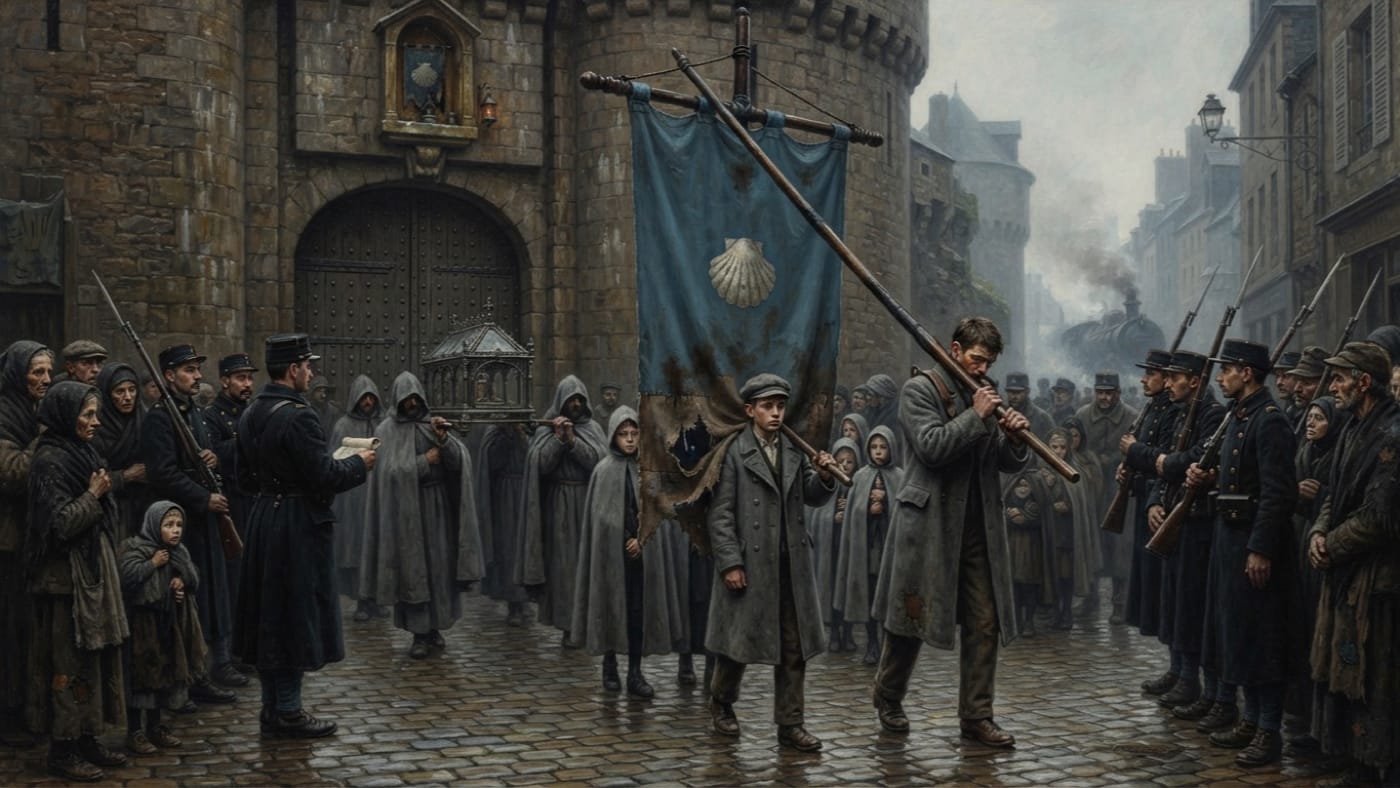
The original banner was plain: a blue field, a white road-shell, and a brown wooden staff darkened by hand grease and sea damp until it looked cured more than carved. No portrait of the saint is recorded on it, and no inscription or gold. Readers who own prints showing lavish embroidery should take the matter up with the engravers, who were paid by the stitch.
Between feast days it hung from a beam in Dinan's banner-house near the road gate. The room was limewashed and salt-stained, though the sea was miles off. The lower hem had been repaired so many times that successive menders argued over how much of the original cloth was left. Rope-makers touched the pole before long walks. Boys were brought to look at it. Mothers disliked the dust and let it lie.
The banner travelled on two straps, one for each bearer, because in coastal wind a pole of that length goes where it pleases unless two backs refuse it. The Departure Register, which survives in a later copy, notes "Hermas boys measured for strap" on the night before the A.S. 10 procession. The line is so flat that I have never managed to read it twice in one sitting. Hermas took the left strap. His elder brother, whose given name this file does not carry, took the right.
The order of march was fixed. The Reliquary of Saint Matthias went first, the banner second, and the candle-children behind. Forty-three pilgrims in grey cloaks sang the Antiphon of Safe Passage on the way through Saint-Malo toward Saint Clement's Chapel of the Tide. They never reached it.
#On the Tear at Saint-Vincent
At the gate a Republican Guard sergeant read a local magistrate's writ under the Secular Gatherings Act and demanded the reliquary for civic cataloguing. Father Gaël answered with four words: "It is not yours." The pilgrims knelt.
The brothers stayed on their feet. This was engineering before it was defiance. Had they knelt, the pole would have come down across the reliquary case. Rationalist pamphlets later described two youths "standing in provocation." They stood so that a stick would not strike a box.
When the Guard line advanced, the elder brother died first. Hermas took the whole weight of pole and cloth into his own hands. The deposition filed as Witness Seven records that the banner swung sideways, struck a Guard's bayonet, tore along the much-mended lower hem and wrapped around Hermas's left arm. Witness Nine says he shouted. Witness Eleven says he did not. Records keeps both statements and charges scholars by the hour to argue over them. It is the only honest thing anyone has done with the discrepancy.
He was struck twice, below the ribs and through the throat. When he fell, the banner fell over him. The cult holds that he kept hold of it until he died. The cult makes no claim that the cloth stayed in the air afterward. Anyone who says it did is selling a print.
Early broadsheets show Hermas raising the banner high above a heap of Republican dead.
Retracted. The public roll certifies no Republican dead. The engraver added them for the composition. The procession was unarmed. Its count stands at forty-three: thirty-one certified dead, seven wounded witnesses and five consumed absences.
#On Fragments and Custody
The original banner does not survive whole. What remains is a scattered assortment that the Bureau of Relics would prefer to call a collection. I call it a quarrel with drawers.
The first item is the principal strip, a length of the torn lower hem, browned and lacquered and recognised as the martyr's chief relic. This file does not state where it is kept.
The second is the lesser fragments: threads and scraps that went into private devotion, parish inventories, and custody disputes that come back roughly once a generation. They are not the principal strip, whatever the label under the glass says.
The third is the pole. It was eventually cut into thirteen reliquary slivers and distributed to donor parishes. The year of the cutting and the full list of recipients do not appear here. I can say only that parishes whose donations arrived before the deadline were thanked more warmly than those whose donations came after.
The fourth is the copies. The Hermas niche at the Porte Saint-Vincent holds a lacquered copy of the banner strip. It is a copy. At the end of the annual silence, the gate warden strikes the inner post with a staff of ashwood capped in dull iron, which is said to contain a sliver of the old pole. That remains a claim, and the Bureau has not ratified it. Vendors outside the cordon sell small cloth scraps for Hermas, at prices that prove none of them is original.
SEALED WITNESS ANNEX, PREVIOUSLY DISCLOSED IN PART When the banner was lifted, the right hand remained closed around a strip torn from the hem. A.S. 18, inspection at Rennes: strip found sewn into the coat lining of a Guard officer. Officer denied knowledge. Strip bled through the lining for three days. Officer: ████████ Classification: Textile Phenomena, Minor, Pending.
#On the Sanctioned Successor
The banner carried each year is a successor. Dinan says so, the Annual Remembrance says so, and the Bureau of Pilgrimage says so on the rare occasions someone corners it.
A Dinan guide of A.S. 76 states that the original Hermas banner remains whole and is processed annually.
False. The original lower hem tore at Saint-Malo in A.S. 10, and its fragments passed into relic custody, private devotion and contested inventories. The annual banner is a sanctioned successor. It carries authority, not intactness.
The successor keeps the blue field and the white shell. This file does not record when it was made or how many times it has been replaced, and nobody with enough rank to force an answer has asked. It hangs from an ashwood staff with a silver cap. Dinan calls the staff new in the tone it keeps for a son-in-law of uncertain income. The Bureau of Pilgrimage calls it appropriate. Both are correct.
The old banner-house now serves as a licensed preface-shrine. On the fourteenth of Corvus the banner comes down from its housing and leaves by the road gate. It travels with the road copy of the Matthias reliquary, the grey cloaks, and the Thirty-One Names, which are read aloud under permit. The primary reliquary stays in Strasbourg. Saint-Malo keeps its gate copy. The original banner, being in pieces, stays in many places and in none of them entire.
Two boys from Dinan carry it. They are chosen for height, for family poverty, and for an expression that Pilgrimage records as solemn and the local women describe as underfed. Their instructions once told them to stand fearless. Now they are told to stand still. Fearlessness cannot be audited. Stillness can be inspected from the far side of the square.
#On Keeping the Cloth Upright
The memorial falls on the fourteenth of Corvus. That date is a liturgical assignment. It does not record the day the banner tore, and calendar printers who say otherwise have mistaken the Church's convenience for evidence. Strasbourg keeps its own observance at the primary reliquary. Brittany keeps the road.
In Dinan the day is local grief with a licence attached. The brothers' mother corrected the family name in three copies of the Martyrology of Saint-Malo, each correction in ink of great violence, and Records keeps all three as devotional marks. Children learn the route by walking it. Rope-makers still touch the pole, though it is the wrong pole now, and nobody has told them to stop because nobody wants to be the one who tells them.
The prayer is four words long: Keep the cloth upright. The Bureau of Pilgrimage licenses it on blue cards. The Bureau of War prints it in recruit chapbooks without attribution, and the Vexillators claim Hermas as their patron. The Bureau of Doctrine permits both uses. Its reasoning is that a prayer, like a requisitioned cart, serves the Church best when it moves quickly.
It should be entered once, plainly, that the banner of Saint Hermas never went to a field. It never signalled a regiment or turned an attack. For a few minutes it stood in a gate while men carrying paper and steel killed the people kneeling in front of it. Then it fell on a boy. The chapbooks tend to leave out the kneeling.
His patronage covers standard-bearers, altar-boys, rope-makers and second sons. The first group wanted him for the pole, and the last group had him already.