
#On the Man Before the Four Words
Father Gaël of Dinan is remembered for a sentence short enough to fit inside a wound. This is fortunate, because the rest of him has been eaten by usefulness.
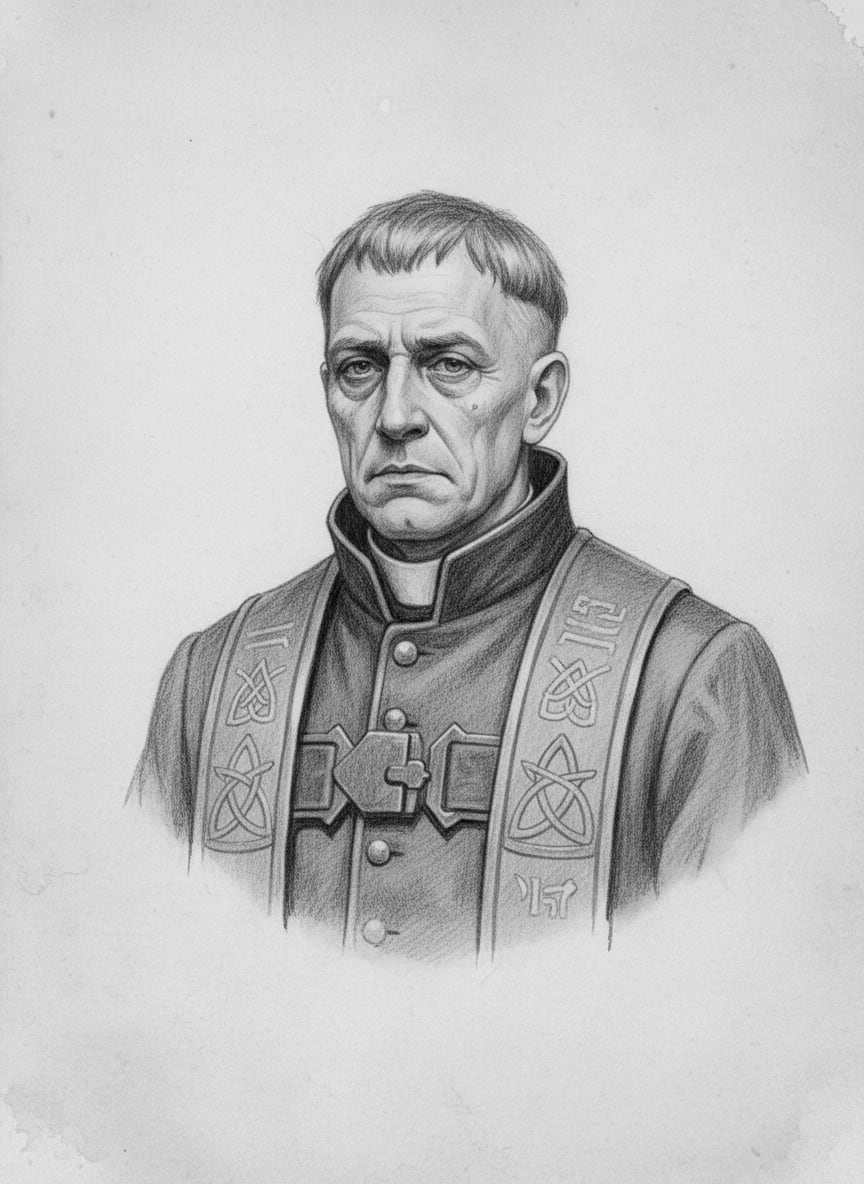
He was a Breton priest attached to the Dinan road houses, prior of the A.S. 10 pilgrimage toward Saint Clement of Brittany's Chapel of the Tide, custodian for that morning of the Reliquary of Saint Matthias, and first named dead in the Martyrology of Saint-Malo. The Bureau of Records possesses no childhood vita, no school disputation, no scandalous correspondence, no portrait with trustworthy ears. Parish scraps call him patient. One inn bill calls him late. A nun's notation from Dinan calls him “difficult with candles,” which is the only evidence in the file that he was human.
Gaël was not yet a saint when he died, and he has never quite become one since. He occupies a thinner office: refusal. Margaux became face; Sabina became service; Hermas became banner; Gaël became the hinge in the mouth where obedience turns into defiance. His cult is smaller than theirs because sentences do not sell candles as reliably as old women, torn cloth, or blood-darkened standards. The Bureau knows this. The Bureau uses him anyway.
#On the Pilgrim Column
The column left Dinan in the grey obedience of dawn: forty-three ratified pilgrims, though some Breton tongues inflate the number whenever wine improves memory. They carried the Reliquary of Saint Matthias toward the Chapel of the Tide, under the Saint Hermas banner and the old coastal indulgences that had sent feet along that road for three hundred years. The Secular Gatherings Act had made such walking illegal by arithmetic. One believer was superstition. Seven were assembly. Forty-three were a public problem with hymns.
Gaël walked at the head because somebody had to keep the prayers in order, the reliquary level, the candle-children from drifting under cart wheels, and the older pilgrims from starting the second antiphon too early. This is priesthood in its unvarnished form: less thunder from heaven than managing feet, breath, bone-box, and weather until the Creator can be approached without the procession becoming a queue.
Sister Margaux joined without organising anything, which made her perfect for later printers. Sabina of Ghent carried bandage cloth and the habit she would tear. The Hermas brothers bore the banner because their shoulders could endure what their biographies could not. Gaël had them all, and for several miles this was enough.
At Saint-Malo, enough ended.
#On the Writ and the Sentence
The Republican Guard sergeant met the column at the Porte Saint-Vincent with a lawful writ, bayonets, and the clean expression common to men who believe paper has washed their hands in advance. He demanded dispersal. The pilgrims knelt. He demanded surrender of the Reliquary for cataloguing. Father Gaël refused.
Four words: “It is not yours.”
The sentence is perfect because it does no rhetorical work beyond ownership. Gaël did not denounce the Republic. He did not preach against Reason. He did not appeal to history, miracle, law, local custom, or the wet-eyed sentiment of the crowd. He identified custody. The reliquary was not theirs. The road was not theirs. The knees of the faithful were not theirs. The Creator, though the Republic had mislaid this memorandum, was not theirs.
The Bureau of Doctrine has considered canonising the sentence itself. The proposal failed in A.S. 92 after the Bureau of Rites objected that a phrase cannot receive a feast day unless attached to a body, relic, office, or recognised acoustic phenomenon. Rites was technically correct, the dreariest form of correctness. Doctrine settled for red ink.
Early classroom plates expanded Father Gaël's refusal into a twelve-line speech beginning “Tell your masters in Paris…”
Withdrawn. No witness records such a speech. Gaël said four words. The longer version was composed by a Rennes schoolmaster in A.S. 18 who understood children, theatre, and nothing of courage. Courage often improves as it shortens.
The sergeant's reply was steel.
#On the Falling
The first bayonet fell at the third hour. Whether the order was shouted or released by a hand signal remains a feast for clerks, pamphleteers, and other carrion. The pilgrims were kneeling. The Guards advanced. The reliquary struck stone. Somewhere in that first violence Father Gaël died.
The Martyrology places him first in the blood-order. This may be sequence, doctrine, or editorial mercy. Witness One saw him step over the reliquary case as the line came on. Witness Three remembered his hand on the lid. Witness Seven remembered his mouth moving after the first wound, without sound. Witnesses are untidy because terror has poor penmanship. Records preserved the disagreement and charged later theologians to pretend preservation was resolution.
There is a rejected Breton tradition that Gaël held the reliquary so tightly the Guards had to cut two fingers from the handle. Records finds no anatomical support. Relics finds no recovered fingers. Pilgrimage finds the story profitable and has been told, sternly and annually, to stop implying possession of body parts it cannot produce.
A sealed Saint-Malo deposition claims the sergeant ordered Gaël's body turned face-down before the second volley “so the priest would stop looking.” The witness recanted under Rationalist pressure. The recantation contains three handwriting styles and one tear-stain tested by Records as genuine.
Father Gaël did not receive the better death in paint. Margaux knelt with a psalter. Hermas fell under cloth. Sabina lived long enough for bandages. Gaël lay where custodianship had put him: between a box of bones and a state that wanted inventory.
#On His Afterlife in Red Ink
Gaël's posthumous career has been narrow, which is to say resistant to incompetence. Hagiographers cannot make him handsome; no portrait survives. They cannot furnish childhood miracles; no one remembered his childhood in time. They cannot give him a relic-body; Saint-Malo's first recovery was a chaos of fish carts, rain, blood, and officials who had already learned the value of misplacing evidence. What remains is office and utterance.
This limitation saved him from the confectioners of sanctity. A blank saint invites decoration. A four-word priest refuses it. Every attempt to enlarge him makes him smaller. Every invented flourish drags attention away from the one thing that matters: the Republic demanded surrender of holy custody, and Gaël said no in the grammar of property.
A.S. 38 devotional calendars styled him “Saint Gaël the Unbending.”
Corrected. Formal canonisation was never completed. The title remains permitted in Breton local devotion, parish theatre, and soldiers' profanity, but Doctrine copies use Father Gaël of Dinan. The Bureau does not object to affection. It objects to unauthorised titles with revenue implications.
His sentence entered the Saint-Malo dawn office in A.S. 12, copied in red ink after some anonymous clerk perceived that black made it look like an accounts entry. Children recite it before learning why adults lower their voices at the gate. Procession Marshals invoke it before high-risk relic transfers. The Bureau of Pilgrimage prints it on grey route tokens for the Clement road, then charges a fee for replacements when pilgrims rub the letters away with their thumbs.
#On What He Teaches
Father Gaël teaches custody. This is less romantic than martyrdom and more dangerous.
Martyrdom can be admired at a distance. Custody demands an answer from the hand. Who holds the box? Who carries the banner? Who keeps the key? Who says the thing in your grasp is not available for cataloguing by men whose forms are cleaner than their souls? Gaël's sanctity, if the word may be used without provoking Rites into another memorandum, lies in the refusal to confuse lawful demand with rightful claim.
The Synod has made excellent use of this distinction and has ignored it whenever convenient. We preach Gaël at Rationalists, smugglers, relic thieves, apostates, careless sacristans, and foreign inspectors. We preach him less often at ourselves, because the sermon becomes lively when a Bureau demands what it has no right to possess. The reader will appreciate why such liveliness is discouraged.
At Saint-Malo, the state brought a writ. The priest brought four words. The writ killed him. The words outlived the writ, the sergeant, the magistrate, the Guard line, the Republic's clean newspapers, and every clerk who thought cataloguing bones was the same thing as owning them.