
#On the Inland Town That Sent the Blood
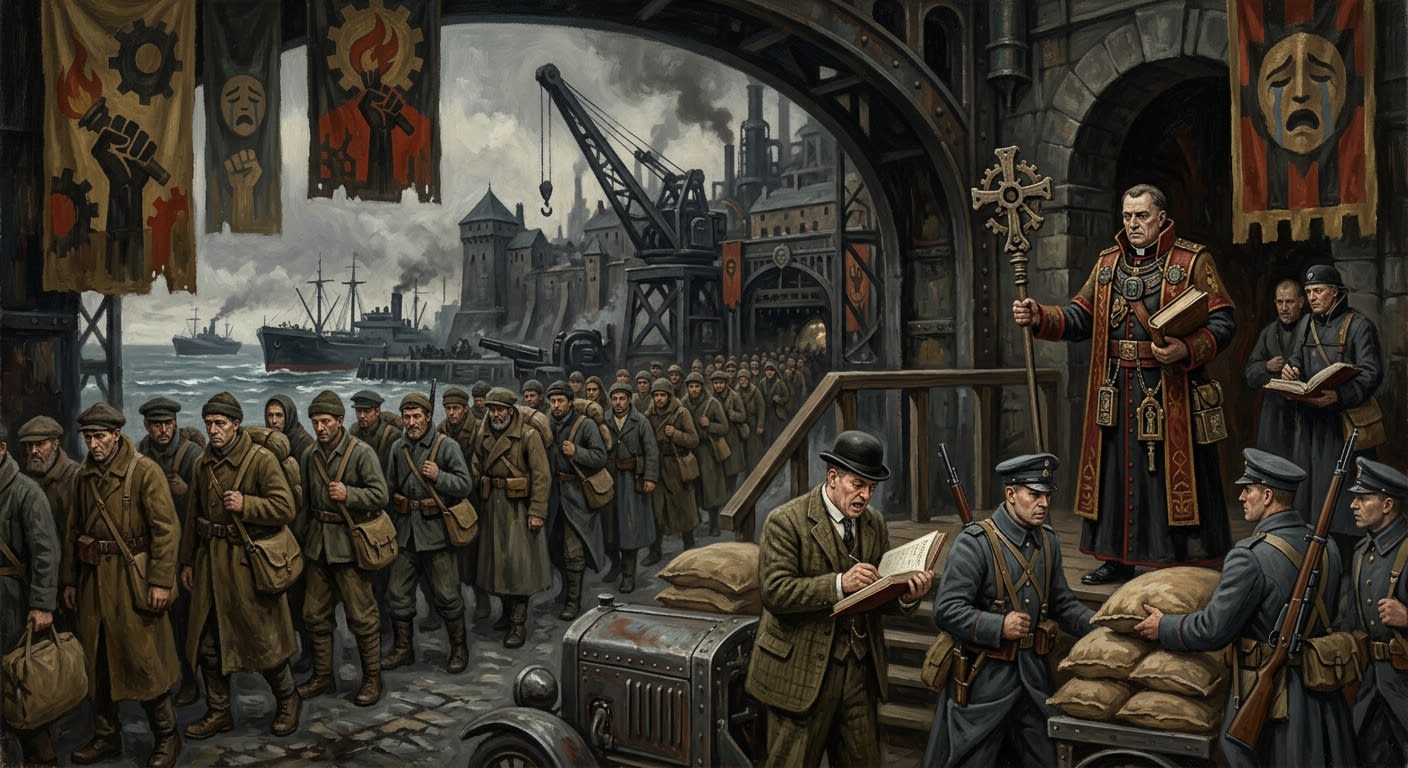
Dinan sits inland from Saint-Malo, a Breton town of stone slopes, river damp, stubborn bells, rope-smell, old chapels, and that local species of piety which does not announce itself because it assumes the Creator has already noticed. Saint-Malo owns the cobblestones. The Chapel of the Tide owns the denied destination. Dinan owns the departure, and departure is the crueler custody, because the town sent forty-three pilgrims out under banners and received back names, relic claims, witness fragments, and a holiness whose first act was absence.
The maps file Dinan as a Zone 1 Breton town, coastal hinterland, linked by pilgrim road to Saint-Malo and thence to Saint Clement of Brittany's Chapel of the Tide. Such phrasing is correct and dead. Dinan is a throat of roads, a stair of houses, a ledger of families whose surnames appear in the Martyrology of Saint-Malo with variant spellings and worse survivals. Its stone does not glitter. Its sanctity does not preen. It keeps accounts, mends rope, breeds mule-tempered parish women, and has never forgiven the sea for becoming famous at its expense.
Before A.S. 10, Dinan was one of many Breton devotional staging towns: useful, crowded in pilgrimage season, quarrelsome in market week, obedient when watched, and privately Catholic in ways the Rationalist magistrates found exhausting. Pilgrims slept under its arcades, purchased blue-thread tokens for Clement, kissed the staff of Saint Hermas in the banner-house, and set out before dawn toward the salt gate. The old route ran through fields and low marsh, then toward the Porte Saint-Vincent, where law, bayonet, and kneeling met with the administrative intimacy of murder.
Dinan's glory, such as it is, is subtractive. It is remembered for those who left it. Father Gaël of Dinan left it. Hermas of Dinan left it under a banner. Sister Margaux, from the house at Sainte-Claire-des-Landes, joined the road that Dinan had prepared. The candle-children left it, or were counted through it, or were later claimed by its families after grief discovered the power of municipal association. The Bureau of Records dislikes such imprecision. Dinan lives inside it.
#On the Town Before the Gate
The old Dinan of the first decade after De Vera Luce was not a rebellious city in the heroic manner. Heroic rebellion is expensive and often badly catered. Dinan was more durable: it complied at the surface and kept prayer underneath, which is how old towns survive reforms designed by men who have never bought rope in rain. The Rationalist inspectors could number chapels, weigh reliquaries, register processions, and fine unlicensed bells. They could not stop mothers tying blue thread into coat hems or old men crossing themselves behind fish carts when the road bent toward the sea.
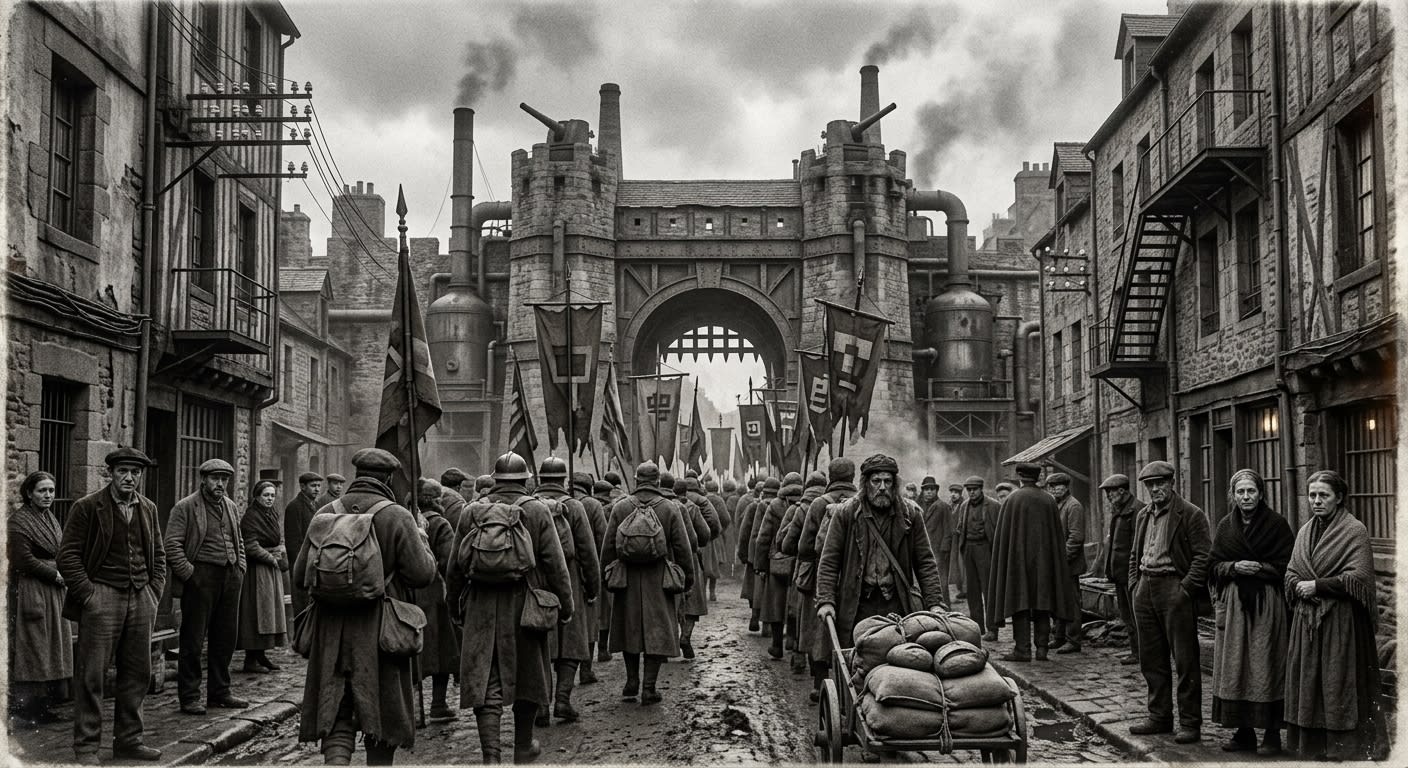
Its churches were poor in gold and rich in habits. Saint-Sauveur kept a cracked side chapel where the Saint Hermas banner hung from a staff blackened by hands. The parish of Saint-Malo-in-the-Road, so called because Breton naming enjoys practical insolence, kept travel candles for those walking to the coast. Convent women mended grey cloaks. Rope-makers supplied straps. Bakers marked pilgrim loaves with a tiny cross on the underside where the magistrate's clerks would not see unless they were hungry and impolite.
The Secular Gatherings Act made Dinan legally nervous and spiritually busier. A procession over seven persons required registration. A relic in motion required declaration. A banner required inspection. A hymn sung in public could become obstruction if a magistrate had eaten badly. Dinan responded with the genius of pious inconvenience. Processions left as family groups and converged beyond the last toll post. Relics travelled wrapped in laundry. Banner poles became “road supports.” Hymns were hummed under coughing. The Republic, possessing Reason, counted bodies only after they were already walking.
A later Saint-Malo sermon called Dinan “a city openly defiant of Rationalist law.”
Corrected. Open defiance is for statues and the dead. Dinan practised hidden obedience to God beneath visible irritation with paperwork. This distinction kept more pilgrims moving than any statue ever did.
The magistrate's files from A.S. 5 to A.S. 10 classify Dinan as “ritually persistent.” This is one of the rare Rationalist phrases worth preserving. Persistent, yes: like damp in stone, like salt in rope, like a grandmother's correction in the margin after Records has misspelled her son. The town did not thunder. It wore down the forms by being daily, local, inconvenient, and older than the men sent to improve it.
#On Father Gaël's Departure
Father Gaël of Dinan was the procession prior, custodian of the Reliquary of Saint Matthias, and owner of the four words that made him more durable than most bishops: “It is not yours.” Dinan prepared him in the manner towns prepare men they will later pretend always knew were martyrs. It gave him parish dust, weak wine, arguments over candle accounts, funerals in rain, road blisters, and the weary authority of a priest who knows exactly which widow is lying about flour and forgives her because the children are thin.
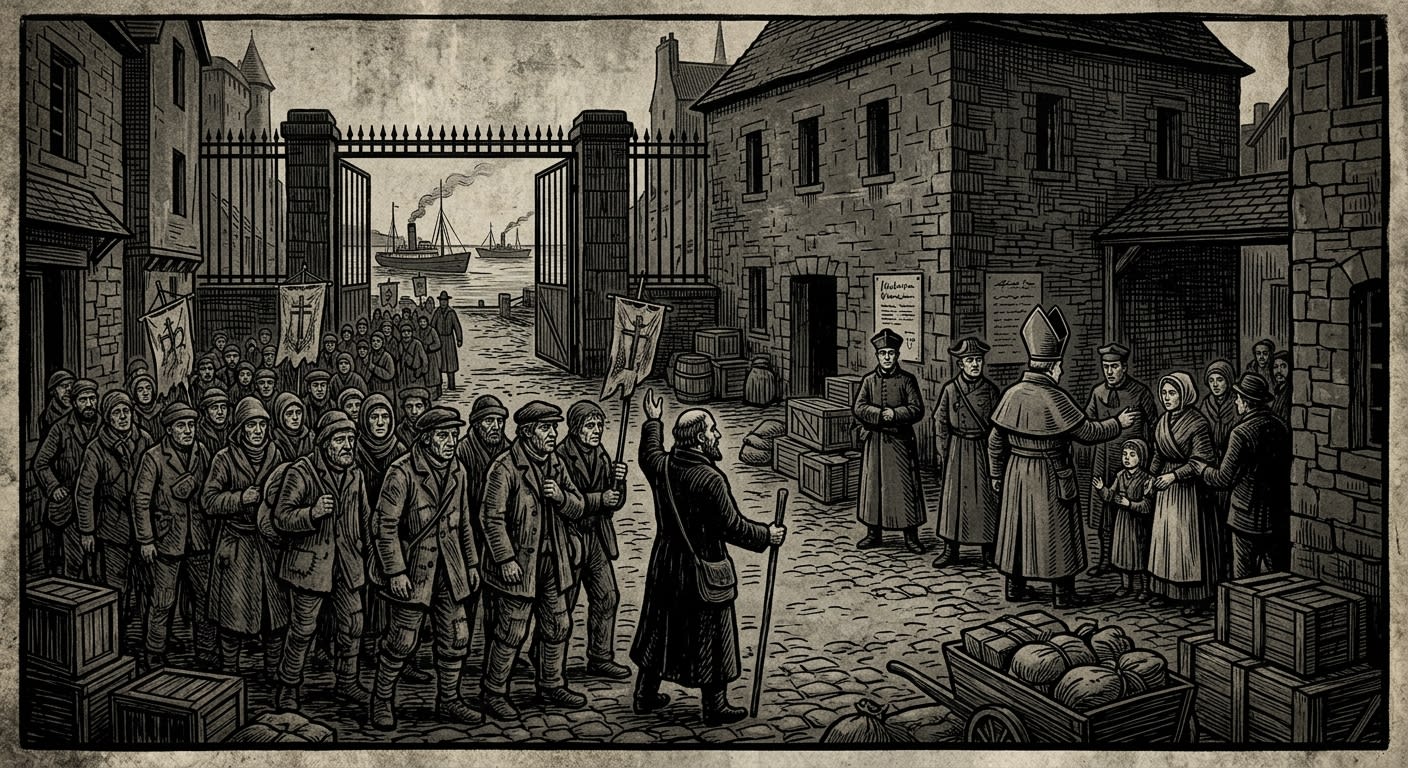
The last night before the procession, according to the local Departure Register preserved in later copy, Gaël slept poorly in the sacristy rather than the guest bed offered by the rope-makers' guild. The Register notes “storm in the west,” “two cloak repairs,” “Hermas boys measured for strap,” and “Matthias case polished, latch sound.” It does not note destiny. Sensible registers avoid words that cannot be invoiced.
Gaël's authority over the road lay not in rank but possession. He carried the reliquary writ, old and challenged, and had defended the route through fines, inspections, and civic little humiliations for five seasons. The Republican Guards at Saint-Malo understood the box as a disputed object. Gaël understood it as a custody older than their law. When ordered to surrender it, he refused with four words. Dinan has repeated them ever since in classrooms, taverns, confession queues, and marriage arguments whose relevance to reliquaries may appear thin until one has met Breton spouses.
Dinan's later cult of Gaël is restrained by Bureau design. He has no fully independent canonisation, a decision that enrages local priests every third generation and improves them by disappointment. The Bureau prefers him inside the Saint-Malo sequence: refusal before blood, voice before bayonet, priest before saint machinery. Detached, he might become a local flag. Embedded, he remains a doctrinal hinge. The Bureau is correct, which local sentiment treats as an insult with excellent memory.
#On Hermas and the Banner-House
The banner of Saint Hermas belonged to Dinan before it belonged to the world. Its house stood near the road gate: small, limewashed, salt-stained despite being inland, with a beam across the ceiling from which the blue field hung between feast days. White road-shell, brown staff, lower hem repaired so often that the original cloth survived mainly as an argument. Boys were brought to see it before their first long walk. Rope-makers touched the pole. Mothers disliked the dust and tolerated it because mothers understand that dirt is often the first pigment of reverence.
Hermas of Dinan, seventeen years old, second son of a rope-maker, was chosen to bear the banner because he was tall, obedient, and insufficiently imaginative to refuse honour that looked like work. His elder brother took the other strap. Their mother corrected the family name in three Martyrology copies after the massacre, each correction a little act of war against clerical spelling. The Bureau preserved the corrections as devotional marks. When Records is wise, it leaves angry mothers alone.
Dinan's banner-house became difficult after A.S. 10. Pilgrims wanted cloth. Mothers wanted dust. Boys wanted to stand where Hermas stood and look doomed enough for praise. The old staff was eventually cut into thirteen reliquary slivers and distributed to donor parishes with a speed that scandalised the poor and pleased Tithes. The present staff is ashwood, silver-capped, and too handsome by half. The Bureau of Pilgrimage calls it appropriate. Dinan calls it new in the same tone one uses for a suspicious son-in-law.
A Dinan guide from A.S. 76 claimed the original Hermas banner remains whole and processed annually.
False. The original lower hem tore at Saint-Malo; fragments entered relic custody, private devotion, contested inventories, and at least one Guard officer's coat lining. The annual banner is a sanctioned successor. It carries authority, not intactness. The Bureau asks readers to learn the difference before touching glass.
The banner-house now functions as licensed preface-shrine for the Corvus departure rites. Two boys from Dinan still carry the successor banner, selected by height, family poverty, and an expression which Pilgrimage describes as solemn and the local women describe as underfed. They are instructed to stand still rather than fearless. Fearlessness cannot be audited. Stillness can.
#On Margaux's Road
Saint Margaux did not belong to Dinan by birth, and Dinan has nevertheless claimed her with the frank territorial appetite of towns near sanctity. She was of the Order of the Blessed Thorn at Sainte-Claire-des-Landes, old, small, grey, slow, and so free of distinguishing features that the Bureau nearly wept from gratitude. She joined the pilgrim column at Dinan on the road toward Clement's chapel, carrying a psalter with a brass clasp. By sunset she had become first blood in a war no one yet admitted had begun.
Dinan’s Margaux devotion differs from Strasbourg’s approved face. Strasbourg displays the kneeling grandmother. Dinan remembers the walker: slow under morning damp, adjusting her cloak, holding the psalter closed until the first antiphon, accepting hard travel bread from a child who later appears in no public roll. This local version is less useful for recruitment and better for truth, which is why it remains tolerated rather than encouraged.
The psalter went to Strasbourg eventually, as all useful objects do when the capital extends its velvet-gloved hand and calls theft custody. Dinan kept stories. Stories are cheaper to guard and harder to inventory. Some are false. Margaux did not stop at every roadside cross; the timing fails. She did not predict the massacre; the Bureau would have used the prediction until the ink wore out. She did not leave a hidden letter in Dinan; three have been exposed as forgeries, one by spelling Matthias with the confident ignorance of a Parisian.
Yet the road itself preserves her better than wax. Old women still pause at the lower bend called Margaux's Breath, where the climb out of town forces slow walkers to stop. Pilgrimage tried to rename it Station Seven. The locals nodded, installed the sign, and continued calling it Margaux's Breath until the sign rotted in place. The Bureau has since adopted both names, proving that authority can learn when resistance is sufficiently repetitive.
#On the Town After Saint-Malo
The news returned before the bodies did, because news is lighter than the dead and less polite. Dinan first heard fragments: shots at the Porte Saint-Vincent, reliquary seized, pilgrims down, Guards at the gate, Father Gaël dead, Margaux dead, Hermas under the banner, children missing. By nightfall the fragments had become a sound no bell could manage. The town gathered at the road gate and waited for a procession that had already ceased being possible.
The local Rationalist office sealed the banner-house, posted two guards, and issued a notice forbidding inflammatory mourning. The notice lasted six hours before someone pasted over it with a list of names in fish glue. The guards tore the list down. Another appeared, shorter and bloodier. By dawn the wall held only one line: It is not yours. The office ordered the wall scraped. The lime beneath took the letters as stains. Officially this did not happen. Dinan has a profitable relationship with official nonoccurrence.
LOCAL SECURITY REPORT — DINAN, A.S. 10 Wall mark removed at third hour. Same mark visible at fifth hour without reapplication. Scraper broken. Guard L. Morvan reported hearing “road-singing” from sealed banner-house. Action: report copied once, then withdrawn from civic packet before Saint-Malo depositions travelled east.
The first mourning in Dinan was not organised. Women brought grey cloaks to the road gate and hung them on the rail. Men carried bread and did not know where to put it. Children asked which names were dead and received answers changing by the hour, which is how children learn that governments and adults share the habit of uncertainty delivered sternly. The town did not yet have Thirty-One Names, seven witnesses, five consumed absences, approved silence, toll schedules, or a gilt folio. It had a road that had failed to return its people.
Within a fortnight, broadsheets arrived. Margaux kneeling. Hermas beneath cloth. Gaël refusing. Guards in blacker coats than most witnesses remembered. Dinan bought them, hated them, hung them, corrected them, and used them to teach children where their own people had stood. A false picture can become useful when the truth is worse and lacks composition.
#On Licensed Departure
By A.S. 14, after Margaux's canonisation and the regularisation of Clement's Empty Arrival, Dinan had become a licensed departure town. The Bureau of Pilgrimage loves departure towns. They supply bodies in countable groups, sell approved tokens, concentrate liability, and permit Tithes to place fee tables where piety has already opened purses. Dinan received route custody under protest, then discovered protest did not reduce revenue and became more cunning in private; no, strike that from the margin — became more Breton, which is older and less apologetic.
The departure rite now begins before dawn on the fourteenth of Corvus. Pilgrims assemble beneath the road arch in grey cloaks. Children from registered families hand out travel bread stamped underneath with the hidden cross, now fully legal and much less exciting. The banner of Saint Hermas is lowered. The Reliquary copy of Saint Matthias, since Strasbourg keeps the primary with the possessive tenderness of a dragon on paperwork, is placed before Father Gaël's red sentence. Forty-three names are read at the gate. Thirty-one are marked dead. Seven are marked witness. Five remain open.
The road from Dinan to Saint-Malo is licensed in stations: Banner-House, Margaux's Breath, Gaël's Stone, Hermas Field, the Salt Ditch, Witness Turn, and the approach to Porte Saint-Vincent. Each station has a prayer short enough for tired people and a tariff long enough for Tithes. The Bureau claims this arrangement protects pilgrims from fraud. It does. It also protects official fraud from competition, which is the higher administrative calling.
Several local vendors advertise “the original route walked without interruption.”
Corrected. The route is interrupted by stations, inspections, token checks, crowd ropes, licensed bread tables, weather closures, and the ordinary foot ailments of sincere pilgrims. The original road ended in bayonets. Those demanding perfect reenactment should be watched carefully and denied sharp objects.
Dinan tolerates the Bureau's route custody because it has learned the art of keeping one ritual inside another. The official procession departs under permits. The town's own departure occurs earlier, in kitchens and back rooms, when families touch old cloak hems, fold bread, and mutter the names before the marshals arrive. This double rite is not disobedience. It is local proofreading.
#On the Road Economy
The road from Dinan to Saint-Malo now supports a whole ecology of licensed grief. Cloak-menders, bread-stampers, token sellers, approved water carriers, blister sisters, route bead counters, banner-strap boys, rain awning keepers, psalter copyists, and two highly suspect sellers of “authentic Dinan dust” occupy the lanes during Corvus week. The Bureau of Pilgrimage calls this devotional infrastructure. The Bureau of Tithes calls it assessable traffic. Dinan calls it the season, which is the local way of admitting that piety has rent due.
The Grey-Clement token is struck in three grades: tin for common pilgrims, pewter for registered family lines, and dull silver for donors whose ancestors became more visible after sufficient payment. Officially the token bears the crozier, wave, and forty-three count of Clement's denied road. Unofficially, many Dinan families scratch a tiny road-shell on the reverse before departure. Pilgrimage objects. The scratches continue. The Bureau has learned that a hidden mark on the back of a token is cheaper to tolerate than to prosecute in a town where every grandmother owns a nail.
The cloak trade is older than the license. Grey cloaks were worn before A.S. 10 because grey hides road dust, sea damp, cheap wool, and fear. After the Massacre, grey became regulated. Pilgrim cloaks require a hem stamp during the official departure. Unstamped cloaks may be worn privately but cannot enter the Saint-Malo gate-run during the Corvus office. This distinction has produced an entire class of cloak brokers who rent stamp-compliant garments by the hour to pilgrims too poor to buy the correct humility. The Bureau condemns exploitation in principle and rents two stalls to the brokers in practice.
Bread remains the holiest commerce because bread travels in the hand rather than around the neck. The underside cross, once hidden from Rationalist clerks, is now openly permitted in the route ordinance, which has made it less thrilling and more expensive. Children stamp the loaves before dawn. The best children press lightly enough that the mark can be felt by thumb but not seen at market distance. The worst press as if killing an insect, which ruins the crust and reveals a future in enforcement.
The road economy also keeps memory local against Strasbourg's appetite. A pilgrim may buy an approved Martyrology copy at the official stall, then buy from an old woman three steps away a scrap listing the Dinan nicknames of the same dead. Records calls the scraps corruptions. They are corruptions. They are also the only place where Child-Candle Three is said to have hated onions, where Hermas is remembered as bad at knots despite being a rope-maker's son, and where Father Gaël's shoes are recorded as patched at the heel. The Bureau owns the count. Dinan owns the scuff marks.
#On Records, Names, and Local Quarrels
The Martyrology fixed thirty-one dead, seven wounded witnesses, and five consumed absences. Dinan has spent two centuries arguing with the edges of that count. Not the number itself — only a fool argues with a ratified number in public — but the spelling, sequence, kinship, lodging, profession, and whether a given pilgrim “belonged” to Dinan, Saint-Malo, Sainte-Claire-des-Landes, the road, the sea, or the Creator. The Bureau answers: the Martyrology. Dinan answers: my aunt knew his mother. Both evidentiary systems have teeth.
The worst quarrel concerns the candle-children. Three appear in the death sequence, one named, one partially named, one sealed. Two Dinan families claimed the sealed child during the A.S. 38 revision, both producing locks of hair, shoes, and testimony from old women whose memories sharpened whenever inheritance approached. Records refused to decide. Doctrine praised the refusal as reverent ambiguity. The families called it cowardice. All three descriptions fit.
Family claims matter because privileges grew around the route. Descent from the Thirty-One grants candle precedence. Descent from the Seven grants witness seating. Association with the Five grants absence privilege, a category so Breton in its melancholy that I nearly applaud: the right to hang an empty token without proving who failed to return. Tithes attempted to monetise absence privilege in A.S. 92. Dinan rioted politely, which in Brittany means no officials died; several hats were drowned.
Dinan's parish archives are full of corrections. Names crossed out and re-entered with accents restored. Mothers correcting sons. Grandsons correcting clerks. Priests correcting both and being corrected in return by widows with better memory. The Bureau regards this as archival instability. I regard it as proof the dead remain socially active.
#On the Present Dinan
As of A.S. 201, Dinan remains licensed, profitable, irritated, devout, rain-polished, rope-scented, and structurally incapable of letting Strasbourg have the last word without adding a local note in the margin. The Bureau of Pilgrimage manages the road. Records audits the names. Doctrine owns the interpretation. Tithes owns the candles, bread stalls, token fees, cloak rentals, and enough of the inns to make poverty sound optional. The town owns the departure because no office can fully possess the moment before people leave.
The old banner-house is open during approved hours. The road gate bears Father Gaël's sentence in red enamel. Margaux's Breath has two names on one sign. Hermas boys still stand too straight under cloth. Blue threads are sold openly, replacing the hidden wrist knots of the Rationalist years. Children learn the route by walking it before they are allowed to sell tokens to outsiders, which is excellent pedagogy and better commerce.
The town's resentment of Saint-Malo is real, denied, and productive. Saint-Malo receives the grand gate, the blood-stones, the bayonet sermons, the better engravings, and most of the salt air in official prose. Dinan receives the preparatory offices: road, cloak, banner, bread, names before death. This division wounds local pride. Good. Wounded pride maintains archives. Every time Saint-Malo prints a programme without sufficient mention of Dinan, a Breton clerk somewhere sharpens his pen and improves civilization.
On the fourteenth of Corvus, before the official bell, Dinan wakes early. Bread ovens open. Cloaks are shaken. The Hermas banner descends from its housing. The reliquary copy is inspected for latch sound. Old women touch the underside of loaves to confirm the cross. Pilgrims gather at the road gate in grey. A child asks whether the road is safe. Someone lies with mercy. The names begin.
Then Dinan sends them out again.