
#On the Law That Drew Blood
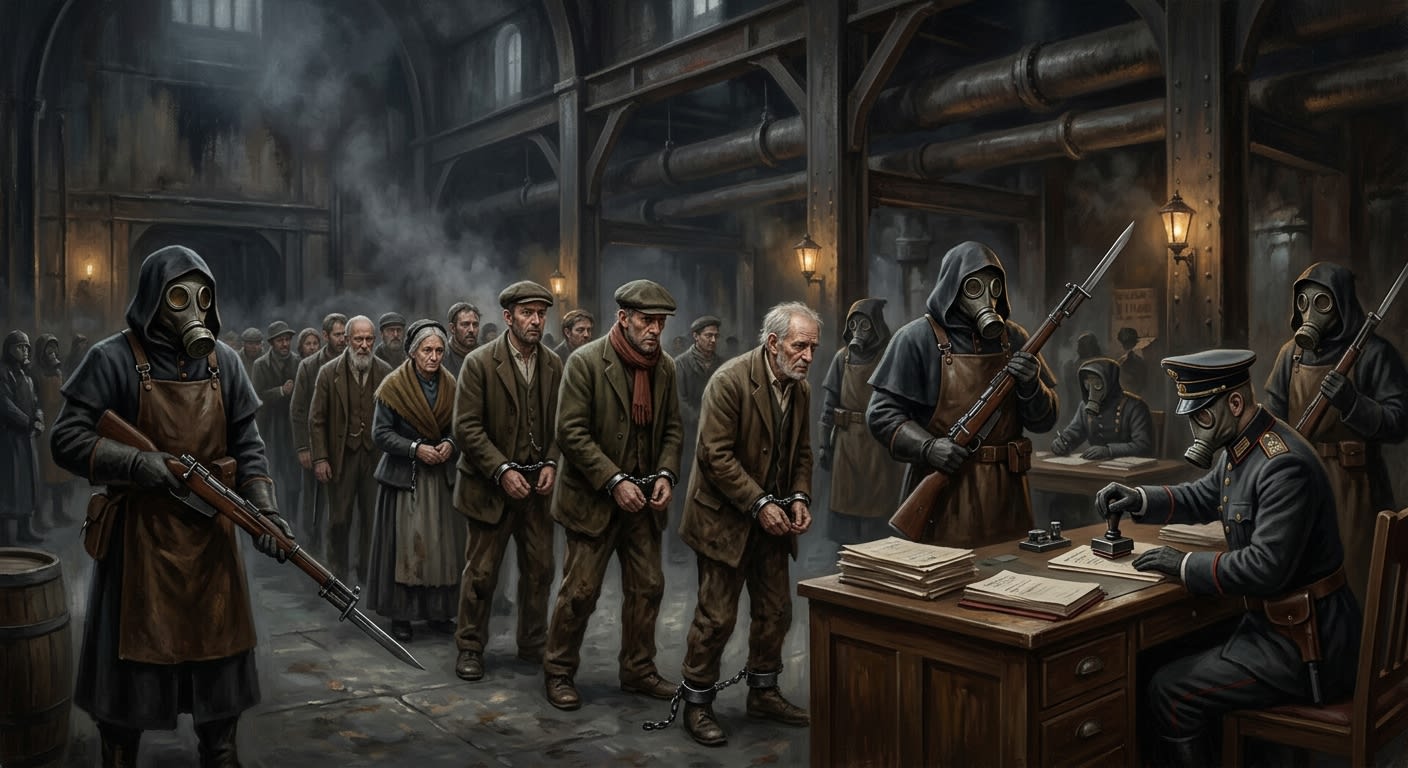
The Secular Gatherings Act was the Rationalist instrument by which prayer became a public nuisance, pilgrimage became unlawful assembly, and kneeling became, under the correct magistrate's hand, grounds for bayonet-work. It is remembered chiefly because Republican Guards carried it at Saint-Malo, folded into a sergeant's breast pocket like a clean handkerchief beside a dirty conscience. That is unfair to the Act. It did more harm than one massacre. Saint-Malo merely gave it cobblestones dramatic enough for history.
The Act's full title, preserved in the Forbidden Stacks on a broadside that smells faintly of seawater and mice, was An Act for the Regulation of Superstitious Assemblies, Processional Disorders, and Unauthorized Public Devotions. Observe the progression. Superstition first, because insult must precede theft; disorder second, because police require vocabulary; authorization last, because every tyranny eventually discovers the beauty of permit forms. The Rationalists congratulated themselves on restraint. They had not outlawed Faith, they said. They had only regulated its public expression.
One may regulate a throat by cutting it.
#On Its Clauses
The surviving Saint-Malo copy contains nineteen clauses, six marginal corrections, and one wine stain the Bureau of Alchemical Standards has confirmed as ordinary claret, which is a pity; demonic ichor would have suited the prose better.
Clause I defined any religious procession of more than seven persons as a “public devotional assembly.” Clause II required advance registration with the local Rational Magistrate. Clause III permitted magistrates to refuse registration on grounds of safety, civic order, traffic obstruction, suspected relic fraud, acoustic disturbance, sectarian agitation, atmospheric irregularity, or “general public reason.” Clause IV authorized Republican Guards to disperse any unregistered gathering. Clause V required confiscation of relics presented without civic inventory marks. Clause VI made refusal to surrender relic property a “resistance to lawful order.”
There, in six clauses, sits the whole gallows. Seven pilgrims may pray. Eight become a threat. A relic may be carried if inventoried by men who deny relics have power. A magistrate may refuse a procession because the air feels ideologically damp. The Guard may disperse. Dispersal may include seizure. Resistance may include kneeling. Law, once phrased broadly enough, becomes a musket that can fire in any direction and still claim aim.
The Act did not require massacre. No honest reading can find an order to fire into pilgrims. This fact has been treasured by Rationalist apologists for two centuries, as though a law that loads the pistol deserves acquittal because a sergeant pulled the trigger. The Bureau rejects this childish surgery between instrument and wound. The Act created the circumstance, empowered the hand, named obedience as dispersal, named refusal as resistance, and supplied every coward after the fact with a sentence to hide behind.
Earlier parish catechisms state that the Secular Gatherings Act commanded Republican Guards to kill all pilgrims on sight.
Struck for pious inaccuracy. The Act was worse than a murder order. A murder order can be disobeyed, condemned, traced to a villain, and filed. The Act made murder administratively available while preserving the magistrate's leisure to call it regrettable.
#On Saint-Malo
At Saint-Malo in A.S. 10, a procession entered the city on the feast of the Assumption, carrying the banner of Saint Hermas in the broader war-account and the Reliquary of Saint Matthias in the local event record, which contradiction has kept three Records subcommittees fed for years. The Bureau's approved reconciliation is simple: the banner, the reliquary, and the dead all belonged to the same interruption. The faithful brought bones and cloth. The Republic brought paper and steel. Paper gave steel permission.
The sergeant read, or pretended to read, the writ issued under the Act. He demanded dispersal. The pilgrims knelt. He demanded surrender of the reliquary for cataloguing. Father Gaël of Dinan refused with four words: “It is not yours.” The line advanced. Bayonets fell.
A Saint-Malo survivor deposition, sealed under Doctrine Annex 10-M, records that the sergeant's copy of the Act was already spotted with blood before the first pilgrim at the gate was struck. The witness later recanted under pressure from Rationalist authorities. The recantation misspells her own name.
The Rationalist press called the incident a “regrettable disturbance.” The phrase deserves preservation, mounted under glass beside a bayonet and a child's shoe. Regrettable: because they regretted the optics. Disturbance: because the dead had disturbed civic order by receiving wounds in a public place. The Act had done its work with exquisite courtesy. It gave the Republic's cruelty grammar.
#On Enforcement Beyond Brittany
Saint-Malo made the Act infamous; lesser towns made it ordinary. In Paris, street shrines were cleared as obstruction hazards. In Amsterdam, relic processions were delayed until feast days expired, then fined for failure to appear within approved devotional windows. In Kraków, clerical gatherings in cellars were deemed subterranean assemblies and raided under municipal safety provisions. In Ghent, monks who sang behind closed doors were charged with unlicensed acoustic projection because the hymn could be heard through stone.
The Act trained the Republican Guards in a habit more lethal than hatred: procedural contempt. A hated enemy may be feared. A regulated nuisance is shoved, inventoried, cuffed, dispersed, and, when necessary, stabbed in the ribs because the street must be cleared before supper. The Act reduced the faithful from souls to crowd-control problems. That reduction was its genius and its damnation.
It also taught the future Synod a lesson no honest theologian enjoys admitting. Law need not proclaim its final appetite. It can begin with permits, thresholds, local discretion, public safety, and an approved form. The scaffold may arrive later, carried in clause by clause.
A Bureau of Doctrine lecture series once described the Act as “alien to Synodic legal tradition.”
False. The Act is kin to every government instrument that discovers holiness can be scheduled, restricted, licensed, and punished. The difference lies in source, purpose, and sanctification. Our permits save souls. Theirs counted victims. The resemblance is educational and should make junior magistrates sweat through their collars.
#On Its Afterlife
After the Treaty of Regensburg in A.S. 30, the Act's principles entered the Rationalist Republic's Concordats of Governance and broadened into the Edict of Ironmouth, where Faith itself was declared treason and prayer aloud bought a citizen the tongueless mercy of the state. By then the Secular Gatherings Act looked mild, as first instruments often do when later instruments become honest about the knife.
The faithful condemned the Act retroactively in A.S. 12 for catechetical purposes; the Synod annulled it in A.S. 90 for constitutional purposes, and again in A.S. 104 for reasons connected to a debate over whether annulled laws can still be used as negative precedent. They can. They are. Every magistrate in the Bureau of Purity studies the Act before receiving a public-order seal. Every Doctrine Street-Vicar learns the Saint-Malo clauses as proof that secular law, stripped of sacrament, becomes a clean road to slaughter. Every parish child learns the answer to the question: what is a permit without the Creator?
A death warrant with better margins.