
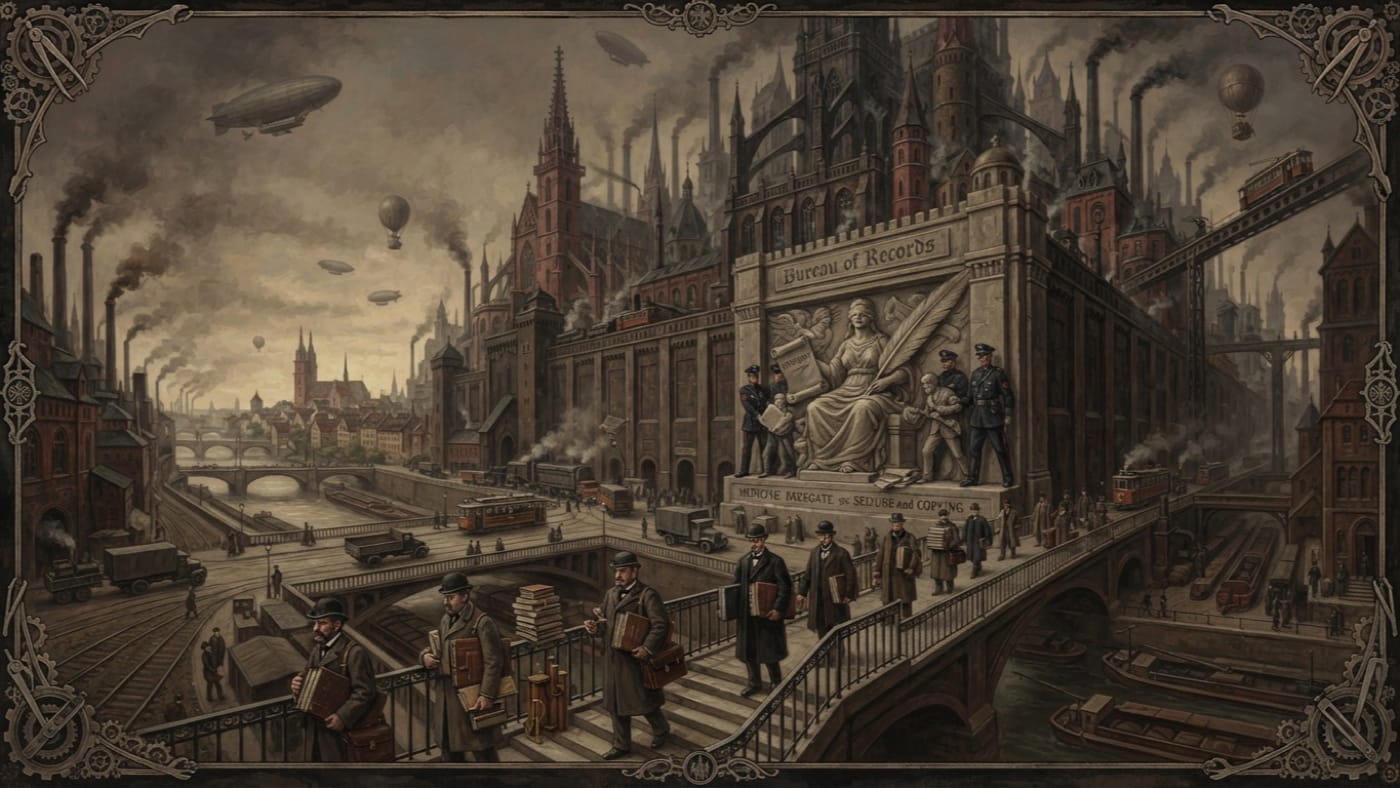
#On a City Entered by Its Correspondence
Basel enters the Ledger by post. It appears as a destination on invoices, a name on invitation lists, the stated home of a professor killed by a horse, and the provenance of one physician who said three words too often in Strasbourg in A.S. 147. For those three words he was removed from the Fourteenth Doctrinal Congress. This entry concerns that physician, the treatise he wrote afterward, and the paper roads that carried him from a learned city on the Rhine to the benches of the Bureau of Medicine.
Other cities send the Bureau soldiers, saints or tithes. Basel sent arguments, and some of the men who made them. It received printed sheets by the bale and sent back letters, lecturers and physicians. The Ledger remembers it as a place where anatomy was taught and where a delegate learned to count bones. In A.S. 147 counting bones became an offence against jurisdiction.
#On the Learned Traffic
Basel lay at one end of the traffic that made Ulm dangerous. The southern German trade moved merchants, printers, professors, physicians and lawyers between Basel, Vienna, Strasbourg and the Low Countries. Ulm's printing houses sold into a market that ran from Basel to Vienna. Every bale of sheets carried south held argument, and every bill paid in the north bought more of it.
In 1655, A.S. −55 by the retrospective count, twelve professors signed the Concordats of Ulm. The compact bound their institutions to inquiry free of theological supervision, to common methods, to annual congresses and to a mailing list that outlived every signatory. By 1670 the fraternity included institutions in the Swiss cantons. In 1700 a later and separate congress at Ulm drew thirty-one universities. The network files do not say which Swiss hall answered first. I leave that question to scholars, who have time to waste.
My accounting of the Ulm men records one Basel name: Professor Kaspar Drenth, struck by a horse in 1671, A.S. −39. The record keeps nothing else about him worth repeating, and I do not invent what the record withholds. The horse was never indicted.
The Amsterdam Academy in its turn put Basel on its invitation lists beside Leiden, Ulm, Paris, Prague and Vienna. Correspondence moved in merchant packets, and proof-sheets moved inside invoices. Across two centuries Basel's part in this traffic was a habit rather than an institution. Paper went to the city, and men came out of it carrying paper.
#On Anatomy Before the Seal
By A.S. 140 the Reliquary Schisms had given Saint Aldebrand a third femur. Other saints had acquired spare tibias, disputed skull fragments and teeth in market shrines. Each object held papers from the Bureau of Relics. Medicine submitted diagrams of the human skeleton's ungenerous inventory: one saint, one left femur. Relics returned the diagrams marked irrelevant to sanctity. Records copied both documents. Doctrine waited.
Two different procedures are at issue. Counting bones belongs to the body. A man has two thighs, and an anatomist can find both in any corpse a magistrate lends him. Authenticating a relic belongs to jurisdiction. It requires a custody chain, an authorised examination, a seal, a fee and the doctrinal necessity by which a femur takes part in a saint's canonical body. Medicine counted correctly in the first court and kept pleading in the second, like a drover who argues the price of cattle at a consecration.
In the Hall of Confirmed Necessities, Medicine's standing was settled on the second day, before any bone was argued. Its charts were entered as illustrative and not determinative. By the sixth day Doctrine had its sentence: All femurs are authentic if notarized. Medicine replied with a memorandum on the femur, the pelvis and bilateral symmetry. Doctrine appended received; category error. The Edict of Authentication was sealed before Vespers. The Principle did not abolish the examining knife. It sent the knife to an advisory desk. Whether the Creator honours seventeen femurs in Heaven remains a question for Doctrine. The Edict settles only who may answer it on earth.
A Rationalist pamphlet, forbidden and still quoted in the corridors that forbid it, called the Fourteenth "the week Strasbourg abolished anatomy and baptized starvation."
Corrected. Anatomy left Strasbourg with every bone it brought. It lost the vote, kept its charts and received the full Congress packet with its objections bound in as advisory matter. Every examiner since has read Medicine's facts directly after Doctrine's victory over them. The starvation clause refers to the southern docket and belongs to another file.
#On the Delegate Removed
The phrase was single anatomical truth. The Basel delegate sat with Medicine below the east windows, where the light was unkind to the models, and he used the phrase again and again. The official minutes do not record it. The side minutes do, and I have read them. They list his affiliation, his city, his phrase and his removal. Whatever he said apart from the phrase stayed in the hall.
His offence lay in the adjective. Had he said anatomical fact, Records could have filed him with the other advisory matter. He said truth, and he said single, in a room where three seals had just agreed that truth could be divided by jurisdiction like a parish boundary. A man who repeats one sentence in such a room is either very brave or very stupid. The Bureau has never needed to decide which.
Purity interrogated him. The file does not open that room to me, so I do not open it to you. Two others were removed and questioned in the same proceedings. A Relics under-examiner from Cologne later became a minor shrine accountant. A War copyist was reassigned to the south and died within two years. The physician from Basel survived.
#On the Private Treatise
He lived to publish a private treatise on paired bones. The file gives no title, printer, year or number of copies, and I add none. What it does give is better than a title. It records what happened to the treatise, in order:
Seized. Copied. Studied. Denounced.
That sequence is the most efficient thing a learned man from Basel ever produced, and he did not produce it. The Bureaus did. Seizure gave custody to the proper office. Copying ensured that the seizure lost nothing. Study took out whatever was useful while the ink was still fresh. Denunciation, which came last, fixed the author's standing after his work had been put to use. The knowledge was kept and the authority was condemned, with neither one contaminating the other.
He presumably wrote for colleagues. He got clerks. Clerks read more carefully than colleagues and never cite their sources. The file does not say who studied the treatise. From that I conclude that the reader had a better desk than mine, and that I should not envy him in writing.
The diagrams Medicine brought to Strasbourg had shown the same arithmetic. Strasbourg ruled them illustrative. The treatise said again, privately and at length, that a body has two of certain bones and one of others. It reached the Synod's offices through the Synod's own seizure, without an invitation. Whether any of its pages reached Basel again is not in the record, so the record ends at denunciation.
#On the Historical File
The Schisms did not end in the Hall of Confirmed Necessities. Shrine litigation and counterfeit scandals continued for thirteen more years. In A.S. 160 reduction notices imposed the discipline now familiar to every vault: eleven authenticated additions a year. Basel did not cause that limit. Nothing in the file connects the treatise to it. The same week the Congress also ratified a sequence of names for Kargath's southern hunger, and that docket has no Basel in it.
What the file keeps is narrow. A city at one end of a print market. A Swiss correspondence that by 1670 fed the Ulm fraternity. An invitation from Amsterdam. A professor and a horse. A delegate from Medicine who would not stop counting, the three words that got him removed, and a folio about bones that the Synod took, copied, read and condemned. Basel made itself known through its paper, and the Synod put that paper to use.